Category: Vessel/Laboratory Page 70 of 89

CTDs, Sea Ice and Polar Bears

Hey there all!

After being in port in Nome, seeing some Northern Lights, swimming in the Bering Sea, moving lots of equipment onboard and singing karaoke with science and new crew, we’re finally underway! It’s been really nice to be cruising this week and getting into the flow of things.

The first couple days were mostly transiting, with some CTD (Conductivity Temperature Depth) casts and preparing an AON (Arctic Observation Network) mooring. We went through the Bering Strait, past the Chukchi Sea and into the Beaufort. At our max, we hit about 72.5 degrees North. We lost internet right as we went into the Arctic Circle. Due to our heading, our mainstay blocks our satellite dish at a very specific angle. You’re reading this because it’s gone back up though, intermittently at least. It’s actually been nice getting away from the internet though.

In the past week, I’ve learned to prepare, check, operate and clean a CTD. I’ve learned how we process CTD data and utilize that to reset our sound velocity profile. Knowing the speed of sound at a particular site is important because it helps us recalibrate our multi-beam sonar. Our TOPAS system and multi-beam sonar are used to map both the bathymetry of the sea floor, and the substrate beneath it. These both operate whenever we’re underway, helping add to worldwide knowledge of the seafloor, one cruise at a time.

I also got to help recover and deploy this Arctic Observation Network mooring. Moorings like this are used to monitor temperature, salinity and other environmental conditions in a location over a long period of time. This helps scientists track climate change or other continued patterns in an area over time. In the Arctic and off the Alaskan coasts for example, scientists are doing research into what role increased glacial melt plays in the ecosystem. In recent years, there has been a coccolithophore bloom off the Alaskan coast, turning the normally dark blue Bering Sea a pale shade of turquoise with their calcium carbonate shells. As we passed through the Bering Sea, we were actually able to observe this, registering an increased amount of carbon at that micron size and seeing the clear blue turquoise of this bloom. Our research ties into this, monitoring nitrogen fixation and primary productivity of the Arctic. This helps us to gauge the Arctic’s importance in fixing carbon and nitrogen, and what the Arctic ecosystem’s role is globally.

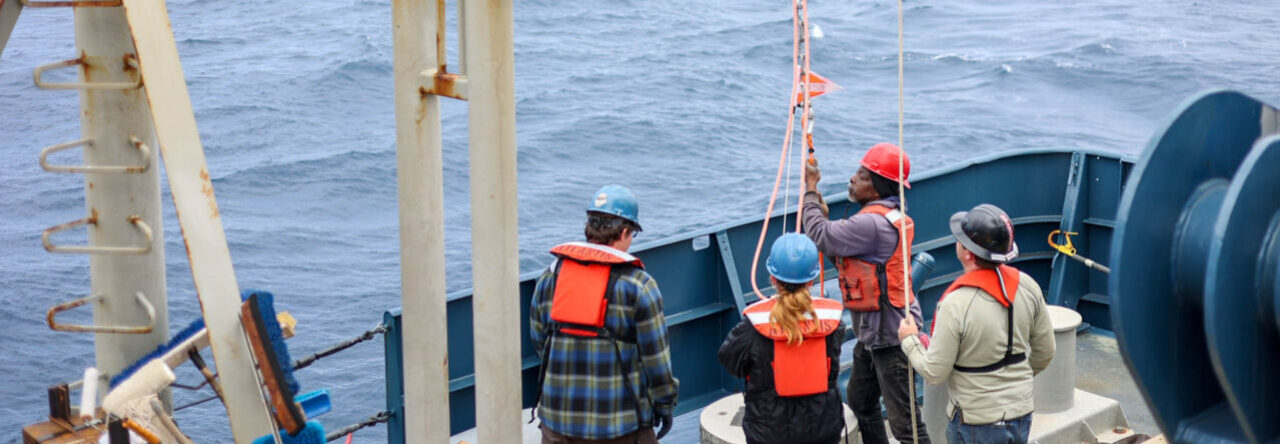
In other cool things, the AON mooring also had an ADCP (Acoustic Doppler Current Profiler) and an Aural whale recorder. Although tricky at times, it was really cool to work with the deck crew to both recover and deploy the AON mooring. We worked together in the stormy Arctic weather to get everything in and out safely. After that, science, science tech and ABs (able-bodied sailors) have come together to make CTD casts happen 24 hours a day for the next 3 days. I really enjoy how the boat pulls together for these operations, it makes the boat community that much more tight. All in all, it’s been really great learning a lot this week, finding my niche and becoming a part of the R/V Sikuliaq family.

Blog 4: Day 22 – White September

Hello World,


Justin Miyano reporting from the Arctic again. It has been almsot 3 weeks at sea, and I seem to be the only remaining person excited about it. This morning, we woke up to some snow on the outside decks. The temperature has been fluctuating between 28 and 32 degrees, and it is quite cold, but I suppose it is way better than cold rain. Ugh, just the thought of it is giving me chicken skin.


Yesterday, we completed the deployment of our 5th acoustic mooring. Between the last blog I wrote and this blog post, I have communicated with some of the scientists to better understand this project better, and I have learned that, after the acoustic source mooring is deployed, 3 transponders are deployed so that at any given time the acoustic source produces sound, the transponders can triangulate the exact position of the source, which anables the scientists to calculate the distance and speed of the sound traveled between the moorings. Once the 3 transponders are deployed, we use an echosounder to locate the precise positions of the three.


On the tech side of things, everything has been working well and our days have been mellow, until 2 days ago, when we attempted the troubleshoot what could be the problem with our faulty GPS system and antenna (the POS-MV system). We power cycled the system (a fancy tech word for turn off and on) so that we could attempt various combinations of the 2 antennas, cables, and extensions to find the broken component, but then the whole system stopped functioning. For hours, we tried powercycling and looking at all the connections, reading the computer outputs to see what could have gone wrong but there were no obvious signs. After a long battle with the POS-MV and sending out an email to the manufacturer’s representative who had helped us in the beginning of the cruise, we called it a night. Then, we woke up to a see the POS-MV working again. The computer said that it had started logging information a couple hours prior to us noticing this morning. What a magical white September morning.


On another note, we recently learned that we have a protp-type buoy onboard from a project called UpTempO (Upper Layer Temperature of the Polar Oceans: http://psc.apl.washington.edu/UpTempO/). They study the seasurface temperatures in the polar oceans to help monitor global warming, using these simple buoy systems. The buoys have temperature and pressure sensors from 2.5 to 60 meters deep! The deployment of this buoy is STARC’s (Oregon State University and Scripps Institute of Oceanography) responsibility, so the two techs, Brandon and Keith are pretty excited that we will be working on the deck for a change!


Other than that, we have corn hole and ping pong tournaments to celebrate Labor Day! Woo for some fun. Happy Labor Day weekend everyone.


P.S. It took me 3 attempts to write this blog because the site kept freezing up when I would try to upload a photo so I am not going to upload a photo this time, sorry.

WEEK 8- Cable Termination, Nearing the End

WEEK 8
August 28-September 3

  The end of my stay here aboard R/V Walton Smith is in sight, and I’m pretty sure they are going to have to drag me away, kicking and screaming.  I’ve really become attached to my new home and family.  We are preparing for my final 3 cruises, making sure the dockside projects are all completed and that the vessel is in ship-shape.

  We are still having issues with a monitor in the bridge, and we have replaced all the components and cables…twice.  I’m beginning to think there is a ghost in the machine.

  Denis, the ship’s Marine Tech, and I cut a 15 meter section from the 322 cable used to deploy the CTD.  On the cruise that involved deploying the Tucker Trawl, it had become damaged as a result of the clumsy retrieval method.

  A short section of the counter-torque cable was unraveled, exposing the wires inside. The stainless steel termination was heated to melt the cerrobend inside, a metal alloy with a very low melting point of 158 degrees, comprised of bismuth, lead, tin and cadmium.  The strands of the counter-torque cable are wrapped in opposite directions, preventing the cable from twisting under a load.  Individual strands were separated and peeled back, then secured back to the cable with a winding of wire. The exposed wires were fed through the termination and out a hole in the side, and the exposed strands of cable were inserted into the bottom.  When the fresh cerrobend was melted and poured in, the splayed cable array served to secure the cable in place, much like rebar in cement.  When the cerrobend solidified, the three wires protruding from the side were then terminated and the cable was once again ready for use, as good as new.

  During the week we completed the horizontal testing of the deck tie-down sockets, using a load cell secured with shackles in line with a chain fall.  The new records were updated and filed for future reference.

  The ship is scheduled for a month-long trip to Cuba in October, and the extensive paperwork has been a nightmare for those involved in handling the logistics.  Next week I’ll be tasked with inventory duties in order to assist with this daunting effort.

Preparing the 322 cable for termination

Transiting on the R/V Sikuliaq!

Hey there!
This is Kristie Okimoto, the final MATE Summer Intern! I’m on the R/V Sikuliaq, also headed up to the Arctic. We are somewhere in the Bering Sea at the moment! Tomorrow, we’re docking in Nome, and will be loading equipment, food and fuel for the upcoming cruise.

The transit from Seward to Nome has gone pretty smoothly. This week has mostly been an orientation week of sorts. The science party has gotten safety talks, an engine room tour and done fire and abandon ship drills. Ethan, one of my two mentors on the ship, showed me around some of the ship systems I’ll be helping to maintain. We looked at the ship multibeam sonar, the TOPAS system, the pCO2 system and the seawater inflow system. These systems operate at all times on the ship, gathering data whenever the system is underway.

As the upcoming cruise will be researching nitrogen fixation and primary productivity of waters in the Arctic, the seawater inflow system will be super important. Scientists will continuously measure the nutrients and gasses of this seawater. The researchers will also utilize a CTD (conductivity, temperature, depth) rosette and an ADCP (acoustic doppler current profiler) to help gauge nutrients throughout the water column and to help gauge the related currents. As marine technicians, we will be supporting all of these instruments.

I am excited for the actual research cruise to get underway! All in all, I have really enjoyed being at sea so far. There really is something amazing about being surrounded by a vast expanse of blue, blue water on all sides. Alaska was also really beautiful! Well, onward to Nome, and then onto the Juranek cruise!

Blog 3: Day 14 – Waiting out the ice

Hello world,

It is day 14th Sunday, and is time for me to update you on what has happened on the ship since the last update.


While I was writing my last post, the ship was just passing through the Bering Straight, and we were about to enter the Arctic circle. Since then, we have continuously traveled northeast up to 75 45N 151 15W, which is almsot as north as the middle Greenland! Woah, that’s pretty north. For the next 430 nautical miles (1 nm = 1.15 miles), the seafloor was between 30 and 40 meters! ONLY 40 METERS! That’s 130′, which is way less than half of the Healy’s full length, 420′. While being mindblown by that fact, we made a pit stop to deploy a NOAA mooring. Because we have expert mooring scientists and technicians onboard, notably chief scientist Peter Worcester and tech John Kemp amongst others, a group of NOAA scientists have ask us to deploy an passive acoustic mooring up here. A mooring has an anchor, a long line the links the anchor to devices to the buoy/s that keep the whole apparatus upright. We have been told that the primary objective of this mooring was to monitor bowhead whale vocolization, but since the hydrophones (underwater microphones) will be recording 24/7, it is expected to record ALL sounds produced underwater. The mooring will be recovered by University of Alaska’s R/V Sikuliaq in several months. After that quick deployment, we proceeded northeast to our stations.


Now, our main project, led by Peter Worcester, is to deploy 6 moorings with scoustic sources and 1 passive acoustic mooring with a ton of hydrophones on it. The 6 moorings will be deployed in a pentagon shape, with 1 mooring source being in the center of the pentagon. The hydrophone mooring will be deployed slightly west of the center acoustic source. Using this acoustic source and hydrophone setup, he wishes to study how sound propagates in the Arctic. What makes sense, but may not be thought of by us who do not study that Arctic, is that sound is affected by the physical properties of the medium is travels through. In water, sound has a very fast velocity (approx. 1400 meters per second), and if the water gets colder, the water becomes denser, and the sound speeds decreases. Once we locate the exact locations of all of the sources and the hydrophones, the scientists can use this to measure the sound velocity in the Arctic. Why is this being studied now? The ice coverage and the water temperature is changing, and it is important to know how the current Arctic deepwater affects sound travel.


Okay, so that’s the cool science that is happening on the ship. We deployed the NOAA buoy and one acoustic source. We traveled further north to our station location furtherest north, but because of slightly excessive winds and ice coverage at our station, we decided to relocate to another station. In the meanwhile, the techs identified that we possibly have a faulty GPS antenna, that is affecting our multibeam (seafloor mapping system)**. We have two antennas that help locate our position for the multibeam system, and since one of them is down, the multibeam is having to depend on a single satellite antenna, which is not ideal but still functions enough. For our mapping purposes, it is critical that we know our exact location so that the seafloor data is relevant. We even have a scientist from the government agency National Geospacial-Intelligence Agency to investigate the quality of our seafloor raw data, because they use it for their hydrographic charts. Other than that, the lab has been a quiet place; I have continuously been shadowing Brandon and Keith as they approach connectivity issues with some of the computers and systems, but everything has been smooth for the most part.


**I wrote that the faulty GPS system was part of the multibeam, but I misspoke. The GPS system associated with the multibeam is working perfectly, but actually the GPS not working well was associated with our MRU (motion reference unit). It is still being troubleshooted for.


The image below is myself redoing the connection between the antenna and the GPS cable. I was up way higher than it looks in the photo.


Photo by Sadie Wechsler

WEEK 7- An Unexpected Visit Home

WEEK 7
August 21-27

  Early Monday morning our Chef, Peter, was kind enough to drive me to the Fort Lauderdale Airport, which was about a 45 minute trek from the ship.  I boarded a 737 bound for Detroit, en route to Lansing, Michigan, where the memorial service for my good friend would be taking place.
  A week earlier, Chris Bapst had been killed as a result of an accident involving his own double-shot Derringer pistol.  Anyone who knew Chris knows he would never have intentionally taken his own life, and the suspicious circumstances surrounding his death have left us with a mystery that may never be solved.  His death remains an open investigation.
  The memorial service was a heart-wrenching event, but at the same time it was uplifting and healing as his friends and family celebrated the life of a wonderful friend and father.  A former bandmate and I had the honor of leading the service in song as we performed many of Chris’s favorites.  His loss will leave a very painful hole in our lives and in the world as we all try to move on, striving to follow the righteous examples for living that he exhibited.
  The next day I boarded a flight that took us through a tornado system in the Midwest, only to land in the path of a tropical storm, on its way toward developing into a hurricane.  
  We all watched the weather closely as we prepared to move the ship either inland up the Miami River, or else up the east coast of Florida, depending on the intensity of the storm.  As it turned out, neither plan would be necessary.  By the time it reached us we were on the outskirts of the storm, but we still experienced heavy (horizonal) rain and 45 mph winds.  The storm continued to gather strength and had finally developed into a full-blown hurricane by the time it made landfall just north of Tampa Bay.  This was the first to see land in Florida in some 10 years.
  In the days leading up to the storm, we began the horizontal testing of the the deck tie-down sockets, and also replaced the cable in the starboard crane, which had begun to fray due to damage it had incurred the previous week.
  On Saturday, Captain Lake, (who also plays the banjo), and I attended the weekly Bluegrass Jam Session in Hollywood, FL.  This is an impressive gathering of talented musicians that meets every weekend at an old fire station and trades licks, performing a fine array of Bluegrass standards.
  Afterward it was on to Luna Star Cafe in North Miami, where I was able to perform several of my original songs at their Open Mic session, which takes place every other weekend.  I’m really growing to love this town.

RIP Chris Bapst

Blog 2: Day 7 – I think I see Russia

Hello world,

Justin Miyano reporting from the Bering Sea/Bering Straight. It is day 7 of my MATE internship and day 5 since we have gone underway. The water has been a little rough today but nothing unexpected.

Figure is of our current location.


I realized that I had not introduced myself in my trial blog post so here it is:


Born and raised in Japan, I have always been drawn to the ocean whether it be hanging out at the beach, learning how to surf, or seafood. That led to my undergraduate career pursuing a degree in biology with a focus in marine biology. I graduated from the University of Hawaii at Manoa in 2014, and after a few volutneer positions, internships, and working for UH, I made it here as a Marine Advanced Technology Education (MATE) intern! Ever since I first sailed on a University-National Oceanographic Laboratory System (UNOLS: https://www.unols.org/) vessel and observed the techs onboard, I have been attracted to the career of a marine technician. While the USCGC Healy is not a traditional UNOLS vessel, being on an icebreaker and witnessing the colleboration between various research institutions and the US Coast Guard is pretty spectacular, not to mention I WILL BE IN THE ARCTIC.


So here we are, day 5 underway. As a MATE intern, I have been shadowing the two STARC (Ship-Based Scientific Technical Support in the Arctic) technicians Brandon D’Andrea (Oregon State) and Keith Shadle (Scripps) as they prepare for the science mission ahead of us. Onboard we have scientists and personnel from Scripps Institute of Oceanography, Woods Hole Oceanographic Institution, Naval Postgraduate School, University of Miami, Oregon State, and OASIS INC.


Under the umbrella of resposnsibilities of marine technicians, there are equipment and sensors that collect data such as meteorological data (i.e. air temperature, wind, humidity), vertical depth profile data (echosounder/singlebeam acoustics), position and orientation of the ship (multiple GPS systems and Motion Reference Units (MRUs – sensor for roll, pitch, and yaw)), seafloor mapping (multibeam acoustics), and the Conductivity-Temperature-Depth system (CTD; a package of electronics and large bottles that are sent down to collect such physical properties of the seawater corresponding to depth and can also capture water samples). Some of these I have seen and worked with a little, but each ship has its own unique set up, and it has been fun following the technicians and learning about how to prepare these devices/systems. As a matter of fact, there have been issues where some of the computers were not reading the incoming meteorological and GPS data, and the technicians have been running around the ship to locate the source of the problem. There are still some other systems that I have not listed that are critical to research cruises but I will talk about them another time.


We will probably enter the Arctic Circle tomorrow. I am fully expecting to be greeted by some narwhals at the entrance.


*Because of limited internet, I could only post one image. More to come in the following posts.

WEEK 6- Alongside

WEEK 6
August 14-20

  Since the only two cruises that had been scheduled this month were canceled, we will be working on maintenance both shipboard and around the facility of Rosenstiel School of Marine and Atmospheric Science. This is located on a slice of paradise known as Virginia Key, which lies 3 miles off the coast in between Miami and Key Biscayne.
  Vertical load testing of the deck tie-down sockets has been completed, so we have moved on to the 45° tests.  This will prove to be less time consuming, since two sockets are tested at the same time.  The only trick is to plan the pairs so that we don’t repeat any, since some are tested to 2500 pounds and others to only 1250 pounds (125% of rated load). There are over 200 individual sockets to be tested, each one requiring about ten minutes, so this is quite a time consuming task.
  A shipping container arrived from Brazil containing new equipment as well as freshly recalibrated sensors, so we spent a day unloading those contents into a new lab space, as well as moving gear from the existing space.  This included half a dozen large metal cabinets, requiring four of us and a fork truck to move, but all went smoothly.  
  It was also time to service the deionization filters in the ship’s reverse osmosis system.  This, of course is what transforms seawater into clean fresh water for the scientists, as well as drinking water.
  On Thursday I received devastating news.  One of my best friends back in Michigan had been tragically killed due to a gunshot wound.  He and I had known each other for many years, and he was one of the noblest souls to ever walk the face of the earth.  To say it was a tragedy would an enormous understatement.  Needless to say, I was paralyzed with grief for the next several days, and began trying to arrange a flight home.  
  Both the MATE Center and UM staff were incredibly understanding and accommodating, something that really meant a lot to me in this dark hour.  By Saturday I had made all the preparations to return for the funeral, and I struggled through the weekend in a haze.

deck tie-down socket testing

Better late than never

Hello all

Well once again I find myself a little bit behind on my blog posting but better late than never.  My days here continue on as usual .  I am currently just finished a ten day long trip that had us traveling from Bermuda down to just off the coast of the Bahamas, up to the coast of Florida to the Carolinas, and then back across to Bermuda.  We didn’t stop at any of those places but we were close enough to see the lights at night. 

During the entire length of the journey we towed a cute little torpedo shaped package (which we refer to as the “fish”) that continually pumped water back up into the science labs within the ship.  It was a little bit tricky getting everything rigged to go out the first time because there is a lot of tubing and rope tied together in an unusual configuration but it all came together in the end.  Also, a little bit unusual, is that this fish is being towed over the starboard side of the ship using the crane.  Normally packages are towed off the back deck using the A-frame and one of the winches.   No problem though just took a little bit longer to piece together.  Once it was in the water the first time it stayed that way for basically the entire 10 day trip.  There was one brief stint where one section of tubing detached from the fish and we had to haul it up to get everything refitted.  It took about 2 hours to make everything completely secure again but eventually we got it back in the water and resumed the trip.  Other than the fish being towed the only other thing we did on the trip was a single CTD cast every day.  Compared to our usual trips that include 4-5 CTD casts a day (on average) this was a very very calm cruise.  Again…in the marine tech world that is the very best kind. 

We leave again for a 6 day cruise the day after tomorrow.  The upcoming trip is for the BATS gang (the Bermuda Atlantic Time Series) and they go out every month and have for the last 30 years or so and collect the same data from the same place.  It is an incredibly powerful set of data that they have accumulated and it is one of the most frequently cited set of data in oceanography.  Pretty impressive stuff.  That does mean that they are very comfortable on the ship and they perform the whole cruise like a well oiled machine.  I really like these types of cruises because it gives me a great opportunity to watch everyone as they get everything in and out of the water so proficiently.  Nothing like watching the masters to up your game:)

On a purely non-work related note, this past trip had us out in the open Atlantic Ocean during the Perseids meteor shower and it was breathtaking.  For the whole trip I was able to watch the sky for a few minutes at a time and see at least one shooting star (or meteor if you prefer).  My shift started at 2am every morning and I would sit outside and watch the sky for at least an hour just watching the amazing stars.  At least 7 of those days I could clearly see the Milky Way.  It was absolutely wonderful.  I grew up in the city and am not much of a sky/star/astronomy buff but there is something incredibly serene and captivating about being on the open ocean, no land in sight, no sounds other than the water, very little light from the ship…just quiet and peaceful with nothing but a gazillion bright stars twinkling away.  Made me feel so unbelievably lucky to be where I am every single night.

And now I think it is only fitting to sign off here on that glorious high note:) If all goes well I am hoping my next post will be entirely pictures if I can swing it so be prepared:)

Elizabeth

Blog 1: Day 0 – Pre-internship post

Hello world,


My name is Justin Miyano, and I will be a MATE intern onboard the USCGC Healy from 8/15 for approximately 5 weeks, cruising up in the northern waters and perhaps even venture on some ice! I flew into Anchorage, AK this morning from Honolulu, HI, and what a difference. I have never been to Alaska so I am looking forward to a little bit of exploring Anchorage, Seward, then Nome at the end of the internship.

Looking forward to sharing all of my expriences throughout my adventure on the Healy!

Aloha,

Page 70 of 89

Powered by WordPress & Theme by Anders Norén