With the ice floes far out of our sight, we began the transit into port. Our days were spent waving the ice goodbye, cleaning up our work stations and preparing for seas. The weather was predicted to pick up and become quite sporty as we headed in, so we began securing gear.
On the day we came into port, I awoke to the familiar feeling of a tug pushing along the hull of the ship. The Healy always has the aide of a tug or two to help guide them into port, as often times a novice is behind the controls up in the bridge. A little bit of help never hurts! Our team stood above on the flight deck, to watch the masters of their craft navigate. A tug boat is something akin to a glorified floating engine, with the sole purpose to push and shove other vessels around. Even so, there can be no understating the importance of their work! They are responsible for helping an endless amount of ships safely navigate water ways, and assist them to avoid running aground.
Hello NOAA ship Oscar Dyson!USCG helo!Healy!
As we docked in the small marina of Kodiak, Alaska, I was taken aback by how beautiful it truly is. The mountains stand tall and imposing over the bay. From over the hills, helicopters and planes soar above in the clouds. Kodiak is a “Coast Guard City”, and has one of the largest coast guard bases in our nation. Once we docked, we finally got our first good look at the outside of the ship! When we boarded, it was via small boat shuttle, so there was no time for gawking at the sheer size of the Healy. Now, looking up from the pier, holy moly! As the largest cutter in the fleet, she is Big Red, large and in charge! She dominates the pier space, and comes uncomfortably close to the fishing ship astern to her. It was a treat to share dock space with the NOAA ship Oscar Dyson, though we sadly had no time for tours. As a NOAA nerd and lover, it is always very exciting to see them out and about! Oscar, if you ever see this, hit me up. We’ll tour and swap CTD horror stories or something.
Truly we were blessed with an awesome group of people. HUGEST shoutout to Tyler and Maya, the coolest mentors around! As they were both previously UNOLS Mate interns, it feels very full circle. From mentee to mentors, they stepped up to the plate in huge ways. Kaleigh is the coolest kat on the west coast, and it was a pleasure to sail with her! Best of luck to all three of y’all, and I am certain we will cross paths again as ships in the night (or rather, on ships in the night. It’s a small world after all).
With a spare day in port, everyone on board was given liberty. Time to explore! The town is bustling with a surprising amount of energy. We ate at local restaurants, walked by the fishing piers, and enjoyed the wild sights of mountains meeting ocean. Though we saw no polar bears, we were extremely excited to see bears on shore! They were out for a stroll, enjoying easy meals out of the dying salmon. Salmon are mostly anadromous and semelparous, which sounds fancy, but simply means two things: they begin and end their lives in fresh water, and die after spawning just one time. During the summer, they return to the river they were born in to repeat the cycle over again. After they spawn, they die, providing abundant nutrients for the next generation of salmon. It is a truly striking cycle that I have always been deeply stirred by, and witnessing it firsthand was touching. The bears and birds take advantage of the weakened salmon by scooping up some easy meals.
Though our time onboard the Healy is done, the memories made and work completed will remain. Invaluable lessons learned and lifelong friends made, I head home. Alaska, wild and enchanting, streams 30,000 feet below me. I’m sure to return.
Special thanks to the Healy, for facilitating us interns to sail with you! The crew, for dealing with our shenanigans and endless questions. To Maria and the entire UNOLS team for helping us each step of the way. To our mentors Tyler and Maya, for sharing their knowledge and encouraging our learning environment always. We are grateful beyond words.
Thank you to my family, for supporting my crazy dreams and believing in my abilities. Without their undying love and unconditional support, I would never make it to this point. Mom, Zak; I love y’all, and work everyday to make you proud! Kayla and Joyce, thank you for encouraging me so I could believe in myself. Love y’all always, my voices of reason.
It is currently day 24 aboard the USCG cutter Healy! We have successfully recovered and deployed all of the moorings that the science crew had set out to accomplish. What an achievement! The moorings we deployed will remain deep under the arctic ice floes, until the ship once again returns to repeat the process. The instruments attached will collect water column profiles, which, long term, can show trends and patterns in data. This enables scientists to predict future changes, as well as observe any changes over time. That’s a big deal!
We have officially passed the halfway point in our mission. With all of the moorings out of the way, we are shifting our focus to sea gliders! With a shift in mission comes a turnover of gear. The lab spaces on board are surprisingly small for such a large ship, and can get rather… crowded. The scientists are often awake into the wee hours of the night, tinkering away with their mechanical treasures. It’s difficult and precise work, but thankfully the Healy is very steady in all this ice. This may be the only ship where people set their things on a desk ledge with no worries of it tumbling off with each roll of the waves! Look’s as though the science crew has some cleaning up to do…
We have become quite accustomed to doing donuts out here in order to clear the ice, but the sight of it is always very interesting. We are still fairly far north, so finding open patches of water is a bit touch and go. When we can’t find one, we just have to make it ourselves! While watching the ice parting, and the patch widening, it is clear to see if someone with more experience is driving the boat, or if perhaps it is one of the greenhorns. Our experienced captains definitely hit the “circle” target bullseye, every time. The greenhorns however… well, they make some funky ovals, puddles, and other fun shapes, which I tend to appreciate more than the boring old circle. It’s art. Call that Picasso!
Everyone’s cups!My cups before…My cups after!
As the classic science nerds we are, we decided to make some shrunken cups! This is a relatively easy project, if you just so happen to have a way to get your simple styrofoam cup a couple thousand meters below the surface of the ocean. Easy peasy, right?!
Using markers, alcohol based such as Sharpies tend to work the best, decorate your cup to your hearts content. There are some astounding artists on board, and it seems as if every member of the crew made one! Once your cup is decorated, stuff it with a paper towel to keep it from collapsing in on itself. Place your stuffed cup into some sort of permeable bag, such as a mesh laundry bag or pillow cases (we filled two entire bags!), and attach it to something that will dive deep into the water. The obvious choice on a research vessel is the CTD rosette! Ziptied securely on for the ride of a lifetime, down down down they went. Into the inky abyss, all of the air within the styrofoam was compressed out, thus shrinking the cups. As an example, here are the cups I made, next to an example of what they looked like before. So teeny tiny! One of my turned out a bit wonky, but it’s all the more reason to love it. Peep the octopus! Cutting the cups before sending them down can make some really interesting shapes. Try it out if you get the chance!
From the same CTD cast, we decided to keep some personal water samples. Using empty hot sauce bottles we scavenged from the mess, the five of us are now the proud owners of arctic deep sea water. Though it may seem like a rather odd souvenir, it is a small sip of history as we know it. This water, while in the ocean, is extremely slow moving, and has probably been within the ocean basin for many, many years. Now, captured in water tight bottles, it wont enter back into the water cycle until the bottles are either emptied, or broken. How incredible it is, to have an encapsulated piece of the environment, and suspend this element in time. Of course, as all good oceanographers do, we simply just had to taste the water. Put your head under the rosette, and open up a spigot! The absolutely frigid water is extremely salty, and might even burn your mouth a bit. So, so worth it.
The floats are larger than I initially realized!There she goes…Just swim, bro!!
We have also deployed the remainder of our ARGO floats, chunking them out into the ocean to do their thang, solo style. To have the name ARGO float, they sure do sink pretty quickly… But don’t worry, once they wake up and get a little motivation, they begin their eternal journey of vertical migrations. They gently bob up and down the water column, until they eventually either fail or run out of batteries. Sigh, such is the sad, sad, life of an ARGO float. Their righteous self sacrificial mission is not in vain, as the researchers cherish the data that the floats have slaved over for so long. Once they have fulfilled their life mission, they aimlessly drift through the ocean. This cycle reminds me much of the mars rover, Opportunity. When the rover eventually ran out of battery, its final transmission amounted to: “My batteries are low and it’s getting dark”. I imagine the ARGO floats think much the same thing near their end.
Anywho, back to the lab! One of the laborious tasks the whole team has been pitching in on is inventory… dun dun dunnnn! This means enumerating, labelling, and testing just about everything on board. Maya and I spent all of one morning trouble shooting Adam modules, which is essentially a fancy signal converter for different devices. What should have been a quick, easy little project turned into hours of frustration and blatant confusion. The software used for trouble shooting was not interested in telling us anything, so we ultimately learned nothing about the current state of our spare modules. Are they still in usable condition? Who knows, but we’ve got ’em inventoried and put away in their proper place!
Go Kaleigh!Well hello there Maya!!
Happy birthday to the coast guard! In the spirit of Coast Guard day, Tyler and Kaleigh participated in a ship wide cornhole tournament, featuring our tech team lead Christina as DJ Oceans! It was right around bedtime for Maya and I, so sleepy as we were, Kaleigh and Tyler had the most monotone and unenergized cheerleaders you could ever want. Or I guess, not want? Unclear if I’m honest. This trivia crushing duo crushed cornhole only slightly less. But, if I do say so myself, they were the most spirited team on the flight deck! Read more about it over in Kaleigh’s blog! https://mateblog.unols.org/author/kaleigh/
One early morning, we were delightfully gifted with a pile of soft snow! Though it was rather chilly, we of course took our time to play and have a snow day. I mean, how couldn’t we? I made short work of snow angels and some little doodles in the powder, at the risk of freezing my fingers off. I may have even dared to throw a snowball at my mentor. Who knows! 😉
Look at her go!!Comin’ up!
Even through the snow, science must go on! We made it to our first glider operation, which was a recovery. The gliders are the same as the ones that I helped to deploy and recover in Thailand aboard the R/V Thomas G. Thompson. Shout out to Jen and Liz for all they taught me, I am seriously missing the tropical sun with you both right now!
This recovery was a bit different than how we ran things on the Thompson. Once we were ready to recover, the scientists communicated with the glider via software, telling it to come to the surface. Unfortunately, because of the ice, it is exceptionally hard to spot. The antenna is only 18″ long, and even though it is bright orange amidst calm water, it is nearly invisible. Once the glider surfaced, the bridge was bustling with spotters wielding binoculars, scanning the horizon for our little friend. This took considerable time!
Finally, after several ascents to the surface and constant searching, we had the glider in sight. Instead of driving the ship right next to the glider to make an approach, and reaching over the gunwale with a noose to snatch the glider as we did on the Thompson, the coasties actually deployed a small rib with science member Justin on board. They drove right up to the glider and hauled it out of the water like a prize tuna had just been caught. A short little ditty bop back over to the Healy, and they tied the glider to the A-frame wire. A simple little elevator ride up and the glider was back on board! So easy!
While we transit to our next stop, and dream of sea gliders soaring through the deep, we were gifted by the sight of one of the wonders of creation: a fog-bow! A sight I have always wanted to witness, and I am so blessed to have seen such an incredible display of God’s hard work of nature, physics, and light. Though this may seem insignificant to some, it has been on my techie bucket list since day one! Another one checked off. With time to go still, how many more can I mark off?! Stay tuned to find out!
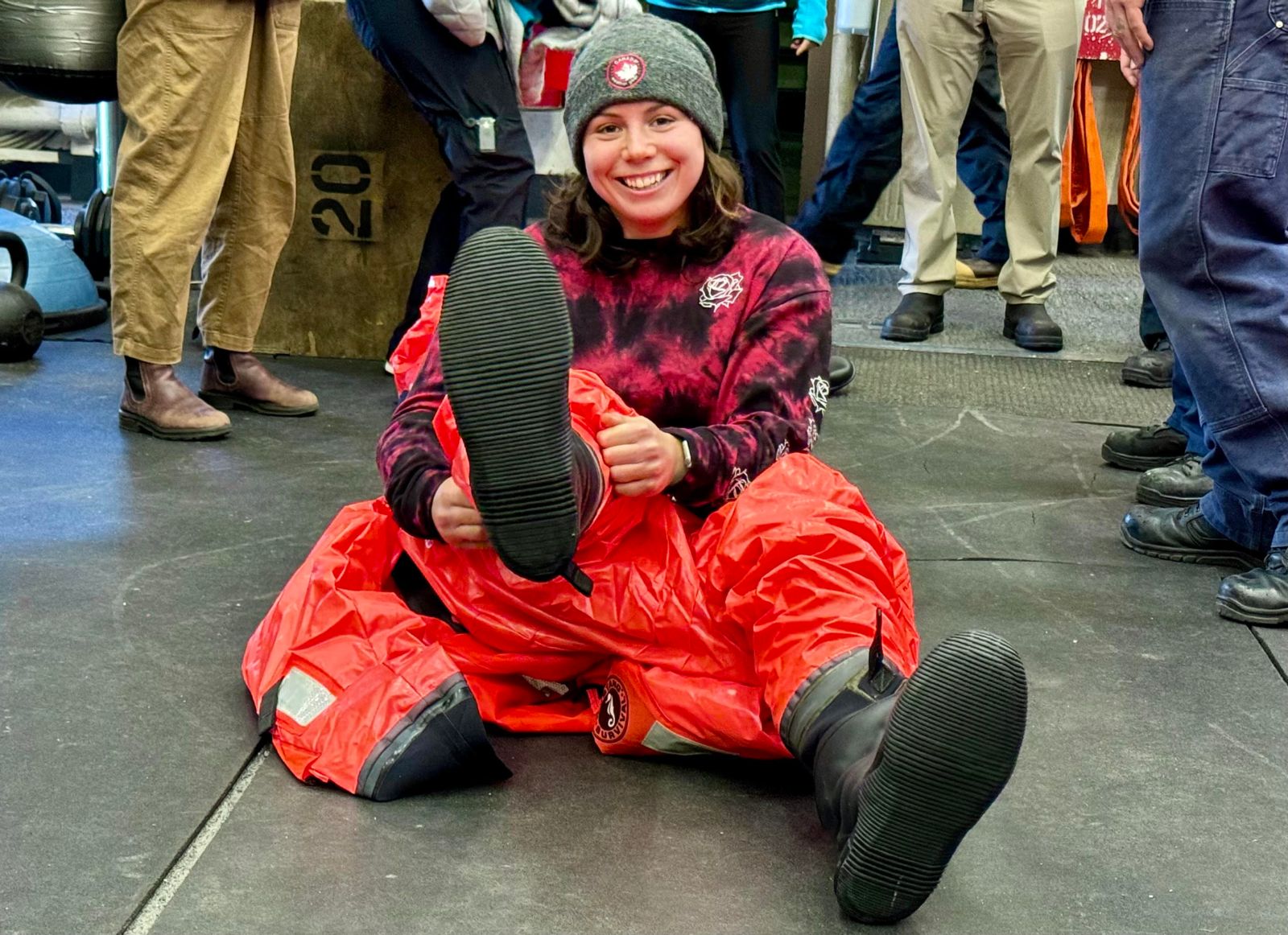
It is currently day 10 aboard the USCGC Healy! Kaleigh and I have received the full onboarding experience, including donning our survival suits. These ones are extra nifty, and can even hook together so you don’t drift apart. They remind me of how otters hold hands while they sleep! Making sure that everyone knows exactly how to don a survival suit ensures that, in the event of an emergency, it is a quick process with no confusion. Reaction time makes a huge difference in dangerous situations at sea!
Along these same lines, we ran many drills. Most of them were for the sake of Coast Guard training, but they are vital for everyone on the ship. Man overboard, fire, gas leak, and medical emergencies are some of the various drills that are practiced frequently. Practice doesn’t make perfect, but it does make for efficient response times. Everyone knows their duty and where their muster station is. Confidence in ability is half the battle!
Coefficients, variables, offsets oh my!
The marine technicians onboard the Healy run 24hrs a day, in 12 hour shifts. I am on the midnight to noon shift with my mentor Maya, and Kaleigh is on the noon to midnight shift with Tyler. The tech lead of our team, Christina, is on watch from 0600 to 1800. Having this overlap ensures that our turnovers go smoothly, and adds an extra hand to the times when science is most likely to occur on the cruise. This setup does mean that I don’t get to participate as much in the science, but gives a realistic view into the life of a technician.
In this photo, Christina (left) and Maya (right) are troubleshooting one of the many softwares that keep science aboard running. On the wall of monitors, each system can be observed at a glance. Generally, green lights mean things are running well, and red ones mean things need to be checked. Hope you aren’t color blind!
Though having this many screens may seem overwhelming, it is an asset. Nothing can be forgotten when it’s right in front of you!
Gravimeter, don’t bring me down…
Being a marine technician has much to do with variety. Having a wide scope of skills and working with many different instruments means always learning. A new piece of equipment for me is the gravimeter. Measuring marine gravity is an interesting science, and a subject that I know little about. I won’t bore you with the details, but check out this short, informational video for more info. My mentor Maya walked me through the process of a weekly test called “Test points”, where we use a multimeter to check resistances. We track the numbers in a spreadsheet, as well as enter the numbers into the deck box for calibrations sake. Next week, it will be my turn to teach Kaleigh, our other intern, how to perform the test.
While on watch, we make several rounds throughout the ship, touring through any space that has equipment and instruments under our supervision. We inspect deck boxes and cables, and remain vigilant for alarms, red lights, or low fluids. One of those spaces is the gravimeter chamber where the unit lives. I have come to quite enjoy our rounds, as it is a nice break from the lab, and we occasionally are able to see others up and about in the dead of night.
That pesky vent screw.No bueno…Takin’ a leak…
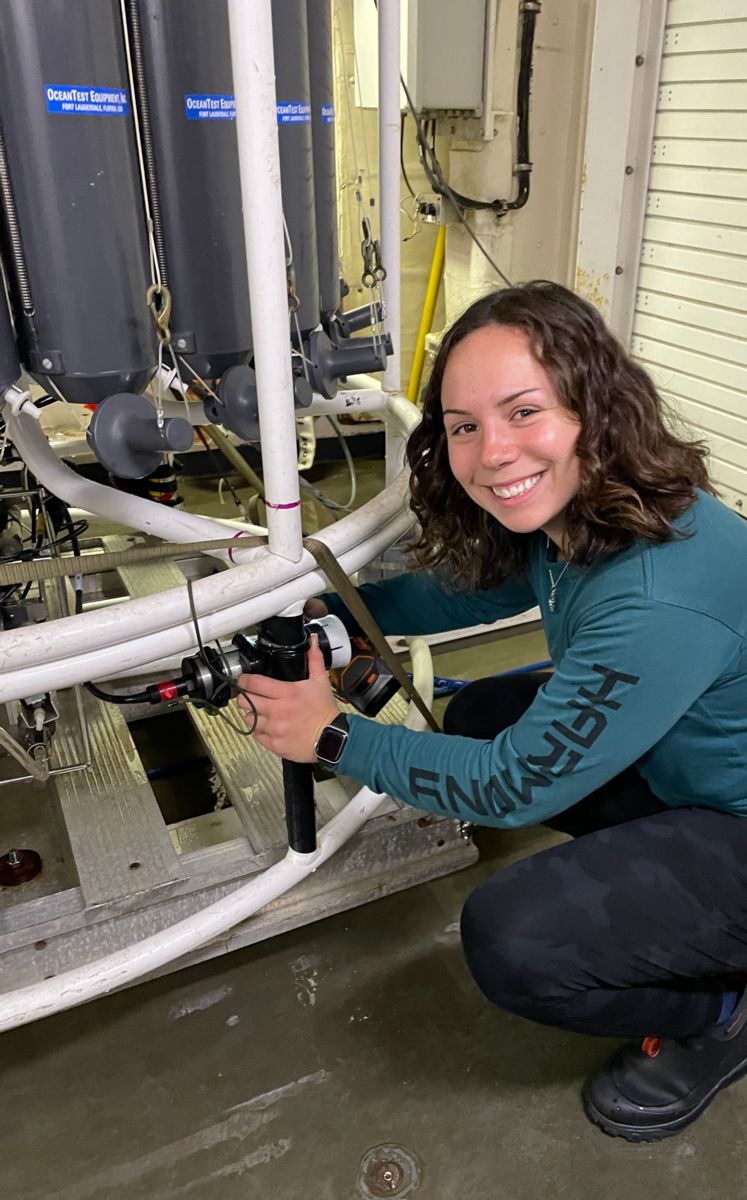
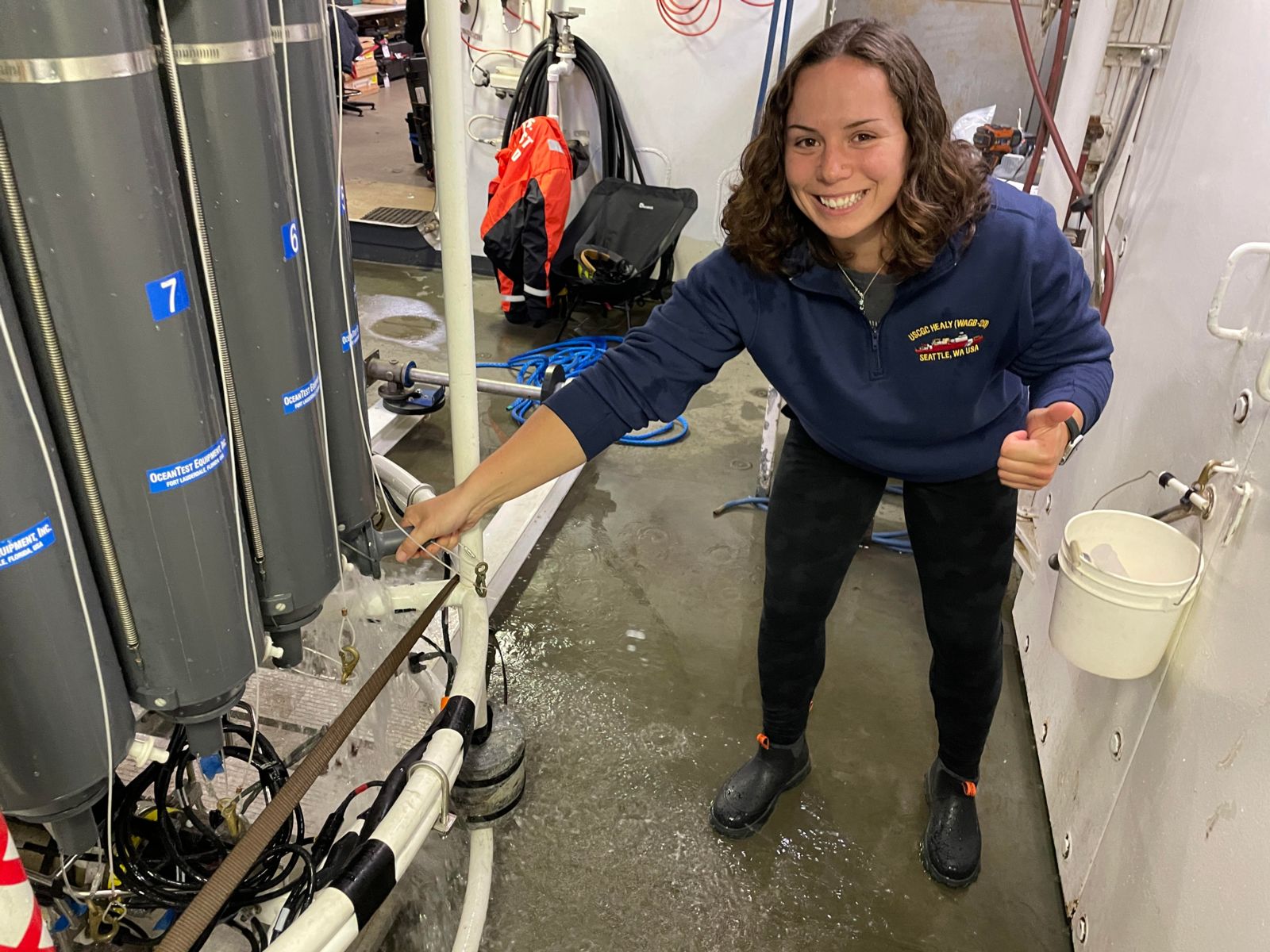
While transiting to science stations, it is a perfect time to test equipment. The CTD was due for a thorough look over, bottles and all. The day shift was working on sensors and the CTD “fish” itself, so it was up to the midnight marooners to test the niskin bottles. First up: do they hold water? Well, they were all full already. So the easy answer was yes! We drained them all out, giving us the chance to test the petcock drain on each bottle.
Interestingly, one bottle refused to drain, even with the vent screw wide open. After dismantling the bottle trying to troubleshoot, we found that it was the fault of a defective vent screw. The vent screw had no vent! A simple replacement solved the issue.
One of the spare bottles had a small leak, and we identified a crack right at the base of the bottles handle. Unfortunately, there is nothing we can do to repair the bottle, so it is simply out of commission. All the other bottles got the A-OK, so I clambered back up into the hangar loft and got the bottles back onto their storage rack.
Babies first sea ice!The Arctic Circle!
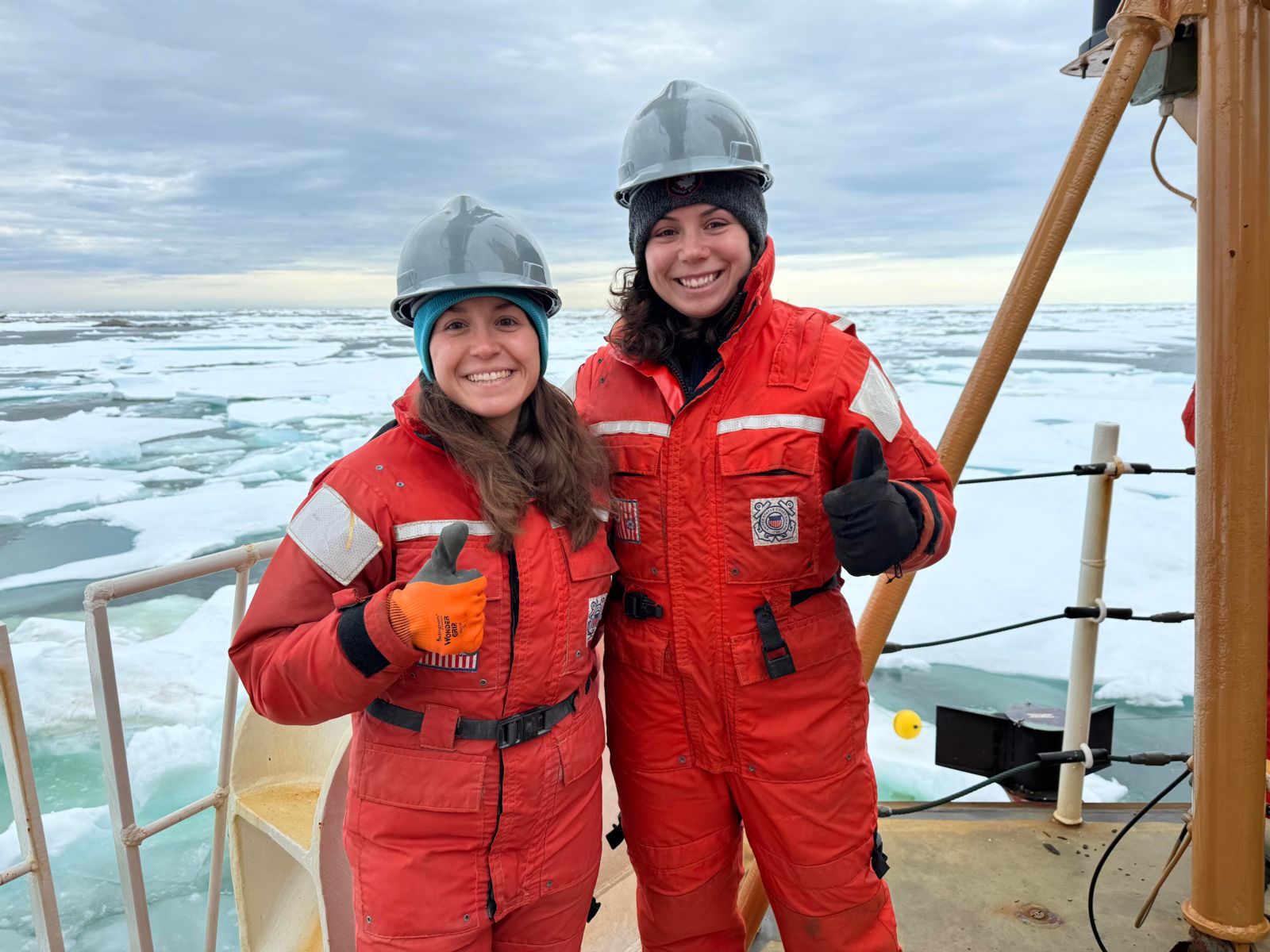
After a couple long days of work, we spotted our first patch of ice. And then another, and another! It’s official, we have entered into the Arctic Circle! This is definitely the most unique and incredible environment I have ever had the pleasure of experiencing. The farther North we chug, the thicker and more consistent the ice becomes. As it scrapes along the side of the hull, it sounds like a wild animal trying to escape the steel. The slow push against the floes sends cracks racing down the surface, and pierces the quiet air as a bullet through the fog. No polar bears yet, but we’re on the lookout always. Kaleigh is keeping a polar bear count in her blog posts, so be sure to keep an eye out for her updates as well!
The ice has quickly become a target of my fixation, and I wind down every day by just watching it float by. As an ice breaker, the Healy is specially equipped to come to areas that other ships are seldom able to traverse. As the ships local biology nerd, I am on the constant lookout for wildlife. Besides the occasional bird following the ship, there have been absolutely no signs of life up here in the ice. The binoculars are getting their fair share of sea time while we endlessly search the horizon for a polar bear, whale, or even just a seal. It is impossible to truly capture the ice and its presence in a photo, but it doesn’t mean I don’t keep trying!
I guess I better act right, or they might put me in here…
Another stop that we make on our daily rounds is the Mica stores. I have yet to find someone who can tell me why the space is called that, but it gets my Micah Stamp of Approval! A huge variable to take into account with science in the arctic is the cold, duh. Things have a tendency to freeze up here in all this ice! One of the systems that keeps things running smoothly are these ‘head tanks’. This creates a glycol-water mix for filling the transducer wells, which prevents freezing. Our only responsibility here is to check the levels, and to alert the engineering crew if they look low. We noticed that a few were low, so once they were freshly filled, we added labels to the level with the current date, for future reference.
You’re telling me farfalle doesn’t come out this end? Are you sure?
Another new piece of equipment I have encountered is this Lebus winch. I have worked with other winch types of winches before, but this one looks akin to a pasta maker! This machine is especially good at pulling loads with long lines and heavy instrument packages. It has special ‘gates’ that can be opened and closed to allow shackles and thimbles to be wound through with no problem. I have not been able to see this winch in action much yet, but I am hopeful that one of our science stations will be on my shift in the upcoming week!
Spaghetti…
Ice breaking is simultaneously an exciting and a rather dull activity. Essentially, once we arrive on station, we do donuts in the ship, which leaves us with some interesting track lines. We break the ice sheets up while steering in concentric circles at varying speed, which leaves behind a nice slushy spot in the middle for us to conduct our scientific endeavors within. Occasionally, we may get lucky, and our operation will happen right amidst a pool of open water, which saves hours of ice breaking. Either way, the science must go on!
As the sun sits stable on the horizon and watches us slowly crush the ice sheets, that’s all I’ve got for you today. At a balmy 2 degrees Celsius, I am hiking up my longjohns and getting to work!
Well, hello again everyone! I hope you have had a restful few weeks, and are enjoying your summer to the fullest. My days at home were full of catching up with family and friends, eating out, and taking plenty of naps. I walked my dogs, sat in the grass listening to the cicadas sing, and enjoyed the rolling hills of Carolina. Even though I enjoyed my break, you bet I’m going back to sea!
Flying solo becomes easier and less nerve racking with every connecting flight. I had a flight delayed by about 6 hours, so I landed in Anchorage, Alaska in the wee hours of the night. I scored a few solid hours of sleep before hopping on the next plane, and finally wound up at my final destination of Nome, Alaska, along with some of my colleagues.
Nome has a local population of around 3,600 people, and was part of the American Gold Rush. People flocked to the area to hunt for the valuable treasure, and gold mining is still relevant in the area today. This sign for Nome pays homage to the gold panning history of the town. The area is often a place of transit for people preparing to board ships, and has a very welcoming and kind community. We were privileged enough to have a full day to explore the area, talk to the locals, and enjoy some of the local businesses.
I met up with one of my mentors, Tyler, my co-intern Kaleigh, and even some of the members of the Coast Guard. We made introductions over dinner and a game of pool at the local pool hall. Check out Tyler’s signature move, which has roughly a 47% success rate!
A rental car allowed us to take in some of the sights on the outside of town as well. Rain and foggy conditions made walking a bit of a chore, so the car was a Godsend. We visited the local visitor center and museum, and everyone recommended we take a drive over the hill. The landscape and environment is so beautiful, and bustling with life. We saw birds of prey such as Osprey, small mammals, and many sea gulls and song birds. Just as we were ready to turn home and call our sightseeing quits, we stumbled upon some Musk Ox, or Ovibos moschatus. You can read a quick article about their conservation efforts here!
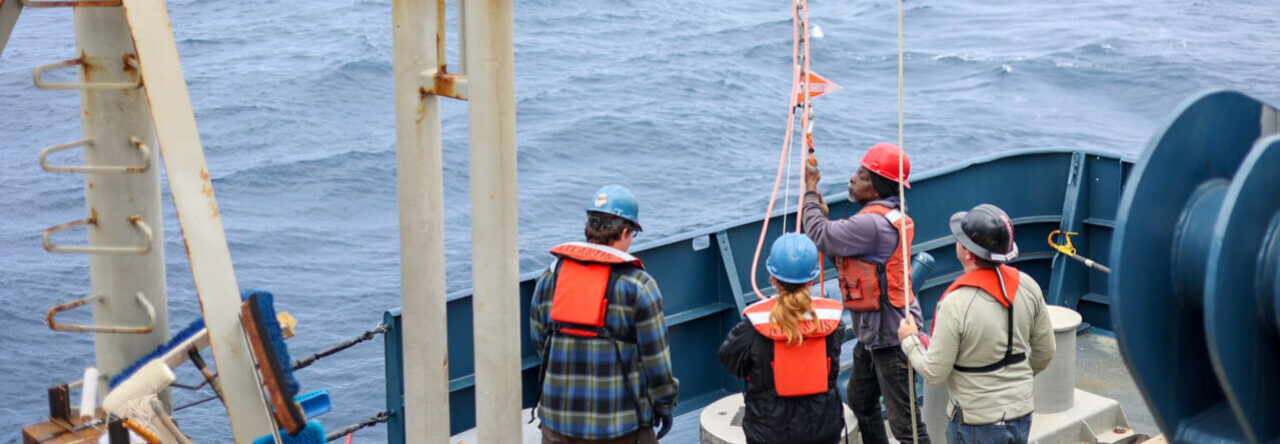
Once our tourist activities were over, it was time to embark on our mission; join the US Coast Gaurd Cutter, Healy! The ship was at anchorage, so a small boat shuttled us from the shore. It seemed to be a bit of a daunting ride in the wind and cold, so we donned our mustang suits and hardhats, and held on tightly for the trip. Thanks to the skilled crew, we made it safely to the shipside and climbed the Jacob’s ladder up. Once all personnel was on board, the luggage came shortly after. Everyone and their things made it safely aboard!
The ship itself is massive, by far the largest I have had the pleasure to step aboard. At 420′ long, she is called the most technologically advanced ice breaker, and also the largest vessel within the Coast Guards fleet. The Healy is a beast of a scientific platform, and for good reason! Research in the Arctic is difficult and harsh, which takes the grit and drive of a vessel such as this. Pictured is the back deck, complete with the all familiar A-frame. In the background, Nome slowly fades out of view as we sail out to sea.
As we begin our transit, we earn ourselves a tour of the humongous ship. Our mentor Tyler was also once a MATE intern, and it is very rewarding to see how different life paths can all converge into one outcome. Seeing how someone in my position can proceed in life and succeed in their career instills hope and even more ambition.
So, this begins my journey of sailing on the Healy. Even though I will most definitely still get lost behind a long line of watertight doors, trust that I am somewhere on board trying my best. I am super excited to see how the Coast Guard functions on board a research vessel, and learn how a marine techs skills can assist the science party in their mission amidst the training drills and station bills. Stay tuned for more, and come rescue me from the labyrinth of hallways if you hear yelling coming from the inside of the bilge!
This week at sea I am learning how to be flexible and adapt to the changing environment. A few days ago, there was an electrical fire that caused a mission ending failure. This has taught me how quickly plans can change at sea, and how difficult it is for us to get the proper support we need all the way out in the Arctic. Luckily everyone is safe, and we are still able to reach about 12 knots to head back towards a port where the ship can be repaired. This unfortunate incident gave insight into the steps the engineers and damage control personnel need to take when dealing with emergency situations. When encountering an emergency, there are certain alarms that the ship will sound; it’s important to listen to these messages and muster when necessary to ensure everyone is safe and accounted for.
I got a tour of the engineering spaces, which was very fascinating to see the inner workings of the ship. I saw the huge generators & four diesel electric drive motors responsible for propulsion, the cycloconverters & transformers responsible for proper power distribution throughout the ship, the heat transfer systems used to cool off the motors, the desalination plant where the ship can make 6000 gallons of freshwater a day, the boiler room which sends steam to power the turbines plus other equipment, and other spaces responsible for running the ship. The Healy is considered the most “technologically advanced” icebreaker because of the variety of scientific equipment onboard and the ability to monitor oil, water, and voltage levels throughout the ship from a computer. Instead of getting down in the hard to reach places in the bilge, the engineers can monitor all systems and control where water, oil, and electricity are sent throughout the ship. I also got a tour of aloft con which is where the ice pilots steer the ship from when we are in 7/10 ice coverage. Aloft con is a few ladders above the bridge, and gives the officers a 360 degree view of the ship. From aloft con, they have a good view of the stern wake. When we are moving through ice, they can see where the ice has high pressure based on how the wake closes in as the ship moves through an area of dense ice coverage.This gives indication of how the rudders should be adjusted and how to maintain the safest track through the ice.
On the science side, we had to stop doing CTD casts because the new mission is to get the ship back to a reliable port safely. We did 24 hours of XBT (expendable bathythermograph) casts which we can do while we are moving. For safe measure, we typically ask the bridge to slow down to about 6 knots when doing these casts. We launched 1 XBT on the hour for 24 hours. The XBT collects sound velocity data by measuring temperature as it falls through the water column. I was on the radio in the computer lab for some casts and on deck for others. In the lab, I request permission from the bridge to stage the XBT launch. Then I tell those on deck that I am standing by for the probe serial number which I enter into the XBT launch program. Once the bridge and lab confirm the serial number, we tell the deck to load the probe and check for good communication with the device. Then the deck asks the bridge for permission to launch. In the lab, I check the multi-beam and if we are in over 1000m water depth, I wait until the probe reaches its terminal depth of 1000m to end the cast. If we are in shallower water, I wait until the probe reaches the bottom and then tell the deck they can cut the copper wire to finish the cast. After the wire is cut, I load the cast data in the sound-speed manager and edit it to delete the data from the surface before the probe hits the water. The water temperature profile is then sent to the multi-beam so the acoustic device can more accurately send and transmit signals to the seafloor. Some of the JOs (junior officers) were sent from the bridge to learn about what we are doing so I got to teach about the process too. They taught me a lot about their work schedules and the qualifications they need to earn to work certain positions. They taught me about the different Coast Guard ratings/ranks and career paths that each can pursue depending on their specialty.
I was also learning how to change the gain value, tx power, range, phase, and process shift on the Knudsen sonar device to get better depth readings. When we suddenly enter deep water or go from deep to very shallow, the acoustic range and phase need to be altered so that the Knudsen knows which depth to look at. Then the gain value should be decreased in shallow water to reduce the surface reverberation. In deep water, the gain value and tx power should be increased to send a signal that is strong enough to receive a return signal. I have learned how to identify multiples that can be caused by multiple harmonics. If there is one multiple, the signal has reflected off the seafloor and back to the surface twice, so the seafloor line can appear deeper. The multiples can be caused by seafloor sediment that is less porous and reflects the sound wave instead of absorbing. The multiples can also be caused by a quick change to shallow water depth. If the signal source is too strong, the sound may be more likely to reflect multiple times off the seafloor before being recorded by the receiver. It is important to monitor the Knudsen and make alterations to the acoustic signal sent to get more accurate depth profiles of the seafloor.
I designed and 3D printed more parts for Brendon and the Boatswain. It’s pretty fun, I feel that designing the parts has enhanced my creative thinking. I have also gotten better at problem-solving by seeing which parts did not turn out well and reconsidering the print orientation and what kind of infill to use.
We also brought out the sewing machine and made some covers for certain devices onboard. The debubbler on the water wall needs a cover so that it stays dark to prevent things from growing inside of the water. The 3D printer needs a cover to protect it from scratches or other wear and tear it could experience from being on the ship for a while. There are electrical boxes outside to control the cranes that also need covers to prevent rust or other buildup.
Aside from work, we saw more healthy polar bears with their cubs and I have learned how to identify certain whales and arctic birds. I learned how to play cribbage and won my first game. We have done other fun activities like spin class, volleyball, UNO, spoons, and even a Mario Kart tournament. We are departing the ship in a few days, and it has definitely been an amazing experience. I have learned some new technical skills, met a lot of interesting people, learned about different career paths I could pursue, and kept a journal of everyday activities. I am very thankful for this opportunity as a MATE intern, and I am excited to see where my career as an ocean engineer will take me in the future!
Me installing my 3D printed fluorometer mount to the rosette
The past week we have been doing many CTD casts. We did our deepest cast the other day that reached about 2800m. We colored some styrofoam cups and sent them down on the rosette to shrink; they were all very creative and turned out so nice. After each cast, we secure the deck unit and take water samples for the scientists. We first need to ensure the bottles did not leak and were properly closed when fired. At each collection depth, we fire two bottles in case one of them leaks. After we have all of our samples, we flood the floor by emptying the Nisking bottles. Then reattach the strings to the top and bottom to leave the bottles open for the next cast. The sensors are then covered with caps and the seawater pumps are flushed with DI water. They did an NSF livestream in which Lorelei and I are in the background of the video doing our CTD maintenance haha.
This week we have also done two mooring deployments. I soldered a new cable for Jim’s deck unit because he needed a five prong pin out as opposed to the three prong that was connected to the Knudsen. The Knudsen is a sub-bottom profiler that performs seismic profiling of the seafloor to indicate water depth below the ship. Jim’s deck unit allows him to send a ping to communicate with the acoustic releases on the bottom of the mooring cable. The moorings are a rather complicated set up because they are anchored at the seafloor and each device on the cable needs to float at certain depths. To set up the mooring correctly, there is a lot of communication going on between those on deck, those on the bridge, the winch operator, and the A frame operator. I learned about the hand signals used between the deck and operators, as well as safety procedures on deck. They had two successful mooring deployments but were not able to recover the older mooring because of the thick ice in the area.
We have also been conducting XCTD casts which are small expendable CTDs. They are released through a canister and connected to a copper wire that transmits depth, temperature, conductivity, and salinity information. For one of the casts I was on the radio communicating with the bridge and aft con. We need to ask for permission to stage the cast, give the serial numbers on the device, load the probe, aft con tells us we can launch, then we cut the wire once we reach the seafloor or terminal depth.
My 3D printing knowledge has also been expanded upon. The printer is capable of making really cool objects, but there are sometimes limitations based on the settings used before printing. I have learned to use supports and a brim to help the printer follow the correct path, stagger the seams for more strength, use alpha infill for an exposed roof so the part does not implode under pressure, and to minimize the size as much as possible so the print does not take too long. My fluorometer mount design is finally working and we will test it out on a CTD cast soon.
I have spent some time on the bridge/ upper decks to get a good view of the ice breaking. It’s pretty incredible to watch and I am impressed with the ship’s capabilities. I’m glad to be here and have definitely been enjoying my internship on the Healy.
Over the past two weeks I have done a lot of traveling. My journey started on June 26 by flying to Seattle then to Anchorage. My thrid plane was much smaller, and I arrived in Dutch Harbor on June 27. I made my way to the Grand Aleutian Hotel and had a nice meal in their Margaret Bay Café. The next day, I met Kristen who had just finished her internship on the Healy. I also met a few of the other marine techs (Brandon, Bowman, and Max). During our few days in Dutch, we explored all that the small town has to offer including the famous Alaska Ship Supply, LFS, the abandoned underground hosptial, Safeway, Amelia’s, and last but not least the Norweigan Rat to play some pool. We did some hiking on Mt. Ballyhoo and enjoyed a beautiful view over the harbor; we saw about a dozen eagles. We did another hike behind the shipping supply; we had an amazing view of the coast and saw many old WWII bunkers. We also got a tour of the labs on the NOAA ship next to us in port. They are mainly studying pollock to monitor the health of fisheries in the area. After I moved onto the Healy, it remained in port for a few days while the engineers and technicians were troubleshooting some issues to ensure that we were ready for a long voyage.
Once the ship was underway, I spent a few days becoming familiar with the different routes to get where I need to go, and the equipment that we would use during the trip. This expedition is very CTD focused, so I spent a while talking with the other techs about each sensor and configuring ways to install the devices onto the rosette frame. Nick and I added a camera to the rosette; we had to find a good way to mount it without other devices blocking the view of the light and lens. The camera detects organisms underwater by interacting with their fluorescent pigments and illuinating them. One of my tasks was to create a mount for the fluorometer so that we can fasten it horizontally as opposed to vertically. This orientation would reduce interference between the multiple devices that are emitting light. I spent some time taking measurements of the rosette and fluorometer. I learned a new CAD software to design a mount that is 3D printing now, I’m excited to see how it turns out.
I was working with Maria-Christina to understand her mass spectrometry instrument that was analyzing oxygen and argon concentrations in the underway seawater. We have to make sure there are no bubbles entering the mass spec and we need to take samples of seawater every few days.
I worked with Chrisitina to disassemble, clean, and reassemble the port side and BioLab waterwalls. The waterwalls have a number of sensors including the debubbler, flow meter, fluorometer, eco-triplet, thermosalinograph, TDGP (total dissolved gas pressure), transmissometer, dissolved oxygen sensors, and the WetStar. All of these devices measure various properties of the underway seawater such as the flow rate, temperature, conductivity, concentration of matter in seawater, flourescence, and more. It is important to do regular maintenance on these systems to ensure the received data is accurate. Another one of my tasks was to use LucidChart to complete a wire diagram that shows how everything is connected on the waterwall. I traced the wires from the Adam boxes and mapped out where the devices were connected.
Brendon also taught me how to solder, that was fun I first practiced by making some wire loops and performed continuity tests. Then we tested my new skill by replacing a float switch on the waterwall. The float switch lifts up when the sink is overflowing and activates a light on the computer to let us know there is overflow.
I worked with Lorelei during the CTD casts to understand the data collection process. Communication between the deck, winch operator, and person operating the data collection computer is important to receive useful data. This communication is also important to ensure the safety of those on deck and to prevent equipment damage.
Before the cast, the rosette needs to be prepped by cocking the Niskin bottles and making sure they are fully open so they do not implode underwater due to the difference in pressure. Brandon and I replaced some of the strings on the bottles that experienced some wear and tear. The camera is also turned on a few minutes before each cast and turned off after each cast. The CTD needs to be submerged about 10-15m below the surface to acclimate the sensors to the water. Then the CTD is lowered to about 10m above the bottom, and it is slowly brought up to specified depths where the Niskin bottles are fired and samples are collected. The data is then processed and a script is run so that the hex file can be interpreted as a cnv file. The scientists then use the data to plot graphs of the pressures, density, salinity, and temperature at each station.
The scientists are also doing seafloor grabs using the Smith-Mac to collect samples from the seafloor. They are studying the samples to check for harmful algal blooms and other toxins that can be identified in invertebrates.
We did an abandon ship drill in which every member onboard meets at the bridge and gathers with their designated raft number. Each person is assigned to bring certain items such as blankets or food. When the ship’s coordinates and heading are announced, we are supposed to write on our the backs of our hands so if we were to contact help they could locate us. They showed us where the abondon ship locker was then I got to try on the cold water mustang suit.
I have really enjoyed my experience on the Healy. I have met and talked with many technicians, scientists, and members of the Coast Guard. I have learned a lot about the roles of those working on the deck and those on the bridge in charge of steering the ship. I have attended a few Coast Guard Officer trainings to learn more about the Healy’s engineering design and ice breaking capabilities. I have been lucky enough to do some whale and bird watching too. After work, I’ve enjoyed going to the gym and have invited some of my friends to learn how to erg. It has been a unique trip and I will update with another post soon!
Greetings! My name is Riley LaPerriere, and I am thrilled to embark on a voyage into the world of marine technology with MATE. As an ocean conservation and exploration advocate, I have always been captivated by the mysteries beneath the waves.
From a young age, my fascination with marine life and the environment sparked my curiosity in how technology can be harnessed to understand and protect our oceans better. This curiosity led me to pursue a bachelor’s Degree in Marine Technology which I will acquire after completing my internship. Although Marine Technology is the main focus of my studies, I also have been awarded my Associate of Applied Science Degree in Unmanned Aerial Systems.
Joining MATE represents an exciting opportunity for me to combine my passion for marine science with hands-on experience in cutting-edge technology. I am eager to contribute to the advancing marine technology industry while fostering environmental stewardship.
Beyond academics and professional pursuits, I am an avid skier during the winter months and enjoy scuba diving, mountain biking, adventuring, swimming, boating, and pretty much anything outdoors during the warmer summer months.
I look forward to the challenges and discoveries that await during this internship. Together with MATE, I am ready to explore new horizons, innovate solutions, and contribute to a sustainable future for our oceans.
Thank you for joining me on this journey. Let’s dive in!
Week two of my MATE Internship has been awesome. After getting underway on Monday, we headed off to Port Angeles again to do some troubleshooting and more flight operations. While we were by Port Angeles I spent some time finishing my wiring diagram for a panel. After spending several days by Port Angeles we headed offshore to conduct winch testing and the multibeam patch test. We first tested the trawl winch with 2000lbs of weight and lowered it down to 1000 meters to verify everything works. We then calibrated the payout sensor. After successfully completing the test weights we then deployed the CTD for training and system testing. We originally planned to send the CTD down to 2300m, but during the cast we lost connection at 800m. We tried to troubleshoot the system while the CTD was in the water but it was not successful so we hauled the CTD back onto the deck so we could figure out what happened. While the CTD was being hauled up from 800m the connection was restored at 200m. After we finished with the CTD test we began the Patch test. We got everything in order so that when we arrived at the coordinates that we had planned so we would be ready to go. Once we arrived after about five minutes the system shut off and we stopped receiving data from the sonar. We ran downstairs to troubleshoot the system and after about fifteen minutes we were successful. After making two attempts we called off the test because the cross swells were between twelve to fifteen feet. As a result of the rolls the multibeam was not giving us very accurate measurements. We got a head start and departed for Alaska, hopefully we will be able to complete another CTD test and Patch test before we arrive later next week. We are doing several tests while underway to see what the issue is with the CTD. We believe that there is problem in the .322 sea cable itself but need to pay out some wire under load to verify the failure. This has been a very busy two weeks and I’m so excited to share everything I have learned and experienced
The first week of my MATE Internship onboard USCGC Healy has been great. After arriving in Seattle early last week, I helped assist the STARC marine technicians with preparing the ship for its transit north. The cutter is leaving for the Arctic Summer deployment, so we worked to ensure all the science systems were ready to be tested while underway. Some systems that we worked on include the flow-through science seawater walls, CTD sensor configuration, data display infrastructure, and different projects to make sure the lab spaces are ready for the incoming scientists. After departing Seattle, we spent several days in Puget Sound and the Straits of Juan De Fuca performing drills and conducting flight operations, where they practiced touch and go landings and refueling. Unfortunately, a concerning vibration was identified so Healy returned to Seattle for more thorough inspections. After a day and a half of analysis, no failures were found so Healy will again head offshore for additional testing to better characterize the conditions under which the vibration occurs.