
It is currently day 24 aboard the USCG cutter Healy! We have successfully recovered and deployed all of the moorings that the science crew had set out to accomplish. What an achievement! The moorings we deployed will remain deep under the arctic ice floes, until the ship once again returns to repeat the process. The instruments attached will collect water column profiles, which, long term, can show trends and patterns in data. This enables scientists to predict future changes, as well as observe any changes over time. That’s a big deal!

We have officially passed the halfway point in our mission. With all of the moorings out of the way, we are shifting our focus to sea gliders! With a shift in mission comes a turnover of gear. The lab spaces on board are surprisingly small for such a large ship, and can get rather… crowded. The scientists are often awake into the wee hours of the night, tinkering away with their mechanical treasures. It’s difficult and precise work, but thankfully the Healy is very steady in all this ice. This may be the only ship where people set their things on a desk ledge with no worries of it tumbling off with each roll of the waves! Look’s as though the science crew has some cleaning up to do…

We have become quite accustomed to doing donuts out here in order to clear the ice, but the sight of it is always very interesting. We are still fairly far north, so finding open patches of water is a bit touch and go. When we can’t find one, we just have to make it ourselves! While watching the ice parting, and the patch widening, it is clear to see if someone with more experience is driving the boat, or if perhaps it is one of the greenhorns. Our experienced captains definitely hit the “circle” target bullseye, every time. The greenhorns however… well, they make some funky ovals, puddles, and other fun shapes, which I tend to appreciate more than the boring old circle. It’s art. Call that Picasso!


As the classic science nerds we are, we decided to make some shrunken cups! This is a relatively easy project, if you just so happen to have a way to get your simple styrofoam cup a couple thousand meters below the surface of the ocean. Easy peasy, right?!
Using markers, alcohol based such as Sharpies tend to work the best, decorate your cup to your hearts content. There are some astounding artists on board, and it seems as if every member of the crew made one! Once your cup is decorated, stuff it with a paper towel to keep it from collapsing in on itself. Place your stuffed cup into some sort of permeable bag, such as a mesh laundry bag or pillow cases (we filled two entire bags!), and attach it to something that will dive deep into the water. The obvious choice on a research vessel is the CTD rosette! Ziptied securely on for the ride of a lifetime, down down down they went. Into the inky abyss, all of the air within the styrofoam was compressed out, thus shrinking the cups. As an example, here are the cups I made, next to an example of what they looked like before. So teeny tiny! One of my turned out a bit wonky, but it’s all the more reason to love it. Peep the octopus! Cutting the cups before sending them down can make some really interesting shapes. Try it out if you get the chance!

From the same CTD cast, we decided to keep some personal water samples. Using empty hot sauce bottles we scavenged from the mess, the five of us are now the proud owners of arctic deep sea water. Though it may seem like a rather odd souvenir, it is a small sip of history as we know it. This water, while in the ocean, is extremely slow moving, and has probably been within the ocean basin for many, many years. Now, captured in water tight bottles, it wont enter back into the water cycle until the bottles are either emptied, or broken. How incredible it is, to have an encapsulated piece of the environment, and suspend this element in time. Of course, as all good oceanographers do, we simply just had to taste the water. Put your head under the rosette, and open up a spigot! The absolutely frigid water is extremely salty, and might even burn your mouth a bit. So, so worth it.


We have also deployed the remainder of our ARGO floats, chunking them out into the ocean to do their thang, solo style. To have the name ARGO float, they sure do sink pretty quickly… But don’t worry, once they wake up and get a little motivation, they begin their eternal journey of vertical migrations. They gently bob up and down the water column, until they eventually either fail or run out of batteries. Sigh, such is the sad, sad, life of an ARGO float. Their righteous self sacrificial mission is not in vain, as the researchers cherish the data that the floats have slaved over for so long. Once they have fulfilled their life mission, they aimlessly drift through the ocean. This cycle reminds me much of the mars rover, Opportunity. When the rover eventually ran out of battery, its final transmission amounted to: “My batteries are low and it’s getting dark”. I imagine the ARGO floats think much the same thing near their end.

Anywho, back to the lab! One of the laborious tasks the whole team has been pitching in on is inventory… dun dun dunnnn! This means enumerating, labelling, and testing just about everything on board. Maya and I spent all of one morning trouble shooting Adam modules, which is essentially a fancy signal converter for different devices. What should have been a quick, easy little project turned into hours of frustration and blatant confusion. The software used for trouble shooting was not interested in telling us anything, so we ultimately learned nothing about the current state of our spare modules. Are they still in usable condition? Who knows, but we’ve got ’em inventoried and put away in their proper place!


Happy birthday to the coast guard! In the spirit of Coast Guard day, Tyler and Kaleigh participated in a ship wide cornhole tournament, featuring our tech team lead Christina as DJ Oceans! It was right around bedtime for Maya and I, so sleepy as we were, Kaleigh and Tyler had the most monotone and unenergized cheerleaders you could ever want. Or I guess, not want? Unclear if I’m honest. This trivia crushing duo crushed cornhole only slightly less. But, if I do say so myself, they were the most spirited team on the flight deck! Read more about it over in Kaleigh’s blog! https://mateblog.unols.org/author/kaleigh/

One early morning, we were delightfully gifted with a pile of soft snow! Though it was rather chilly, we of course took our time to play and have a snow day. I mean, how couldn’t we? I made short work of snow angels and some little doodles in the powder, at the risk of freezing my fingers off. I may have even dared to throw a snowball at my mentor. Who knows! 😉


Even through the snow, science must go on! We made it to our first glider operation, which was a recovery. The gliders are the same as the ones that I helped to deploy and recover in Thailand aboard the R/V Thomas G. Thompson. Shout out to Jen and Liz for all they taught me, I am seriously missing the tropical sun with you both right now!
This recovery was a bit different than how we ran things on the Thompson. Once we were ready to recover, the scientists communicated with the glider via software, telling it to come to the surface. Unfortunately, because of the ice, it is exceptionally hard to spot. The antenna is only 18″ long, and even though it is bright orange amidst calm water, it is nearly invisible. Once the glider surfaced, the bridge was bustling with spotters wielding binoculars, scanning the horizon for our little friend. This took considerable time!
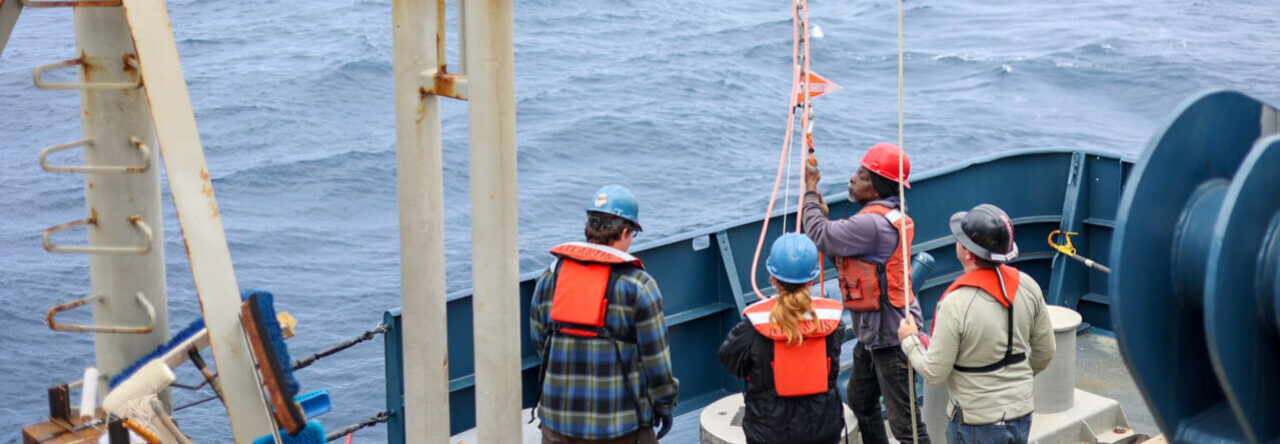
Finally, after several ascents to the surface and constant searching, we had the glider in sight. Instead of driving the ship right next to the glider to make an approach, and reaching over the gunwale with a noose to snatch the glider as we did on the Thompson, the coasties actually deployed a small rib with science member Justin on board. They drove right up to the glider and hauled it out of the water like a prize tuna had just been caught. A short little ditty bop back over to the Healy, and they tied the glider to the A-frame wire. A simple little elevator ride up and the glider was back on board! So easy!

While we transit to our next stop, and dream of sea gliders soaring through the deep, we were gifted by the sight of one of the wonders of creation: a fog-bow! A sight I have always wanted to witness, and I am so blessed to have seen such an incredible display of God’s hard work of nature, physics, and light. Though this may seem insignificant to some, it has been on my techie bucket list since day one! Another one checked off. With time to go still, how many more can I mark off?! Stay tuned to find out!
Micah Barton – God bless – 08/08/2025