Category: R/V Atlantic Explorer Page 1 of 8

L2W2: BIOS, BATS, and BVALiciousness

Howdy all,

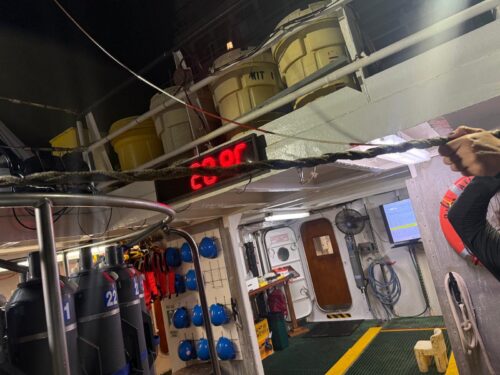
It’s been a minute since my last post and I have some big updates to share! After a two-week break and a lengthy flight, I touched down at the Bermuda Institute of Ocean Sciences (BIOS) station to kick off the second leg of my internship! Over the first few days I was at BIOS, I met the marine tech team, sang karaoke with the crew of the R/V Atlantic Explorer, and connected with the Bermuda Atlantic Time-series (BATS) techs through a glow worm light show. In addition to meeting everyone and getting acquainted with BIOS, I helped with some light cruise prep, like setting up WiFi access points and relocating a rain gauge with the tech team. 

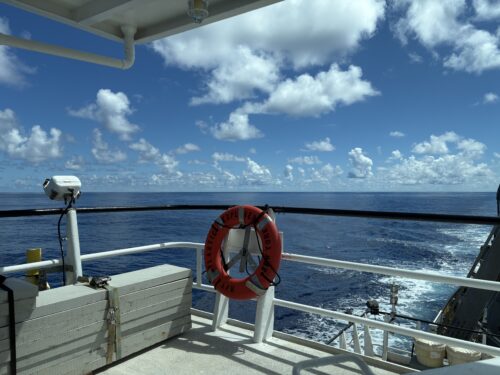
The R/V Atlantic Explorer

For those unfamiliar with BATS, here’s some good information for ya. The BATS study is a time series of ocean physical and biogeochemical data that has been maintained since 1988. Scientists and technicians try to conduct a BATS cruise every month of the year to consistently observe trends in oceanographic data, much like the Hawaii Ocean Time-series does in the Pacific. In oceanography, some research requires decades of data, so the length and quality of these time series are extremely valuable to the global ocean research community. Some topics of research that BATS addresses include how the ocean responds to increased levels of atmospheric carbon dioxide, surface ocean nutrient concentrations, phytoplankton blooms, ocean acidification, modeling, biogeochemical cycling, and much more! 

The BATS/BATS validation (BVAL) cruise I am currently on is an extended version of their typical four-day cruise. Once a year, the BATS team samples at multiple stations between Bermuda and Puerto Rico to better understand the mesoscale and large-scale variability of the region surrounding the regular BATS sampling station. At these BVAL stations, technicians collect ocean physical and biogeochemical data using net tows, CTD casts, in-line pumping, optical sensor casts, and the ship’s flow-through system. Working under BIOS marine tech pros Lydia Sgouros, Emily Tate, and Jace Innis, I have had the opportunity to assist with the preparation, execution, and troubleshooting of these operations. Lydia and Rory O’Connell have also thrown me various projects to do in my free time. Each of these projects has presented a new challenge and learning opportunity.

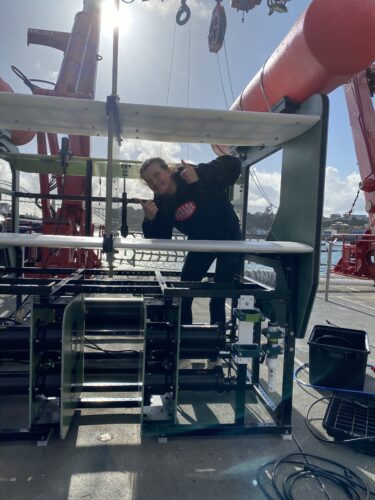
 A Manta net tow, used to filter out microplastics at the ocean surface by skimming across the water

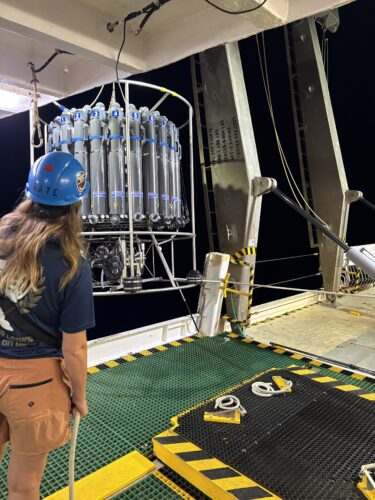
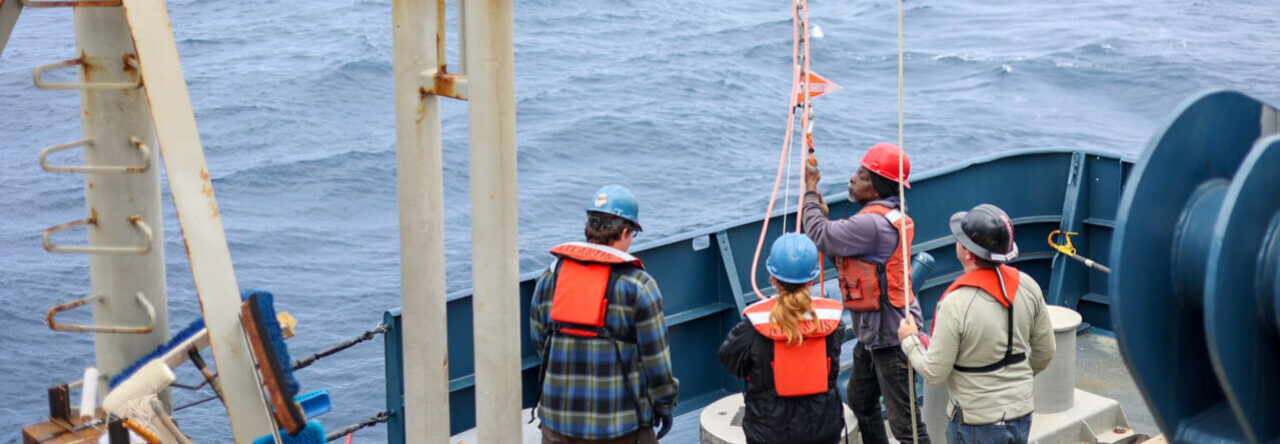
– Deploying CTD using tag lines and the ship’s starboard A frame

– McLane pumps being deployed through the ship’s aft A frame to sample specific proteins from different depths in the water column

Over the last two weeks, I’ve tackled everything from deploying and retrieving instruments like the CTD and Manta net to wiring LED lights for freshwater tank monitoring. I’ve also linked various meteorological sensors to a CR1000 data logger and set up CCTV hotkeys for easy camera switching for crew and winch operators. So yeah, I’ve been doing a little bit of everything (which is awesome). Working with the BIOS team so far has been a great opportunity to get hands-on technical experience at sea and expand my project portfolio – all in just the first two weeks!

– Making a project box to hold LED light strip battery and button at the tech bench

LED strips are used to illuminate the inside of these freshwater reservoir tanks to make checking fluid levels easier for techs

After a quick stop in San Juan, Puerto Rico for some sightseeing and downtime, we’re now homeward bound to BIOS in Bermuda. On the way back, I’ve been working on some of my projects, helping out with deck operations, and learning as much as I can from the pros. Stay tuned for more updates. I can’t wait to share more from BIOS in my next post, which will be coming your way in about two weeks!

– Leaving San Juan

All the best,
Hunter

Week 5: Atlantic Explorer

The schedule of our last few cruises was moved around in response to hurricanes, and I was very lucky to get to go on one extra cruise for this internship. This morning, we finished our one and only cruise mission. In fact, my internship came full circle, because we recovered one of the lost mooring lines from my first cruise with our visitors from NIOZ. The buoy started communicating its position not too long ago, and it turns out that it drifted very far from its deployment site. It took 20 hours from Bermuda just to get to the mooring. Recovery took place this morning, and it’s nice to see the familiar face of these big orange buoys on deck again.
 

One of NIOZ’s buoys

I am also grateful for the two extra days of my internship, since it’s given me more time to work on my personal project. In an earlier post, I had mentioned the project but added no specifics because the whole thing was giving me a headache. By chance, I managed to find a component that was absolutely necessary for the project’s completion, one which I thought we didn’t have. I’m extremely thankful that it showed up just in time.

The project, in summary, was to connect a data logger to a weather transmitter, which senses several meteorological parameters like wind speed, temperature, and humidity, and sends them back to the logger. The sensor had, at some point in the past, been reconfigured to communicate in a way that was incompatible with all other devices on board that we could use to talk to it. There was no way to get through to it until I found an RS-422 to RS-232 converter. The converter takes the sensor signal I can’t read and changes it to one I can. From there, I was able to reconfigure the device’s settings so it could talk to the data logger. I even found a way to deploy it just outside the ship’s bridge.


Weather sensor deployed on ship


Right now, it’s collecting data, and what I’ve seen has been consistent and accurate, so I’m very happy with the state of the project. If I can find time, I will plot the data over the collection period and compare it to data from other ship-board sensors. 

We are currently headed back to Bermuda, and I will depart from BIOS soon afterwards. I am going to wrap up my project and, importantly, document as much of it as I can in case someone else picks up the same weather sensor and needs help communicating with it. I’ll leave some parting words on this blog site once the internship is over and I’ve had some space for reflection.
 

Week 4: Atlantic Explorer

This week, we wrapped up our cruise with our visitors from WHOI and Stanford. The last couple days went just as well as the rest of the trip, with the scientist successfully collecting data and having a good time doing it. They were barely sleeping, staying up to participate in as many deployments as possible, and somehow managed to carry their level of enthusiasm through to the end of the cruise. 


A group photo with our visitors, MTs, the captain, and two of the crew


Most of the week has been in port, and there’s never a shortage of things to fix before the next cruise. Most notably, we wanted to replace the device which feeds data to winch operators. We tried to do this before the last cruise, but ran into issues the first time using the winch and swapped it back to the old device. Hopefully, we have ironed out those issues this week after installing the new devices again. I spent the first day or two creating documentation for this process, which will hopefully help prevent future headaches with this device.

I have also attached a pinger to the side of the CTD, which we plan on incorporating into our CTD casts in the coming cruises. Several weeks ago, I replaced all 20 of the device’s batteries to prepare it for deployment. Attaching it to the CTD seems conceptually simple, but the pinger weighs 70 pounds and had to be lifted over my head. I probably should have gotten a second set of hands. In any case, it is now held on with 4 hose clamps and a shackle, so I’m confident it will stay put.


The pinger on the CTD


At the end of the working week, another hurricane blew over us, this one more intense than the others. It was a good incentive to stay inside, if nothing else. On Friday, the captain informed us of yet another hurricane on its way, at the time predicted to have a straight track directly over Bermuda. We pushed our cruise departure date up and worked through the weekend. No time to mourn my lost day off, since we had a lot to get done before leaving. In fact, we’re leaving BIOS in only a couple hours.


The prediction we were looking at on Friday. Luckily, the track is now predicted to head off to the east before it reaches Bermuda


I am nearing the end of my time here and have decided to take on one more big project. I would like to document as much as I can in the ship’s internal wikipedia. It houses a lot of information, mostly for MTs, and can be a valuable reference. However, I have found it to be lacking in many areas. The pinger, for example, has never once been documented. When I tried to learn more about the device, like how it has been used in the past, how the MTs want to use it in the future, or even where on the ship it was being stored, there was nothing. For future MTs, and future MATE interns especially, filling in these gaps can be a huge benefit. It would allow them to work independently far more effectively.
 

Week 3: Atlantic Explorer

This week, we finally got to go back out to sea. The hurricanes of last week kept us in port for far too long, and another hurricane may be on its way. Our guests at the moment are from Woods Hole Oceanographic Institute and Stanford. Unlike the last cruise, we have a very packed ship, and our numerous visitors work round the clock deploying moorings and nets, running tests on collected samples, and gathering vast quantities of data. Every one of them is enthusiastic and more than willing to talk about their projects.


One of WHOI’s enormous net traps


Because we are on a 24-hour schedule for this cruise, the marine techs’ shifts are spread around the day, with me working from 4 AM to 4 PM. It took a couple of days to get used to the unconventional work schedule, but I’m feeling very well-rested after night three. My main focus is running the CTD deployments and recovery. While my mentor still sticks by me to make sure I do everything correctly, I can now run the entire process like a full-fledged marine tech. A special shout out to the ABs who were very patient with me in the earlier days of the cruise when I was still getting the hang of things. I’m very happy with how much progress I’ve made.

Between CTD deployments, the MTs and scientists do mooring recoveries and deployments. I am still learning the rhythms of this process, and I get hands-on when I can. We had an especially interesting recovery yesterday morning when the ship was stuck in a storm. It was already raining hard when I woke up and only got worse for the next hour or so. Coming out to the back deck was an eerie experience. The only lights were those on the ship and the occasional lightning strike off towards the horizon. Everything else was completely black. We had to find a window of relative calm to bring everything in quickly. Of course, relative calm still meant zero visibility, waves crashing over the side and back of the deck, and rain soaking everything that wasn’t already splashed by the sea. It sounds rough, but it was pretty exciting.


Me, looking very happy to get to hold a line (with chief engineer Mike in the background, looking very neutral)


This week, I am more independent than I was able to be on the first cruise. I am far more cognizant of where I need to be and what I need to do. A log entry of mine  from the last cruise reads “This job requires a lot of waiting.” I do not think that’s the case anymore. I’ve had something to do nearly every moment of this cruise, and it’s been a great experience. There’s so much to learn, and this week has been an excellent teacher.

Week 2: Atlantic Explorer

Just as my first cruise on the Atlantic Explorer came to an end, week two of my internship began. The approaching hurricanes were, from this point on, a constant logistical concern. The first hurricane, Franklin, hit a couple days ago. It wasn’t particularly intense, but it was still windy enough that there was not much for us or our visiting scientists to do but stay on the ship. The second hurricane, Idalia, is sitting on top of Bermuda as I type this. Other than getting in the way of weekend plans, the storm has not been particularly unpleasant. The power is out on the BIOS campus, but I’m lucky enough to be on the ship’s generator power.


Idalia’s position right now


This week was quite busy. I started on a personal project, which has, unfortunately, been very uncooperative with me. I’ll write about it once I make some actual progress. For now, let’s focus on the enjoyable parts of this internship.


We’ve been doing several odd jobs around the ship now that it’s in port. We moved a temperature sensor onto the main mast, cleaned parts of the ship’s water intake system, and replaced the batteries in a pinger that we may soon attach to the CTD. BIOS has a new liquid nitrogen generator, and I got the chance to fill a dewar, pictured below, with liquid nitrogen, which we will use on a future cruise. 


Me filling a dewar


Additionally, I was given a tour of The Mid-Atlantic Glider Initiative and Collaboration (MAGIC) vehicle, and the process by which its buoyancy is adjusted so that it can fly through the ocean effectively. It is lowered into a tank of seawater and weighed by two scales, which allow scientists to compare the weight at the front and back of the vehicle and fine tune it by adding or removing weighted material from the inside of the glider.


One of MAGIC’s gliders


Lastly, today I had the chance to do something totally unrelated to work. My mentor and I used some of the liquid nitrogen from the generator to make ice cream. We mixed up a basic recipe, mostly made of half-and-half we took (with permission) from the galley. It came out pretty close to Dippin’ Dots, and we mixed up the following flavors:

Vanilla

Peanut butter chocolate

Coffee

Kiwi strawberry

Maple nut

Grape

Give it 5 or 10 years, and grape ice cream will be all the rage. It’ll be a Bermudan specialty. We hope to give this ice-cream making process another go, and I’ll write about all the fun flavors we make in a future blog post!


Week 1: Atlantic Explorer

My introductory post is here

I arrived in Bermuda on Monday just before a brief downpour of rain. Just after boarding the RV Atlantic Explorer, I was informed of a change of plans. Our first cruise was meant to leave later in the week, giving me a couple days in port to get ready and acclimate to the ship. However, in response to the approaching tropical storms, the departure date was moved up to Tuesday. Lydia, my mentor and one of the ship’s marine techs, immediately started giving me a tour of the place. At the same time, our visitors from NIOZ (Royal Netherlands Institute for Sea Research) brought their equipment aboard and prepared for their experimentation. 


Once the cruise got going, each of our days were basically laid out the same way. We deployed a VMP 6000, a device which belongs to our visitors, then lowered our CTD (pictured later in this post) to a depth just above the bottom of the ocean, raised the CTD back up, recovered the VMP 6000, then set out to find and recover mooring lines, one line each day, that our visitors deployed over a year ago. 


Unfortunately, however, recovering said mooring lines was never an easy task. Out of the four lines, three were missing the uppermost section, making them difficult to bring aboard. One was missing entirely, perhaps still underwater, perhaps broken and floating off to who knows where. Every day, it took hours to locate the mooring lines. I spent those times circling the bridge deck, staring into the ocean looking for small buoys that marked the upper end of the mooring, but finding nothing but water and sargassum. Once a buoy was spotted by someone aboard, we then spent hours hauling the lines onto the ship by winch, a process that generally stretched well into the evening.

One of the mooring line’s buoys

While I may seem a little unenthused by this tedious process, I want to make it clear that I’m having the time of my life. Being able to have a hands-on interaction with this research project is very fun. I enjoy hearing about the NIOZ team’s various educational backgrounds, and their past projects. As the week goes on, I am able to do more significant tasks. Lydia has been finding good places to slot me into the process of CTD deployment and mooring recovery so that I can get some experience under my belt.


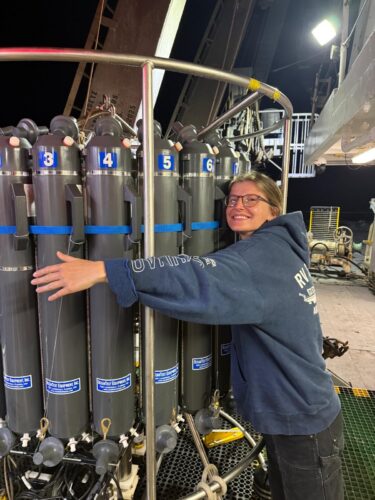
Running the CTD has been my favorite part, by far. Everything from setting up the device, launching the device into the water, running up to the bridge to begin data collection, communicating with the winch operator, watching the data plot itself, and bringing the device back on board with a winch and three control lines (one which I get to handle), is an intricate and engaging process. On the last day of CTD deployment, just for fun, our visitors sent down a mesh bag with styrofoam cups that were compressed by the extreme water pressure.

Me climbing on the CTD
 

Outside of the work, I am adjusting to the ship just fine. The food is wonderful, everyone is welcoming, and I sleep very well, even when I’m a little seasick. The onboard stationary bike is especially delightful. In fact, my laptop is zip tied to the handlebars as I write this. We are coming into port soon, and I look forward to exploring Bermuda for a bit before hurricane Franklin hits.

Next week I’ll be starting on some personal projects, and I’ll get to tell you about it in my next post!


Hello Bermuda- Week Three

Happy Saturday!

We just arrived in Woods Hole, MA. We are unloading equipment and loading some new equipment on the ship. Part of the science party is leaving today, but we are getting four new members of the science party tomorrow. The mooring we were supposed to deploy on leg one was having issues so we now have a tech on board who will hopfully fix the issue and we can deploy it on leg two. I wasnt on my phone as much this week and didnt take as many notes for each day unfortunatly. I forgot to mention earlier that the science party is made up of scientists and students from, Rutgers University, MIT, WHOI, VIMS, Skidaway and NRL. 

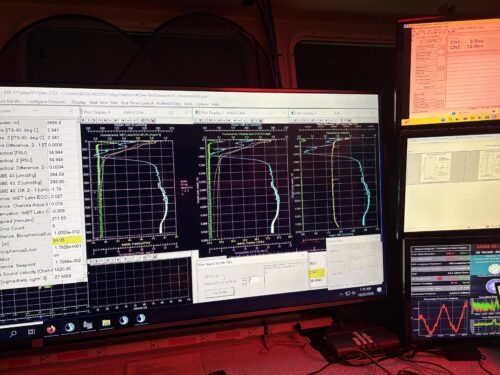
While doing the 2000m CTDs I talked to Jeff, Co-chief scientist (NRL), and he told me about the SOFAR Channel(SOund Fixing And Ranging) that starts about 1000m down. Whales and humans use this channel to emmit low frequency sound waves thst can travel thousands of miles. In certian areas of the North Sargasso Sea, which is where we were, there is also 18 degree mode water that allows for a simillar but smaller channel like the SOFAR to form closer to the surface. In the photo below you can see the sound velocity of the 2000m CTD cast where we see this happening. 

During the week I switched my 8am-8pm shift for two days to 12pm-12am in order to see some night time operations. During those shifts I worked with the science party deploying the Underway CTD off the aft deck of the ship. Jack and Bre, two students with the science party, showed me how to upload the UCTD data once we got the device back on board. We did these UCTDs twice a hour for almost 24 hours for a few days. 

On our steam to WHOI we ended up with some pretty nice, calm weather which was nice. At sunset on June 1st we saw our first whale! It was a sperm whale. Then on June 2nd we were on the bow taking a group picture when we saw a pod of pilot whales and then two humpback whales. We continued whale watching after the picture and ended up seeing some seals and a few more whales. 

Hello Bermuda- Week Two


Been out to sea for almost a week now. We are in the North Atlantic where we are deploying gliders, recovering gliders and doing three types of CTDs. The food is amazing and I’ve tried a few new Filipino desserts that were unexpectedly really good. One was a coconut and rice bar and the other a corn and pineapple jello like cake. 

May 23

We were still in transit to our first station and so I worked on a task Rory gave us. It’s a cyber security type task, where I’m gathering information on all the apps and what versions are on all the computers. Around 330/4pm we were at our first station where we were recovering a spray glider that was in trouble. I helped search for it on the bridge and then mostly watched the recovery with a few of the science crew. After dinner I worked with Oban on building a holder for the acoustic device that needed to be taken on and off the CTD frame for short 300m cast. We had to get creative and try a few things and by the time 930 rolled around I was a hour and a half over my shift and decided to head to bed. In the morning I saw that they had stuck with the original idea but instead of using hose clamps to hold it to the CTD they used ratchet straps. 

May 24

Got on shift at 8am to a 2000m CTD cast and recovery. After that we moved to the Underway CTD. A Underway CTD is put off the back of the boat and is dragged on a long line behind the boat while going at a speed of 3-4 knots. It collects the same time of data the CTD collects but it gets horizontal data and not vertical data. Then we tried to do a 300m acoustic CTD every hour on the hour if possible where I got to do tag lines and help deploy and recover. The weather was getting a little iffy and rainy and Lydia and the ABs were working on a hydrological issue so I was given a radio to be the marine tech on deck for the next UCTD cast which was cool. The weather started to get bad after lunch and all further science was put on hold. I worked some more on the cyber security task and then Oban said I was free for the night. I watched two movies with the science crew, the Secret Life of Walter Mitty and Insidious chapter 3. 

May 25

Woke up and the weather was better and there was some blue sky and the sun was out! Although it went back to overcast a few hours later. We did more 300m acoustic CTDs and some 2000m water profile CTDs. After lunch we launched two gliders which took all afternoon. The scientist had to make sure they were communicating with shore operations. After dinner we planned to launch another one and it ended up taking a while so I got off at 8 before it was deployed. I have been reading a lot during meal times and when I am off and finished two books already! 

May 26

Finally Friday and all we had on the docket was 2000m CTD casts going into the Gulf Stream. These 2000m CTD cast take around 2 hours deployment to recovery. After deploying we go up to the bridge to fill out a CTD sheet. We write down time, location, air temp, wind speed, wind direction, rainfall, humidity, barometric pressure, sea state, swell height, wind wave height and the name of the station and what number cast it is. Then we sit and wait while it goes down 2000m. In that time a few of us read and watch the screen that’s showing real time data as it goes down. We are keeping an eye out for spikes that may indicate a sensor error. After lunch during one of the 2000m CTDs we started noticing a few of these spikes and Lydia went and fiddled with the sensors and after she went to bed at 3pm Oban and I still saw a few spikes so we replaced the sensor and it seams to be working better now. We did these 2000m casts all day long. I got off around 8pm and went straight to bed.

May 27

Another long day of 2000m CTDs! I have been mostly having a good time! It’s always hard being the odd one out, the science party all knows each-other and then the crew is all close and I’m in the middle. I’ve been spending a lot of time between talking to the Rutgers/VIMS students and Oban(marien tech) and Eli(chief mate). Got another long week ahead of us before we head into WHOI June 3rd for a quick port call before we head back out! 

Hello Bermuda-Week One

Good afternoon readers!

I got to BIOS saftley on Tuesday May 16th around 130pm. I got a tour of the facilitys and got settled into my room and rested before dinner at 5pm. I meet the crew and the other Marine Techs I will be learning from, Rory, Lydia and Oban. Lydia will be our lead tech for the Miller cruise. I got invited to go with a few of the crew to some local caverns and we ended up swimming in one of the deep pools located in the caves which was amazing! 

On Wednesday I got right into working, since we are at port for the week we work 8-5pm everyday with a lunch break at 12pm. We have a morning meeting everyday at 8 with all crew to go over what needs to be done that day and then we had a marine tech specific meeting to discuss what would be on our task list for the day. I helped Oban with getting a wind sonic sensor from the mast down that needs to be fixed. Rory then showed Oban and I how to do a rinse of the underway water system using a simple green mix that we let sit in the pipes for 24 hours before rinsing it out with freshwater.  I then started on fixing some parts on the niskin bottles and quickly realized the bolts on the hose clamps were really stuck and needed to soak in a penetrating catlyst that helps break down rust. Was shown a few things around the ship and then it was time for dinner. After Dinner I took a walk on the “rail trail” to a local cove and went swimming and saw some really beautiful parrot fish. Then Eli, the chief mate, took me into St. George by boat to get a few things at the store I forgot to pack.

 Thursday I finished the niskin bottles with Obans help which took up all of the morning. I helped dispose of the lithium and alkaline batterys aboard the ship and then we did that underway system fresh water rinse. We then washed all the niskin bottles and let them dry before removing them off the boat for storage since we will not be using them on this cruise. After dinner I took a short walk and hungout with some of the crew before bed. 

Friday Lydia gave me the task of fixing a slip ring and then I watched as they removed the RAD van from the vessel to make more room. Rory took me up top to show me the internet domes and how they work! The domes are very large and allow for us to have access to the internet at sea! After lunch we had a meeting with some of the scientist to discuss the deployment of the deep sea mooring we will be doing. I believe its going down 2223m with the top being 300m from the surface. Lydia then had me help with the GPS anntenas that are not quite working like they should and then we called it a day around 245pm for a birthday pig roast for one of the engineers!

Today (Saturday) we are moblizing for the cruise and the scientist are coming abourd the ship. Lydia showed me the moonpool where a transducer can be attatched. Now time for a safty talk! I’m also having a hard time uploading pics so I will try again later!

Week 5: HYDRO, Mooring, and Goodbye!

Tuesday May 2, 2023

The first half of the day consisted of A-frame testing. In the previous tests (see blog post…) it was noted that the A-frame warped while being tested with weights. 

These weights were approximately 4,600lb combined. When picked up by the dush 4 winch and A-frame, it would significantly warp. Today was to test possible causes for that. They did that by positioning weights and lifting on either side. This would isolate the problem. If the A-frame warped equal amounts with the weight lifted on either side. 

The hydraulic differential appeared to be a symptom of the problem. One of the differentials was struggling much more than the other. When the weights were tested on the Aft side, these differentials were the same, indicating that the problem lies with the bow hydraulics. 

After break Rory took me on top of the bridge where the satellites and antennas are mounted and I got to go inside one of the domes!

Apparently these are some really big domes for this size ship. You can see the picture of me inside them for comparison. We have to make sure these domes are turned off while working on them because of the radiation produced. 

After that I went back to working on the code from before. There’s always room for improvement with coding. The current task is to get the code to be able integrate with not just the TX520 sensor but all devices that produce serial data with an RX232 input. Technically the input should be easily changed but it’s needed to go into the code and manually change the pin ID’s.

The goal is to make this completely automated with no action required from the user. 

Essentially we want it to:

Connect to sensor

Cycle through baud rates until the correct one is found

Write the incoming data to a list 

Print these out on an LCD and update while new data is sent in.

This is an interesting project but it is definitely time consuming. Seeing as I only have 6 days left and 5 of them will be spent at sea I’m not sure how much more time I’ll be able to allocate to this. 

May 3, 2023

Today we had a day-long HYDRO station cruise with BATS. It consisted of a few CTDs at various depths along with a glider recovery. Apparently the glider notified land that there were a few leaks relinquishing it inoperable. Here you can see the glider (yellow) getting hooked so we can bring it in on the boat.

Very simple day. We docked at St. George’s and are waiting on the weather forecast to see if we’ll begin the mooring deployment tomorrow or wait until Friday. As it stands, it seems that we will be waiting until Friday to deploy in better weather.

The bridge notified us that the wind sensor was not functioning and so Oban and I went to see if there were any obvious disconnects in the wire. This lead to us going “Aloft” and Oban strapped into a harness to climb up. I wanted to do it but my inexperience would have just had me climbing up there for fun. You can see how high he climbed in the picture below. 

Nothing of significance was noted in the wire connection and so we decided to call it a day. 

May 4, 2023

Dock day! Today we did any last minute maintenance around the ship that can be completed in a day. 

Oban has contacted the company that made the weather sensor in order to get any guidance for possible troubleshooting. It seems that they might need to send it in for re-calibration.

Most of the day I was altering my code that I wrote to read out data from NMEA sensors. My goal today was to get it to automatically change baud rates once the correct sequence of data is found. I got a rudimentary code working but it wasn’t working well enough to put to use. At this point the code started having more and more moving parts in it and so I decided to move things into a finite state machine in order to get it to work. That’s a task for tomorrow though. 

May 5, 2023

Today we deployed from St. George for the mooring cruise at 7:30 am. 

We were in transit for the first half of the day and since there wasn’t much to be done I took the liberty to go down into the engine room and talk to the chief engineer to see if I could learn a thing or two. 

Afterwards Rory showed me how the satellites connect to the internet, and then how the internet is managed. It’s surprising how many components go into this but yet seem so simple. 

We deployed a CTD once we got to the approximate position of the mooring so we could do some samples at depth and again at surface. This will help to calibrate the findings on the mooring. After it was deployed we had quite a bit of down time so I picked up my code again in order to implement the finite state machine. It took a bit of testing but so far it’s working! I only have one sensor with one baud rate to test it against but Lydia might be able to get me another this evening or tomorrow. When we were docked I could use the GPS input sensors but since we’re deployed it’s not a great idea to mess with any coordinates that are imperative to the boats navigation system. 

We just recovered the CTD and are now done for the day. Finally tomorrow we will be able to recover the mooring! 

We have to get up before the sun rises to begin recovery because the first thing that we do after releasing the mooring is “see” where it is. Since there is a flashing light on it it’s “easiest” to see it when it’s dark. I’m quite excited. 

I will likely be on the first morning shift so I can see all the goings-on required for this, which means I also will likely get to break earlier.

Fingers crossed nothing goes wrong this time. 

We recovered the mooring!!!! It’s fascinating how long it is (over a mile in length) and it’s hard to imagine just how deep the water beneath us really is, but this recovery definitely helps put things into perspective. Interestingly, the way that the mooring is recovered here is to pick it up from the bottom and wind the wire in up to the top, stopping for wire replacements and instrument removal. Here you can see the final buoy and ADCP being recovered on deck.

In the morning (before daylight) the ship turns off all transmitting acoustics so that the scientists can turn on their own acoustic transmitter (this is what I helped set up in the straza tower a week ago). This is because they need to “communicate” with the bottom mooring release in order to tell the mooring to drop the weights and resurface. Having multiple acoustic transmissions going at the same time is similar to trying to hear one person when many are talking all at once. essentially messages consisting of:

 “Are you awake?” 

“Yes I’m awake” 

“Please drop the weights” 

“Ok”

Once the weights have been released, it takes approximately 5-7 minutes for the top of the mooring to surface and about 40-50 minutes for the rest of it to surface. Now everyone working right now needs to go up to the bridge and look for the mooring. One of the crew mates, Henderson, was exceptionally good at spotting it. Once it is spotted, the person that sees it will hold their arm with hand open, gesturing towards where they saw it and try and get as many eyes on it as possible. Each of the instruments attached to the mooring have their own set of buoyancy spheres that will raise and so it is important to see each of these segments (with different colors and numbered spheres) in order to know where to pick the mooring up. After we located it, the whole mooring surfaced, and we picked it on a grappling hook, then is where the winches and lines come into play. 

It took us a total of 7 hours (a little on the long side) but this was because we had to replace FOUR 400 meter long lines. We also had 2 tangles which impeded progress significantly. This is where things get more confusing, because you can have a whole mess of wires going in every direction with a bunch of tension on each of them and you need to decypher which ones go where. The scientists have each of the segments of wire labeled so that’s how we would tell where it’s supposed to go on the mooring. It was really cool to see all that tension transfer from one line to another in order to remove and repeat the processes. We had to replace a lot of the segments of wire which was done after a certain number of deployments or after significant damage from a tangle. In order to replace the segments, we had to reel it onto the big squid (large winch we were using), tie off the rest of the mooring with a deck line to hold the tension, unhook the line and wind it onto an empty spindle. Unfortunately, the spindle that holds all the wiring when loading and unloading it onto the mooring, is HAND OPERATED. 

It requires a lot of arm strength. Apparently they’ve got a compressed air powered spooler ordered but it won’t arrive for quite some time, and so hand spooling it is in the meantime. I had a critical job on this recovery- taking care of the diapers. Each of the links on the mooring need to be covered with a protective cushioned cloth so that when it’s tension-loaded onto the winch, the shackles won’t bend or pierce the wire around it. I’m so glad I got to see the mooring recovery as I was worried that our last trip cancellation might not allow me this. 

Tomorrow we will be re-deploying the mooring which includes dropping a 2,500 lb weight at the end of the line and having it sink down. Apparently this process is much more straight-forward and therefore runs faster. We will see if that rings true tomorrow. 

May 7, 2023

Today was mooring deployment day! It took us around 5 hours to get everything in the water. Similar to yesterday it was a lot of taking tension on and putting it somewhere else in order to attach different wires, buoys, and instrumentation. 

Page 1 of 8

Powered by WordPress & Theme by Anders Norén