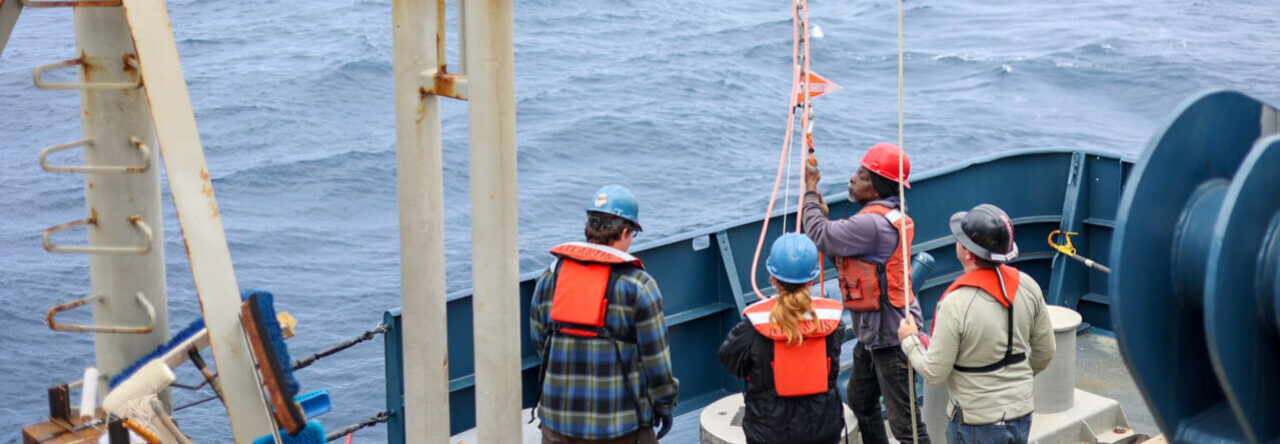
This week, we wrapped up our cruise with our visitors from WHOI and Stanford. The last couple days went just as well as the rest of the trip, with the scientist successfully collecting data and having a good time doing it. They were barely sleeping, staying up to participate in as many deployments as possible, and somehow managed to carry their level of enthusiasm through to the end of the cruise.

A group photo with our visitors, MTs, the captain, and two of the crew
Most of the week has been in port, and there’s never a shortage of things to fix before the next cruise. Most notably, we wanted to replace the device which feeds data to winch operators. We tried to do this before the last cruise, but ran into issues the first time using the winch and swapped it back to the old device. Hopefully, we have ironed out those issues this week after installing the new devices again. I spent the first day or two creating documentation for this process, which will hopefully help prevent future headaches with this device.
I have also attached a pinger to the side of the CTD, which we plan on incorporating into our CTD casts in the coming cruises. Several weeks ago, I replaced all 20 of the device’s batteries to prepare it for deployment. Attaching it to the CTD seems conceptually simple, but the pinger weighs 70 pounds and had to be lifted over my head. I probably should have gotten a second set of hands. In any case, it is now held on with 4 hose clamps and a shackle, so I’m confident it will stay put.

The pinger on the CTD
At the end of the working week, another hurricane blew over us, this one more intense than the others. It was a good incentive to stay inside, if nothing else. On Friday, the captain informed us of yet another hurricane on its way, at the time predicted to have a straight track directly over Bermuda. We pushed our cruise departure date up and worked through the weekend. No time to mourn my lost day off, since we had a lot to get done before leaving. In fact, we’re leaving BIOS in only a couple hours.

The prediction we were looking at on Friday. Luckily, the track is now predicted to head off to the east before it reaches Bermuda
I am nearing the end of my time here and have decided to take on one more big project. I would like to document as much as I can in the ship’s internal wikipedia. It houses a lot of information, mostly for MTs, and can be a valuable reference. However, I have found it to be lacking in many areas. The pinger, for example, has never once been documented. When I tried to learn more about the device, like how it has been used in the past, how the MTs want to use it in the future, or even where on the ship it was being stored, there was nothing. For future MTs, and future MATE interns especially, filling in these gaps can be a huge benefit. It would allow them to work independently far more effectively.