Month: June 2026 Page 1 of 2

Week 7 – Working aloft & New Centerboard Shoe Sonar Installation

I am certainly getting used to living in protective gear. Much of the drydock work requires full PPE – respirator, safety glasses, hard hat, gloves. Now I can add a harness to my list of working gear. This week, I ascended the forward mast to uncover our forward meteorological sensors and give the forward mast bolts some TLC. This required two days working aloft.
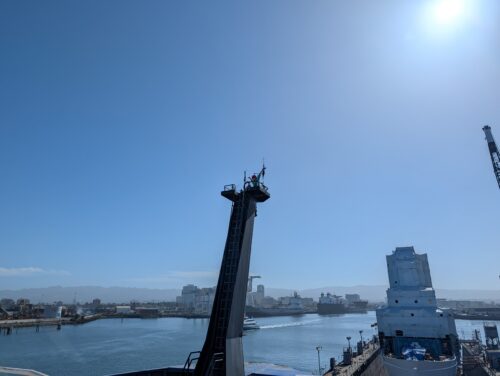
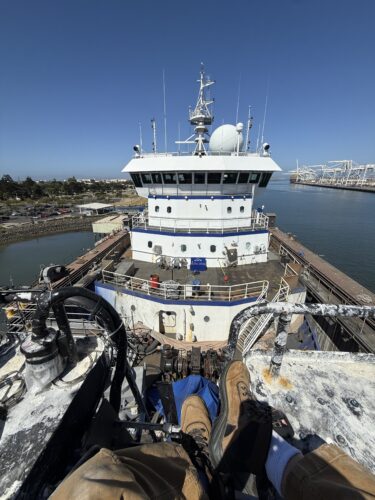
That’s me up there!
View from the top of the forward mast

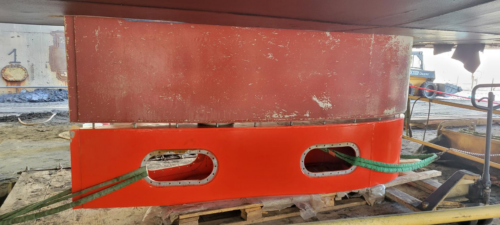
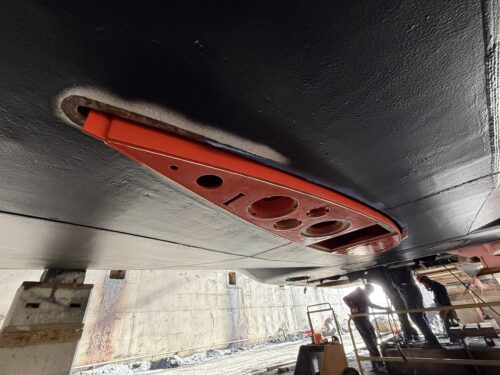
This week, the Sikuliaq team also tackled the physical installation of the sonar suite and EK2042 shallow water multibeam on the new centerboard shoe. This project required lots of creative problem-solving and careful cable management within the shoe. The team had to drill out and align a new bolt pattern for the EM2042 installation. We also installed 3 zincs inside the shoe to prevent galvanic corrosion. The new shoe houses a Tonpilz transducer, EM 2042 shallow water multibeam echosounder,150 kHz ADCP, EK 80 sonar suite including a 70 kHz transducer, 120 kHz transducer, and 200 kHz transducer.
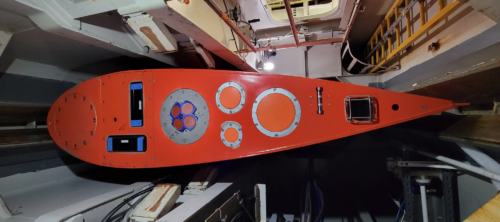
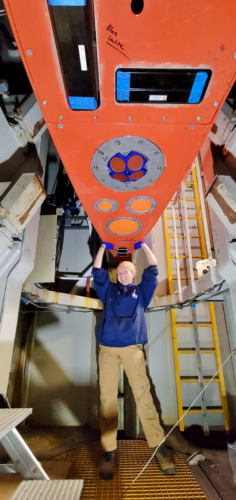
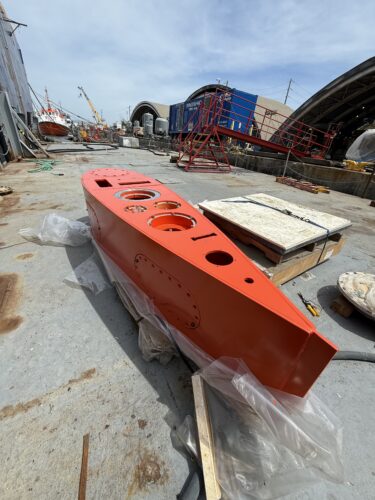
Newly installed centerboard and sonar equipment
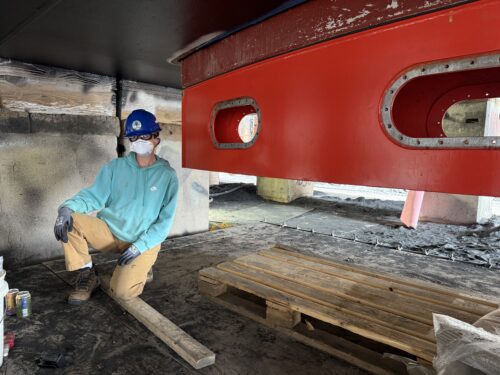
Matching colors with the transducers

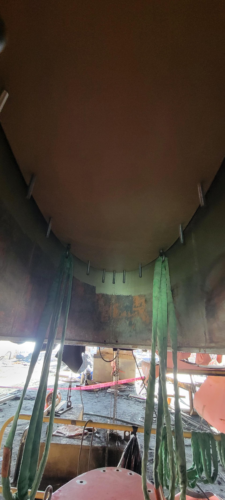
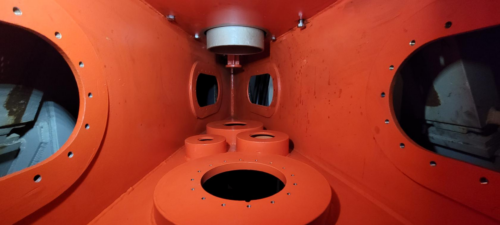
Installing sonars on a giant moving platform was a learning experience in correctly managing cables. Additionally, this project took away a lot of the mystery in how data is transmitted from the sonars to our computer systems. Much of the installation process also required working in a very tight environment (see window plate installation below).
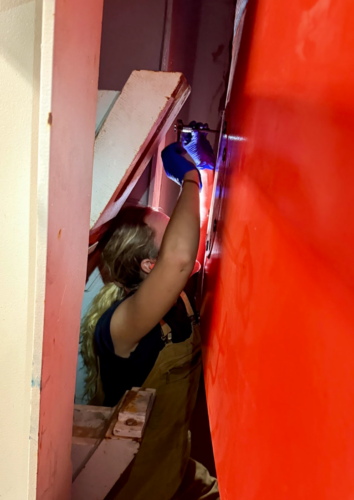
Installing the window plates on the centerboard shoe

The new shoe is looking great with the sonars installed. Next step: testing & troubleshooting.

-Paige FitzPatrick
Week Three

After a long transit we’ve finally started science operations. On our way north, we stopped a couple of times to deploy ARGO floats. Our typical schedule has consisted of CTD casts at night and mooring operations during the day. Following the first few CTD casts, we noticed that the conductivity values from one of the sensors were drifting quicker than normal, so we replaced it with a spare sensor.

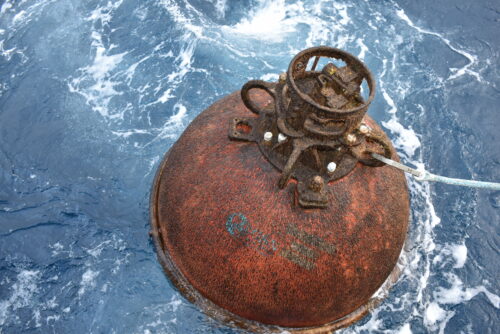
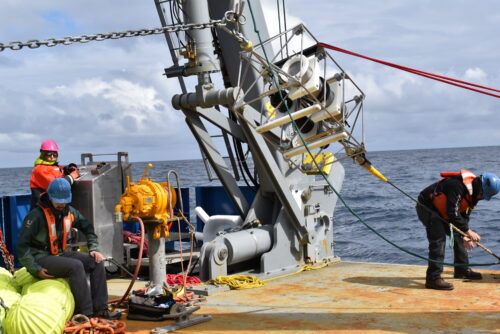
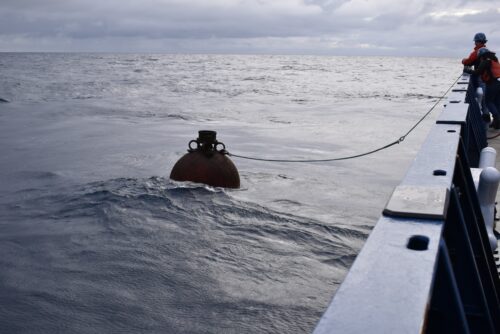
The first few days were spent recovering and redeploying two OOI moorings. Each recovery took place in two stages. We started by recovering the upper 500 meters of the mooring, a process that took about an hour. Shortly after, we deployed the new mooring, which was a multi-hour operation. Once the new mooring was in place, we returned to the original recovery site to retrieve the bottom portion of the previous mooring. During these operations, I had the opportunity to assist with both the A-frame and the winch.

Over the past couple of days, we also recovered and redeployed moorings for NIOZ (Royal Netherlands Institute for Sea Research). Compared to the OOI moorings, these operations have been a bit quicker since the wire is considerably shorter.

Aside from science operations, I also spent some time transferring files to the new backup data drive that I have been setting up. Once the files were copied over, I set up the automated tasks that will be used to run the required scripts if needed.

Week Two

On Monday morning we docked in St. John’s Newfoundland, where we picked up the rest of the science party and crew. Many of us had never been there before so we spent some time exploring the city and hiking along the coast. We got lucky with great weather!

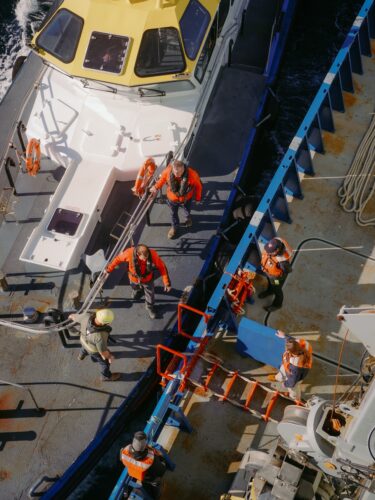
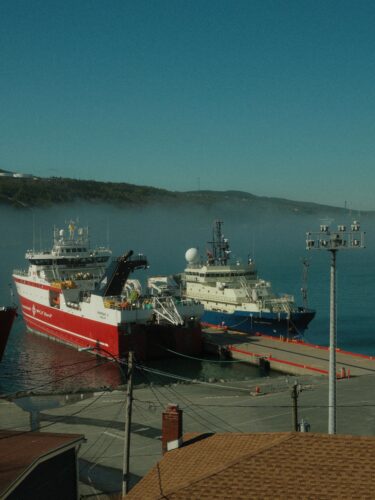
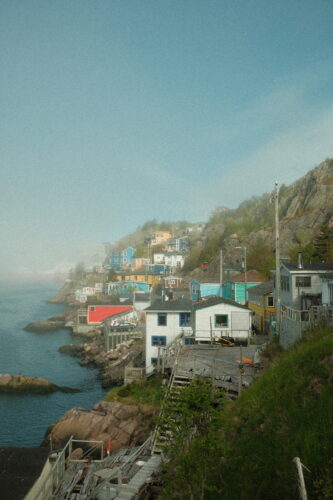
To the right is a photo of the pilots boarding the ship before we entered the harbor. Below are two photos from the trail, one of the Armstrong docked next to a Canadian fishing vessel and one of the neighborhood along the trail.

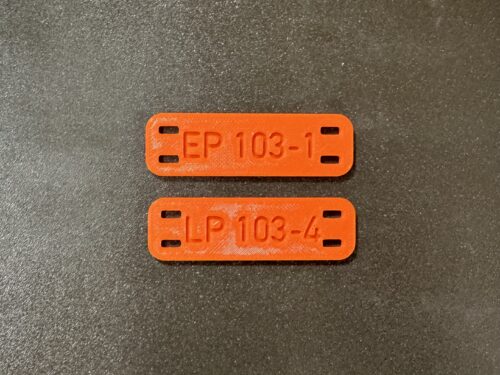
Once again, this week has been slow for science so I have been working on more small projects. When we left port on Wednesday, I relabeled many of the servers and computers on the ship with their new IP addresses that they were given recently. This task has definitely helped me become more familiar with these machines. I’m continuing to practice with the 3D modeling software and have been busy printing some identification tags that the engineers have requested (pictured below). Aside from those two projects, I’ve been spending much of the last few days going through interactive Linux tutorials on my laptop.

Although we have been transiting for most of the week, we stopped a few times on Wednesday to deploy RAFOS floats, which track the motion of the water in the ocean. We will hopefully get to our first CTD station off the east coast of Greenland by Tuesday!

Week 6 – New Shoe!

Week 6 in drydock has come to a close. This week has been focused on installing the new centerboard shoe. The centerboard shoe formerly housed an EK80 system of sonars, acting on a retractable platform to protect the sensors from ice damage. The new shoe is upgraded with the EM2042 multibeam sonar, specialized to map out shallow water regions.

To install the new shoe, weighing around 2,700 pounds, we first had to align and drill the bolt pattern of the old shoe into the new shoe. This bolt pattern was not included in the original drawing, though it is critical to the functionality of the shoe. Facing this problem included using the old shoe’s bolt pattern as a stencil. To confirm the alignment was correct, the new shoe was maneuvered beneath the centerboard, allowing the Sikuliaq team to ensure the new shoe would fit. Maneuvering the centerboard was a great challenge underneath the hull, where there is only about 5.5 ft between the drydock floor and the looming hull of the vessel. A rubber gasket was additionally placed betweent the new shoe and the centerboard.

Overall, this was a process of trial and error. In many situations, it seems there is no real guidebook on how to accomplish a very challenging task. We had to figure out how to install an extremely heavy steel object in a space with too low a ceiling for a forklift. Thinking creatively, using tools wisely, and working as a team are all essential in successful scientific research missions.

With the shoe installed, the team can start installing the new multibeam system and EK80 sonar suite.

-Paige FitzPatrick

Docked, Demobed, and Dreaming of the Next Cruise

And just like that, we have docked up in Nouméa, New Caledonia. In this final week aboard the R/V Thompson, we transited across Vanuatu waters, completed the last OBS deployments off New Caledonia, experienced slightly larger swells (~10ft), and got to celebrate World Oceans Day at sea!

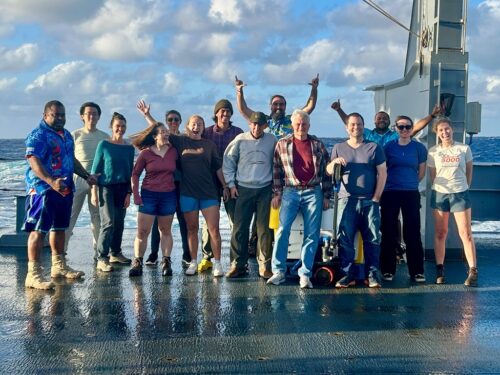
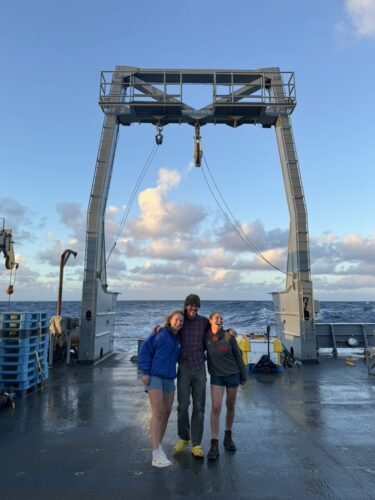
The seismology science party

During some of the final deployments, I was entrusted with the OBS release line. This is the high-stress job of ensuring the instrument is not released from the crane until it is in the water and all other tag lines have been released. Luckily, all of my deployments went smoothly!

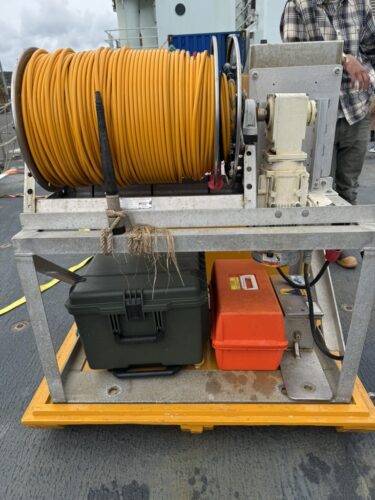
Once at the dock and the ship cleared customs, demobilization began. This primarily consisted of preparing the magnetometer gear for storage and eventual shipment from Guam. We retrieved the magnetometer, rinsed both the cable and instrument with freshwater, and level-wound the cable neatly onto the winch drum. The winch was then unbolted from the deck and placed inside its storage box with the rest of the gear.

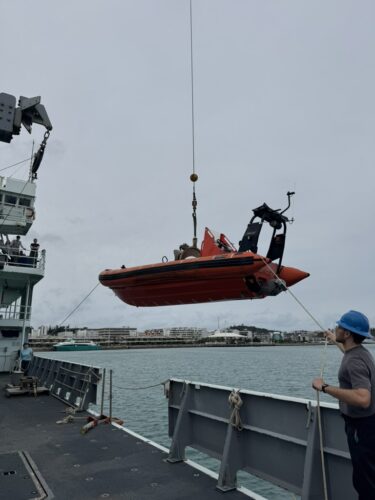
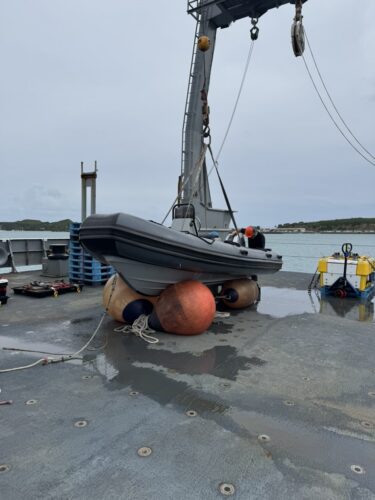
The ship’s crew planned to perform maintenance on the safety boats while in port. Flying boats do exist! They also created a makeshift cradle with fenders—sometimes you have to get creative out here.

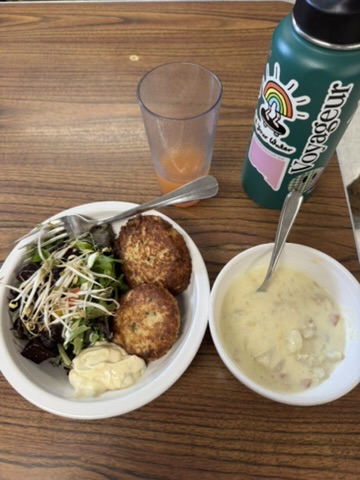
My favorite meal this week consisted of crab cakes and homemade clam chowder. A big thank you to Gabriel, Juanita, and Caleb for all the amazing grub!

This week, I had the realization that I was actively living out my childhood dreams. What an amazing experience for a landlocked girl from Colorado to travel the world and spend three weeks at sea assisting with marine research! I am beyond grateful for the opportunity to set sail as a MATE intern, especially with the amazing crew aboard the Thompson. I gained a lot of experience and knowledge, but the people onboard are what made this experience so valuable. I am already hoping to get back out to sea as soon as possible.

Until next time!

-Avery

Week One

We departed Woods Hole last Sunday and have been underway to St. John’s Newfoundland to load some more gear and pick up a few more people.

There hasn’t been much science going on so Emily has been giving me a small project most days. I spent the first couple days practicing 3D modeling and printing. There are two 3D printers on board, but when I first arrived one of the raspberry pi’s connected to the printer was broken. Emily tasked me with setting up a new pi, so now we can print from our laptops again and watch the process with the camera that is set up. Once I got that printer working again, we noticed the print quality from the other printer was pretty bad in comparison, so I’ve been troubleshooting that issue.

I also spent a day working on reformatting a server to install a new operating system. Everything about this was completely new to me so it took me a while to get things right. Later, I spent some time building the ethernet cable for this server. Eventually, we will set it up to be a backup data drive.

After a few days we stopped to do a test CTD and deploy the first mooring, both of which went smoothly. The mooring landed about 700m away from its target location, which seemed reasonable considering the 4000m of line and 5000m seafloor. I was able to help out running the A-Frame and winch as needed.

Chapter 35 of Moby Dick is the Relevant One

Today is our 15th day at sea. By now, I’m deep in my watch standing rhythm and the days have started blending together. This week, I’ve averaged 3 cups of coffee, 2 cups of tea, 75 twisties chips, and about 100 pages of Stephen Ambrose’s New York Times Bestseller, D-Day (borrowed from the ship’s library) a day.

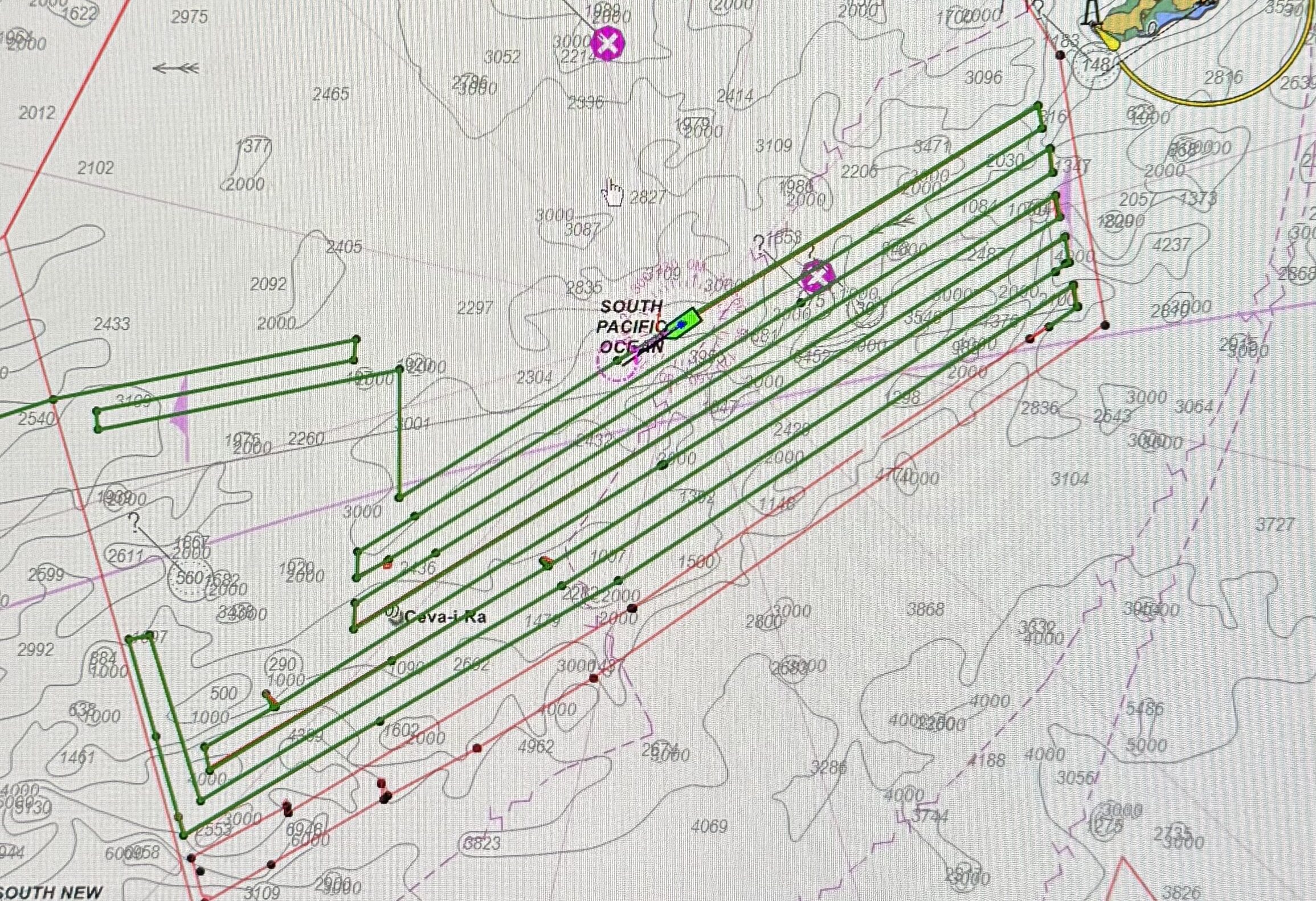
We’ve completed our first cluster of OBS deployments so we have a lot more downtime as we cruise back and forth along the North Fiji Basin collecting bathymetric data. The magnetometer has still been putting up trouble; a few days ago, the 300 meter winch towing the instrument failed so we had to pull it in by hand while we prepared for an OBS deployment (this was the second occasion of such a task). It was nice to supplement the exercise I’ve been getting in the ship’s gym. Using the rowing machine in swell kind of turns it into a roller coaster.

That pesky maggie!

In between deployments, we’ve been learning general technician skills from Liz and Andy. I’m happy to report that my time spent as a youth playing video games has given me some great background in learning the ins and outs of IT networking. I also got intimately acquainted with how to terminate an ethernet cable when I wired it wrong 3 times in a row. Beyond that we’ve also practiced soldering wires and configuring network switches. I love when the techs give us a task to complete and leave us to figure out how to get it done. Sometimes it takes me a lot longer than it should but I feel like I learn the best when I’m left to my own devices to solve a problem.

“Weird Al” Yankovic spoke of this in his 2006 RIAA Platinum certified hit “White & Nerdy”

In addition to our technical duties, we’ve also been joining the science party for daily science presentation, where we rotate through sharing ongoing or past science projects. It’s forced me to brush up on my tectonics and I now feel more confidant discussing subduction zones than I ever have before. I also got to refresh my own presentation skills as I discussed some of my past work. I tried to remember Shakespeare’s maxim, “brevity is the soul of wit” but I also do love to hold the floor. In all seriousness, it was great to practice speaking about my research experience to a scientific audience.

All in all, it’s been a great week with calmer seas and good weather. The seas are forecasted to come up from a storm blowing out of the Tasman Sea so I’m glad I’ve been taking advantage of sunsets on the aft deck—I’m not sure how many more of them I’ll get.

Can confirm I was listening to Pirates of the Caribbean soundtrack

Oh also, I made it onto the instagram! Cruise is a huge success.

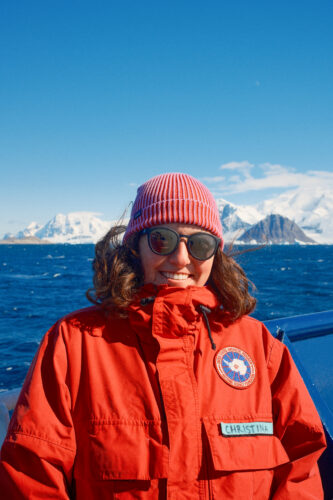
Introduction: Christina Rorres

Hello! My name is Christina and I am an intern on the upcoming Armstrong cruise from Woods Hole, MA to Reykjavik, Iceland. This cruise is primarily for the Overturning in the Subpolar North Atlantic Program (OSNAP), but there will be some work with Ocean Observatories Initiative (OOI).

I am taking a short break from my current position as a research assistant at WHOI to shadow and work alongside the marine techs onboard here. Over the past three years, I have sailed on various UNOLS vessels as a science member, so I’m excited to sail with and learn from the SSSG’s (Shipboard Scientific Services Group) over the next six weeks.

OBSessed

Another week down. This one was even calmer than the last, with only a few OBS deployments. The magnetometer continues to function as we “mow the lawn” southwest of Fiji, collecting bathymetric mapping data.

With the extra downtime, we’ve continued lessons and hands-on challenges to learn as much as possible from the onboard marine technicians. So far, that coursework has included networking challenges, cable management and termination, serial data communication, CTD setup, and a variety of other technical skills.

I presented some of my past research experience which was a fun opportunity to bring some physical oceanography and ecology topics to the onboard science team which largely consists of seismologists and geophysicists.

I am also learning an important lesson about the dangers of having auto updates enabled on a computer actively being used for data collection. Not only did we lose data during the update, but a driver had to be manually updated before we could resume data collection. Learn from our mistakes.

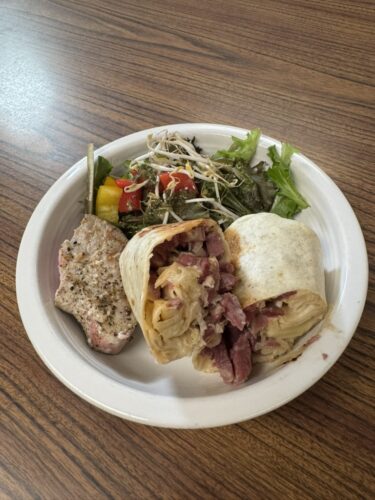
The menu onboard continues to impress. My favorite meal this week was a Rueben wrap, tuna steaks, and salad with Italian dressing.

The weather has been fantastic, with swell between two and five feet and many sunny days. I’m trying to enjoy the calm before the storm as we brace for a schedule packed full of deployments, larger swell, and rough weather in a few days.

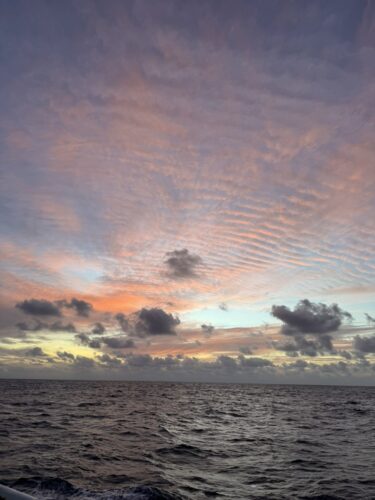
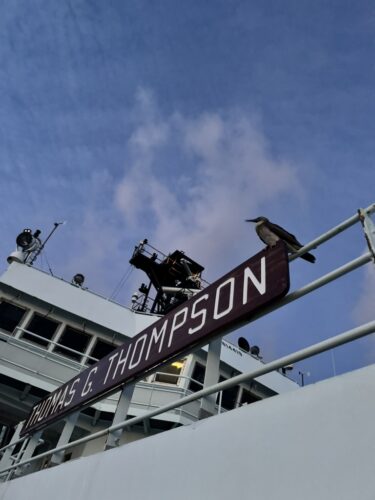
Please enjoy this amazing sunset, which included a visit from some red-footed boobies!

-Avery

Week 02 – Survey Central

This week on the Thompson we are finishing up the deployments of the first OBS array. After a final deployment Friday night, we are starting to head to the western array, taking a detour to map more of the seabed that is critical to answering this cruise’s research questions. 

The aftermath of deploying the magnetometer (Maggie affectionately) during a downpour

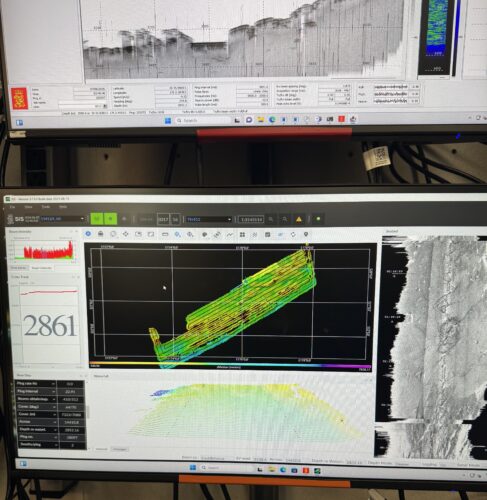
During these long stretches of multi beaming surveys, when deployments are on hold, we have more down time. Trying to take advantage of this time when we aren’t needed for operations, the marine technicians have been showing Avery, Benny, and me the components of being an at-sea technicians and the responsibilities they have during their 12 hour watches. 

Sunrise on the fantail. One of the perks of waking up at 0100

On the last few survey/transit days, we have been tackling all things networking and cables. Because of the central role that the ship’s server plays in all of the operations, networking has become a major component of the MarTech role. 

So far, Liz and Andy have gone over the basics of networking and how it is applied to the ship and their day to day activities. Once we have an overall concept of how things work, they give us tasks to apply what they taught us in scenarios similar to ones they would be responsible for troubleshooting. Andy started us out with a switchboard troubleshooting assignment where we had to reconfigure a switch and the setup of 2 laptops so that we were about to communicate with them through a management computer. Liz Then had us working with network cables starting out with terminating ethernet cables and splicing and soldering wires together. More recently, we had the task of taking an ethernet cable and terminating one end into a converted DB9 connector. 

Successful data stream from converted ethernet to DB9 cable activity

We have been very grateful to the technicians for going out of their way to introduce us to their jobs and keeping us busy, especially during these quiet survey periods. 

Bonus! A Booby impeded our Maggie deployment this morning. He was quite irked when we interrupted his feather cleaning

Page 1 of 2

Powered by WordPress & Theme by Anders Norén