11/12
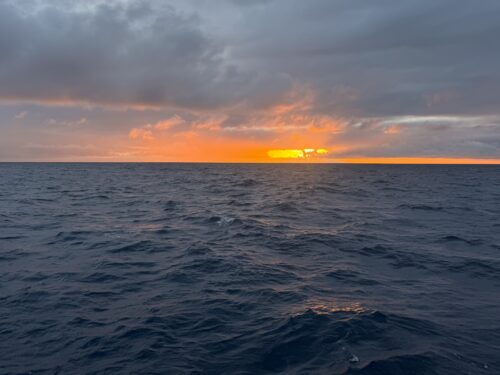
After steaming all night up to Martha’s Vineyard and stopping to do CTD casts the whole way, we arrived to a beautiful day dawning in the Vineyard. It was a rolly steam through the night, so as this was a day off the OOI site, many people (including me) rested and caught up on sleep.
11/13
After the storm passed, we steamed back to the site. I worked on odd jobs around the ship while the rough seas prevented the scientists from doing any work. In the main lab there are several power strips mounted which needed to be replaced with ones that the Navy approved, and down in the science storeroom there was a lot of organization of the cables and spare nickin bottles that was badly needed.


(I realize I dont always post a before and after to the organization I’m doing, but it’s just too many pictures, so just trust me when I say it looks a whole lot better)
In the afternoon Emily and I touched base on what I’ve learned so far that I’m feeling strong about, and what I would like to learn more of. In the next few weeks I would like to delve deeper into the computers that run all the ship’s various transducers and how they all interact with each other, as this is essential for understanding a huge portion of the tech work done onboard.
Later in the afternoon during a calm spell the science crew launched a small drifter off the stern. The little drifter is named “Lady Lance” and the original has already made the transit from the US to Ireland. Students at a local school have built a sister to the original boat, decorated it, and mounted a new GPS tracker to watch as the currents hopefully take the boat back across the Atlantic.

The evening hours were filled with more CTD casts, where the team and I running them were feeling good despite the rough conditions. This was only made better by the display of white-sided dolphins, who were feasting on a school of small fish right next to the ship. As we did our casts the dolphins put on quite a show! I ended up getting splashed from the waist down on one of the last casts of the night but I couldn’t feel very upset about it because of how amazing it was seeing the dolphins!

(the best picture I could get)
11/14
My schedule for this week has been a bit wonky, so lately I have been skipping breakfast and getting up for lunch. This morning however I heard a great commotion in the hall. I learned later this was a stow-away drill going on, and the crew and scientists were gleefully hunting down a single engineer who had been chosen to act as the ‘stow-away’.
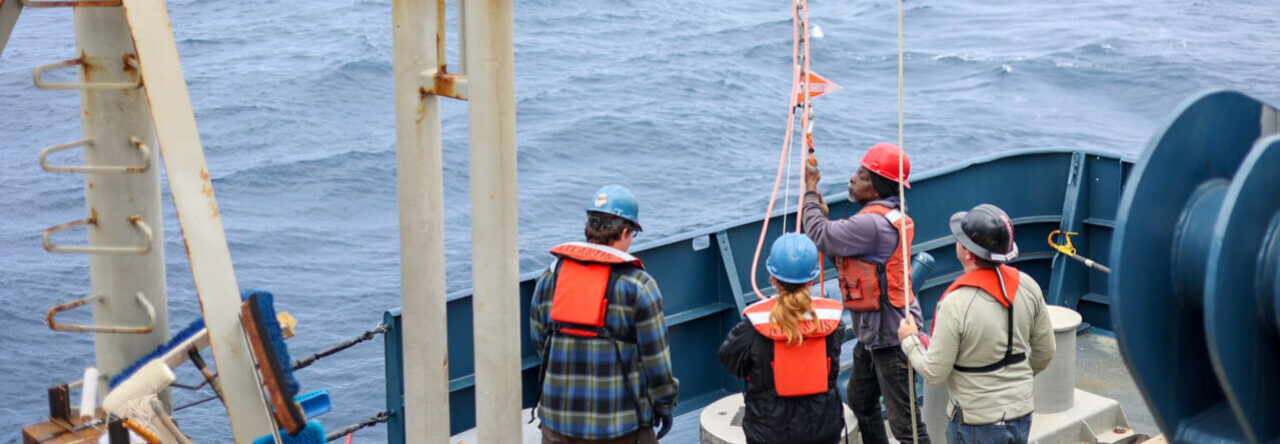
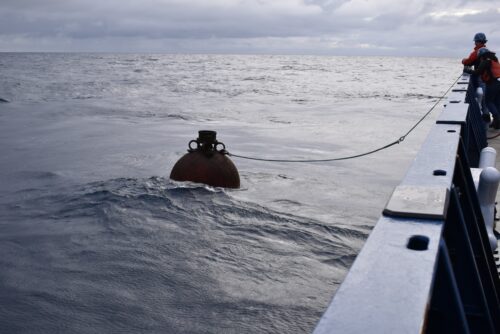
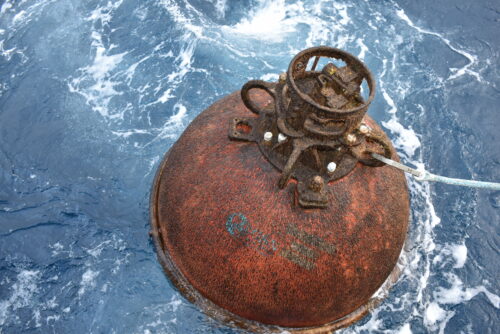
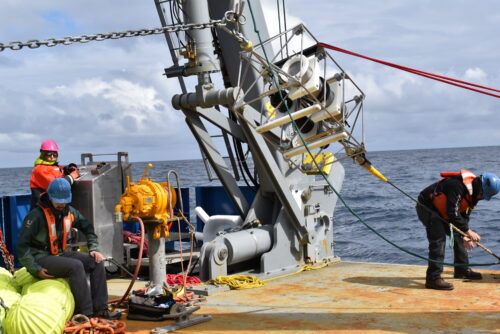
In the afternoon the scientists had scheduled another mooring recovery, and Emily and I geared up and headed out to watch the operation. The bosun was good enough to let me run the A-frame, which turned out to be uncomplicated, but very fun to operate. For this operation the scientists had brought their own winches, so all I was doing on the A-frame was raising the mooring on the pulley attached to the center of the A-frame and then lowering it on deck. Of course it’s never just the mooring, and we stayed through the whole operation collecting the subsurface flotation, profiler and anchor.
Speaking of anchors, the science crew was also gearing up today for the ROV operation to recover the anchor that was stuck, as the weather was only supposed to improve more. Sonia and I tested the Sonardyne nano transponders, of which the scientists have two, by charging them up and strapping them to the CTD, and sending them down with the cast. We lowered the USBL pole and were able to track them as they descended. This obviously is a good idea, as no one wants to deploy the ROV and not be able to track its position during the operation. All was well there and as we only had a few casts to do this evening, I turned my attention to other projects.
The ship is full of cameras to monitor the systems and machinery, and the camera in the transducer room had apparently not been working for a while, so I went down to check it out. I determined the camera wasn’t working because it wasn’t plugged in. But how to plug it in? The camera is mounted to the ceiling of the transducer room and the ceiling is perhaps 15 feet high… and I am very short comparatively. Even standing on the tallest transducer I am still lacking the height to work on the camera, more to come on this project as we figure out how to get up there.
To feel productive after I couldn’t make progress on the camera project, I spent a good chunk of the evening organizing the ‘random hardware’ drawer in the science storeroom. I sorted through all the bits and bolts, and now the drawer is ready for new dividers to keep everything organized and accessible. Now on an organizing streak, I waited for the main lab to clear out of scientists for the night and then organized the drawer of tools in there. This may all sound like typical intern work, but I actually appreciate it not only for the satisfaction, but also with how it forces me to be familiar with the layout of the ship.
At the end of the night Sonia gave me a run through of the Ksync system, which is just a computer program to sync multiple transducers to ping at intervals where they won’t interfere with each other. The main culprit here is the EK80, which is very susceptible to interference from other instruments, so much so that we ask the bridge to turn off some of their speed and wave tracking instruments while the EK80 survey is underway. The Ksync program will take control of all the instruments and time each to ping sequentially. This ensures the best quality of data from the EK80, which gives the most fascinating look at the water column! The scientists explained the data we were seeing was different water currents as they flowed near to each other, but different enough in temperature and salinity they weren’t mixing. It doesn’t hurt either that the data is shown in rainbow colors, so it’s very visually appealing.

11/15
I woke up for the big event of the trip, the ROV operation to recover the mooring anchor that was lost earlier when the recovery line broke. During the night we steamed in a rectangle for an ADCP survey, and then stayed on station above the last location of the anchor until time to launch the ROV after breakfast. We had a perfect day, with only 1.5 meter waves and calm winds. The techs don’t have a ton to do directly with this operation, but as usual they act in a support capacity, ensuring the video feeds from the ROV go to the correct places and the USBL pole is deployed so the Sonardyne Nano transponders can talk to the ship. Something that I didn’t know about this specific ROV is that it is made by Saab! The OOI group use it with another contraption called a ‘parking meter’ and each has a nano transponder so operators onboard can know the exact location of both. The parking meter is used as a spool for the line used to attach to the anchor, and also to take the tension off the ROV itself. The ROV then has about 25 meters of cable to explore, and if more exploration is necessary, once the ROV and parking meter are at depth the whole ship can move to let the ROV then drift into a better position.

The mission went well and the anchor was found close to the last known waypoint. It was amazing to watch the ROV go down to nearly 500 meters, through darkness and particles of organic matter and see the anchor sitting on the bottom! The ROV clipped on to the anchor, and despite protests from some crabs, made its way back to the surface for recovery. However when attempting to recover the anchor with the newly attached line, the clip came loose, and so we started the whole operation again in the afternoon. It seems those crabs were very fond of that anchor!

Funnily enough (but not for the ROV team) after finding the anchor again in the afternoon and clipping on, the same thing happened. It was a common joke that the crabs had been unclipping us because they made the anchor their home. Whatever the issue, we couldn’t stay on site anymore, and at 1900 we began our steam north back to WHOI. With the weather we no longer have two to three days in port for demobilization before leg two, now we are coming in for just shy of 24 hours and leaving again on Thursday.
11/16
The day began early, arriving at the dock around 0930 and immediately the deck crew began offloading the mooring equipment. The techs mostly stay out of the way of these deck operations except for the important task of connecting to shore internet! Emily then walked me through several of the end-cruise computer tasks like ensuring the data collected is copied to the correct places and everything is turned off and logged as so. As we did this a diver came and dove on a sea-chest where they will be installing a new transducer in a few weeks. The ship is not going to dry-dock, since it has a few spare sea-chests with no transducers installed, we can put this one in without having to pull the ship out of the water. The diver was investigating how difficult it would be to take the bolts off the plate covering the sea-chest, and after he was done we went down and exercised the seacock, which seemed to turn very well (we had expected the valve to be frozen and possibly immovable).
We took a field trip to shore to collect various parts and tools we ordered in the past week, and also a surprise! The new transducer that we will be installing was waiting for us! The transducer has been in a lab being tested, and has now finally come aboard to be mounted. The issue is the transducers need to be mounted below the ship’s hull, and obviously we cant do that without going to dry-dock. The solution to this is mounting the transducer on an elevator attached to the sea-chest. When everything is installed and working properly, the seacock can be opened and the transducer can be deployed down below the hull via the elevator, similar to how the USBL pole operates.
One of the tech gurus from shore then came aboard to demonstrate how we test the transducers for the various instruments. This is a long and frustrating process, as each instrument has multiple transducers for sending and receiving signals, and each must be plugged in and tested individually. The testing today was just an example of what we would eventually do to all of them, and after some issues were found with the computer connected to the transducer tester, we determined this was not a project for the limited hours we were in port between these legs, and moved on to other projects.
Emily and I then joined a meeting on zoom about this transducer we would be putting in. It was really good to finally put faces to names I’d been seeing in email chains! The meeting was mainly focused on the logistics of installing the transducer elevator, which is in the process of being machined out and will need to fit down a narrow shaft to the transducer room to be assembled. As you might imagine, the dimensions of the shaft and the weight of the parts are the major limiting factors, as well as the fact that the ship is still slated for a Navy INSURV inspection in early December. This means we can’t begin the installation project until the inspection is finished, shortening our install time window significantly. For me it will be an excellent opportunity to help the techs on a larger project that involves many aspects of WHOI personnel.
We saved the best project for last, testing the new workboat! This was a very essential project which for the techs, involved getting in the old workboat to provide a comparison to the new one. Safe to say, the new workboat has twin 120 hp outboards, while the old one has twin 60 hp outboards… I’ll let you guess which boat won!

(For those of you wondering, no they didnt let the intern drive the expensive, new workboat, not until the Captains got to test it out! Maybe next week in port!)
11/17
Our time of departure this morning was scheduled to be 0950, but the mates onboard the ship must perform Gear tests within 12 hours of coming into or leaving port. Today I was invited up to the bridge to run through the tests with our 2nd mate, Chris. The gear test just involves a full test of all maneuvering devices, from the engines to the thrusters, and a test of all the control stations on the bridge, of which there are three, center and each side station. He was able to explain some more of the ship’s systems, including the DP (dynamic positioning) system used to keep the ship in place within a few meters of a specified position. This means that the ship hardly ever has to anchor!
As we left the dock for this second leg of the OOI cruise, I finished washing all the plumbing for the transmissometer and PCO2 instruments, which will get gunked up after only a week or so of running. We are again running the stern diaphragm pump for the uncontaminated sea water as the scientists don’t want the creatures taken up by the pump to be in pieces.
My schedule for this week’s leg will be similar to last week’s leg, and I went down for a nap to wake up in time for dinner and the night’s first CTD casts. The casts for this week involve much more time, as these scientists are collecting massive amounts of water samples. We had about 90 minutes between stations, perfect chunks of time to work on this blog!
11/18
The first full day of this second leg opened with CTD casts early in the morning, thankfully there were enough scientists who got up which meant I didn’t have to. They also started mooring retrievals early so by the time I got up they were on their second retrieval of the day and had already had an anchor release malfunction. The weather for the coming week is looking windy and turbulent (spicy), which will make ROV operations difficult or impossible depending on the severity. This has caused a majority of the cruise to be left to day-by-day planning, and sometimes hour-by-hour changes. The scientists have set objectives, such as recovering all the small coastal profiler buoys and anchors, along with all their set CTD cast waypoints, and all of these events are now up in the air schedule-wise.
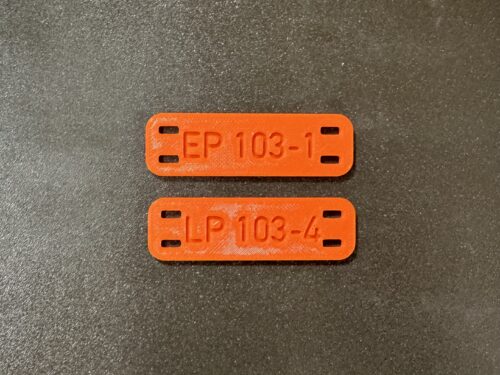
As we steamed out to a different station for more CTD casts and samples Emily set me to designing and printing my first part on the 3D printer. This has always been a fascination of mine and I’m so excited to start learning how to print things! My first lessons in 3D printing went something like these:

Errors in printing can come in many forms, starting with your design and ending with the printer itself, so mistakes are practically inevitable. I was attempting to make a small cover for a bolt on the CTD where a lanyard for one of the niskin bottles gets caught some of the time. The final version is printing as I get ready to post this blog, so you will be updated next week hopefully with the part in place!