Category: R/V Roger Revelle

Week 2: Seep Searching

Hello again, everyone!

It’s Norman again with my second and final update from the R/V Roger Revelle after two weeks at sea. Last time, I talked a lot about my work on preparing the AUV Sentry for its seafloor survey. This time, I’ll talk about how the data collected by Sentry has guided the ROV Jason’s dives as well as the work I’ve done after Sentry’s dive.

While underwater, Sentry collected multibeam data, which the Sentry team used to generate a bathymetric map of the topography in the area where Sentry completed its mission. Simply put, multibeam sensors emit sonar waves underwater and collect two pieces of data to generate the maps: the time it takes for the sound wave to return to the sensor, and the intensity of the sound at the time of its arrival at the sensor. The arrival time tells us how far away the seafloor is, and the intensity tells us about the seafloor material where the sound wave reflects back. Just so you can visualize this, here’s an image created using the ship’s multibeam sonar. The vertical, orange feature there is a seep.

By “sweeping” the seafloor with multibeam sound waves, Sentry generated maps of the seafloor and picked out the seafloor seeps we wanted to find. 

And seeps we did find! Sentry found signs of seeps at certain locations, and it was then up to the Jason team to send Jason down to those seeps and get a closer look at them. The Jason team’s operations astounded me. A few hours after watching Jason go into the ocean, I entered Jason’s control van and was reminded in many ways of a NASA mission control center. I loved looking at the seafloor through Jason’s cameras and watching the delicate movements of Jason’s robotic arms slowly but surely performing scientific experiments at the seafloor. The many aquatic animals that came to watch Jason work were fascinating in their own right. Finally, I was simply in awe watching scientists and engineers come together that night to learn something new about the ocean.

I enjoyed watching Sentry and Jason in action over the last week, though I am a little bummed I only got to see Sentry go into the water once. Regardless, the resulting spare time taught me a lot about all the important work that gets done even when Sentry isn’t in the water. Over the past week, I’ve cleaned out and refilled old oil containers, de-rusted multiple tools in the Sentry van, organized a bunch of components in Sentry’s van, and helped out with the end-of-cruise cleaning aboard the Revelle. I’ve also helped get seawater out of Sentry’s thrusters and prepare a spare sea bladder for Sentry for future cruises. Even when Sentry’s out of the water, there’s always some way to help ensure that future Sentry missions go as smoothly as possible.

I’ve had fun working on Sentry aboard the Revelle for the past two weeks! I learned a lot, and yet I feel like there’s still a lot I have to learn about marine field work. Hopefully, I’ll get to go out to sea and meet the wonderful people I met again one day. With that, this internship comes to an end.

Thanks for reading!

Norman

Week 1: The Human Orchestra

Greetings from the Gulf of Mexico, everyone!

It’s Norman from the R/V Roger Revelle with my first update. It’s been about a week since I first got on this ship, and I’ve already picked up a lot about life and work at sea. As a refresher, I’m working with the AUV Sentry team from Woods Hole Oceanographic Institution (WHOI). Both the AUV Sentry and ROV Jason teams from WHOI are here on the R/V Roger Revelle, and the two robots are working together to look at seafloor hydrothermal seeps in the Gulf of Mexico. The plan is to have Sentry survey the seafloor for seep locations within the area we’re interested in, then have Jason enter the fray and take a detailed look at the seeps we find.

A lot of my work so far has focused on getting Sentry prepared to take its underwater survey. So far, I’ve helped re-attach Sentry’s fins and propellers, attach various sensors and related components onto Sentry, and cleaned out some small O-rings to keep certain compartments watertight. I figured I would get to help maintain the robot at the start of the internship, but I was surprised by just how much work also goes into setting up the spaces needed to run Sentry. Alongside my work on the robot, I’ve helped run ethernet cables across the ship, secure tables and equipment down within lab spaces to keep the ship’s motion from tipping them over, and de-rusted, cleaned, and organized lots of the tools in Sentry’s work van.

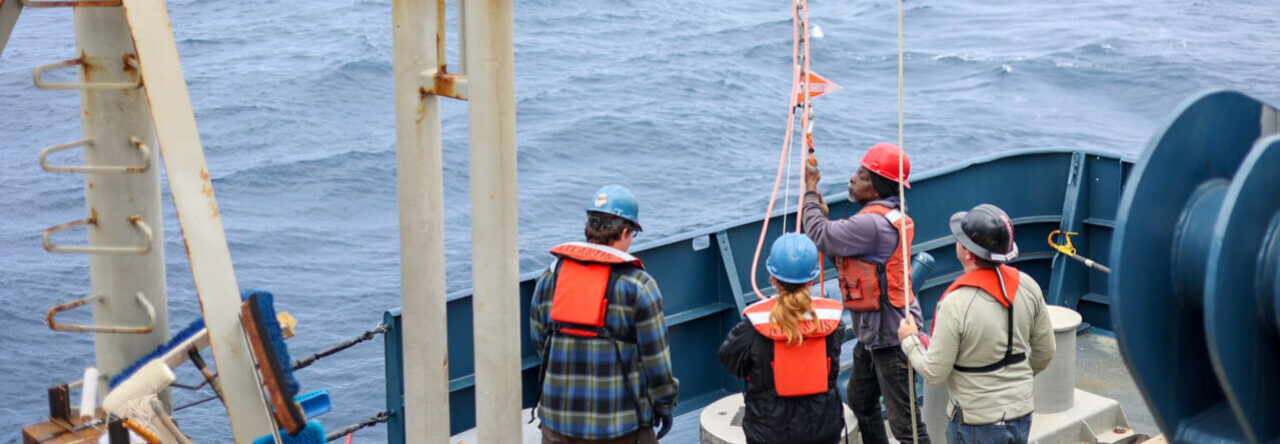
All of the Sentry team’s work has paid off. I felt exhilarated as I watched the Sentry and Jason teams work alongside the Revelle’s crew to get Sentry over the ship’s starboard side and into the ocean. I saw firsthand how the Sentry team watches over the robot as it performs its deep-sea mission, and I even did a mini-watch stand in the morning right before it was time to recover Sentry! The recovery process was just as exhilarating to watch as Sentry’s deployment. After a bit of math, we moved the Revelle to its recovery position at the perfect time. I then climbed up to the bridge to help lookout for the surfacing robot, and I rushed down to the deck soon afterwards to help get Sentry out of the water and back into its cradle. I’m happy to say that Sentry is safely secured and ready for some post-dive maintenance!

I’ve been impressed by a lot of stuff on this cruise so far, but nothing marvels me more than thinking about how many hands have come together to make a cruise like this one possible. I see the mass of electronics, wires, nuts, and bolts within Sentry and Jason and wonder how many hours of human effort went into making these behemoths work. I’ve watched the Revelle’s crew working and appreciate how their efforts got us out to and into the sea. Finally, I’ve thought about the scientists whose research gave us reason to go out into the Gulf of Mexico and look at hydrothermal seeps in the first place. It’s a gargantuan, concerted effort which in my mind I dub “the human orchestra.”

As we enter the second half of the cruise, I’m excited to watch Jason in action and to see what’s lurking around the bottom of the ocean through Jason’s eyes. Here’s hoping everything goes smoothly.

Thanks for reading!
Norman

Introduction – Norman Chung

Hi everyone!

My name is Norman Chung. I graduated from Caltech with a double major in mechanical engineering and geophysics last June, and I’m currently a first-year master’s student in Ocean and Resources Engineering at the University of Hawai’i at M?noa. I’m currently doing research in marine robotics, and I’ll be on the R/V Roger Revelle this May as a UNOLS-MATE intern working with the AUV Sentry team from Woods Hole Oceanographic Institution. Engineering and earth science are two topics near and dear to my heart, and I’m beyond excited to learn more about both topics while doing marine field work for the first time. In my free time, I enjoy cooking tasty food, doing Muay Thai, and spinning poi to music I like.

Stay tuned for my fun, little updates from the R/V Roger Revelle! 😀

Week Six: At the Dock

May 28, 2018

1530 local time

Happy Memorial Day!

It is a beautiful weekend, and I can’t think of a better place to be than sunny San Diego. The Revelle was back at the dock on Wednesday afternoon following a really short but eventful cruise. In the afternoon of our last full day at sea, the Jason engineers finally got the ROV in the water and took it all the way down to the seafloor some 4500 meters below. It was really cool to see them testing out the two arms on deck and running through all the various checks and “football float” attachments to the cable before the long descent.

After dinner, I went in the Jason control van and watched Jason land gently on the seafloor, kicking up plumes of sediment all around it. Multiple, high-definition camera displays allowed us to see the surrounding seafloor as the pilots white-balanced the 3D camera and used the arms to remove heavy, metal plates acting as ballast. During the dive, the engineers could also test the accuracy of the USBL to detect Jason’s position. It was really cool to be able to see the operation and to watch live feed from the deep ocean.

Since the Jason team were mostly operating independently, this left Matt and me free to prepare for upcoming cruises. I was able to update the inventory for the CTD, including all of the spare sensors and cables, as well as clean and defrost the science freezers in the various lab spaces. Had it been warmer out on deck, I would have suggested a snowball fight with all the frost I managed to scrape off.

Matt and I also terminated the 0.322 CTD cables for the Desh 5 and Cast 6 winches. Matt printed out the instructions for me to review, and it was really beneficial for me to work through a different procedure from that at WHOI, but still arrive at the same result, which is a successfully insulated and communicative connection between the deck box and CTD. I also got to use an automatic wire stripper for the first time and found myself wondering why anyone bothers with any other style. Instead of the Scotchcote mold used on the Armstrong, we made our soldered connections water tight by carefully wrapping a layer of vulcanizing tape and electrical tape, and then brushing on some Scotchcote compound. It made the process a lot quicker, so you can easily re-terminate if there are any problems during science operations.

After we arrived back in port, the first two days were incredibly busy. All of the Jason accessories needed to get packed away in various storage holds and two containers needed to be moved to the bow of the ship and secured. We also needed to bring on the CTD carousel and rosette and some huge equipment for coring operations on the upcoming cruise. I also got a chance to work with Kelsey on attaching two Niskin bottles to the frame of a multicore sampler in a way that would ensure the bottles are tripped when the multicore tubes are also triggered. This took some engineering on our part, especially as the bottles themselves weren’t even in working condition yet and had to have various replacements made. I think it will work, but we will see!

In addition to all of the equipment preparation, moving, and securing, they also had to move the Sproul from it’s docked position in order to make way for the Sally Ride. On Friday, they sailed her over and ended up side-tying her to the Revelle and running a power cable and gangway from the Sproul to the Revelle.

Overall, it was a very busy but rewarding week, and I am glad I got to assist in some of the preparation operations for the upcoming cruises. Next up for me is a quick trip out on the Sally Ride, leaving this upcoming Friday, supporting the NSF GEOPATHS initiative for hands-on training and research experience for students in geoscience. I am looking forward to assisting in the collection of sediment samples with the use of the multicore, and am also interested to catalogue the many similarities and differences between the Armstrong and the Ride as I have never sailed on sister ships before.

– Emily

Week Five: Hit Ground and Run

May 20, 2018

1830 local time

Hi there!

I am not sure about you, but I have had a very busy week. When I last wrote, the R/V Neil Armstrong was just a few hours away from tying up in Reykjavik. In the final hours, Amy and I finished up the termination on the CTD, secured the underway systems and echosounders, and started the data transfer process while the pilot climbed aboard and guided the ship in.

Joe met us once we went through the immigration process, and he and I tried our best to waterproof a security camera monitor for the gangway watch stander as there was no port security on this specific dock. Our delay getting in meant that he was not the only one waiting to board. We had a full science crew who started moving on almost immediately. Thankfully, I had already packed my duffel and moved it out of the way. After the rough seas we had all transit, it was a nice feeling to be on solid ground again. The crew celebrated the arrival that night and less than 24 hours later, I was on a flight to San Diego to board the R/V Roger Revelle and begin my time at Scripps.

The Shipboard Technical Support (STS) team at Scripps is a well-oiled machine headed by some very cool and seasoned people. Within the team are a Geophysical group, Oceanographic Data Facility group, Computer Technicians, and Resident Technicians. On the morning after I arrived, the staging area next to the dock was a hotbed of activity. This worked out for me, because I was able to jump right in and help the Geophysical group load vans with new equipment and gear and met a lot of the team members in the process.

Being closer to home also means that I am closer to some of my family. My dad is a UCSD alumnus and I was able to take him and my stepmother on a tour of the Revelle and give them a better understanding of what I hope to be doing for a career once the internship ends. Roger Revelle was a household name when I was growing up due to his innovative and influential work, so it was a real treat for my dad to set foot on the ship named in his honor.

This ship has an impressive history and she is incredibly active throughout the year. For the next few days, we are off the coast of San Diego to complete a series of engineering tests for the ROV Jason, in preparation for a packed summer of OOI cruises. Being a day late, I missed the mobilization of Jason and all his accessories. However, it has been pretty cool to watch the operations and assist when I can. So far, this has included setting up the ultra-short base line (USBL) system, which will help calculate Jason’s subsea position and required mounting and lowering a pipeline down a well that led straight from the deck to the ocean below. Thankfully, no bolts, tools, or cell phones were lost in this effort.

Jason has an amazing engineering team traveling aboard right now, so they do not need much assistance from the technicians. When we are not needed for operations, I have had the chance to familiarize myself with the ship and learn more about the responsibilities and skillsets of a resident technician from my new mentor Matt. I have had the chance to assist in crane operations and putting an asset over the side as well as an XBT launch – love those! On the Armstrong, a flow-through SSVS system provided sound velocity profile data to the EM122 multibeam. Here on the Revelle, the XBT probe profiles are uploaded for the EM122 to reference. The science team can request one launch per day and the portable laptop/deck box system the technicians created makes this a very simple operation.

Hopefully, the weather will improve and allow the Jason team to get their testing satisfactorily completed during the next couple days. Even though this is my only cruise on the Revelle, I think it is an exciting one, and I am looking forward to seeing Jason piloted through the water. My next post will be back in port during cruise preparations for R/Vs Roger Revelle, Sally Ride, and Robert Gordon Sproul – oh my! See you then.

 – Emily

Powered by WordPress & Theme by Anders Norén