May 28, 2018
1530 local time
Happy Memorial Day!
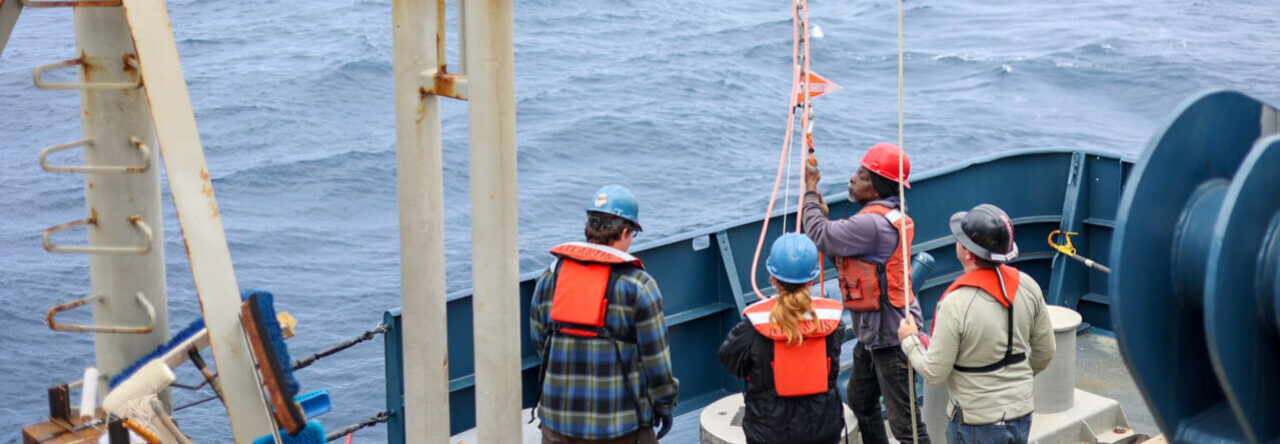
It is a beautiful weekend, and I can’t think of a better place to be than sunny San Diego. The Revelle was back at the dock on Wednesday afternoon following a really short but eventful cruise. In the afternoon of our last full day at sea, the Jason engineers finally got the ROV in the water and took it all the way down to the seafloor some 4500 meters below. It was really cool to see them testing out the two arms on deck and running through all the various checks and “football float” attachments to the cable before the long descent.

After dinner, I went in the Jason control van and watched Jason land gently on the seafloor, kicking up plumes of sediment all around it. Multiple, high-definition camera displays allowed us to see the surrounding seafloor as the pilots white-balanced the 3D camera and used the arms to remove heavy, metal plates acting as ballast. During the dive, the engineers could also test the accuracy of the USBL to detect Jason’s position. It was really cool to be able to see the operation and to watch live feed from the deep ocean.
Since the Jason team were mostly operating independently, this left Matt and me free to prepare for upcoming cruises. I was able to update the inventory for the CTD, including all of the spare sensors and cables, as well as clean and defrost the science freezers in the various lab spaces. Had it been warmer out on deck, I would have suggested a snowball fight with all the frost I managed to scrape off.
Matt and I also terminated the 0.322 CTD cables for the Desh 5 and Cast 6 winches. Matt printed out the instructions for me to review, and it was really beneficial for me to work through a different procedure from that at WHOI, but still arrive at the same result, which is a successfully insulated and communicative connection between the deck box and CTD. I also got to use an automatic wire stripper for the first time and found myself wondering why anyone bothers with any other style. Instead of the Scotchcote mold used on the Armstrong, we made our soldered connections water tight by carefully wrapping a layer of vulcanizing tape and electrical tape, and then brushing on some Scotchcote compound. It made the process a lot quicker, so you can easily re-terminate if there are any problems during science operations.

After we arrived back in port, the first two days were incredibly busy. All of the Jason accessories needed to get packed away in various storage holds and two containers needed to be moved to the bow of the ship and secured. We also needed to bring on the CTD carousel and rosette and some huge equipment for coring operations on the upcoming cruise. I also got a chance to work with Kelsey on attaching two Niskin bottles to the frame of a multicore sampler in a way that would ensure the bottles are tripped when the multicore tubes are also triggered. This took some engineering on our part, especially as the bottles themselves weren’t even in working condition yet and had to have various replacements made. I think it will work, but we will see!
In addition to all of the equipment preparation, moving, and securing, they also had to move the Sproul from it’s docked position in order to make way for the Sally Ride. On Friday, they sailed her over and ended up side-tying her to the Revelle and running a power cable and gangway from the Sproul to the Revelle.

Overall, it was a very busy but rewarding week, and I am glad I got to assist in some of the preparation operations for the upcoming cruises. Next up for me is a quick trip out on the Sally Ride, leaving this upcoming Friday, supporting the NSF GEOPATHS initiative for hands-on training and research experience for students in geoscience. I am looking forward to assisting in the collection of sediment samples with the use of the multicore, and am also interested to catalogue the many similarities and differences between the Armstrong and the Ride as I have never sailed on sister ships before.
– Emily