Category: University of Rhode Island, Graduate School of Oceanography Page 1 of 2

Week 2.5: Troubleshooting, acoustics, and… a shark attack?

Hi all, it has been a packed week and a half! Two days ago, we made a relatively unplanned stop in Boston Harbor after spending the previous week 400 miles offshore. The primary piece of equipment that the scientists are using to collect their data, an oil-filled acoustic array, THORA, went down a few days ago and they did not have the parts they needed to fix it onboard due to 4 packages that contained their troubleshooting equipment and spare parts being lost by the airline. We had to leave port without them at the beginning of the cruise due to time constraints, but they were found a few days ago. The Chief Scientist decided that getting the equipment onboard to fix the array was worth the two-day transit to pick it up, so we’ve spent the past 5 days primarily transiting from our study site to Boston and back. 

So far, we have done multiple CTD (conductivity, temperature, depth) and XBT (eXpendable BathyThermograph) deployments and a whole bunch of acoustic tow tracks. The acoustic array looks like a long, thick cable with a long, oil-filled tube attached to it that extends hundreds of feet in the water behind the ship. It listens for sounds in the surrounding water, including sound broadcasted from the R/V Roger Revelle, which has been operating acoustic research equipment in the area for the same project. The Revelle has been deploying an acoustic source, and the THORA array that we tow behind the ship has been listening for the sound emitted by the Revelle to understand how sound transmission through the water is affected by the Gulf Stream and the seamounts at our study site. CTDs and XBTs both give us a vertical profile of sound velocity in the ocean, since sound velocity is a factor of temperature and salinity. 

When I first came onboard the ship, I expressed interest in gaining experience in troubleshooting science systems. Well, I’ve definitely gotten my fair share of it over the last week and a half. The CTD was giving us data transmission errors on one of our winches for almost all of the first week, with some of the errors corrupting an entire upcast and others just being small blips in the data. So, myself and the two full-time marine techs, Bonny and Jason, have spent a significant amount of time troubleshooting the source of the errors. The current list of things we’ve done to troubleshoot is nearly in the double-digits, but the CTD is now working error-free on our second winch and we are planning on testing it on winch 1 again soon!

We are currently towing the acoustic array behind the ship and doing coordinated operations with the R/V Revelle and deploying XBTs about every hour along our track. Later today, we will put the SeaTrac, an autonomous boat, in the water to collect additional acoustic data from an array that it tows beneath it. In my downtime while on shift, I’ve mostly been reading manuals for the various shipboard science systems, learning more about the computer networking systems onboard, helping out with regular maintenance tasks like cleaning and organizing, and various other tasks given to me by my mentors.

TTYL!


Armored THORA cable after a suspected shark attack. The science team suspects that the stress inflected on the cable during the attack may have partially caused the system to go down a few days later. Photo credit: Johnathan Todd.
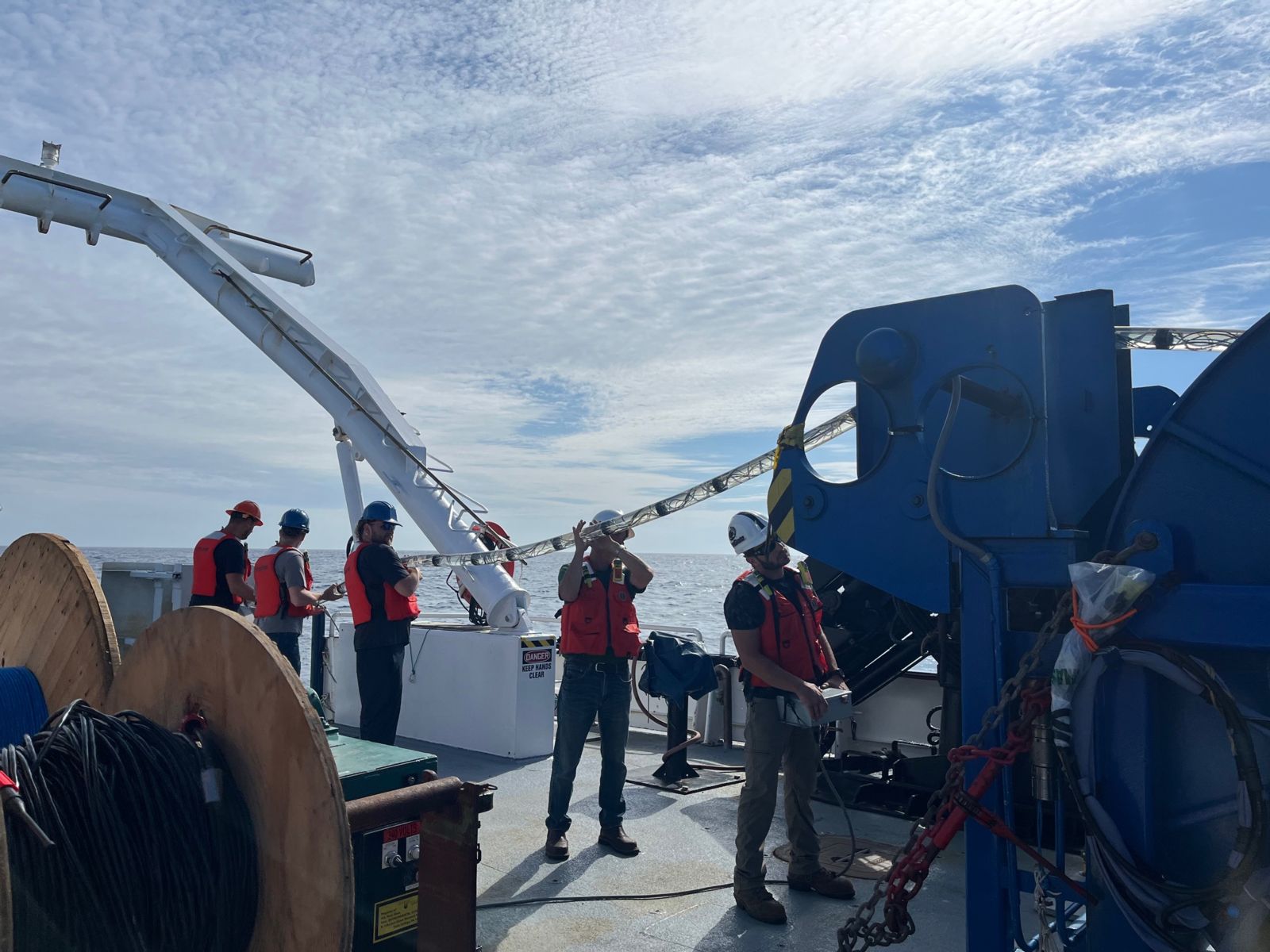
 

THORA acoustic array being deployed.
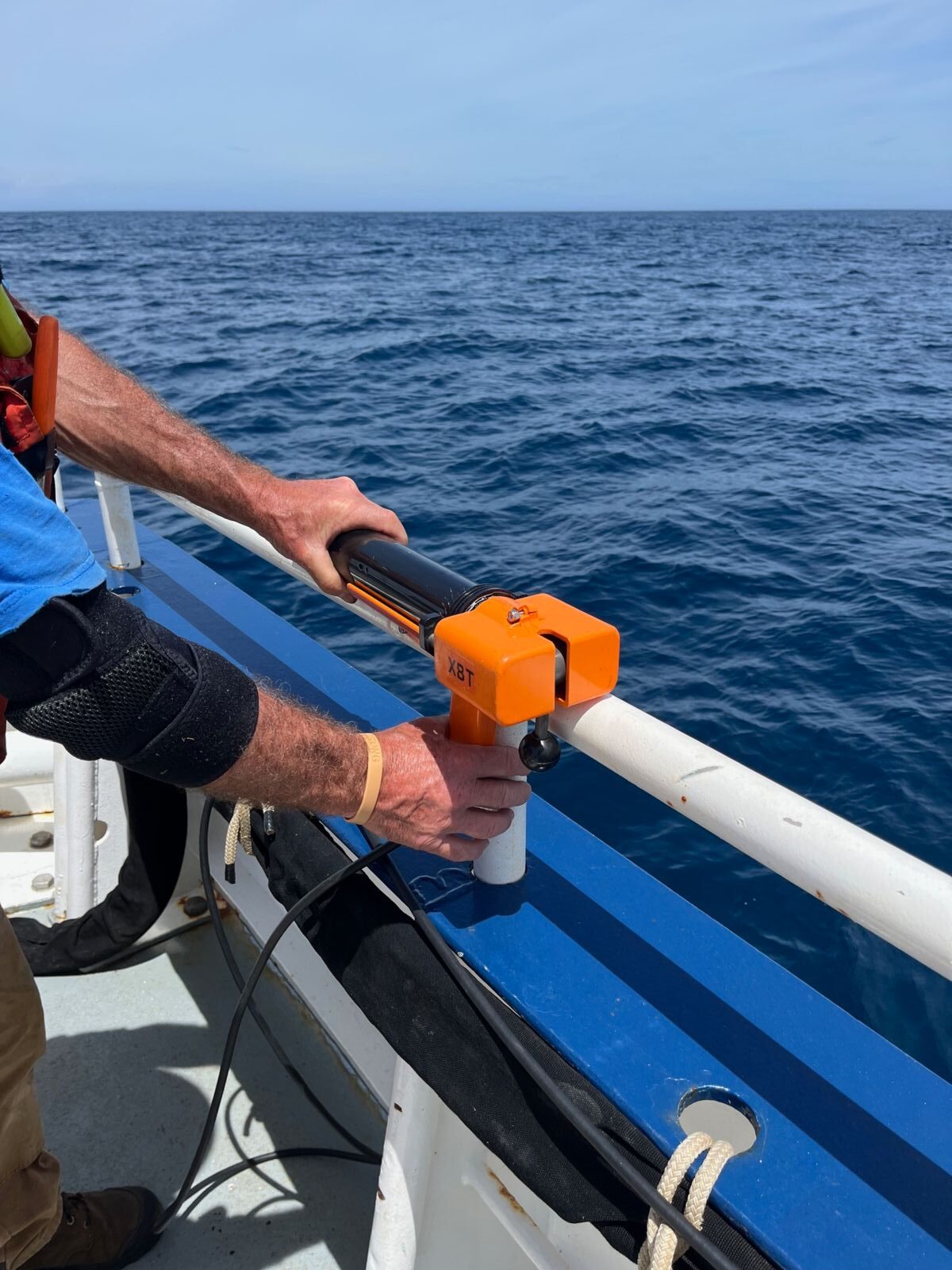
 

Bosun Oscar securing the XBT launcher to the rail.


Myself (left) and my mentor Bonny (right) re-terminating the CTD cable as part of our troubleshooting efforts.


Bonny deploying a CTD at sunset.

Week 1: In port + first two days of cruise EN719

We embarked on cruise EN719 aboard the R/V Endeavor yesterday morning at 10am! Currently, we are steaming towards our first study site, the Atlantis II Seamount Group, and testing some of the acoustic systems the scientists brought aboard. Since this cruise is studying underwater acoustics, we will be doing multiple CTD casts and XBT deployments to get a profile of sound velocity in the ocean, towing acoustic sources and receivers, and collecting passive acoustic data (listening for sounds in the ocean). The CTD is a profiling instrument that collects data on conductivity (salinity), temperature, depth, and often other data such as oxygen, pH, and turbidity. XBT stands for eXpendable BathyThermograph, and it is a single-use probe that measures temperature throughout the water column. 


This morning, we successfully tested one of the onboard winches and a towed acoustic receiver, and I performed some basic maintenance including changing the o-rings on two Niskin bottles and cleaning/changing the filters of the two -80 degree C freezers. The Endeavor has one flow-through system with two sensor packages, the SBE21 and SBE45, which take seawater from near the water’s surface (5m) and return real-time data on temperature, conductivity/salinity, and chlorophyll fluorescence. This afternoon, the salinity sensor on the SBE21 was measuring about 1 full PSU lower than the sensor on the SBE45, so we decided to clean the sensor to see if biological fouling was the cause of the problem. Surprise: it was! The offset was fixed once the system was cleaned and re-installed. After dinner, my mentor Bonny and I changed the CTD connection from winch 2 to winch 1 and did a deck test of the system to make sure everything was working the way it should be. 


For the week and a half before we left port, I spent the majority of my time getting situated on the ship, learning a bit about the systems and instruments I’ll be working with, and helping out with all of the various pre-cruise tasks. I arrived at the R/V Endeavor on Thursday, June 27th, and on my first full day of work, I got an introduction to the computers/displays for the underway flow-through system, CTD, CCTV cameras, navigation, ADCP, and the various network connections. The following week, I learned about how power is supplied to the labs and instruments, including the flow-through system, and how data is transferred from instruments to the databases and displays throughout the ship. I also got an introduction to the satellite internet systems on the ship. There are 4 different satellite internet systems on board, so there is a backup to the backup to the backup! Each one has a different speed and coverage, with the fastest being Starlink. We should be under Starlink coverage for the entire cruise (Yay!), which means that the internet is good enough to do video calls, if necessary. The second fastest satellite connection is called Sealink Plus, or the KU band, and its antenna lives in a big white dome on the 01 deck. Prior to embarking, we inspected the antenna and everything looked good!


Seas have been gentle so far, and I am excited to keep learning more!


Marine Technician and former MATE Intern Claire Mayorga (right) and me (left) inside the KU band antenna dome 07/03/2024

Leaving Narragansett Bay on 07/08/2024

Flow-through wall in the wet lab

Acoustic array being deployed 07/09/2024

Introduction: Josie Adams

Hi everyone! My name is Josie Adams. I am originally from Batavia, Illinois, and I graduated from the University of Washington, Seattle with a B.S. in Oceanography at the beginning of this month. I will be interning on the R/V Endeavor for the month of July and I am super excited to learn more about marine technology aboard research vessels. I have previously sailed on the R/V Rachel Carson, R/V Thomas G. Thompson, R/V Sikuliaq, and RVIB Nathaniel B. Palmer and I worked at the Argo Float Lab at the University of Washington for 3 years while earning my undergraduate degree. Watching and learning from the marine technicians and scientists I’ve met during my time at sea and at UW guided me towards wanting to be a marine technician for the academic research fleet, so I am very excited to continue the learning process aboard the R/V Endeavor!

In my free time, I enjoy volleyball, sewing, art, running, and being outdoors! I am super passionate about travel and hope to continue traveling throughout my career. Tune in for more updates!

Week 7: Saying Goodbye

Hi all! We returned to port about one week ago now. The last few days were filled with taking the rest of the science equipment down, packing everything up, and enjoying the last little bit of time at sea.

Taking the passive air sampler down (and missing the weather in the Tropics)     [Photo by Ben Geyman]

Nearly the entire research fleet is shut down for the next few months, so we also took a detour to check on the Coastal Pioneer Array. This is a complex array of surface moorings, gliders, and AUVs located on the continental slope south of Rhode Island that is part of the Ocean Observatories Initiative, a program involving collecting an incredible amount of data in arrays at sites of interest in order to observe processes and change. Three of the moorings had problems with either a wind turbine or antenna and we went to take pictures and see if we could determine any more about these problems.

One of the moorings. With two of most components and many backup systems, none of the failures were critical

Ultimately, two of the failures were easy to identify – the wind turbines were simply gone – but the third remains a mystery.

We landed the morning of April 1st and New England was kind enough to welcome us back with some classic April weather – cold, windy, and with some sleet.


Landing     [Photos by me and my mother, Celia Gelfman]

This has been an amazing adventure. I got to learn and do new things nearly every day from running CTD casts to finding a computer that could still run DOS to visiting the highest and lowest parts of the ship – the transducer well and the upper decks. And all of this on a moving platform where some days there is 10 meter heave (motion up and down from passing over a wave), 20 degree roll, and 40 knot winds to deal with and other days you are treated to dolphins, flying fish, squid, and strange creatures from the deep. The crew has been fantastic from the steward, Mike, and messman, Rick, who made three delicious meals for us plus cookies and cakes each day to the engineers who happily answered my million questions including whether they had thin copper pipe, shim stock, something to make an epoxy mold with, a 5” pipe wrench, or anything metric (yes to all but the last) to our awesome boson, ABs, mates, and captain. The scientists have been great to work with and learn from and Gabe has been an incredible mentor.

Returning home to this strange world of Zoom, masks, and bleaching your groceries has made me more grateful of my time at sea. There’s nothing like being trapped in a 50 foot across apartment to realize just how spacious 185 feet is.

 [Photo by Ben Geyman]

While my internship has unfortunately ended early due to COVID-19, I know that this is absolutely a field I would like to continue in and I can’t wait to get back out.

Stay safe out there and a big thank you to MATE for giving me this opportunity.


Week 6: Heading Home

Hi all! We are now just a day out from returning to port in Narragansett. This week has been a lot of packing up stuff, working on miscellaneous improvement tasks, helping the scientists with their ongoing sampling, and working on some small scripting projects in my extra time. One of the big projects early on this week was disassembling the entire multicorer and packing it all up in crates for storage.

That’s all that’s left!     [Photo by Gabe Matthias]

Besides that, we’ve been doing lots of cleaning, refinishing tables, and reorganizing, the tasks that have to be taken care of when there’s time between cruises.


Cleaning, organizing     [Photos by Gabe Matthias]

We’ve also definitely left the Tropics behind by now. While not quite the weather we’ll be returning to, it’s now in the 50s and rainy. Twice a day, the high volume air samplers get filter changes and I caught a couple of pictures over the past week that nicely show the difference:


Tropics vs New England in March     [Right Photo by Ben Geyman]

We also felt the edges of the Nor’easters that have hit New England in the past week. For us, this mostly meant waves up to about 25 feet which yielded pitch and roll up to 10-15 degrees and 10m heave at the stern (total motion up and down as the ship passes over a wave). Changing the air filters with that was particularly exciting.

The bow while we’re changing the filters up above the bridge


After five weeks at sea with the same 20 people, we’ve definitely seen some increase in cabin fever, or “cabin” as we prefer to call it. At this point, I know that Rhode Island, Ohio, and many other states have issued stay-at-home orders and a lot of you are probably feeling the same way, though the 185 feet we have may feel luxurious to some of you in your small apartments and homes. Anyway, some of my favorites from the last week include hot sauce ingredient readings at breakfast, searching for the biggest, baddest toaster money can buy, and sieving all our extra mud (we found mostly mud with a smattering of foraminifera and a couple possible worm casts).

We’ve been quite lucky aboard the Endeavor the past few weeks in what seems to be one of the safest spots on the planet at this time. Once we arrive in port, some of us will be headed to our homes in Rhode Island, and others to Massachusetts, Maine, and even Mexico (eventually on that one). As I mentioned last time, it’s been scary watching the news and how fast everything has been changing from out here and, while we would like to get home, it’s scary circumstances to be returning to.

Tomorrow we will land, unload, and head home. I’ll be sure to write an update about that and finishing up the cruise; lots more pictures to share too.

What’s up?

Week 5: Thinking Mud, Part II

Hi all! Since my last post, we saw the end of science for this cruise, a brief stop in Cabo Verde, and now we are heading back across the Atlantic. When I wrote my last post, things were just starting to look up for this cruise. As I mentioned, coring is notoriously difficult and this cruise was actually the repeat of one that happened about ten years ago in which they only had success getting cores at one site. So there was a lot of pressure this time around to do it right. We had a much larger corer than the last cruise and the Soutar as backup and that, along with the camera and some other tools were our efforts to see what was happening and get it right.

One of the things that makes coring so much harder than operating the CTD is that our communication with it is very limited. The CTD wire has electrical cables in it running all the way up to a deck box. During deployments, we are able to watch the data from the sensors appear on a computer screen real time and decide exactly when we want to trigger each Niskin bottle to capture water samples. So, we put it in the water then run inside and watch the data plots all the way down and back up. Occasionally, a Niskin bottle doesn’t seal right and we lose the sample, but most of the time there is very little tension when it comes back up, we already have the data. Operating the multicorer is completely different. There is no computer aboard the multicorer and we use a dumb wire, so once we lower it into the water, communication is extremely limited. All that we generally have is a pinger that we put on the wire 10m above the corer. The pinger pings each second at a specific frequency and we use our echosounder in a listening only mode to watch the time delay of each ping increase as the multicorer moves away from us. As we get close to the bottom, we also track the reflection of the pinger off the seafloor and the convergence of this and the original ping marks the corer reaching the bottom. That and change in tension are all that we have to judge what happens on the seafloor and after that we have to wait another two hours to see if we got any mud.

Tension runs high as we peer in to catch sight of the corer. Casts were at all hours of the day; this one came up around 2am     [Photo by Sam Katz]

Relief as we catch sight of mud, two casts later and during the day this time, but same idea     [Photo by Ben Geyman]

Last time I talked about the camera system that I worked on for the corer. That was very useful in seeing what went wrong, but every time the corer fails, we lose about 5 hours of time, so real time data is really what we need. To this end, I also worked on rigging up a pre-trip pinger system – a way to mount a second pinger onto the multicorer that only turns on once the multicorer trips. We didn’t finalize a good configuration for the second pinger on this trip, but have some methods and new ideas to test on future cruises with the multicorer.

Sometimes when the CTD or multicorer comes back up, it brings us additional presents from the deep. The other day, when the CTD appeared at the surface I caught sight of this strange thing tangled at the bottom of the cable.

Reminiscent of a jellyfish or sea cucumber, it turns out that this is a pyrosome, and only related to each of those as far as kingdom, which is to say not at all. In fact, they’re closely related to the tunicates that live on the underside of docks. In contrast to those, pyrosomes are free-floating and can grow to be many meters long. The pyrosome is actually a large colony with each little bump its own zooid. They’re also bioluminescent and in high enough numbers, can be seen glowing in the sea.

One other cool thing that we found in a mud sample is the following:

The photograph doesn’t do it justice, but this is nature’s fiber optic. It’s a spicule, or structural element, from a deep-ocean silica based sponge species, sometimes called a glass sponge. It has some amazing optical properties. It conducts light just as well as the fiber optic cables that our communications depend on and, in fact, possibly a little bit better due to the sodium content. Besides that, it’s extremely strong and flexible thanks to an inner protein layer. All that we have are the spicules, so we don’t know exactly what species they’re from but one similar species, Venus’ Flower Basket may use these optical properties to its advantage. The depths of the ocean are not exactly where you’d think that organisms would have adaptations to use light, but it turns out that Venus’ Flower Basket serve as the home to bioluminescent bacteria. They also house small shrimp and it seems that the optical properties of the sponge funnel light in such a way to attract small organisms that the shrimp eat. It’s a crazy adaptation for a crazy symbiotic relationship and a great example of the cool things that live deep in the ocean that we still know little or nothing about.

It has been scary watching the extremely fast progression of COVID-19 separated as we are on our ship. Since I last wrote, we watched as the various schools we come from – URI, Case Western, and Harvard – announced transitions to virtual learning, first for a few weeks and now for the whole semester. While we are safe on the ship, stopping in ports and getting scientists from places all over the world are now more dangerous things. Due to the risks, nearly the entire academic fleet will hold off on their operations until the situation improves. This decision was made near the end of our cruise and so we still had to go to port in Praia, Cabo Verde in order to get fuel and stores for the trip back. However, we stayed in quarantine in Praia to protect the ship and made an extremely quick turnaround of about 21 hours.

Praia looks like a beautiful place. I’d love to visit sometime.

One of the last planes before Cabo Verde shut its borders.

Now we are headed directly back to the Endeavor’s homeport at GSO instead of to Florida, where the next cruise would have begun. Those of you who have been following my blog from the beginning know that after my time on the Endeavor, the plan was to head to Bermuda. That is now on hold until the situation improves so just a couple more blogs for now and I’ll make sure to post an update if that changes.

These are strange times, stay safe and healthy out there.

Weeks 3&4: Thinking Mud

Hi all! It’s been a busy, busy week and a bit. Sorry for the irregular blog schedule, it turns out that 5° is not a great place for satellite internet coverage when crossing the Atlantic. Anyway, this week all the fun really began.  We left Bridgetown, Barbados the morning of Thursday the 27th for a three-day transit to our first station.

Bye Barbados! The last land we’ll see for 3 weeks

The main object of this cruise is to look at black carbon from biomass burning in Africa as well as heavy metals and PFAs in the atmosphere, water, and sediment. For the air sampling, the science party runs 4 high volume air samplers on the level above the bridge and one above that. For the water sampling, the scientists run filtrations all the time with our flow-through seawater system to look at water near the surface. These systems are always on while we’re in transit and are only shut off when it’s time to stop for a station to do deep water and sediment sampling. Over the course of the cruise, we’ll be stopping for between 10 and 12 stations. At each, we start with a CTD cast. On the way down, we get to see the profile of the water concerning temperature, salinity, oxygen content, fluorescence, and more. Then on the way back up, we trigger bottles to fill with water at depths of particular interest, like the maximum depth, maximum oxygen content, or right below the surface. At some stations, we’re just interested in the top 1000 meters of water, and at others we will do the CTD to full depth.

Directing a CTD cast. That’s me with the blue hard hat by the rail     [Photo by Sam Katz]

Following this, it is time for the main object of the cruise – to get mud. We have time to do up to 2 or 3 casts at each station using the MC800 multicorer or the Soutar box corer. The MC800 is a notoriously tricky piece of equipment. It has a large outer frame and a central portion that holds the core tubes. The outer frame will sit on the bottom while the central portion gets pushed down into the mud. Then as it pulls out of the mud, it triggers lids and feet to flip shut on all of the tubes and capture the sample. The problem is that sometimes it gets triggered too early by motion in the water column and sometimes it doesn’t get triggered at all. The Soutar is simpler in its triggering mechanism, but requires enough tuning that we keep it as the backup in case we’re having no luck with the MC800 and so far, we’ve only had to use it once when we failed to collect samples with the MC800 twice in a row (we didn’t have success with the Soutar either).

Setting up the MC800 multicorer. You can see the bottles, feet, and finicky triggering mechanisms     [Photo by Sam Katz]

The box corer getting it’s turn. That’s me on the A-Frame     [Photo by Sam Katz]

Lots of nerves in the room as the corer gets close to touching down     [Photo by Sam Katz]

One of the big projects that I’ve been working on so far is a small camera system called DEEPi developed at URI. A previous iteration of the camera had been tested to depths of around 1100 meters and during this cruise, we were hoping to test it at greater depths and use it to determine what was causing our multicorer to trigger early. During a 3300 meter cast at the second station, I put the camera on for the first time. That cast ended up going poorly with an early trip and no mud collected and the camera was able to show us just how early the mechanism tripped. At a depth of 3300 meters, the pressure is nearly 330 times more than what we experience and this turned out to be enough to kill the light that we used with the camera, but not the camera itself.


The DEEPi camera, the full system undergoing thermal testing, and all set up to watch the multicorer     [Center photo by Gabe Matthias]

A couple of additions to the list of things I wish the Endeavor has are LEDs and lots of clear epoxy, but I was able to harvest some LEDs from a flashlight and found a couple tubes of five-minute epoxy. That plus some resistors and a lovely duct seal sacrificed to form a mold yielded a light to let us continue testing. I had some trouble with the epoxy not hardening well and my attempt at a vacuum chamber went poorly. But, we decided to put it in and see what happens. Bubbles are a big problem at the depths we’re talking about, but I figured that it would yield good data even if it lasted for only the first few hundred meters.

Unfortunately, the DEEPi did not survive its second cast, to a depth of 4645 meters. It’s cause of death is from some combination of the super high pressure itself and possibly some water ingress, but it’s a bit hard to tell with everything buried in epoxy.

Despite the unfortunate foreshortening of its life, the camera was able to capture the bottom of the ocean. That’s the slightly browner smear near the bottom of the frame.


The light that died. The light that survived. The one on the left is not rated to 3300m and the one on the right is, surprisingly, okay at 4645m.


We are currently at Station 8 and have 4 more before reaching port around March 17. I’ll try to post another blog before then to talk a little more about the different things we’re up to and for now enjoy the stern at dusk.

Week 2: Barbados

Hello from Barbados! This past week has been a busy mix of finishing up the first transit, reaching Barbados, and preparing for the science on our upcoming cruise. Last Wednesday the 19th, we started to see some islands popping up through the mist. Saba was particularly striking with it’s clearly volcanic peak rising straight up out of the water.

With the warmer water and islands nearby, we also started to see many more birds, like the brown booby below. They were flying along with the boat and catching flying fish as they popped up. Flying fish are another thing I have not seen before and it is amazing how far they are able to propel themselves out of the water.

We could have reached Barbados on Thursday evening, but did not have berthing in the port till Friday so we hung out nearby and went in early Friday morning. After yellow fever shots for all, we cleared customs. In port, we have been following a schedule of working during the day and then spending our time in the evening exploring Barbados. Many things are easier to do when the boat is still, so we worked on a number of items that had gone on to the to do list during the transit.

Our upcoming cruise has a few scientific aims, but the main one is examining carbon content in the sediment. Ideally we will be using the MC800 multicorer in order to collect mud samples, but in case we have trouble, we also have a Soutar box corer. Whereas the MC800 can push up to 8 core tubes into the bottom at one time, the Soutar only has one square tube. Because of this, it has more force pushing the single tube into the ground so if the sediment is too hard for the MC800, the Soutar may still be able to push through. In order to get it functional just in case, we fixed and lubricated the release system and examined some rusty areas. While we are in port, we still do not have great access to everything we could need, so we sometimes have to come up with creative solutions. In this case, the problem was that petroleum-based lubricants could mess up the carbon being measured in the samples. The solution: Crisco.


Working on the core tubes and reassembling the CTD     [Photos by Gabe Matthias]

While we’re on the move, there are always some water measurements being taken. We have a flow-through system for seawater and measure temperature, conductivity (for salinity), and fluorescence (for an idea of phytoplankton in the water). Only when we’re in port will we shut off these sensors. We took advantage of their being off to clean the fluorometers and remove a PAR sensor (which measures light) that is no longer needed.

The Port of Bridgetown, Barbados is very large and has rapid turnover. There’s been an average of about 3 cruise ships arriving in port each day. Besides that, we’ve gotten to see a beautiful tall ship as well as a German research vessel, the Maria S. Merian. The Merian was right behind us and we got the chance to take a tour and talk to some of her crew. Their ship dwarfs ours at 311 feet as compared to our 185. While we have similar equipment, it was amazing how much bigger, more complex, and more modern her equipment was. For some comparison, their winch cable has a working load of 4 to 5 times ours. She’s headed on to Punta Arenas and then Antarctica for research involving clouds.

The Maria S. Merian

We were supposed to depart port for the next cruise on Monday, but again we ended up with a delay in the schedule.  This time the reason was a failing bearing on one of the generators. Sleeves were made to fit around the shaft (which had lost a significant amount of material) as well as around the bearing and the installation was just finished. If all goes well, we will be leaving Barbados tomorrow morning at 9am and the next time I write it’ll be from out at sea.

We got the chance to go for plenty of evening swims and enjoy the beaches of Barbados. We even saw the silhouettes of a couple turtles once the sun went down.

Week 1: Aboard the Endeavor and off to Barbados

Hi all! I can’t believe it has gone this quickly, but I have now been with the Endeavor for one full week. Last Monday, I met up with the R/V Endeavor at its homeport on Narragansett Bay in Rhode Island. I’ve spent a lot of time on Narragansett Bay in various boats and at the GSO campus where my mother works and I have gotten to see the Endeavor arriving, leaving, and in various states of mobilization and demobilization, but it was very cool to go aboard for the first time and it’s a special ship for my first time at sea. 

On arrival, I got to meet Gabe, the marine tech aboard the Endeavor who will be serving as my mentor. He gave me a tour of the ship and then I spent the rest of the day helping with various things on the to-do list before departure. Tuesday was the official mobilization day when the science team brings their equipment aboard and for me this meant more helping to load the ship and making sure everything got properly secured. I also got to do some work setting up the CTD, which will be one of the primary instruments we use at sea. This is one of the main instruments, or really package of instruments, of oceanographic research and measures conductivity, temperature, and depth of the water. Ours is a bit more complex and also features 12 Niskin bottles which take samples of water at different depths, a fluorometer to measure chlorophyll which gives information about phytoplankton in the water, and an altimeter for better depth measurements among other instruments. 

Our departure was scheduled for Wednesday, but things did not quite line up to make that happen. The ship has two antennas for two different internet systems and on Tuesday night, one of them went down. It turned out that a small belt responsible for connecting a positioning servo had broken and unfortunately there were no spares. Two vendors were found and two boxes of these belts raced our way, arriving Thursday morning. Installation went well and we were off Thursday around 12:30.

The R/V Endeavor leaving port at GSO     [Photo by Celia Gelfman, my mom]

The port at GSO leaving the R/V Endeavor     [Photo by me]

While I have spent plenty of time on smaller boats and have been out in the ocean a few times, this is my first time at sea for an extended period and my first time on a research vessel. Perhaps the sea is testing me but shortly after leaving port, we reached large swells that had the ship pitching significantly. By the next morning, the pitching was gone but since then we have been experiencing fairly sharp rolling of up to 15 degrees each way (enough that soup is a scary thing and extra precautions have to be taken to prevent falling out of bed). While my sea legs are not quite there yet, I think I do look less ridiculous trying to walk around then I did at first. 

At the moment we are in transit to Barbados where our scientific cruise will begin next Monday the 24th. On this leg, there is only a small amount of science happening, so I have had plenty of time to work on projects. My main one has been building a rack for the core samples that we will be collecting on that cruise. This is a simple machining project, but it has given me a taste of just how difficult things can be in a moving reference frame. It consists of a plastic back plate and a bunch of plastic struts through which bolts and pins fit for the cores to be locked into. Really all it required was a lot of positionally accurate holes. With a mill or a drill press this would usually be an easy project, but as I had learned, supposedly easy things like walking are not very easy on a ship, and so slightly less easy things like using a drill press become significantly less easy. With a 15 degree or so roll going on, the vise that I put on the drill press table quickly decided that it preferred the floor. After that, I got much better with clamps, but with so much relative motion between me and the drill press, it was still very hard to line things up to clamp them down and even the actual drilling was not made easy with my leaning around to keep my balance. I have never thought of drill presses as so exciting before.

Though completed, the rack will look pretty boring until it’s all mounted, so instead a picture of the multicorer that it will be used with. I’m painting over areas that had significant corrosion that we sanded down     [Photo by Gabe Matthias]

Another project that I helped Gabe with was redoing the terminations to the cables on the winches that will hold the CTD. The cables have wires around the outside with an electrical cable at their core and this means that the place at which the electrical cable separates out while the cable is attached must have a special termination for proper strength and waterproofing. The basic procedure entails unwrapping the cable and bending each of the wires back. Molten arconium is then poured in to seal everything up.

Undoing the cable for the termination     [Photo by Gabe Matthias]

That’s most of what I’ve been up to this past week. I’ve had an amazing time meeting the crew, learning how the different pieces of scientific equipment work, working on projects, and learning about the things that are a little harder at sea. We will pass the Tropic of Cancer within a few hours and will be in Barbados probably next Friday. I’ll be writing here on a weekly or so basis, so keep checking in to hear about the cool things I’m up to next!

-Lydia

Pre-Cruise Introduction

Hi all! My name is Lydia Sgouros and in just one, short week, I will be going aboard the R/V Endeavor for my first cruise as a MATE intern. I am from Rhode Island, currently attending Case Western Reserve University in Cleveland, Ohio, where I am a senior in Mechanical Engineering. Last year, some classmates and I started up an ROV team and competed in the MATE International ROV Competition with our robot, the Wobbegong. I loved the unique engineering challenges of the undersea environment and I look forward to learning more about these challenges and the special technologies used to collect data from the depths of the ocean over the next six months.

The Wobbegong    [Photo by ROV Team Captain, Rhys Hamlet]

The Endeavor’s homeport is at the University of Rhode Island Graduate School of Oceanography.  In the next couple days, I will drive home, finish packing, and prepare to go aboard. I will be sailing with the Endeavor until April at which point I will head to Bermuda where I will sail with the R/V Atlantic Explorer out of the Bermuda Institute of Ocean Sciences until mid-July. I will post a weekly blog here giving updates about my cool new experiences at sea.

Last year, on Lake Erie. Now to bigger seas!    [Photo by Kristina Collins]

Page 1 of 2

Powered by WordPress & Theme by Anders Norén