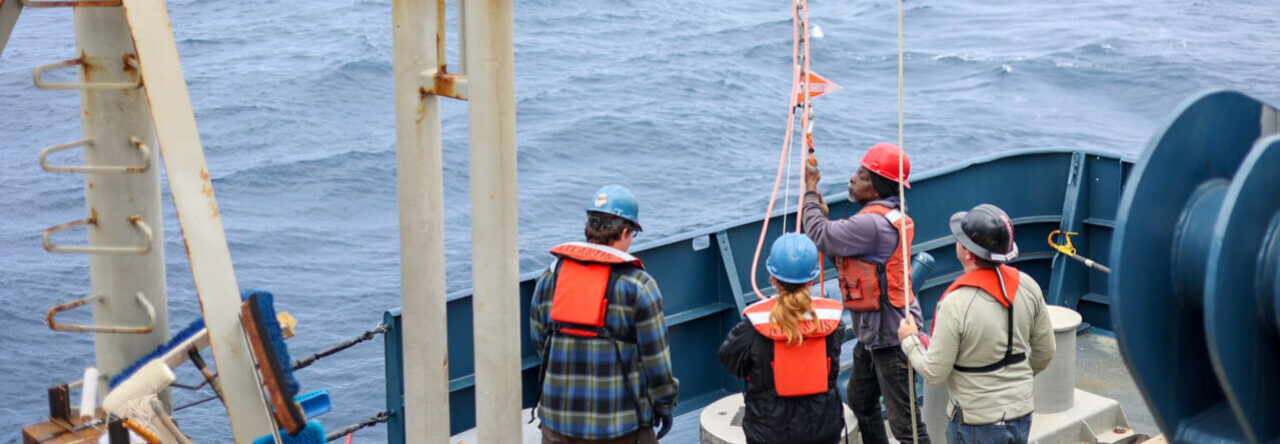
We embarked on cruise EN719 aboard the R/V Endeavor yesterday morning at 10am! Currently, we are steaming towards our first study site, the Atlantis II Seamount Group, and testing some of the acoustic systems the scientists brought aboard. Since this cruise is studying underwater acoustics, we will be doing multiple CTD casts and XBT deployments to get a profile of sound velocity in the ocean, towing acoustic sources and receivers, and collecting passive acoustic data (listening for sounds in the ocean). The CTD is a profiling instrument that collects data on conductivity (salinity), temperature, depth, and often other data such as oxygen, pH, and turbidity. XBT stands for eXpendable BathyThermograph, and it is a single-use probe that measures temperature throughout the water column.
This morning, we successfully tested one of the onboard winches and a towed acoustic receiver, and I performed some basic maintenance including changing the o-rings on two Niskin bottles and cleaning/changing the filters of the two -80 degree C freezers. The Endeavor has one flow-through system with two sensor packages, the SBE21 and SBE45, which take seawater from near the water’s surface (5m) and return real-time data on temperature, conductivity/salinity, and chlorophyll fluorescence. This afternoon, the salinity sensor on the SBE21 was measuring about 1 full PSU lower than the sensor on the SBE45, so we decided to clean the sensor to see if biological fouling was the cause of the problem. Surprise: it was! The offset was fixed once the system was cleaned and re-installed. After dinner, my mentor Bonny and I changed the CTD connection from winch 2 to winch 1 and did a deck test of the system to make sure everything was working the way it should be.
For the week and a half before we left port, I spent the majority of my time getting situated on the ship, learning a bit about the systems and instruments I’ll be working with, and helping out with all of the various pre-cruise tasks. I arrived at the R/V Endeavor on Thursday, June 27th, and on my first full day of work, I got an introduction to the computers/displays for the underway flow-through system, CTD, CCTV cameras, navigation, ADCP, and the various network connections. The following week, I learned about how power is supplied to the labs and instruments, including the flow-through system, and how data is transferred from instruments to the databases and displays throughout the ship. I also got an introduction to the satellite internet systems on the ship. There are 4 different satellite internet systems on board, so there is a backup to the backup to the backup! Each one has a different speed and coverage, with the fastest being Starlink. We should be under Starlink coverage for the entire cruise (Yay!), which means that the internet is good enough to do video calls, if necessary. The second fastest satellite connection is called Sealink Plus, or the KU band, and its antenna lives in a big white dome on the 01 deck. Prior to embarking, we inspected the antenna and everything looked good!
Seas have been gentle so far, and I am excited to keep learning more!

Marine Technician and former MATE Intern Claire Mayorga (right) and me (left) inside the KU band antenna dome 07/03/2024

Leaving Narragansett Bay on 07/08/2024

Flow-through wall in the wet lab

Acoustic array being deployed 07/09/2024