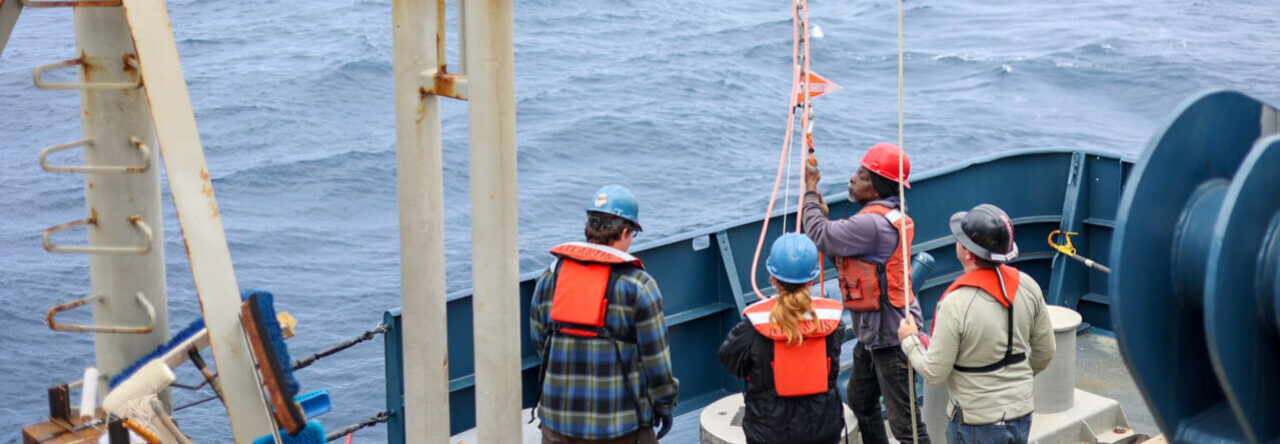
Last week was the last week of my internship and it was an absolute blast! We completed the last of our Alvin dives, saw some more dolphins, and I got to go in the small boat again. The small boat trips were probably the highlight of my internship since it was so remarkable to feel so small on such a large ocean.
We did miss one of our dives last week due to weather that was supposed to come in after 9 a.m. but only came in briefly to ruin the cookout that was planned that day. Funnily enough, that was also the day a whole bunch of things broke and the Electrical Technicians were working super hard on fixing Alvin. The rest of the dives went without issue though.
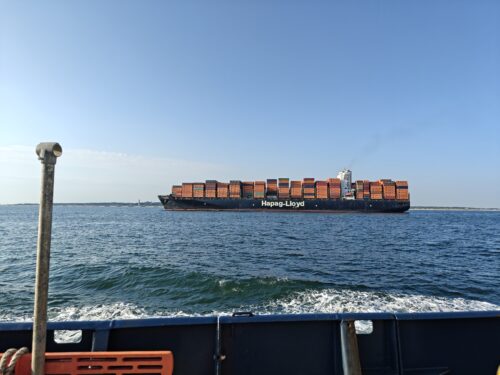
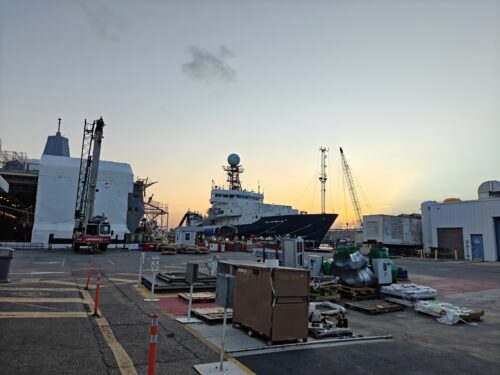
On the way into port, we passed by some gigantic container ships and the naval base again.
oplus_3145760
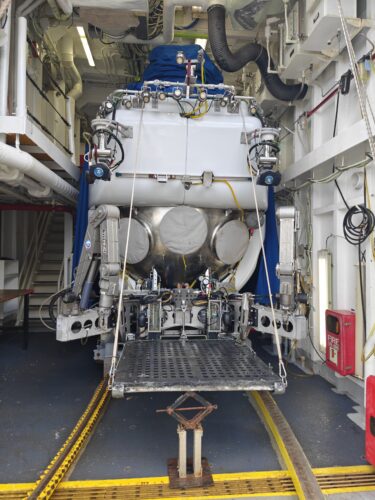
Once in port, the Alvin team and I had a lot of final work to do since this was the last Alvin cruise of the year. We had to take the motors off to send them back to WHOI, as well as clean up the Hydro lab, mech shop, and hangar. Everything had to be packed into boxes and then lifted off the ship with the onboard crane. It was a lot of work, but having a lot of hands made it easier and we were able to finish earlier than expected.
oplus_3145760oplus_3145728
Working with the Alvin team over the last few weeks has been a truly exceptional experience! I got to see and learn so much, as well as meet so many talented and unique people. This is definitely an internship I will never forget, and one I hope to come back to!
This past week has mostly followed the same routine of the week before. I’ve continued helping with pre and post-dive, as well as assisting during basket changes. Two days ago, a dive was cancelled due to weather, but conditions have improved and are looking good for the rest of the cruise.
oplus_3145760
Yesterday, after Alvin submerged, we had to build weight stacks again. Even with seven people helping, it still took us a long time. Doing the math, together we moved a total of about 4,500 lbs. of weight from the hold to the deck to build the stacks.
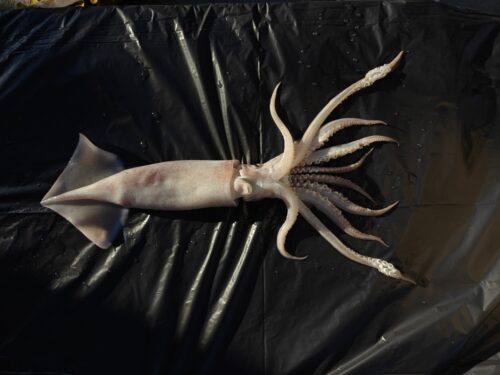
One of the more exciting experiences was watching Molly dissect a squid. Two squid had gotten stuck in Alvin during one of Molly’s dives and she wanted to save their beaks. It was fascinating to watch her cut open random organs and everyone trying to identify what was what.
oplus_3145728
Over the past few days, Bruce has been explaining the different systems of the sub to me, including the Variable Ballast System. Coincidentally, we ended up resetting the system later that same day because of a weight issue during a dive. Being able to watch the system being filled while receiving explanations from both Bruce and Nick, the mechanical lead, gave me a much better understanding of how it works and its role in Alvin’s operations.
The Atlantis left Norfolk last Saturday morning, and we have now been at sea for roughly one week. So far, it has been an incredible experience, and I have already learned a tremendous amount!
Before leaving port, the Alvin team and I had the opportunity to tour the USS New Jersey, a Virginia class nuclear submarine. Unfortunately, we were not allowed to take any photos, but it was one of the most impressive pieces of engineering I have ever seen.
While still in Norfolk, I was able to observe the mechanical team assembling two Alvin motors that had recently arrived from the shore-based engineering crew. They also showed me the oil compensation system and explained how it prevents electrical housings from collapsing under the immense pressure. Nick, the mechanical lead, gave me a tour of both Alvin and the Atlantis, and everyone on board was incredibly welcoming and eager to help me understand the vehicle and its systems.
oplus_137363488
As we departed port, we got to see a pod of dolphins following the ship. We also passed Naval Station Norfolk and saw several impressive Navy vessels, including the USS Nimitz and USS Harry S. Truman.
oplus_3145728
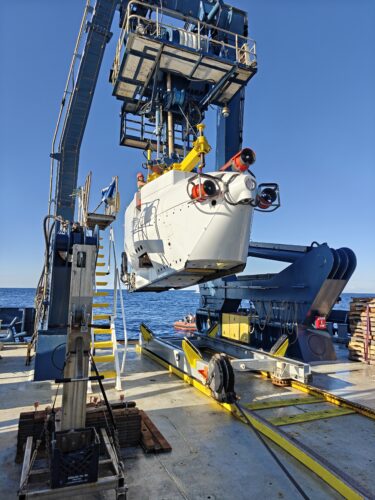
Since departing, I have spent most of my time assisting with Alvin launch and recovery operations. I’ve helped prepare the tool basket, clean the submarine, and load and unload equipment from the sub. Scott and Janna also taught me how to prepare, install, and remove the MISO cameras, so I have been helping with that every day as well.
A few days ago, I had the opportunity to ride in the small boat with Esteban during a launch. Being in the small boat really put into perspective just how far from shore we are. The experience felt surreal.
oplus_3145760
Molly has also been teaching me various sailor’s knots, and Catfish showed me how to handle the stern line during small boat deployments. It made me feel like a pirate.
Post recovery, I have started helping the science team assemble and set up push cores. It has been a good time to talk to various scientists and learn what they are doing and why. There is an artist onboard who has been making interpretative paintings of the science going on and I’ve been able talk to her about her work and how she is turning hardcore science into something palatable for a general audience.
oplus_3145760
Other than that, I’ve been hanging out in Top Lab with Nick, Bruce, and Kaitlyn since it’s quiet up there and has a nice view. It gives me the opportunity to ask them questions and learn more about everything that is going on.
The food is extremely tasty on board, and the crew have been watching old school Star Trek during meals, which has also been entertaining. The sunrises and sunsets are beautiful, and a few people have mentioned that the stars at night are really pretty, so I will go out tonight to take a look, and the results will be in next week’s blog, so come back for that.
My name is Aarav Shah and I am the UNOLS intern aboard the R/V Atlantis for the Joye Cruise! I am scheduled to be sailing out of Norfolk this Wednesday (8/26) to study methane seepage in the Atlantic with HOV Alvin for about 3 weeks.
I’m a rising sophomore at the University of Washington studying Electrical Engineering and have an interest in marine sciences and technology. At UW, I am part of the Underwater Remotely Operated Vehicle Team that competes in the MATE ROV competition which also grew my interest in underwater vehicles and research.
This will be my first time aboard a research vessel but I’m really looking forward to the experience and meeting everyone on board!
After a productive start to the cruise, the weather finally caught up with us early last week, so we stopped mooring operations. We continued with CTD casts for a while longer, but eventually the seas become too rough for those as well. We steamed away from the area and were able to avoid the worst of the storm.
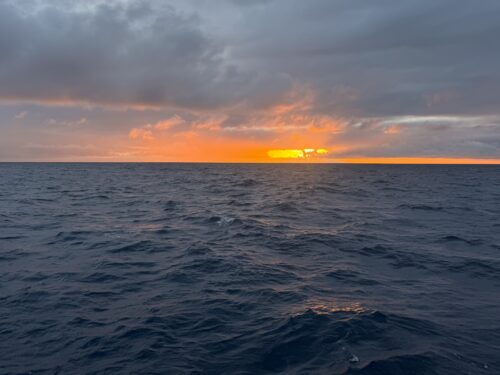
One final sunrise before the storm
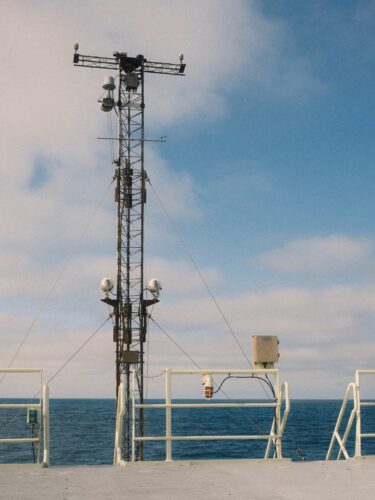
For the next few days, I kept busy with computer work and learning. I watched videos about various SeaBird sensors, started learning Python, and put together a poster advertising our 3D printing capabilities in case any of the scientists need parts. Emily also took some time to show me a few things around the ship. One day we exercised the HiPAP pole and gate valve to help prevent biological growth, and another day she walked me through the meteorological sensors on the mast (pictured below).
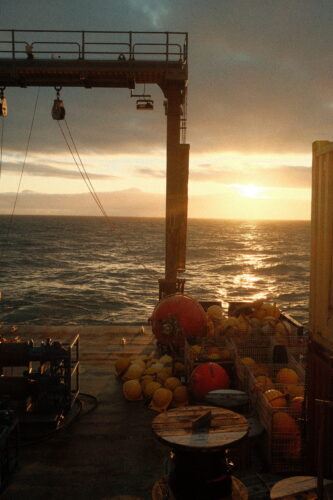
By Thursday evening, the weather had improved enough for us to resume CTD casts, and by Friday morning we were back to mooring operations. We still had two more NIOZ moorings to recover and redeploy, so I spent most of my time helping on the back deck. It’s been a great way to learn more about line handling and safety on deck. Once we wrapped up with the NIOZ moorings we moved onto the University of Miami moorings. It’s been interesting to see how each group builds and deploys their moorings since everyone has their own way of doing things. Just one more week at sea before we tie up in Reykjavik.
After a long transit we’ve finally started science operations. On our way north, we stopped a couple of times to deploy ARGO floats. Our typical schedule has consisted of CTD casts at night and mooring operations during the day. Following the first few CTD casts, we noticed that the conductivity values from one of the sensors were drifting quicker than normal, so we replaced it with a spare sensor.
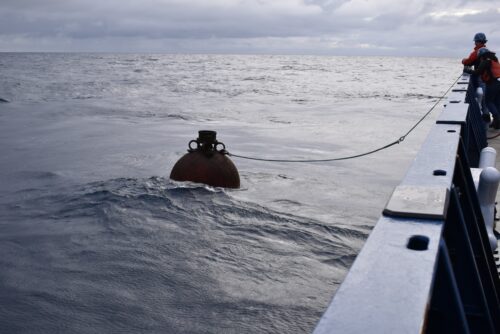
The first few days were spent recovering and redeploying two OOI moorings. Each recovery took place in two stages. We started by recovering the upper 500 meters of the mooring, a process that took about an hour. Shortly after, we deployed the new mooring, which was a multi-hour operation. Once the new mooring was in place, we returned to the original recovery site to retrieve the bottom portion of the previous mooring. During these operations, I had the opportunity to assist with both the A-frame and the winch.
Over the past couple of days, we also recovered and redeployed moorings for NIOZ (Royal Netherlands Institute for Sea Research). Compared to the OOI moorings, these operations have been a bit quicker since the wire is considerably shorter.
Aside from science operations, I also spent some time transferring files to the new backup data drive that I have been setting up. Once the files were copied over, I set up the automated tasks that will be used to run the required scripts if needed.
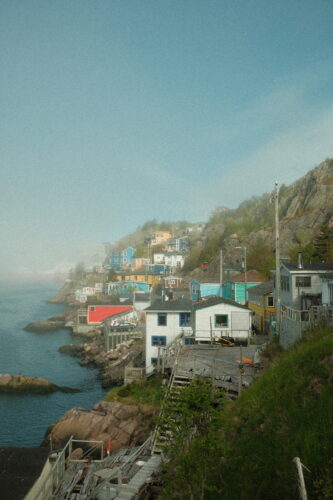
On Monday morning we docked in St. John’s Newfoundland, where we picked up the rest of the science party and crew. Many of us had never been there before so we spent some time exploring the city and hiking along the coast. We got lucky with great weather!
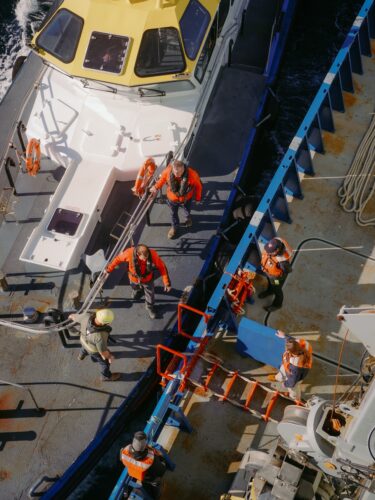
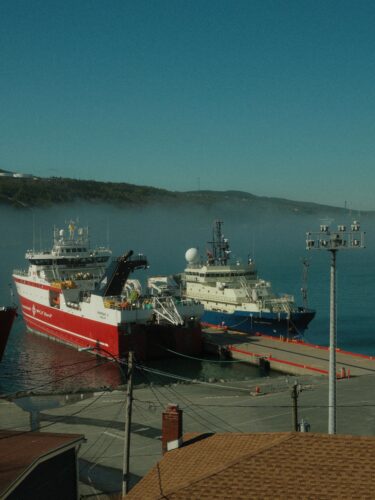
To the right is a photo of the pilots boarding the ship before we entered the harbor. Below are two photos from the trail, one of the Armstrong docked next to a Canadian fishing vessel and one of the neighborhood along the trail.
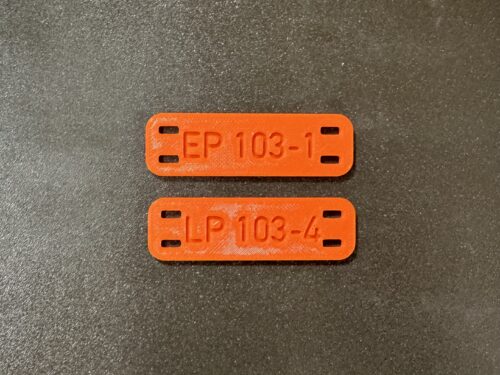
Once again, this week has been slow for science so I have been working on more small projects. When we left port on Wednesday, I relabeled many of the servers and computers on the ship with their new IP addresses that they were given recently. This task has definitely helped me become more familiar with these machines. I’m continuing to practice with the 3D modeling software and have been busy printing some identification tags that the engineers have requested (pictured below). Aside from those two projects, I’ve been spending much of the last few days going through interactive Linux tutorials on my laptop.
Although we have been transiting for most of the week, we stopped a few times on Wednesday to deploy RAFOS floats, which track the motion of the water in the ocean. We will hopefully get to our first CTD station off the east coast of Greenland by Tuesday!
We departed Woods Hole last Sunday and have been underway to St. John’s Newfoundland to load some more gear and pick up a few more people.
There hasn’t been much science going on so Emily has been giving me a small project most days. I spent the first couple days practicing 3D modeling and printing. There are two 3D printers on board, but when I first arrived one of the raspberry pi’s connected to the printer was broken. Emily tasked me with setting up a new pi, so now we can print from our laptops again and watch the process with the camera that is set up. Once I got that printer working again, we noticed the print quality from the other printer was pretty bad in comparison, so I’ve been troubleshooting that issue.
I also spent a day working on reformatting a server to install a new operating system. Everything about this was completely new to me so it took me a while to get things right. Later, I spent some time building the ethernet cable for this server. Eventually, we will set it up to be a backup data drive.
After a few days we stopped to do a test CTD and deploy the first mooring, both of which went smoothly. The mooring landed about 700m away from its target location, which seemed reasonable considering the 4000m of line and 5000m seafloor. I was able to help out running the A-Frame and winch as needed.
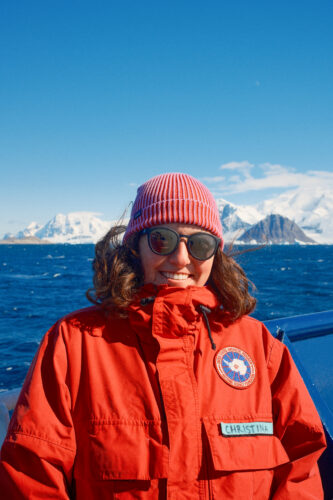
Hello! My name is Christina and I am an intern on the upcoming Armstrong cruise from Woods Hole, MA to Reykjavik, Iceland. This cruise is primarily for the Overturning in the Subpolar North Atlantic Program (OSNAP), but there will be some work with Ocean Observatories Initiative (OOI).
I am taking a short break from my current position as a research assistant at WHOI to shadow and work alongside the marine techs onboard here. Over the past three years, I have sailed on various UNOLS vessels as a science member, so I’m excited to sail with and learn from the SSSG’s (Shipboard Scientific Services Group) over the next six weeks.
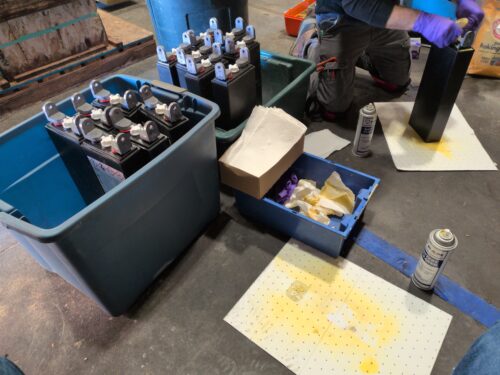
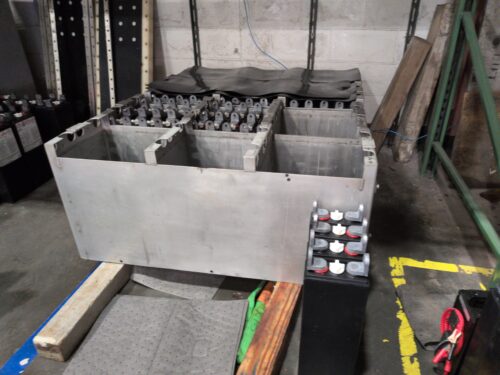
The main batteries were the centerpiece of this week. These are the large lead-acid battery packs that power Alvin during a dive, and it was time to replace the individual cells. Each battery is constructed of 60 cells in two trays, top and bottom, with two batteries installed at a time. Generally one is dedicated to powering port side equipment and one to starboard. Each cell is roughly 2 volts, for a total of 120 volts DC for the high power devices, stepped down by the power bottles to various lower voltages for everything else. There is a third battery and a consistent rotation of the three, so that while two are in service the third is going through regular preventative maintenance.
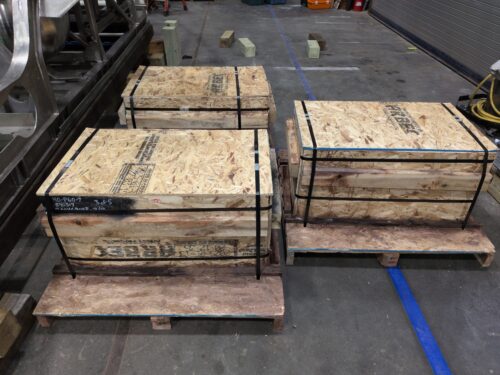
To cover replacing each cell across all three batteries, five pallets totaling 200 new cells were ordered, 60 cells per battery with 20 spares to cover the multiple years they will be in service, ensuring the cells will always be of the same construction and age. With each cell being of similar weight to a car battery, there was a lot of manual labor involved.
The first stretch of the week, Monday through Wednesday, was spent on the swap. The old cells were pulled from the trays a small quantity at a time while a similar amount of new ones were pulled from the shipping pallets and cleaned before installation. The used cells were stored back in the shipping pallets for later return, and the new cells were inserted into the trays.
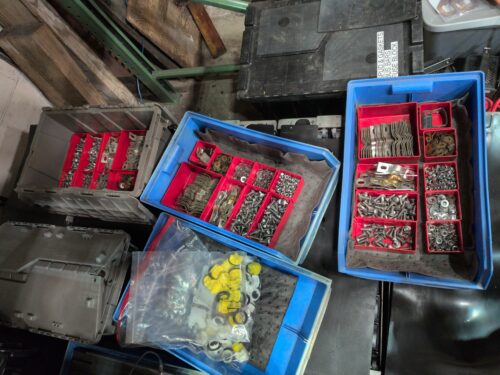
The new cells are a slightly different height than the old ones, which meant new spacer plates that sit beneath them and protect the cell bottoms needed to be fabricated to bring the terminals to the correct height. And in preparation for the future work of connecting all the cells together, the terminal connection hardware was cleaned with degreaser and run through the sonic cleaner, then sorted and set aside for later installation.
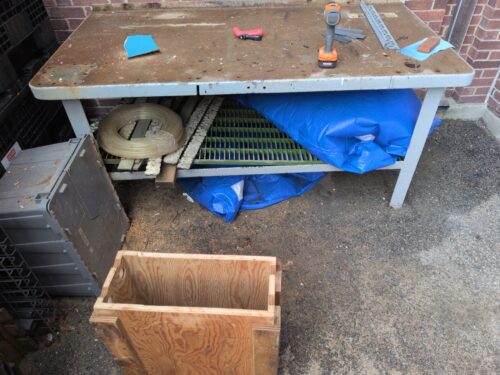
With the trays fully populated, Thursday shifted elsewhere. The spare cell storage boxes were modified to make it easier to store and remove spare cells. And work began on sealing up the pallets of old cells for shipment.
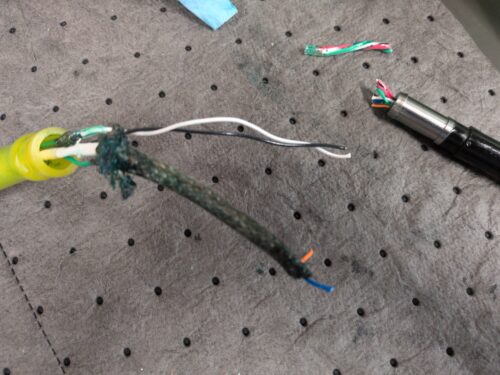
Friday was a mix of tasks. A pair of camera PBOF cables needed shortening to remove damaged sections, with the connectors replaced in the process. The rest of the day went toward finishing up the used cell pallets and getting them secured. Once sealed, the pallets were moved out to clear space in the shop for the following week, when a specialized metrology company was arriving to create a precision 3D scan of the sphere.
Week 17:
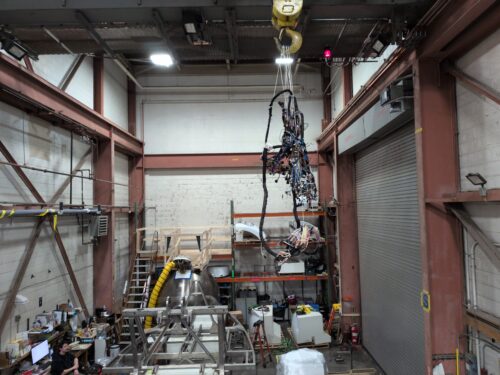
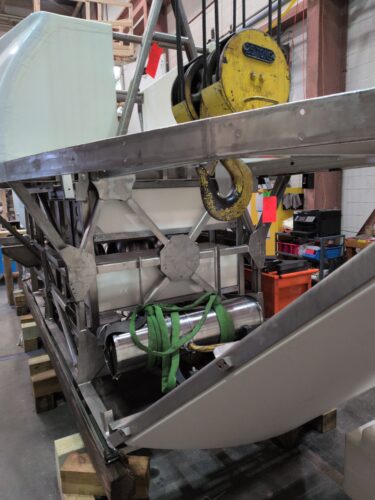
Monday started with installing the I&I bottle housings back into the forward section of the frame. And the sphere wiring harness was craned back to the sphere. Rick is leading the task of re-installing the equipment and harness into the sphere.
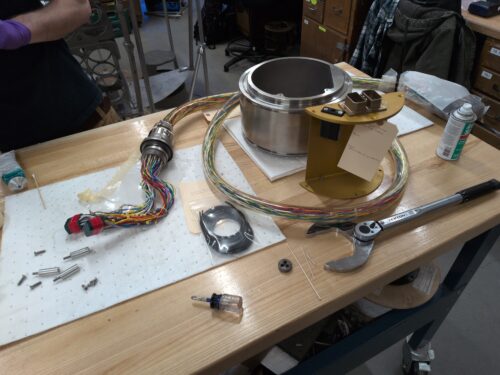
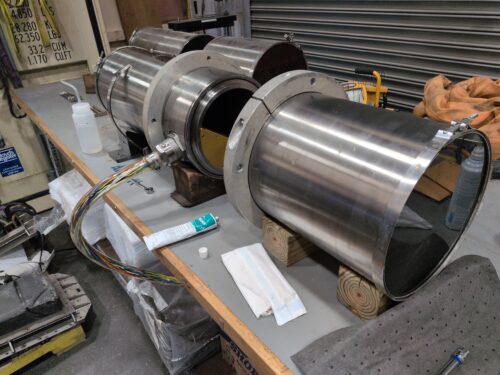
On Tuesday, some minor alterations were made to cables running to various junction boxes. And I joined Scott to begin reassembly of the power bottles. The power bottles consist of a high power side and a lower power side, joined by a middle ring that contains further connections.
Power bottle reassembly continued through Wednesday.
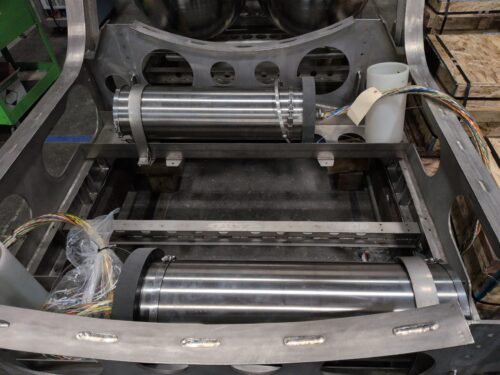
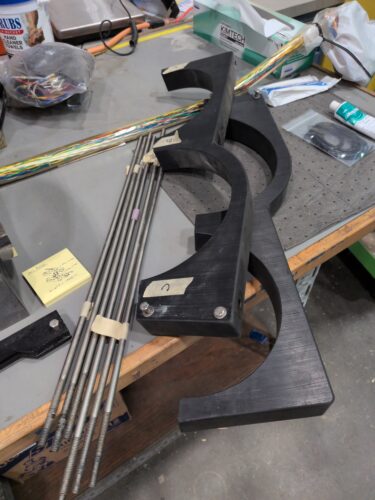
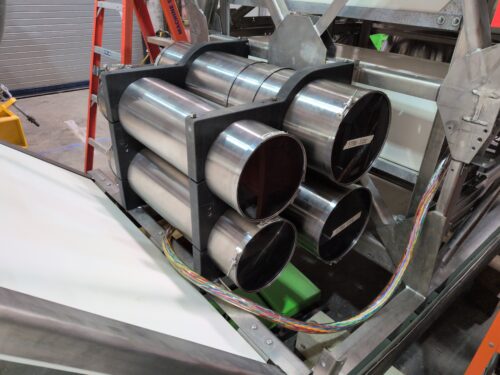
Thursday was spent on the re-installation of the aft bottle rack, which houses the power and data bottles. It needed a cleanup, and several holes were enlarged to better accept the threaded rod that bolts the rack assembly together.
The week wrapped up Friday with finishing the installation of the aft bottle rack and populating the power and data bottle housings into the frame.