Month: November 2022

Week 5: End of OOI and Happy Thanksgiving!

11/19

Morning operations were successful as the mooring group recovered the last small coastal profile buoy, with its accompanying sensors and anchor. They also recovered an anchor that was left behind from last week. The wind picked up to a constant 30 knots and our destination that day had us steaming into the waves and pounding down for most of the afternoon. This influx of bubbles under the hull is a very big problem to say the least, as it disrupts the ship’s array of transducers. Not only transducers though, the constant supply of sea water being pumped for the main lab supply and to run through some other instruments was heavily disrupted by all the slamming. Emily and I worked to troubleshoot the PCO2 sensor which seemed to have an array of issues stemming from the interruptions in flow. We initially thought we were successful by replacing a drip sensor that had become corroded, but the system kept emergency stopping itself and the drip sensor was not the biggest problem. 

The evening was taken up by a battery of CTD casts, where we would steam (pound) north for half an hour, and then go out on deck and launch the CTD while trying not to get pummeled by waves coming over the side. In between casts I emptied and organized the cabinet in the HIPAP area, which was suffering from poor labeling and the internal lights for the cabinet were low on charge, making it very difficult to find anything. Many (most) things in there were networking pieces of technology I had never seen before, so I did have to bring Sonia in several times for the game of, ‘what is this and do we need to keep it onboard?’ This cleaning also doubled as a purging of equipment in time for the INSURV inspection, where anything superfluous will be removed from the ship. In the end, I was very pleased with the results!

(Also here is the promised CTD bolt cover final print!)

11/20

    The weather remained the same but the CTD casts were done in daylight today, which gave you more light to see the waves crashing onto the deck! 

    The evening brought a break from CTDs, as the EK80 was turned on for a long transect survey. Meanwhile Sonia started me on a coding journey, first showing me some resources to learn the basics, then setting me up with a virtual computer to test out what I was learning. This was lovingly titled “Intern Playground”, and it’s a place for me to get comfortable with a system similar to the ship’s, while also being safe from killing any of the ship’s systems.

11/21

    The weather gave us a break for the ROV operations, but not before giving us another taste of a bumpy night. Everyone was extremely motivated to finish up though, and the first dive of the day brought up the anchor claimed by the crabs last week. 

    The SSSGs had many meetings concerning an upcoming cruise in December, new ideas for upgrading the email system for the WHOI ships, and the upcoming ADCP installation after INSURV. These meetings ended just in time for us to go back into the main lab and watch Chris snag the final stubborn anchor. This one had fired off it’s linepack, but it had snagged somewhere on the way to the surface, so he had extra line to avoid getting tangled in with the ROV. This final anchor meant the last of deck operations, and the ship turned north to head back home. There were a planned group of CTD casts along the way, but the weather had turned against our favor and by the middle of the night, CTD casts were called off.

11/22

    No one got much sleep as the ship rocked and rolled its way back to port. I was personally attacked by all the items on my desk, in my vanity when it swung open and emptied all contents, and my desk chair when they all went flying during various rolls. I did not, however, fall out of my top bunk, which is an accomplishment. 

    No sleep and a bumpy ride makes for a low-spirited crew, but everyone was bolstered by the fact that we accomplished all of the OOI array goals, picking up all of the equipment and doing many CTD casts and surveys along the way. We came into the dock at WHOI around 0900 and quickly the deck and science crew began unloading. 

    As with the last demobilization days, the SSSGs mainly stick to going through end_cruise  work, moving data to the correct places and shutting systems down. This involved the techs all together to figure out what was wrong with the PCO2 sensor. In the end it was a drip sensor that kept stopping the system, but because with all the air in the systems from the ride, the pressure differences caused spontaneous releases of sea water in weak places in the tubing system.  

    The end of the OOI cruise doesn’t mean an end to the work, as now we can fully turn our attention to the INSURV inspection. This meant for these days leading up to the holiday, zip ties were our best friend, as we have to secure all cable runs. This is just one of the many steps for the SSSGs before INSURV, and all other departments on board will be working through the next week and a half painting, cleaning and securing.

11/23

    Our first full day back on shore was a busy one as the demobilization efforts continued. All the moorings and associated equipment are removed, as none of it can stay for the inspection. Speaking of inspections, many different aspects of the ship need to be looked at, including the fume hoods in the lab spaces, and the hull itself, as we had snagged a lobster pot on our bow thruster on the way back. (No there weren’t any lobsters, we asked.) The divers also exercised the bolts on the sea chest plate. You may say this sounds like a lot of exercising for this project, but they take opening holes in the ship very seriously. For our purposes we aren’t opening a gaping hole to be exact, but the outside plate of the sea chest will need to be removed if we are to install a transducer on an elevator and don’t want to hear it go ‘bump’ on first deployment. 

    On the topic of the new ADCP transducer, one of the scientists on the team stopped by in the afternoon, and the techs met with her to discuss the install. For a few days the team had been emailing back and forth about an issue with the cable bend. After discussing many solutions over Zoom, this scientist who visited agreed that the cable bend was not ideal, but likely workable, as the instrument is only planned to be onboard the ship for a year of at-sea testing. For us this means we can continue with the installation plans, as again, we can’t start this project and have it unfinished during INSURV, so it must be started directly after.

11/24

    Happy Thanksgiving! I am fortunate to be spending the holiday weekend at home, and I hope everyone has a great holiday and eats lots of good food!

I did bring a small project home with me, modeling out two more small parts, one to cover a missing outlet (think a protector you have for a baby, but for a hollow outlet strip) and the end cap for those strips of outlets. I will update progress on the parts next week!

Week 4: Finishing OOI Leg 1, Jumping straight into Leg 2!

11/12

    After steaming all night up to Martha’s Vineyard and stopping to do CTD casts the whole way, we arrived to a beautiful day dawning in the Vineyard. It was a rolly steam through the night, so as this was a day off the OOI site, many people (including me) rested and caught up on sleep. 

11/13

    After the storm passed, we steamed back to the site. I worked on odd jobs around the ship while the rough seas prevented the scientists from doing any work. In the main lab there are several power strips mounted which needed to be replaced with ones that the Navy approved, and down in the science storeroom there was a lot of organization of the cables and spare nickin bottles that was badly needed.

(I realize I dont always post a before and after to the organization I’m doing, but it’s just too many pictures, so just trust me when I say it looks a whole lot better)

In the afternoon Emily and I touched base on what I’ve learned so far that I’m feeling strong about, and what I would like to learn more of. In the next few weeks I would like to delve deeper into the computers that run all the ship’s various transducers and how they all interact with each other, as this is essential for understanding a huge portion of the tech work done onboard. 

    Later in the afternoon during a calm spell the science crew launched a small drifter off the stern. The little drifter is named “Lady Lance” and the original has already made the transit from the US to Ireland. Students at a local school have built a sister to the original boat, decorated it, and mounted a new GPS tracker to watch as the currents hopefully take the boat back across the Atlantic.

The evening hours were filled with more CTD casts, where the team and I running them were feeling good despite the rough conditions. This was only made better by the display of white-sided dolphins, who were feasting on a school of small fish right next to the ship. As we did our casts the dolphins put on quite a show! I ended up getting splashed from the waist down on one of the last casts of the night but I couldn’t feel very upset about it because of how amazing it was seeing the dolphins!

(the best picture I could get)

11/14 

    My schedule for this week has been a bit wonky, so lately I have been skipping breakfast and getting up for lunch. This morning however I heard a great commotion in the hall. I learned later this was a stow-away drill going on, and the crew and scientists were gleefully hunting down a single engineer who had been chosen to act as the ‘stow-away’. 

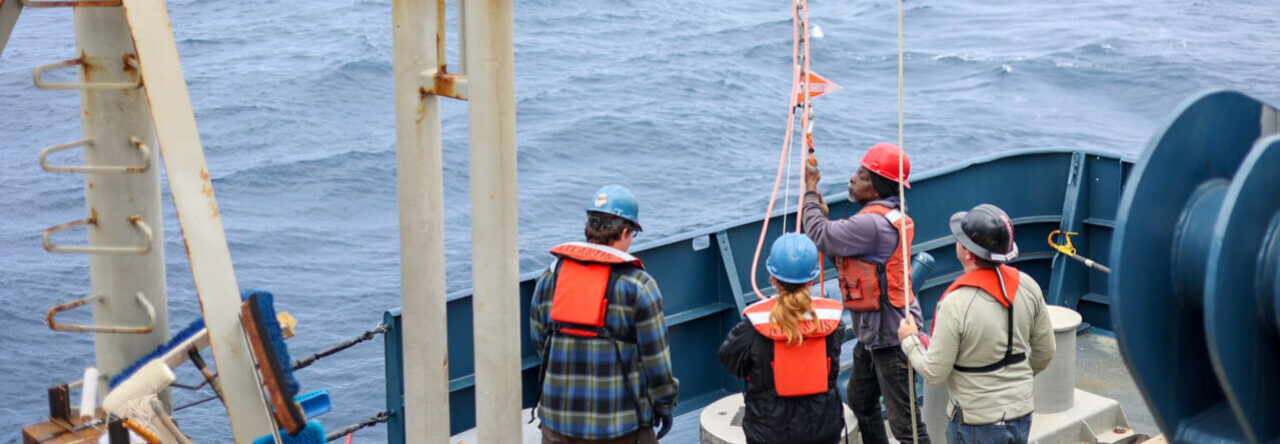
    In the afternoon the scientists had scheduled another mooring recovery, and Emily and I geared up and headed out to watch the operation. The bosun was good enough to let me run the A-frame, which turned out to be uncomplicated, but very fun to operate. For this operation the scientists had brought their own winches, so all I was doing on the A-frame was raising the mooring on the pulley attached to the center of the A-frame and then lowering it on deck. Of course it’s never just the mooring, and we stayed through the whole operation collecting the subsurface flotation, profiler and anchor. 

    Speaking of anchors, the science crew was also gearing up today for the ROV operation to recover the anchor that was stuck, as the weather was only supposed to improve more. Sonia and I tested the Sonardyne nano transponders, of which the scientists have two, by charging them up and strapping them to the CTD, and sending them down with the cast. We lowered the USBL pole and were able to track them as they descended. This obviously is a good idea, as no one wants to deploy the ROV and not be able to track its position during the operation. All was well there and as we only had a few casts to do this evening, I turned my attention to other projects. 

    The ship is full of cameras to monitor the systems and machinery, and the camera in the transducer room had apparently not been working for a while, so I went down to check it out. I determined the camera wasn’t working because it wasn’t plugged in. But how to plug it in? The camera is mounted to the ceiling of the transducer room and the ceiling is perhaps 15 feet high… and I am very short comparatively. Even standing on the tallest transducer I am still lacking the height to work on the camera, more to come on this project as we figure out how to get up there. 

    To feel productive after I couldn’t make progress on the camera project, I spent a good chunk of the evening organizing the ‘random hardware’ drawer in the science storeroom. I sorted through all the bits and bolts, and now the drawer is ready for new dividers to keep everything organized and accessible. Now on an organizing streak, I waited for the main lab to clear out of scientists for the night and then organized the drawer of tools in there. This may all sound like typical intern work, but I actually appreciate it not only for the satisfaction, but also with how it forces me to be familiar with the layout of the ship. 

    At the end of the night Sonia gave me a run through of the Ksync system, which is just a computer program to sync multiple transducers to ping at intervals where they won’t interfere with each other. The main culprit here is the EK80, which is very susceptible to interference from other instruments, so much so that we ask the bridge to turn off some of their speed and wave tracking instruments while the EK80 survey is underway. The Ksync program will take control of all the instruments and time each to ping sequentially. This ensures the best quality of data from the EK80, which gives the most fascinating look at the water column! The scientists explained the data we were seeing was different water currents as they flowed near to each other, but different enough in temperature and salinity they weren’t mixing. It doesn’t hurt either that the data is shown in rainbow colors, so it’s very visually appealing.

11/15

    I woke up for the big event of the trip, the ROV operation to recover the mooring anchor that was lost earlier when the recovery line broke. During the night we steamed in a rectangle for an ADCP survey, and then stayed on station above the last location of the anchor until time to launch the ROV after breakfast. We had a perfect day, with only 1.5 meter waves and calm winds. The techs don’t have a ton to do directly with this operation, but as usual they act in a support capacity, ensuring the video feeds from the ROV go to the correct places and the USBL pole is deployed so the Sonardyne Nano transponders can talk to the ship. Something that I didn’t know about this specific ROV is that it is made by Saab! The OOI group use it with another contraption called a ‘parking meter’ and each has a nano transponder so operators onboard can know the exact location of both. The parking meter is used as a spool for the line used to attach to the anchor, and also to take the tension off the ROV itself. The ROV then has about 25 meters of cable to explore, and if more exploration is necessary, once the ROV and parking meter are at depth the whole ship can move to let the ROV then drift into a better position. 

    The mission went well and the anchor was found close to the last known waypoint. It was amazing to watch the ROV go down to nearly 500 meters, through darkness and particles of organic matter and see the anchor sitting on the bottom! The ROV clipped on to the anchor, and despite protests from some crabs, made its way back to the surface for recovery. However when attempting to recover the anchor with the newly attached line, the clip came loose, and so we started the whole operation again in the afternoon. It seems those crabs were very fond of that anchor!

    Funnily enough (but not for the ROV team) after finding the anchor again in the afternoon and clipping on, the same thing happened. It was a common joke that the crabs had been unclipping us because they made the anchor their home. Whatever the issue, we couldn’t stay on site anymore, and at 1900 we began our steam north back to WHOI. With the weather we no longer have two to three days in port for demobilization before leg two, now we are coming in for just shy of 24 hours and leaving again on Thursday. 

11/16

    The day began early, arriving at the dock around 0930 and immediately the deck crew began offloading the mooring equipment. The techs mostly stay out of the way of these deck operations except for the important task of connecting to shore internet! Emily then walked me through several of the end-cruise computer tasks like ensuring the data collected is copied to the correct places and everything is turned off and logged as so. As we did this a diver came and dove on a sea-chest where they will be installing a new transducer in a few weeks. The ship is not going to dry-dock, since it has a few spare sea-chests with no transducers installed, we can put this one in without having to pull the ship out of the water. The diver was investigating how difficult it would be to take the bolts off the plate covering the sea-chest, and after he was done we went down and exercised the seacock, which seemed to turn very well (we had expected the valve to be frozen and possibly immovable). 

    We took a field trip to shore to collect various parts and tools we ordered in the past week, and also a surprise! The new transducer that we will be installing was waiting for us! The transducer has been in a lab being tested, and has now finally come aboard to be mounted. The issue is the transducers need to be mounted below the ship’s hull, and obviously we cant do that without going to dry-dock. The solution to this is mounting the transducer on an elevator attached to the sea-chest. When everything is installed and working properly, the seacock can be opened and the transducer can be deployed down below the hull via the elevator, similar to how the USBL pole operates. 

    One of the tech gurus from shore then came aboard to demonstrate how we test the transducers for the various instruments. This is a long and frustrating process, as each instrument has multiple transducers for sending and receiving signals, and each must be plugged in and tested individually. The testing today was just an example of what we would eventually do to all of them, and after some issues were found with the computer connected to the transducer tester, we determined this was not a project for the limited hours we were in port between these legs, and moved on to other projects. 

    Emily and I then joined a meeting on zoom about this transducer we would be putting in. It was really good to finally put faces to names I’d been seeing in email chains! The meeting was mainly focused on the logistics of installing the transducer elevator, which is in the process of being machined out and will need to fit down a narrow shaft to the transducer room to be assembled. As you might imagine, the dimensions of the shaft and the weight of the parts are the major limiting factors, as well as the fact that the ship is still slated for a Navy INSURV inspection in early December. This means we can’t begin the installation project until the inspection is finished, shortening our install time window significantly. For me it will be an excellent opportunity to help the techs on a larger project that involves many aspects of WHOI personnel. 

    We saved the best project for last, testing the new workboat! This was a very essential project which for the techs, involved getting in the old workboat to provide a comparison to the new one. Safe to say, the new workboat has twin 120 hp outboards, while the old one has twin 60 hp outboards… I’ll let you guess which boat won! 

(For those of you wondering, no they didnt let the intern drive the expensive, new workboat, not until the Captains got to test it out! Maybe next week in port!)

11/17

    Our time of departure this morning was scheduled to be 0950, but the mates onboard  the ship must perform Gear tests within 12 hours of coming into or leaving port. Today I was invited up to the bridge to run through the tests with our 2nd mate, Chris. The gear test just involves a full test of all maneuvering devices, from the engines to the thrusters, and a test of all the control stations on the bridge, of which there are three, center and each side station. He was able to explain some more of the ship’s systems, including the DP (dynamic positioning) system used to keep the ship in place within a few meters of a specified position. This means that the ship hardly ever has to anchor! 

    As we left the dock for this second leg of the OOI cruise, I finished washing all the plumbing for the transmissometer and PCO2 instruments, which will get gunked up after only a week or so of running. We are again running the stern diaphragm pump for the uncontaminated sea water as the scientists don’t want the creatures taken up by the pump to be in pieces. 

    My schedule for this week’s leg will be similar to last week’s leg, and I went down for a nap to wake up in time for dinner and the night’s first CTD casts. The casts for this week involve much more time, as these scientists are collecting massive amounts of water samples. We had about 90 minutes between stations, perfect chunks of time to work on this blog! 

11/18

    The first full day of this second leg opened with CTD casts early in the morning, thankfully there were enough scientists who got up which meant I didn’t have to. They also started mooring retrievals early so by the time I got up they were on their second retrieval of the day and had already had an anchor release malfunction. The weather for the coming week is looking windy and turbulent (spicy), which will make ROV operations difficult or impossible depending on the severity. This has caused a majority of the cruise to be left to day-by-day planning, and sometimes hour-by-hour changes. The scientists have set objectives, such as recovering all the small coastal profiler buoys and anchors, along with all their set CTD cast waypoints, and all of these events are now up in the air schedule-wise.

    As we steamed out to a different station for more CTD casts and samples Emily set me to designing and printing my first part on the 3D printer. This has always been a fascination of mine and I’m so excited to start learning how to print things! My first lessons in 3D printing went something like these:

Errors in printing can come in many forms, starting with your design and ending with the printer itself, so mistakes are practically inevitable. I was attempting to make a small cover for a bolt on the CTD where a lanyard for one of the niskin bottles gets caught some of the time. The final version is printing as I get ready to post this blog, so you will be updated next week hopefully with the part in place!
Week 3: Leg 1 of the Final Coastal Pioneer Array OOI Cruise

11/7 

    After a relaxing weekend at home, I returned to the ship, rested and ready to work! This week began with prep for the upcoming OOI cruise. The main lab hadn’t seen any scientists for a few weeks, so we began cleaning and organizing the space, and plans were made to make some of the tools more accessible to the scientists. We took a field trip to the Smith lab, where all ordered supplies come in for the techs to pick up. 

    I then spent my afternoon putting my recently acquired knowledge on terminating coax cables to use, helping to terminate the new cables for the main lab. Sonia and I terminated for what felt like hours, and finally at the end we had six new cables to run the length of the lab. 

11/8

    We woke to an issue with the pCO2 system, all tests indicated that the systems were fine but that it was an issue with the server. After running all the logical tests, the system fixed itself and we were left wondering what went wrong in the first place. An issue for the future! 

    Sonia and I ran the new coax cables in the main lab and over to the new J box. The science crew started to move aboard and the lab setup began. The techs and I continued with random tasks for the rest of the morning, purging broken equipment (chucking it into the dumpster) and working with the CTD track motor (confirming that it still needs to be rebuilt in the winter). After all this excitement the techs and I attended the weekly SSSG meeting in person. Its nice to finally put some faces to the names I’ve been seeing over Zoom! 

    I closed out the day by helping troubleshoot issues with the ship’s camera system, starting with the one at the top of the A-frame with Emily!

Luckily I’m not afraid of heights because two stories up may not seem like a lot from the ground, but it certainly does while you’re up there! We continued troubleshooting the cameras for the ROV people and ended up doing more terminations of coax cables that were thought to be fine, but under closer inspection were looking shifty. 

11/9

    The ship had to wait for a slack tide to leave, which meant we had time for some last minute errands on shore before departing close to 1100. The techs had me work on some of the starting cruise procedures, including turning on the ADCP, the 710 multibeam, and lowering the SSV probe (this time without shearing off any screws). We initially had issues starting the Knudsen echosounder, and were more confused when everything checked out fine with the servers and the Knudsen itself, after some thinking it turned out to be a harmless permissions issue. This was easily fixed by logging off, and logging back in on the account with the correct permissions to run the Knudsen. The techs and then I joined the science crew for safety and abandon ship drills. 

    One of the many great things about this internship is how flexible it is! The techs asked me what area I would like to observe during this science cruise, we had been told that most CTD casts would be done at night, so I asked to be put on a night ‘shift’. I was not strictly in charge of anything but I got to stay up with the tech on duty and work independently when there were no issues, and jump into action with them when something came up. After showing me the launch and recovery procedures for the CTD, the techs left me to it along with a grad student from the science party. 

As the mission was outlined, this first week-long leg would be to recover the three large surface buoys and their anchors, and most of the gliders for the array. For a glider recovery, the scientists are able to tell the glider to stop and come to the surface, then those coordinates are sent to the watch officer who then takes the ship to that area. What follows is everyone looking around for the single, small blinking yellow light on the glider, which is pretty hard to spot at night or in the day! The glider will have some kind of line or attachment point for someone on deck to hook it with a line attached to a crane to hoist it up on deck and safely into a cradle. This is considered to be a relatively easy recovery, as in, not requiring the A-frame and multitudes of lines as is needed for the larger moorings, hence why many of the glider recoveries were slated for the evening. 

I began my first evening shift with the first glider recovery, which came with a small school of Mahi,

…and then my first CTD cast! The grad student, Lukas, and I worked well together and were able to do several casts before the midnight EK80 survey. 

11/10

    I slept in through breakfast this morning, but caught lunch and started my day prepared to be up late for my shift. While I slept in they recovered a large surface buoy and its accompanying risers. By the time I went out on the deck to watch, they were on the last stage of the mooring recovery, pulling up the anchor! This ended up going a bit awry, with the recovery line breaking part way through pulling up the anchor, meaning an ROV mission is now needed to reattach the anchor. 

    I joined the tech meeting in the afternoon before the OOI crew recovered two more gliders, and did more CTD casts at each site. Meanwhile I continued my catalog of the CTD sensors, now figuring out the calibration dates and which ones are past due. 

    With the upcoming hurricane Nicole, plans are kept flexible while the crew watches the storm, expected to hit us Friday night into Saturday. Ultimately it was decided to head back north to Martha’s Vineyard to hide while the worst of the storm passes over us. With the adjusted schedule, Lukas and I were able to complete many CTD casts for his research again, stopping at midnight for an EK80 survey. 

11/11

    Another morning, another buoy recovery! This time I made sure to get up early to see it happen though. It is amazing how small these things look out on the water, but on deck you could open the hatch and climb right inside! The deck operations for the recovery are very interesting to watch, as this group has sailed on this ship for maintenance on the OOI array nearly every six months, they work like a well-oiled machine, carefully capturing the buoy, leading it up with the A-frame and then gently guiding it on deck and into position for the transit back. 

    After a nap I woke to hear that the recovery of this buoy’s anchor went better than yesterday’s, and with the change in plans due to the hurricane the ship steered over to pick up a smaller buoy in the vicinity before heading north to Martha’s Vineyard. These smaller buoys were mostly slated for the second leg of this trip, but with the interference of the hurricane (now downgraded to a tropical storm thankfully) it was determined that we might as well do what we can with the time out here we have. 

    As I post this I’m looking forward to at least six more CTD casts tonight while I’m on watch helping out! 

Week 2: Terminations Terminations Terminations!

10/29

    The day was calm, clear and perfect, so Emily and I worked on routine CTD maintenance outside in the fresh air. We rinsed the whole rosette in freshwater, now that most of the rolling waves were done, it was important to wash all the residual salt off. Despite working in a salty environment, it is never good to just let the salt eat away at the wiring and electronics. Next we washed all the windows for the sensors, and flushed the pumps with DI water. We attached a Fluorometer (used to measure the biomass of algae and other photosynthetic life) that had been removed on the ship’s last cruise. 

    I also did a lot of cataloging today, finishing my list of CTD sensors with all those currently on the rosette and their calibration dates. This list will now be checked with the standard calibration info from WHOI and the sensors’ manufacturers to see which need to be taken off and recalibrated this winter. I also created a small inventory of the chemicals kept in the tech shop, which will be useful for INSURV (Navy Inspection) slated for the beginning of December. 

    We finished up the day with some yoga with some of the crew and a quiet evening to catch up on sleep. 

10/30
    We woke to a beautiful morning, with clear skies, warm weather and the time change back into EST. As it was so lovely, Emily and I worked on the CTD outside all morning. We began by taking a tour of the CTD .322 cable from where it connects to the CTD itself (and all the terminations), moving up through the LARS arm, to the spool up on the working deck, through the slip ring, and finally down to the main lab and the computers to interpret all the data. While there we started the system up for deck tests of the CTD, as it will be used frequently on the next cruise scheduled. As the name implies, during a deck test the CTD isn’t actually lowered into the water, but all the systems are turned on and DI water is pumped into the pumps for baseline data. After determining all the data coming back was appropriate for out-of-water conditions, the techs set me to the task of constructing a small cover for the carousel while its out of the water, to protect it from debris and things that might get stuck in it while on deck. I never thought my sewing skills would come in handy for this internship, but here we are!

The final event of the day was Emily giving us a demo in Autodesk Fusion 360 on how to model something for 3D printing. This is an area that I’ve always wanted to get into, so I will start now and see how much I learn in the course of this internship!

10/31

    Today we arrived in Woods Hole! But before we could do that, we began all of the end-cruise procedures. This included on the tech-end, turning off the EK710 multibeam (which had been mapping the seafloor along our whole transit), PCO2, and bringing up the valeport SSV probe (for which new screws were found to replace the ones I sheared off on my first day). Also in preparation for docking we ran a fiber cable outside for connecting to dock internet. While we waited to come into the dock (slack tide is best), we had a compass technician onboard and so passed the time doing circles to calibrate the ship’s compass. I used this downtime to organize the unistrut supplies in the main lab, which would be heavily used by the next cruise. 

    We arrived in port at 16:11, and had a busy rest of the afternoon going through customs and offloading equipment before finally breaking and the crew celebrated a safe return from a successful cruise!

11/1

    The first day back in port began quietly but picked up as some of the crew changed out and work began offloading leftover science equipment. Now that it’s gone I can truly appreciate how much deck space we have onboard! The morning was devoted to light work updating the ship’s website and working on my blog. I also cataloged all the XBT’s onboard and input the data into the ship’s wiki. 

    The rest of the day, for me, was devoted to taking my parents on a tour of the ship. It was a rainy day so we focused mostly on the labs and spaces inside, and when asked, the engineers happily gave them a tour of the engine rooms! They thoughtfully brought my car, so after an excellent dinner cooked by the crew (clambake and smoked meats), some crew and I went into Falmouth for snacks (specifically ice cream and cake). 

11/2

    I began the day with a lesson in terminating SBI cable. I still have much more to learn in this area, and there will be many more opportunities as the OOI cruise unfolds. Once we were caffeinated enough, the techs and I took a field trip to the WHOI stockroom. After coming back from the stockroom run, Sonia walked me through terminating ethernet cable, which she said was one of the hallmark skills of an SSSG. We finished off the afternoon by listening in on the RVTEC conference, happening this year in Seattle. 

While we didnt participate in any Hallween festivities, we continue to reap the benefits, as Hallween candy has inundated the ship, and provides a necessary afternoon pick-me-up most days. 

11/3

    Emily and I started off with an introduction to Roxblocks, a modular-based sealing method for cables and piping pass-throughs. We began the process of taking down a superfluous cable from a previous science group. It ran all the way from the fly bridge, through a roxblock into the bridge void, then through another roxblock down into the computer lab, and then through a final roxblock into the main lab.

The roxblocks are a great solution to needing waterproof and nonconductive pass-throughs for something like a ship, but they are known to be a pain to work with. I got to experience this when Emily left me to work with the roxblock between the main lab and the computer lab. Generally getting the roxblocks out is easy, but getting them back in can be very frustrating, especially when following directions and applying the lubricant (lard) that comes with the roxblocks kits. This lubricant is meant to make the modules slip in together so the wedge can clamp them down for a tight seal. It also serves to make your hands, tools and workspace a bacon-smelling slip and slide. 

    After the morning work with the roxblocks, I wanted a bit of a break from lard so I spent the afternoon listening in on the RVTEC conference and cataloging more chemicals that were turned up in the tech shop. 

11/4

    Friday began with Emily and I finishing the job of taking out the extra cable, which meant more work with roxblocks! The fun began when we attempted to take the circular roxblock assembly out, but despite loosening all the screws for the wedges, it took some creativity to actually get it out.

    Sonia then took me back up to the fly bridge to work on the SES box up there. In the past that box had some severe water intrusion, so a good 3 inches of water sat inside for some time until the techs worked on the box. This is a difficult area to work on however because of all the radars and antennas up there that must all be turned off for people to safely be there. Our task today was to re-terminate the terminations that had been submerged, and hence had corroded. This just required new ring terminals, and I spent the rest of my afternoon sanding out the inside of the SES box. 

    I am fortunate to live in the area, so I will be going home for the weekend!
 

Powered by WordPress & Theme by Anders Norén