Category: University of Alaska Fairbanks Page 1 of 5

Week 2 – Mackenzie Hilburn

Happy (belated) Halloween!

A line of carved pumpkins, all backlit with indigo LED lights. The first one is a an orange grinning cat, the second is a warty gourd with a seasick expression, the third is a white pumpkin that has been painted to resemble Wilson from the movie Casaway, and the fourth is a depictions of two penguins with a chicklet.
The galley staff picked up some pumpkins in Seward before we left!

After fighting some rough winds through the Bering Strait, the Sikuliaq has arrived in the operations area as planned! And the rumors are true: the arctic is very cold. The ocean is green and black and so cold that every wave hurls sleet up onto the deck. We all stay inside as much as possible, except for a few nights ago when everyone gathered on the bridge deck to view the northern lights.

This second week has been all about getting into a steady routine. The science team is busy monitoring the multibeam seafloor map and sub-bottom profiler in between casting CTDs, collecting samples, and servicing meteorological buoys. Up on the bridge, the mates and the captain have been fighting the wind and waves (up to 40 knots and 10 feet tall, respectively!) to keep us stable and on the correct heading. And the engineering crew runs the tightest ship I’ve ever seen- a ship like the Sikuliaq requires a labyrinth of machinery to operate in extreme climates like the arctic, and they keep it spotless and running smoothly every single day.

As a marine tech, my job is to collaborate with all of these groups and to help with operations in any capacity I can. I especially enjoyed helping the engineers service the A-frame hydraulics; machinery of that scale is fascinating to me, and I appreciated the chance to get some grease on my brand new work gloves! Another highlight was joining the crew in one of the small boats to recover a meteorological buoy. It’s hard to really appreciate the sheer size and power of the Sikuliaq until you’re sitting in a three-person raft and watching it bear down on you.

I’m excited to see what this coming week holds!

Week 1 – Mackenzie Hilburn

My first week aboard the R/V Sikuliaq has flown by! After arriving in Seward, Alaska, I leapt at the opportunity to do a bit exploring. Seward is a beautiful town with a lot of history, but it’s quiet this time of year as the tourist season winds to a close.

The weather cleared up as the Sikuliaq got underway! The extended maintenance period at the dock in Seward turned out to be a blessing in disguise: the delay prevented us from sailing through an intense storm cell in the Bering Sea. So, we began our transit that would take us through Unimak Pass, along the western coast of Alaska, and eventually through the Bering Strait and across the Arctic Circle.

Today is day 8 of our transit. Winds around 30 knots have been whipping up the waves and slowing our progress towards the Bering Strait– and the turbulence was enough to knock my sea legs right out from under me! I have noticed that the color of the sea has changed the further north we have gone; I have some theories but if anyone happens to know why this is, I would love to learn!

During the transit, I have been getting acquainted with the ship, the crew, and my duties and responsibilities as a Marine Technician. Some projects I’ve tackled so far are installing and calibrating sensors on the CTD array, replacing batteries in universal power system banks, and learning the daily maintenance of tools like the uncontaminated seawater system that allow for the continuous collection of valuable environmental data. In the next week or so, I expect that we will have crossed the Arctic Circle and reached the operations area; I hope to see some ice fields and maybe a polar bear (from a distance.)

Introduction – Mackenzie Hilburn

Hi everyone! As a long-time follower of this blog, I am very excited to be sharing my upcoming experience aboard the R/V Sikuliaq as a Marine Technician Intern!

There’s not much ocean to be found in Missouri, but I make do.

My name is Mackenzie Hilburn. I love visiting new places, jamming out on my bass guitar, and watching/reading/writing/all things horror! Little known fact about me: I am afraid of deep water. In spite of this (or maybe because of it!) I have always had a profound love for the ocean. Vibrant shallow reefs, bleak and mysterious abyssal plains, teeth-chatteringly frigid polar shores– every part of Earth’s largest habitat is fascinating to me. My dream is to explore every unseen corner of the oceans; in other words, to boldly go.

Photo from a prior expedition; I absolutely love being out at sea!

I’m on the edge of my seat waiting for the beginning of this expedition! No small part of my excitement is due to the research cruise objectives, which have to do with the seasonal formation of coastal ice and how it affects the strength and frequency of waves impacting other coastal regions. This is a subject that is particularly close to my own heart; you can read about the specifics and further objectives here.

A large part of my excitement also comes from the fact that this will be my first time visiting Alaska! Earlier this year I had the incredible experience of sailing aboard Ocean Exploration Trust’s EV Nautilus in an expedition to the Mariana Islands backarc. In terms of geography, climate, and my own personal learning objectives, these expeditions are in such stark contrast, and I definitely intend to take this opportunity to broaden my experience in the field of marine engineering on the whole.

I just hope the winter jacket I ordered arrives before I have to travel!

Final Dispatch from the RV Sikuliaq – Cybersecurity in the Wild

The SECURE-IT cyber training cruise aboard the R/V Sikuliaq has come to an end, and I’m writing this final post while taking in the cold Alaskan air after days of navigating the Pacific. It’s hard to put into words how transformative this experience has been, both technically and personally.

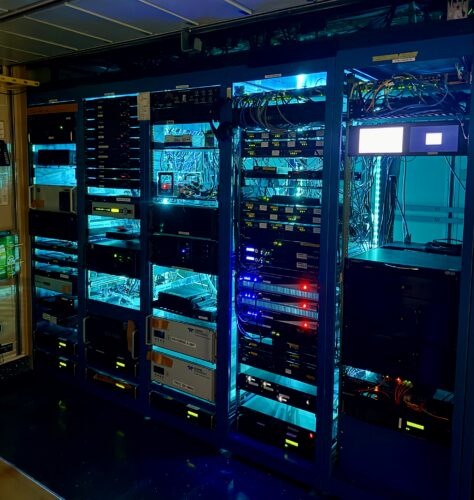
Each day onboard was a full-immersion dive into maritime cybersecurity and cyberinfrastructure. We configured segmented networks using Fortinet firewalls, utilized Proxmox virtual environments, and worked with legacy systems still commonly found in real-world maritime operations. We tackled bandwidth limitations, satellite communications, and network segmentation in a way that mirrored actual at-sea constraints—and that’s not something you can fully simulate in a classroom.

One of the most impactful parts of this experience was the people. Having such a diverse crew—ranging from seasoned technologists and marine technicians to undergraduate students from across the country—created an environment rich in what’s known as tacit knowledge. These are the kinds of insights that aren’t always written down—techniques, workarounds, and instincts that come from time spent in the field. Watching the experienced professionals troubleshoot or explain their setups gave me a much deeper appreciation for the human element in technical problem-solving.

Another standout for me was having Tyler Peterson, a former MATE intern, onboard. His background as a marine technician and his experience with more traditional MATE internships helped bridge the gap between the classic marine tech path and this first-of-its-kind cruise focused on Information Technology, cybersecurity, and cyberinfrastructure. While we weren’t supporting an active science mission during this cruise, Tyler helped connect the dots between shipboard IT systems and how they ultimately enable and support scientific research. That context was incredibly valuable—it made the purpose behind the tech we were building feel real and relevant.

Something else that really stuck with me: it takes a variety of disciplines to make scientific research at sea possible. From satellite communications and data acquisition systems to physical deployments like the ARGO floats, the cruise was a reminder that meaningful science only happens when engineers, IT professionals, technicians, and scientists work in harmony. This cruise wasn’t just a training exercise—it was a snapshot of what that collaboration can look like in action.

One of the personal highlights: I earned three cybersecurity certifications during this cruise—two from Fortinet and one awarded by the R/V Sikuliaq team. These credentials not only boosted my technical skill set, but also marked a real milestone in my journey toward becoming a cybersecurity professional in the maritime world.

Massive thanks to the University of Alaska Fairbanks (UAF) for hosting, Fortinet for the technical resources, the MATE program for making this internship possible, the crew of the R/V Sikuliaq, and everyone who made this adventure happen. Special shoutout to Julian Race for leading the charge and creating space for real hands-on learning. I’m leaving this cruise sharper, more inspired, and more confident in my future as a cybersecurity professional in the maritime space.

Until next time—signing off from the Gulf of Alaska.

Cybersecurity at Sea – Aboard the R/V Sikuliaq

Hello! I’m currently writing from my newly designated workstation aboard the R/V Sikuliaq, docked at the University of Hawaiʻi Marine Center in Honolulu, Hawaiʻi. We are scheduled to get underway later this evening. The Sikuliaq, operated by the University of Alaska Fairbanks, is a 261-foot ice-capable research vessel, and our current expedition—SEACURE-IT—is focused on advancing cybersecurity practices in maritime environments.

Our mission centers on understanding and strengthening shipboard cybersecurity infrastructure. Today’s focus was building a simulated research vessel network using Fortinet hardware, including a FortiGate next-generation firewall and a FortiSwitch managed switch. Each virtual vessel was named after a Star Trek captain, and I’m pleased to report that the R/V Christopher Pike is now fully operational.

To bring the system online, we began by installing the firewall and switch hardware, gaining access through the serial console port. From there, we configured a VLAN (Virtual Local Area Network) and assigned appropriate switch ports. After establishing basic connectivity, we implemented firewall rules to enable WAN access for the VLAN while maintaining strict segmentation between networks.

One of the critical lessons in maritime cybersecurity is the need to separate Information Technology (IT) systems from Operational Technology (OT). Onboard vessels, OT systems (such as industrial controllers managing propulsion, navigation, and critical mechanical systems) are sometimes based on legacy architectures and lack modern security hardening. Allowing these to share a network with IT systems—or worse, exposing them to the internet—creates serious vulnerabilities. Our firewall policy design reflects this reality, ensuring the IT and OT VLANs remain isolated. It is also best practice to separate these networks so that everyday users do not accidentally interfere with critical operations.

After confirming secure internet access on the IT VLAN, we deployed a lightweight Ubuntu virtual machine using the Proxmox hypervisor. While running on limited hardware, the system performs well thanks to the efficiency of Ubuntu, enabling us to simulate key cybersecurity operations within our constrained environment.

To put our network control to the test, I implemented a multi-layered blocking policy targeting a known security concern: TikTok. Using FortiGate’s Application Control, DNS Filtering, and Web Filtering capabilities, I successfully restricted access to TikTok domains and traffic patterns. As a result, no devices on our network can currently access the platform—a practical example of layered defense and policy enforcement in a live environment.

This experience has already been invaluable. I’m gaining exposure not only to enterprise-grade network security tools, but also to the nuances of securing mission-critical systems aboard research vessels.

Introduction – RaymondJames

Hello, I’m RaymondJames Gallant, a cybersecurity student at Eastern New Mexico University and a 2025 MATE intern. I’ll soon be embarking on a cyber internship aboard the RV Sikuliaq, where I’ll be learning firsthand how cybersecurity supports maritime research and operations. I’m passionate about protecting critical infrastructure and excited to explore the intersection of technology and ocean science. I’ll be using this blog to document my experiences, growth, and reflections throughout the journey—thanks for following along!

Week 9 (Gisler): Goodbye For Now

Hello readers,

It’s hard to believe that I have been on the Sikuliaq for 72 days. Going into this internship, I knew there was a possibility that I would not like the work or that I would be unsuccessful. Now, I can enthusiastically say that I was able to positively contribute to the tech team and that I have been hooked by this industry. The people aboard the Sikuliaq are amazing, passionate about what they do, and so kind. I feel lucky to have been able to work alongside them for this short period of time and to call some of them friends. 

In the last week, the calibration cruise came to an end with all the tasks completed. We had to come into Newport early due to weather but we were still able to get everything done. I did some smaller tasks such as install the 3D printed PAR mount onto the CTD, mount a new TV in the baltic room, complete my internship tasks, apply for jobs, start to learn Python, and build some networking skills by interfacing with a Raspberry Pi over the network. 

Spotting a seep with the echosounders. It’s almost 400m tall! 

Driving under the Newport bridge

CAD assembly of PAR mount. A cool technique that I learned during this internship was to combine hardware and 3D printed parts. Printing threads is tricky so instead one can incorporate nuts into the design to provide the means of threading in a bolt. In this design, the nuts were press-fit into the print and aligned with the bolts. Now, what would be the weakest point of the design, printed threads, is no longer an issue.

Mounted PAR sensor

Thank you for reading!

Sarah


Week 8(Gisler): Calibration Cruise

Once we left Seattle, we headed out to perform calibrations on the new 304 sonar array and the 710 sonar array. We originally were going to do all our calibrations on the open ocean but we were able to get permits for Canadian waters last minute so our first few days were smooth sailing (thank goodness, I could’ve kissed the messenger). Calibrating the sonar arrays involves driving the ship over the same stretches of ocean repetitively, recording sonar data as you go. A software package then uses the data to correct for heading, pitch, and backscatter. Some days, data collection was tricky due to windy conditions. During conditions with lots of wind and the boat starts to crab, bubbles can be driven under the ship which interfere with the sonar readings. Bubbles cause disruptions to the data due to their difference in density from water and prevent the sonar beams from traveling through the water column to the seafloor. One of the exciting new things I’ve been able to learn is how to deploy a CTD. The process involves communicating with the winch operator which depth to bring the CTD to, cocking/firing Niskin bottles, guiding the CTD in/out of the baltic room, and sending the thermosalinity profile to the sonars. However, there is some downtime but I have kept busy by doing small 3D printing projects such as creating a new CTD mount for the PAR sensor and a table stand for our Black Box monitor. I also started to plan my next steps as I only have one more week on board:( Our SUNA sensor is also having problems so I got to help troubleshoot the problem.

CTD monitor

CTD ready to be picked up and boomed out

Thanks for reading,

Sarah

Week 7 (Gisler): Seattle

During this past week, I was able to became familiar with the website Coriolix, weight test winch booms, weight test CTD cable connections, design a MouseTrap, replace an ADCP, and explore Seattle.

Coriolix is a website that allows scientists on shore to monitor the sensors aboard multiple research vessels and also gather data from them. It was also a great tool for me to get an understanding of what sensors are aboard the Sikuliaq. 

I mentioned in an earlier post that the winch boom had it’s cable sheave replaced. Once that was complete, the boom needed to be weight tested. We used water bags for the weights and tested the boom at fully extended and partially extended. The fully extended boom was tested at 7,500lbs and the partially extended was 11,000lbs.

Water bag in yellow

A-Frame testing with full water bags

CTD cable splice. The cable was first electrically connected to a pigtail that would be plugged into the CTD and then mechanically connected.

ADCP dunk test. During the cruise over to Seattle, two of the ADCP’s beams broke and it needed to be taken out in order to be troubleshot. 

MouseTrap version 1, a 3d printed device for preventing the computer mice from flying off the desks.

Final installed version of the MouseTrap. 

Biking to the Fremont Troll

Thanks for reading,

Sarah 

Week 6 (Gisler): 5 Things The Gulf of Alaska Doesn’t Want You To Know (They’re All Meclizine)

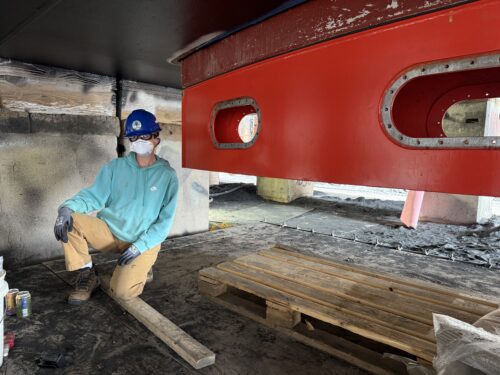
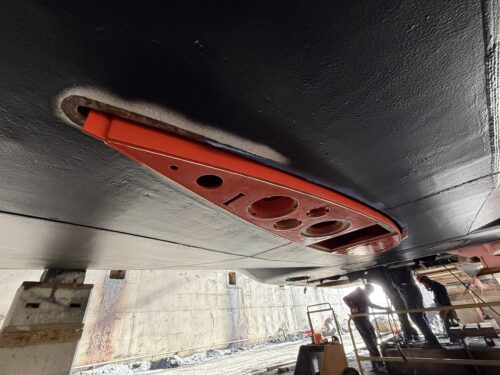
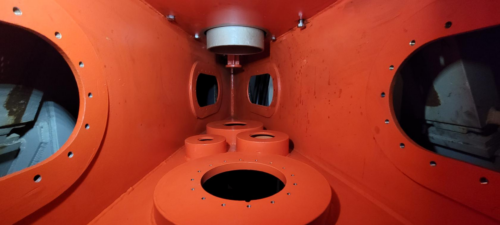
After the ship was floated, we needed to get the ship ready for the voyage to Seattle on the 14th. This meant finishing closing up the eighteen! opened Roxblox and installing a temperature sensor. The temperature sensor is located in the bow thruster room on the inlet pipe of our seawater system. The intake pipe is located about six meters below the waterline on the hull of the ship to the bow of the ship. This location is important because the seawater taken in from this pipe feeds an array of scientific equipment called the wet wall and its important that the collected seawater isn’t contaminated by the ship. Having the temperature sensor at the beginning of the intake pipe is also important for getting accurate data because as soon as the water enters the ship, it gets warmed. Some things that the ship constantly monitors through the wet wall of sensors is pH, oxygen, and salinity. Another sensor that we installed was the Met4ay which measures barometric pressure, humidity, and temperature. This install was located on top of the foremast. 

Inside passage and foremast. The Met4ay is hanging off the top left of the ledge.

Wet wall. These instruments are fed by the intake pipe.

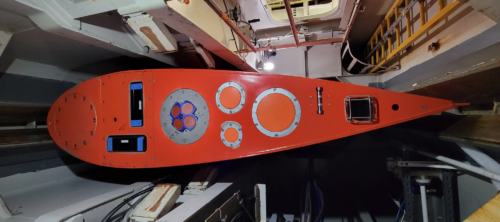
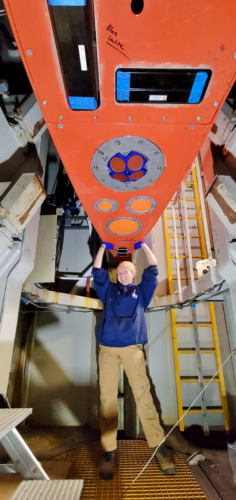
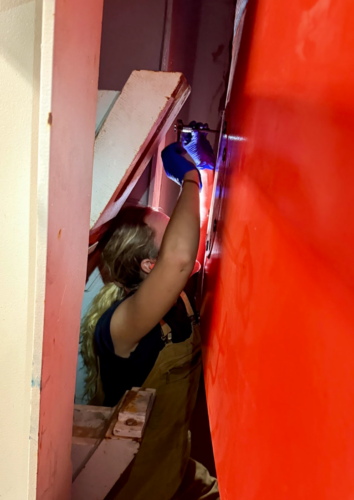
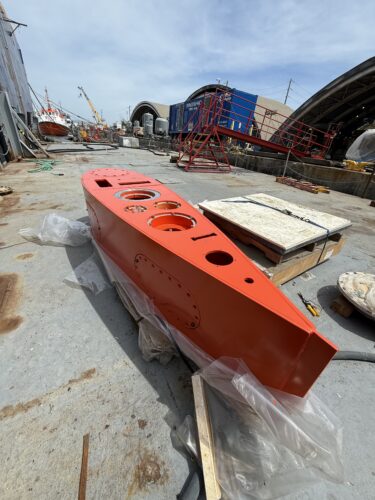
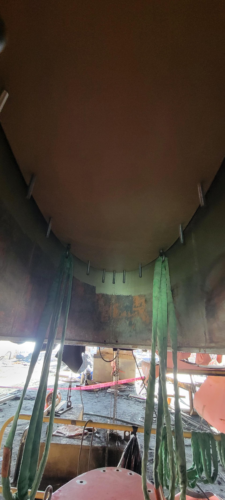
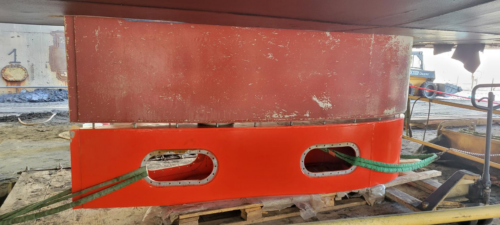
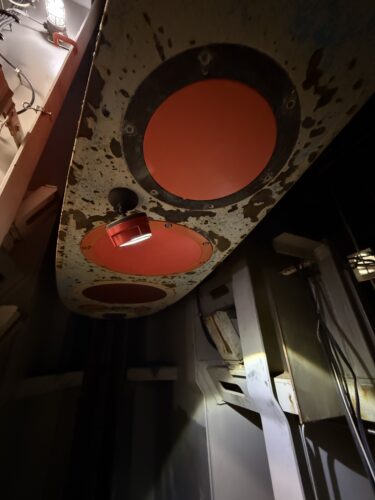
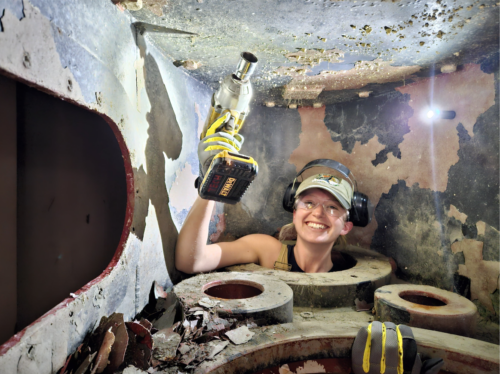
The centerboard is a three thousand ton feature of the ship that runs vertically through the whole ship and is moved up and down by ropes. At the bottom of the centerboard is an array of sensors such as temperature and pH but also ADCPs. ADCP stands for Acoustic Doppler Current Profiler and it measures ocean currents. It does this by measuring the speed of tiny particles suspended in the water using sound and exploiting the Doppler Effect. Another thing that exists in the water column besides particles is bubbles. Bubbles “look” the same to the ADCP as particles but dont give accurate current data. The centerboard allows the ship to lower the ADCP instruments below the hull of the ship to avoid the bubbles that the ship creates as she moves through the water. The centerboard has a locking feature that allows the centerboard to be moved into the exact same position every time it’s deployed. This feature was broken and I was tasked with helping fixing it. This meant jumping into the centerboard well, climbing on the centerboard itself (it likes to move in the well), and shimmying into a tiny crack next to the three ton beast. Unfortunately, the task proved impossible and we were unsuccessful in fixing the locking mechanism:/

Exiting the centerboard well

The next two days were spend at the mercy of the Gulf of Alaska. It’s safe to say that I get seasick and that bacon does not taste as good coming up as going in haha. Luckily, there are some very good drugs out there and I was back in fighting shape the next day. 

Rockin, rollin, and hurlin

The other day, I was able to install my IRT design! Once it has been properly calibrated, this will allow us to measure the skin sea surface temperature. As I mentioned before, the ship takes in water at about six meters below the surface. In areas such as the Arctic, there could be high stratification in the water column so the ocean temperature at six meters down could be radically different than on the surface. Eventually, this will also allow the ship to validate satellite sea surface temperature data. Satellites experience barriers such as clouds and so their data could be compromised. By comparing data taken right above the sea surface to the satellite data, we can know how accurate the satellite data is. I’m really grateful to my mentor for giving me this project, and collaborating with me on it’s design and fabrication. During the fabrication process, I used SOLIDWORKS to CAD the design, a 3D printer to create the dial parts with a nylon/carbon fiber blend, and drill press. 

Desktop assembly

Installed! The sensor on the foreground is measuring the sky radiation and the other sensor is measuring the sea surface radiation.

🙂

Bonus content:

Ethan working on installing the CTD winch boom bearing

CTD and winch boom. The CTD, structure with the gray bottles, is lowered into the ocean using the winch. The bottles (in gray withitn the cage) allows scientists to take water samples at different depths. The depth at which samples are taken is controlled in the computer lab by marine technicians.

A nice day

Thanks for reading,

Sarah


Page 1 of 5

Powered by WordPress & Theme by Anders Norén