Category: Columbia University, Lamont-Doherty Earth Observatory Page 1 of 10

Week 3 – “Leave Her Johnny” [HNL:MAJ]

–Underway from MAJ–

For the final week of this internship (May 1-9) we finalized our pending tasks of installing all the new phone lines in the portable labs along with several internet access points and a few more SOFAR Buoy deployments.
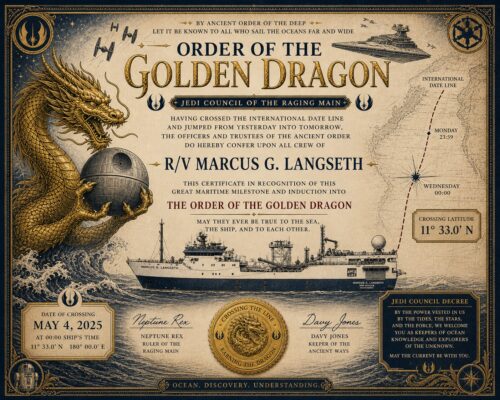
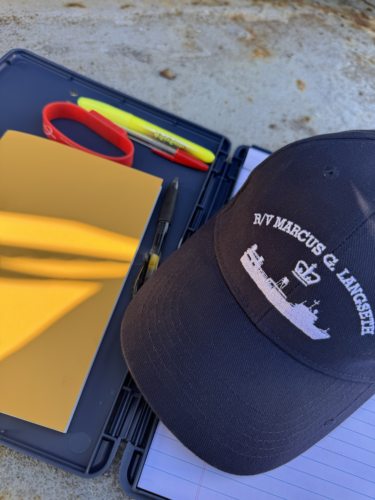
Before that however, we crossed the anti-meridian and successfully completed the “Order of the Golden Dragon” sailor’s merit, which just so happened to occur on May 4th and inspired Cody to create a commemorative print out (with some minor adjustments).

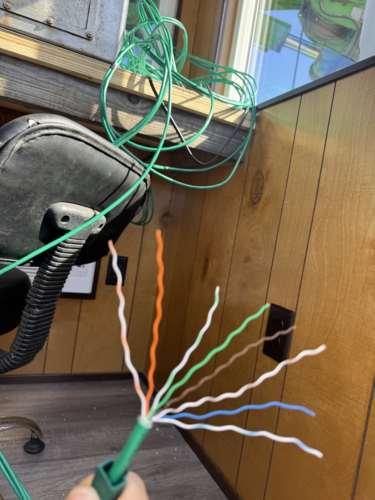
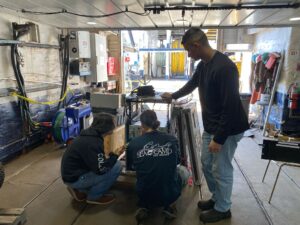
The first part of this task included setting out 6 sets of CAT5e cables, each measuring approximately 15 fathoms of length. After setting these cables and terminating both ends, we fed the lines into our port lab switch box before inserting 2 cables into each of the DICE portable lab transits.
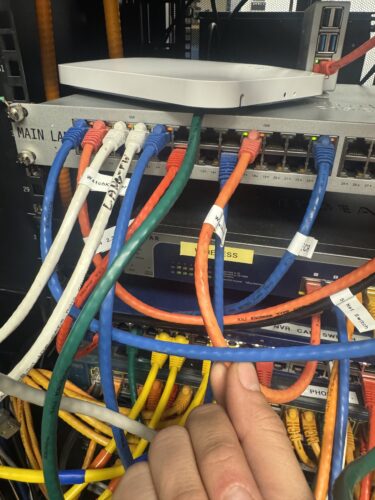
After troubleshooting a faulty port in the main lab server rack, all lines responded well to our internet access point modems and phones which lead us to wrap up our work and close the transit. For our remaining work, we assessed a previous gravity tie and land tie in order to determine our delat and rate of change between previous readings, which as metadata could be used to determine if e would need to have the gravimeter recalibrated soon. We also had enough time before reaching Majuro to set up another CAT5e cable in a POE termination pattern for the aft IFR camera, which will serve as a useful tool for supervising seismic gun operations and ensuring no sealife are around high risk sections. Finally, I also had the opportunity to practice XBT launches, which will add a new incredibly relevant skill to my professional summary.

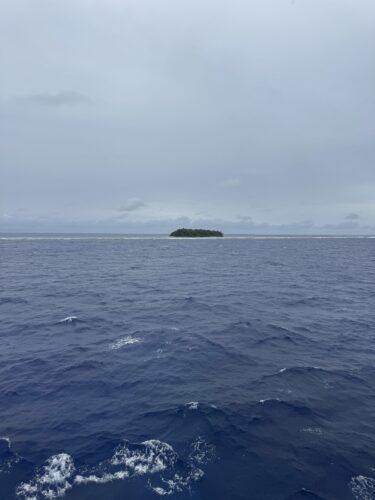
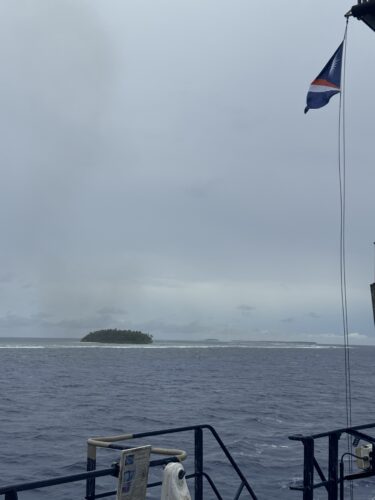
–Arriving to MAJ–
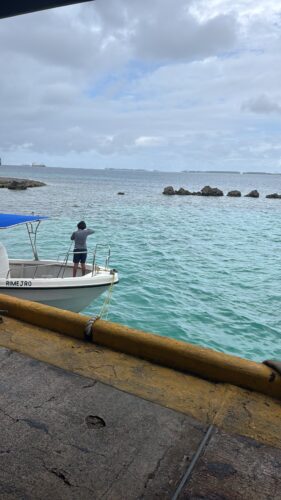
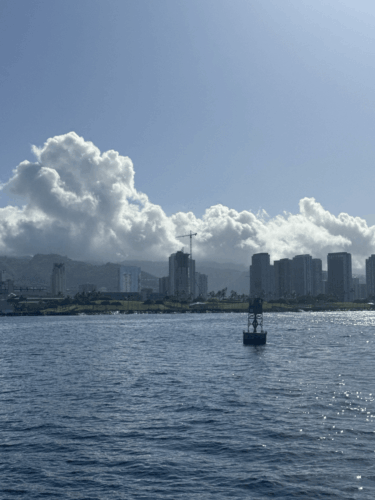
We arrived to Majuro a short while after finishing our work, and I was able to spend some time ashore speaking with the incoming technicians and science team, in fact, Theo (previous MATE intern and current field scientist aboard the R/V Langseth) and I got to meet up and talk about how much this program has changed our careers.

–Final Thoughts–

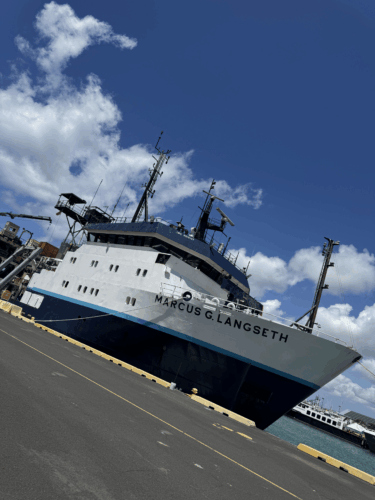
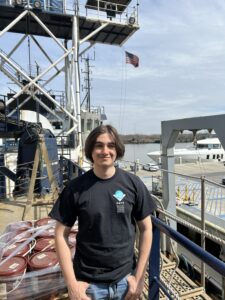
As this program comes to a close, I want to thank the R/V Marcus G. Langseth’s crew for being so welcoming, and I especially would like to thank Jacob Greenberg and Cody Bahlau’s tremendous guidance throughout this program. The UNOLS-MATE program has made me a much more confident scientist, oceanographer, and maritime technician, and will surely lead me to a successful career in the near future, for now however I say farewell and hope to have even more stories to tell some day, whether online or in person when we recognize each other in a remote part of the world.

Yet for now, fair winds and following seas!

-Conrado A.B.
Week 2 – “Rolling Down To Old Maui” [SAN:HNL:MAJ]

–Underway from San Diego—

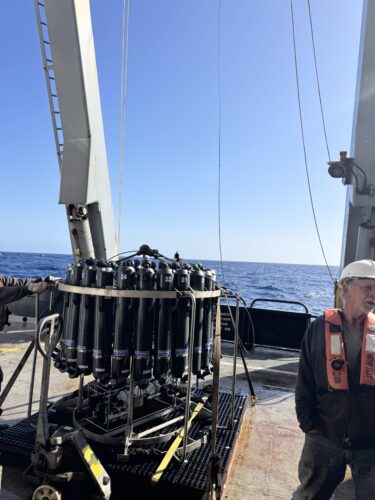
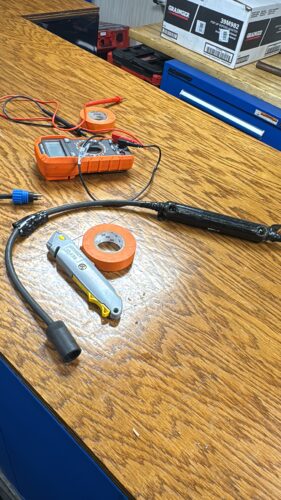
During the second week of this expedition to Majuro (April 24-30) we were able to successfully reterminate the CTD sea cable and through doing so solved the persistent shorting problem we had noticed during the end of the first transit week.

As such we immediately began testing and re-assessing the communication between the deck box and CTD, which we found to be nominal. To add to the excitement we also crossed the Tropic of Cancer a few hours after, marking our approach to the islands of Hawaii. As our next objective we began fixing and preparing the ship’s deck equipment for future use, such as attaching metal fasteners to allow our extension poles to hold boat hooks.

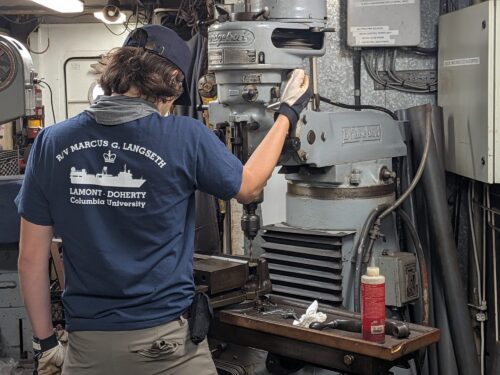
By drilling pilot holes using the ship’s mill press, we were able to bolt the fasteners and poles together at a point that would allow them to reach their maximum height. Shortly after, we began preparing for our arrival in Honolulu by further securing sensitive cargo such our CTD with a tarp and cleaning our major workspaces such as the “gun shack”, “tech shack”, main lab, wet lab, dry lab and our metal shop.

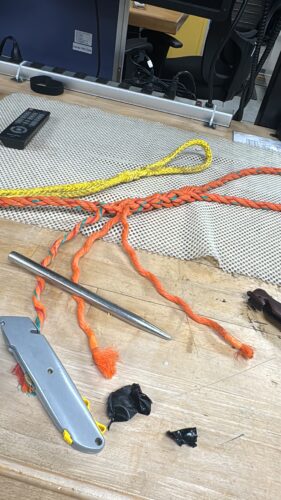
Taking advantage of the bit of downtime we had available before having to shut down our sonar systems, I had the opportunity to practice splice knots and learn how to terminate CAT5 cables. In the last few hours of our approach to Honolulu we shut down our major sonar systems and did our final set of checks before shutting off analytical systems such as the pCO2 system in port, and had the great opportunity of exploring some of the island before our departure the next day. I took the opportunity to visit sites like Pearl Harbor, Waikiki beach, and the site of Sailor Jerry’s original tattoo shop where he developed the modern americana style of sailor tattoos.

–Underway from Honolulu—

The next morning we began making our way out of port and headed out for Majuro, as our first priority, my mentor Cody Bahlau and I began talking about the objectives we would be working on during the transit to Majuro which varied from terminating new cabling to installing a new FLR camera on the OBS deck.

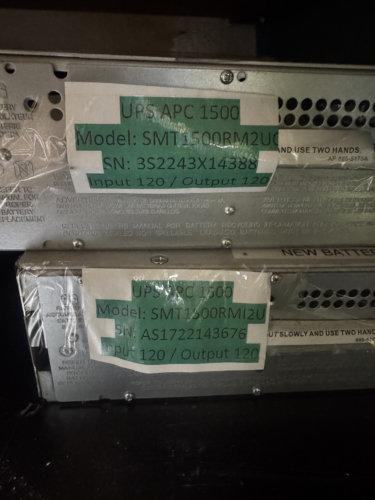
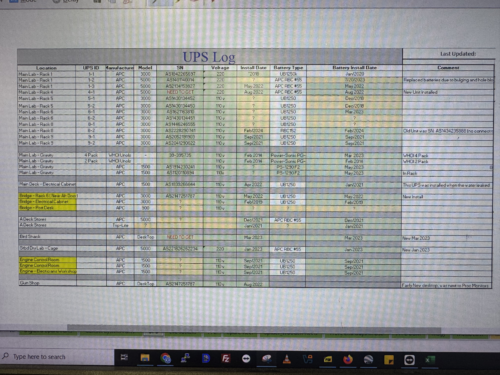
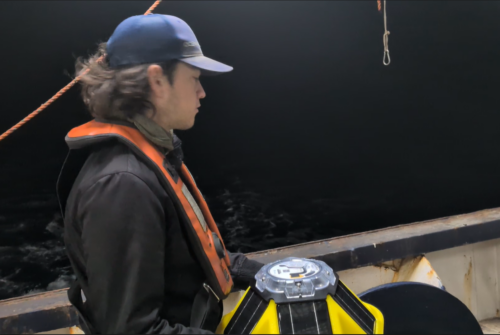
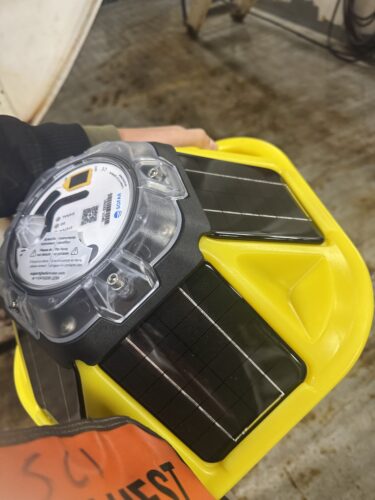
Taking advantage of our initially calm waters we decided to start by fully inventorying and organizing our APC battery supplies, we also updated our logs to identify if any batteries in use were due to be swapped from the ship’s power. Further on we launched the first SoFar buoy/sensor of the transit and had our weekly check in with the rest of the tech team to review our current goals, ongoing projects, and a review of any pending questions or issues.

The next day we wrapped up the week by reterminating our remaining CAT5e and CAT6 cables along with setting up the working directories for interdepartmental phones that will be installed inside the portable scientific workspaces found throughout the ship.

Our work continues on the ship and weather has remained calm on our departure from Hawaii, although it has begun taking a turn for choppier waves.

I’m excited that we continue to approach the antimeridian and will successfully cross it during the last set of days in our journey, completing the sailor’s achievement of “Domain of the Golden Dragon”. Sadly we will be crossing just 2 degrees north from the equator and won’t complete the “Golden Shellback” achievement. This internship has been a tremendous aid in sharpening my skills and further understanding a marine technician’s role aboard oceanographic research vessels, and I greatly thank everyone who has been a part of supporting and mentoring my journey!

Fair Winds and Following Seas,

-Conrado A.B.
WEEK 1 – “Anchors Aweigh and Getting Underway” [SAN:HNL] – Conrado

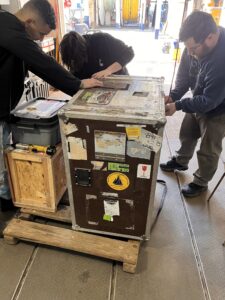
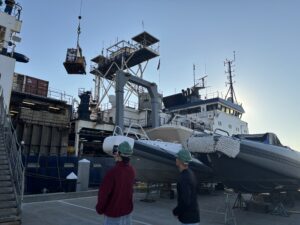
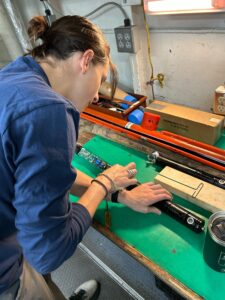
Over the course of this last week (April 15-23), I’ve had the great pleasure of assisting in the R/V Marcus G. Langseth‘s procedures for getting underway and initiating its essential scientific systems. Two days before leaving port I arrived on the ship to begin loading and securing outgoing scientific gear destined for other UNOLS facilities such as the UH Marine Center in Honolulu. Additionally, we began stowing the mission critical equipment that we would later be testing, maintaining, and in some cases deploying. As such I began familiarizing myself with the ships laboratories and main deck spaces that we would be using over the next few weeks to deploy SOFAR buoys along with both “Deep” and “Core” variation of Argo Floats. A-Frame calibration checks were done to ensure accurate tension readings from the winch system and in order to begin preparing it for our use in future CTD/ rosette carrousel deployments. In our last day before leaving San Diego, we secured our remaining scientific equipment through the use of unistrut eye-bolts and ratchet straps before reviewing key documents related to the ship’s systems such as its coaxial camera to video system infrastructure.

—Underway from SD —

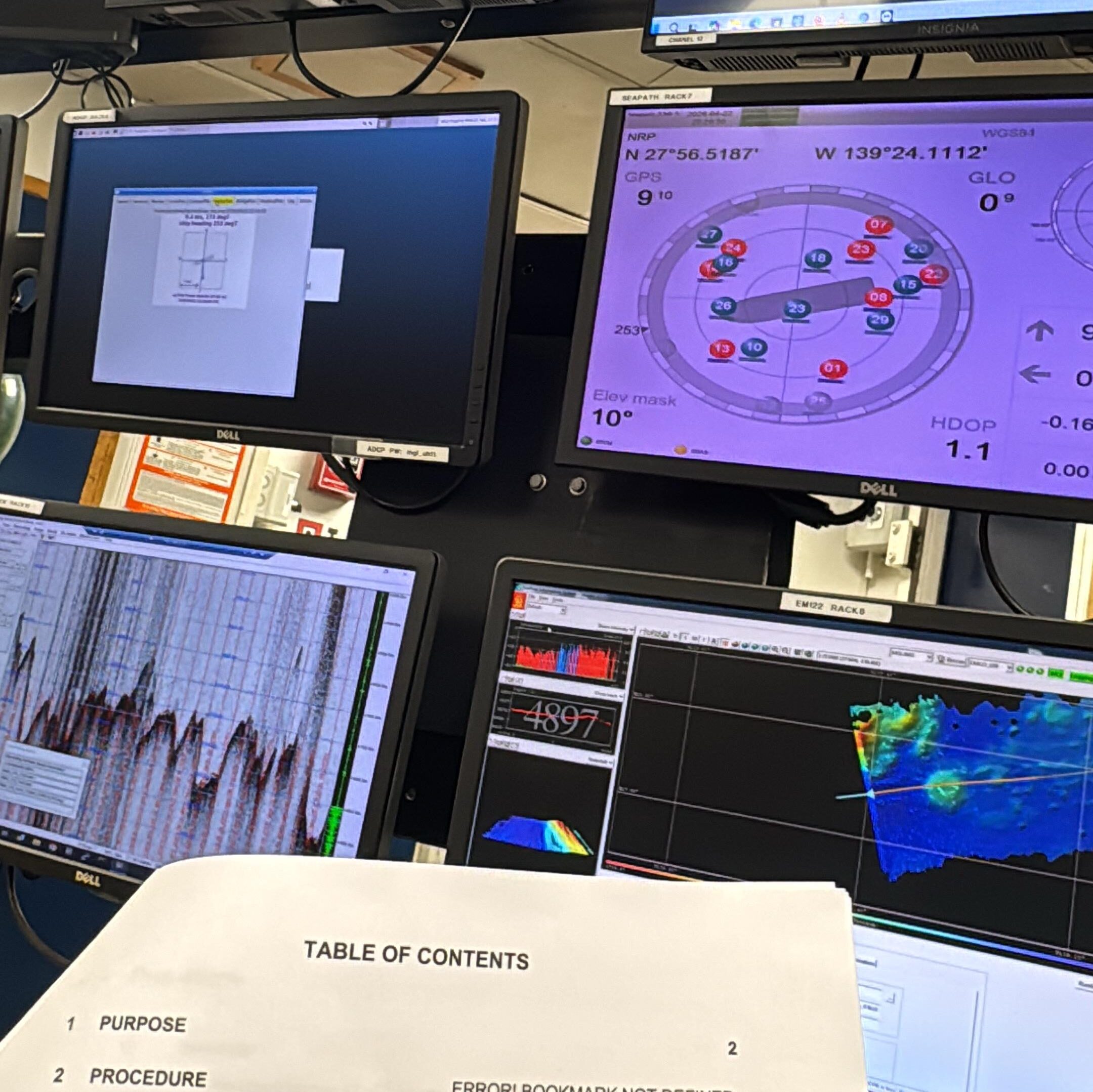
This first week of the transit from san Diego to Honolulu has been highly demanding and busy, we began the week with securing miscellaneous equipment while beginning our transit out of the bay and into deeper waters. Throughout this time we took advantage of the calm waves to add fixtures in both the ship’s wet-lab and dry-lab that would ensure better access and protection to the science team’s equipment, especially considering our expectation of encountering rough weather within the next few days. Once out of the coast, we began powering the ship’s multi-beam echosounder (an EM122 by Kongsberg), ‘CHRP’ ADCP (3260 Echosounder by Knudsen) and SeaBird SBE systems. Shortly after, we noticed incongruencies on the live data between the ADCP and echosounder’s depth readings and began early troubleshooting efforts which were finalized by that afternoon.

The next two days were spent focusing on deploying and testing our CTD system, during the morning deployment all systems worked nominally until we reached 100m, at which point we stopped receiving data but still held a firm connection between the deckbox and CTD module. As such the rest of the day was spent troubleshooting the system and having a post-launch debrief on our next steps.

Later on we would find that the CTD’s deckbox to sea cable fuse had blown and as such began testing the sea cable’s wiring in an effort to locate a possible short, this would later lead to us tracing the short to the terminations between the seacable and CTD plug.

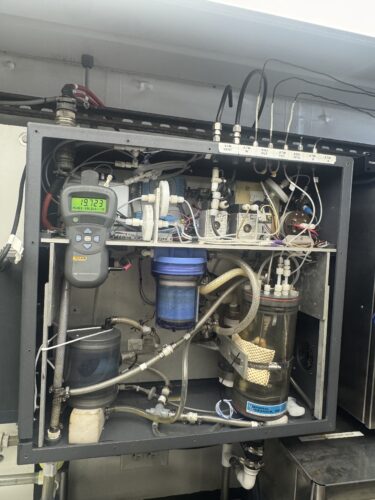
During the next day we deployed our first SOFAR buoy at 5am and as part of our daily checks ensured that the temperatures of our sample-housing refrigerator units remained nominal. As part of an ongoing project to improve the infrastructure of our pCO2 measuring system we also began mounting a dedicated bracket for it’s dedicated power station, that same afternoon we would also begin a lengthy process to activate and at times de-airlock this delicate gas-mixture dependent piece of equipment.

The remainder of the week would be characterized by troubleshooting some of the ship’s server room computers which had lost their remote-connection capabilities due to power lapses, along with launching two more SOFAR buoys, an Argo “Core” float and an argo “Deep” float.

Our work continues on the ship and weather has calmed extensively, dropping our previous roll of nearly 5.2 degrees and heave of 5m to a 1 degree roll and 0.5m heave. Conditions continue to improve with our approach into tropical waters and the next log will be marked by us crossing the Tropic of Cancer. I am extremely glad to have this opportunity of assisting on board and greatly look forward to the next few weeks!

Fair Winds and Following Seas,

-Conrado A.B.
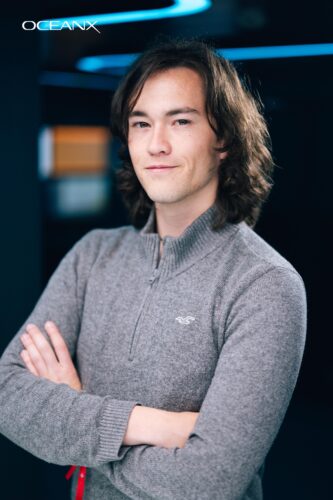
Intro: Conrado Acevedo Batiz

Ahoy there and good timezones!
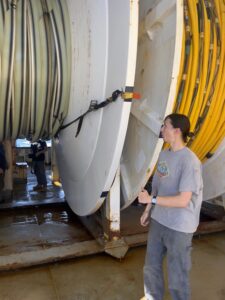
My name is Conrado Acevedo Batiz and I am a new intern aboard the R/V Marcus G. Langseth for the UNOLS-MATE program. I am an oceanographer and seafarer with a passion for exploration and expeditionary research, as of right now my goals are to become a maritime technician for oceanographic research vessels and I hope to one day become an ROV and submersible technician/pilot. I’m incredibly grateful for this internship opportunity and look forward to spending a month at sea learning from the highly skilled technicians and crew that make the RV Langseth such a valuable asset to ocean exploration and research. Cheers and pleasure to meet you!

Internship Overview – Ethan

Hello everyone,

I’ve spent the past week aboard the Marcus G. Langseth, gaining valuable exposure to its unique labs and state-of-the-art oceanographic equipment. On my first day, I had the opportunity to tour several areas of the ship, including the Main, Wet, Dry, and Port Labs, as well as the Gun Shop, Bird Shack, and Muster Station. Each of these spaces offered insight into the operations and specialized functions aboard the vessel.

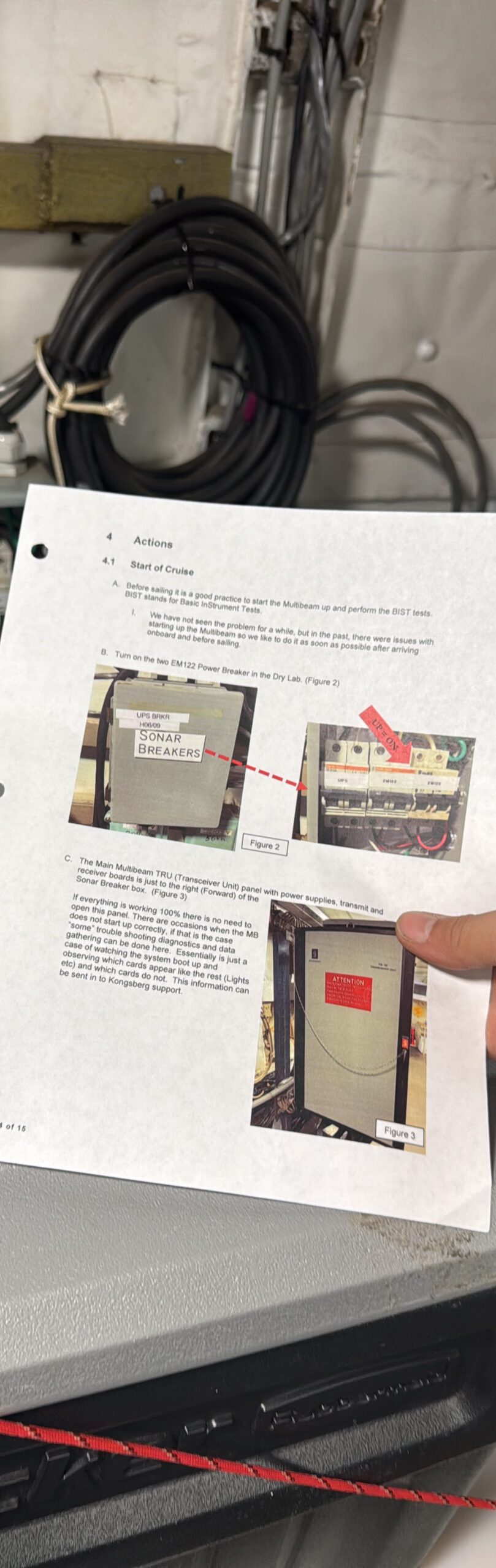
Throughout the week, my fellow interns and I worked closely with our mentor, Cody Bahlau, on a variety of tasks around the ship. One of the daily activities we assisted with was performing the BIST for the swath mapping sonar, ensuring its functionality, and resetting the weather station.

I also participated in the weekly gravity check and gravity tie, a critical task to ensure that the gravimeter remains properly calibrated and provides accurate readings. To complete the gravity tie, I traveled to the pier where the Land Tie was performed. Since tide height can vary, we took measurements from the pier to the water at three different stages: when the tie began, at 50% completion, and when it finished. This process allows us to account for the tide’s effect on the gravity measurements. Once the gravimeter was confirmed to be working accurately, we carefully prepared it for transport by placing it into its protective case, securing its batteries, and carefully moving it up to the Wet Lab, all while ensuring it remained powered throughout the process.

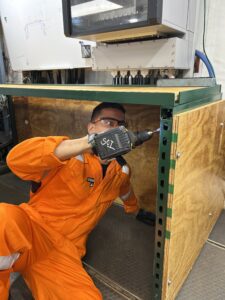
In addition to the technical tasks, we were also involved in some practical maintenance work. We helped secure loose items on deck in preparation for transit, organized and restocked personal protective equipment (PPE), and spent a considerable amount of time over two days cleaning and constructing new desk spaces for the Dry Lab. Building these desks was an unexpected yet highly rewarding experience. Because the ship’s environment requires extra durability, we made sure the desks were sturdy enough to withstand movement and could be securely bolted to the floor. To accomplish this, we used metal framing for the desk skeleton, ensuring it could be anchored to the ship’s floor. We then cut and fitted the top, side, and back panels to add further stability, improve the overall aesthetic of the lab, and hide wires and cables. This hands-on project allowed me to work with various power tools, including a chop saw, angle grinder, and buzz saw—skills I was excited to develop.

Overall, this experience has been a fantastic blend of technical work and practical skills, giving me the chance to work with cutting-edge equipment and learn valuable hands-on techniques. Unfortunately, due to changes in the ship’s transit schedule and an extended length of travel, I won’t be able to stay aboard the Langseth for its journey to Cape Verde. Nevertheless, this has been an unforgettable experience, and I truly hope I’ll have the opportunity to work aboard a vessel as impressive as the Marcus G. Langseth again in the future.

Week 3 – Arriving at Cape Verde/ End on Internship – Will

Hello for the last time from the R/V Langseth! As I am writing this, I am about 100 nautical miles from arriving at the island of Sao Vicente, part of the Cape Verde archipelago! While my time aboard the Langseth has been relatively short, it has been nothing short of an amazing and worthwhile experience that I would heavily recommend participating in should you have the opportunity!

Early in the week, Theo and I tackled revisions to the DigiBird calibration manual, making it more concise, structured, and user-friendly. We wanted future users to have a clearer, more streamlined guide, and we’re confident our updates will make troubleshooting much easier.

Midweek, we turned our attention to inventorying our equipment, unpacking and inspecting 56 old and new Niskin bottles for damage before organizing them into labeled palletainers. I also got my first experience calibrating Acoustic Pingers, which are much easier to work with compared to DigiBirds. Acoustic Pingers are an essential component of the Langseth’s streamer deployment, as they communicate with not only one another, but also the ship, relaying critical information as to where exactly the streamer currently is in the water. Working up in the protected species observer tower was a nice change of pace—removing and recalibrating Vaisala weather station antennas gave us a reason to soak up the fresh ocean air while still getting things done.

A major highlight of the week was learning about streamer deployment and seismic data acquisition. We unspooled a streamer on deck, attached LAUMs (Line Acquisition Unit Modules), and got hands-on experience using the SEAL 428 seismic recorder system. It was fascinating to see how hydrophone data is converted from analog to digital and how external noise sources, like fishing gear and passing ships, can interfere with data collection.

To end the week, Theo and I tackled the task of replacing the Digibird motor modules that were either bad or paired with bad electronic modules. Cody had recently taught us how to do so, so this allowed us to put his teaching into practice, which we did with great effectiveness! To replace a motor module requires essentially stripping the Digibird of all its interior components, requiring very cautious exactness and patience in order to ensure we do not damage any components during a motor swap.

We were able to complete either a motor swap or a complete haul of every component on every bird we aimed to, allowing us to finish our internship with a great sense of achievement and set the next set of interns up for success, as we tested all spare motors to find which were good and bad so they didnt have to! I can say for sure, I am adept in all things relating to the calibration and troubleshooting of Digibirds!

Thank you for keeping up with my weekly posts, it has been a pleasure sharing the amazing experience I have had. I also want to give a huge thank you to Chief Science Officer and my mentor, Cody Bahlau, for his dedication in seeing that Theo and I succeed, thrive, and take as much advantage of this opportunity as possible. And of course, a huge thank you to the UNOLS-MATE Program Manager Maria Osiadacz for making this opportunity possible and being such a wonderful support throughout the entire internship!

Wishing you the best,

Will

Week 3 — Closing in on Cabo Verde — Theo

We’re finally closing in on Mindelo in Cabo Verde! We get in tomorrow morning at around 6am, and after that I am headed back to San Diego. This past month has flown by, and I’m super grateful to have had this opportunity—I feel like I have learned so much. I’m looking forward to staying in touch with the technical team and participating in similar opportunities down the line!

Now let me catch you up to speed on this past week. And when I say catch you up to speed, only one thing comes to mind: birgatory. We spent a lot of time working in the Bird Shack this week, and we started off pretty easy working on the Acoustic Pingers. These instruments are very similar to our digibirds except they’re a whole lot simpler: they basically just ping the boat to let us know the location of the streamers in the water behind us. All we had to do was recalibrate them and recharge their batteries. We were bumped up a level in difficulty, however, when we started working on the digibirds with bad motors. This took FOREVER. Let me walk you through testing one bird: you dismantle the bird, carefully dismantle and pull out the compass module, push out the motor and the electronics modules, carefully disconnect the motor from the electronics, carefully reconnect a new motor back to the electronics, reinsert both modules back in the bird, put the whole bird back together, and finally retest the motor functionality. If the bird still doesn’t work, you troubleshoot it by redoing that process all over again with a different motor. If both motors aren’t working, then the electronics module was bad, which meant stripping the bird for parts and retesting both the original and replacement motors. It was definitely hard work and ever-so-slightly mind numbing. At the end of the day, however, (and maybe because I never have to do it again) I can tell you that it was definitely a valuable learning experience for me. In any opportunity moving forward, I know I can calibrate, troubleshoot, and repair sensitive scientific equipment, even if I know very little about the instrument to begin with.

Speaking of sensitive equipment, perhaps the highlight of my week was getting the chance to run through troubleshooting our streamers. We finally got to test out one of the streamers on deck, unspooling the very end before screwing in a few LAUMs (line acquisition unit modules). Following that, we moved downstairs to learn how to read and interpret the data from the hydrophones, and how to troubleshoot the system if something goes wrong. It was super super interesting, and I would love to get more experience doing data analysis and troubleshooting in the Main Lab control room in the future. The program the Langseth team uses, SEAL, models all the data being transmitted from each individual hydrophone along the entire 15km line, as well as every LAUM and FDU (field digitizing unit). This amounts to five hundred something hydrophones for each streamer, half that many FDUs, and a couple dozen LAUMs. It’s pretty incredible technology and was great to experience so closely.

I’d say my final highlight of the week was working up on deck, familiarizing myself with Niskin Bottles and working on the Vaisala Weather stations. This scientific equipment aligns a lot more closely with my own personal interests in biological oceanography, and after a few weeks it was interesting taking a little break from seismology. While we didn’t actually get to apply either of these instruments, I did become pretty familiar with how to take them apart and put them back together again. If I’ve learned anything from this experience, understanding the fundamentals of how something works is a great substitute to deploying an instrument in the field. I know I got a lot more of the former than the latter over the course of this internship, but I am leaving feeling very confident in my ability to perform technical duties aboard a scientific vessel. Again, I am very grateful to have had this opportunity, and I look forward to applying the skills I learned over the course of this internship to future projects.

Week 2 — Transit — Theo

2 weeks already—it’s a little hard to believe. We’ve been at sea for just about a week so far, and the transit has been great. We haven’t hit any patches of rough weather, and it’s starting to get a lot warmer too. The ocean has been choppy for most of the week, and the motion took some getting used to, but otherwise I’ve felt quite good this whole trip. Part of that is definitely because of our stewards; the food has honestly been amazing so far (to my surprise). One more week until Cape Verde!

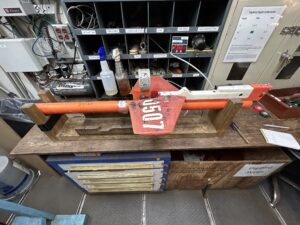
Our biggest project since my last post has been our work on the digibirds. As a marine seismology vessel, the Langseth uses two key tools to gather seismic data while at sea. The first of these tools are our four airguns: sources that release soundwaves into the ocean that bounce off different layers of rock and sediment below the seafloor. The second of these tools are our streamers: four 15km long seismic hydrophone cables that float behind the research vessel listening for the returning soundwaves. Together, they allow researchers to gather 2D and 3D images of the ocean floor and the features beneath it. The digibirds themselves are devices that attach to the streamers that allow us to remotely monitor and control the position of the cables in the water column. Using the digibirds, we can keep the streamers at a specific depth and at a specific distance from one another, allowing us to gather more precise seismic data. The ones on the ship have been through a lot of wear and tear, so our job repairing them is critical for the ship’s ongoing research.

Over the course of this past week, Will and I have worked through about 60 digibirds. They’ve come with all sorts of issues: incorrect depth indicators, poor wing movement, broken motors, bad electrical systems, and even physical damage. For each bird, we’ve had to test thefunctionality of each system and identify what we can actually fix and what has to be sent back to LDEO. We calibrate the depth systems and test the movement of the wings, and if either of those fail we replace the wing module with one we know is functional. If either of those tests fail again, we know we have an issue with the bird itself, and not just the sensors. For the most part, however, we’ve been able to fix the birds up just by replacing or tweaking the wing module before recalibrating all systems. Definitely a cool hands-on mechanical and data-driven experience to have under my belt!

While that was definitely our biggest project this week, it wasn’t the only thing we did. One of our daily tasks at sea has been monitoring the echosounder and multibeam data streams and outputs. These are essentially the same device, except they output in 2D and 3D respectively, with the echosounder measuring the depth directly beneath the ship and the multibeam mapping underwater topography. We’ve learned how they function and how to read/analyze their data outputs, which will be super valuable for future projects. Other electronic systems we’ve worked on this week aboard the Langseth include installing a monitor displaying our sonar system power information, designing junction box schematics, and troubleshooting the AML SVP. This last device is used to measure the speed of sound in a given location and standardizes the measurements of our multibeam systems. It sits below the ship’s hull and has swappable attachments to measure temperature, salinity, pressure, and more. All in all, I’ve learned a lot this week, and I know there is much more to come!


Week 2 – Underway to Cape Verde – Will

Hello again from the R/V Langseth! This week has been very busy and productive as our responsibilities and tasks have increased since setting sail for Cape Verde 6 days ago! While the weather hasn’t been terrible the entire way, we have definitely hit a few rough patches here and there that have thrown me for a loop, but thankfully, I have started adjusting. Definitely bring some seasickness medication as a preventative!

We have certainly developed a greater understanding for the oceanographic equipment and seismic capability the Langseth is equipped with, as we have spent the majority of the week troubleshooting unique devices known as DigiBirds and monitoring the ship’s data streams. The Langseth is outfitted with 4-15km long streamers that deploy hydrophones into the water – these hydrophones are what makes the collection of seismic data and seafloor bathymetry possible! To adjust where in the water column the hydrophones “sit” and collect data, DigiBirds are placed along the hydrophone streamer ever 300 meters for a total of 52 DigiBirds when fully deployed! While these devices are highly versatile, allowing for the hydrophones to be adjusted within the water column from the comfort of the Langseth, they are just as susceptible to sensor drift and wear-and-tear as any other piece of oceanagraphic equipment.

Our primary responsibility this week was troubleshooting the various issues these DigiBirds had sustained over their last couple deployments, such as issues with their depth indicator, wings not adjusting properly, motor not functioning, or physical damage amongst a host of other miscellaneous problems. With each DigiBird, we would diagnose the issue and formulate the appropriate solution as to how we could return each bird to service. Some were easier than others, requiring a recalibration of their wings or depth indicator; however, some posed more complicated issues that we eventually learned to solve as our experience and confidence grew more and more. The birds that were beyond recovery (ie. physical damage) were labeled to be sent off back to Columbia. Over the course of the week, I believe we went through just about 60 of these devices! Not too shabby for our rookie debutes!

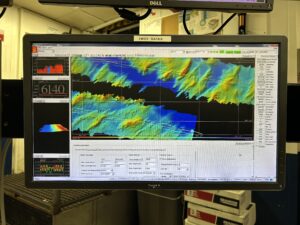
The other of our key responsibilites this week, and one that will continue until the conclusion of our time aboard the Langseth, was the monitoring of the Multibeam & Echosounder data collection, ensuring we were recieved an uninterupted stream of new, incoming data from our current cruise. These devices are responsible for the collection of 2D & 3D bathymetry mapping, allowing us to better understand the seafloor and add to a global database! In the above picture, you can see 2 sets of bathymetry data that are seperated by a black line. This is because the top portion of bathymetry data was from a previous cruise the Langseth took from Cape Verde while the bottom is the data we are currently taking and adding on to our database! The Chief Science Officer does his best to plot a route each cruise that allows the Langseth to maximize the amount of new bathymetry data it can collect.

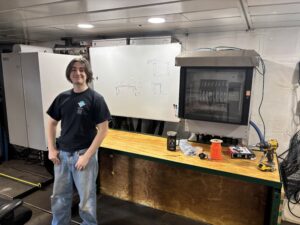
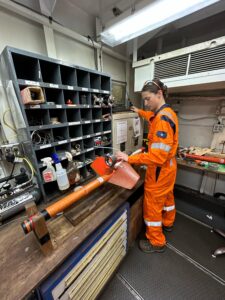
We also had some fun today taking a photoshoot in full PPE “working” around the ship. The avid reader might notice I am working on the shelf that was fully constructed last week, anything for the LDEO LinkedIn! Some other minor tasks this week included inventorying our spare multibeam equipment, modifying the DigiBird storage in the A-Deck Lab to have dividers to increase organization, performing walkarounds to ensure all of our equipment is secure, and learning my bowline knot! Oh how I love my bowline knot. Thanks for reading, see you next week!

-Will

Week 1 — Preparing in Port — Theo

Hello! All is well on the Langseth; I’ve really enjoyed working with Cody (the Chief Science Officer), the other interns, and the rest of the crew so far. Quick update—we are no longer headed to Costa Rica. Things have been a little crazy around here, and because of some uncertainties about funding we’ve made a rare last minute change in plans. We are now headed to Cape Verde to pick up some OBS equipment that was deposited last year, which means we’re sailing across the Atlantic!

This first week has been super eventful and I’ve learned a lot. The Langseth is a very impressive boat and it’s been really great getting my bearings around the ship. It’s a global-class marine seismological vessel—the only of its kind in the UNOLS fleet—and the equipment they have on board is incredible. We’ll start working more closely with some of those systems next week—most of what we’ve done so far has involved a lot of maintenance and upkeep across the ship’s different labs and stations. We’ve packaged and shipped some outdated equipment back to Columbia and WHOI, and have also unpacked and stored new shipments of PPE, tools, and stores. Some daily and weekly responsibilities we have include cleaning the labs and making sure all loose items are tightly secured for the transit. It’s been quite busy but I’ve enjoyed getting my hands dirty, especially on a few key projects!

One of our first projects involved prepping the Lamont-Doherty Earth Observatory’s gravimeter for transport back to Columbia. This instrument is incredible—it’s a gray box built in the 60s that measures localized gravitational pull. It’s fragile and a little finicky, so we learned how to run daily checks on the instrumentation, run a gravity-tie test for calibration, and how to prepare it for transport without ruining everyone’s day (it would be a very costly break). We had to constantly keep it hooked up to a power supply and had to be very careful while moving it so as not to upset any of its internal workings. I’m very grateful I got the chance to work with it and to pick Cody’s brain about what makes it tick.

Another one of our projects was creating two shelfs/desks in the Dry Lab to create more workable surface area. I’ve never worked seriously with power tools before, and it was a blast getting to test things out with all the equipment and materials around the ship. This was definitely the project that took us the longest: we had to plan out the dimensions, clear the location, figure out our materials, cut out our metal frame, cut out our wooden surfaces, bolt pieces together, smooth out rough patches, and stain the wood. I’m very proud of our end product and it’ll definitely inspire me to work on more construction projects once I get home.

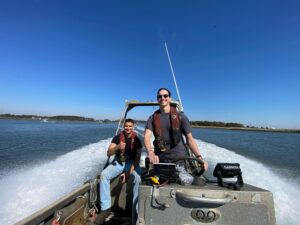
Finally, we spent some time on the workboat when we went to go get it fueled. This boat is kept on the ship in the event technicians need to perform maintenance on deployed equipment or lines. We were only supposed to be gone for an hour and a half, with the fuel dock being about 5 miles away, but our little vacation turned into a 4 hour maintenance trip. We initially had some problems with our electronics and port motor, which snowballed into an oil leak we had to patch and refill at the dock. It was a great time! We saw some dolphins, enjoyed the weather, and got very, very familiar with the inner workings of outboard motors.

Really looking forward to starting the transit tomorrow! I’m excited to get the ball rolling with a bit more technical projects, including working on our digibirds, getting familiar with our sonar systems, and testing out the streamers. Fingers crossed that I don’t get seasick!

Page 1 of 10

Powered by WordPress & Theme by Anders Norén