Category: R/V Sally Ride

Week Twenty-Two: Part of Something Big

1930 Local time

Hiya!

We are one week in on the Ocean Observatories Initiative (OOI) Endurance Array cruise on the Sally Ride. If you have not looked up OOI yet, then let me encourage you to do so by giving you some handy links. The Endurance Array is just 1 of 6 uncabled arrays spanning the Pacific and Atlantic ocean basins and provide a wealth of data on climate variability, ocean circulation, ecosystem impacts from climate change, sub-seafloor and ocean-atmosphere interactions, plate dynamics and more! The great thing is that there is a lot of outreach to the science community and public alike, and all of the observation data is available 24/7 through the OOI data portal.

Thankfully, while we were out at sea, NSF awarded $220 million to Woods Hole, University of Washington, and Oregon State University (the team I am with) to continue to operate and maintain the OOI system for the next 5 years. Woo hoo!

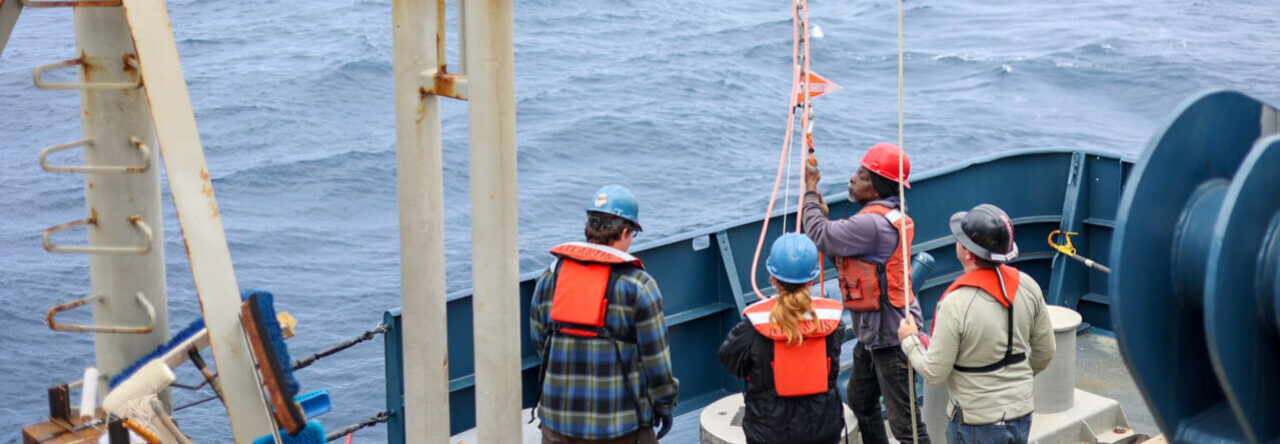
This past Tuesday saw us off the coast of Washington deploying and recovering shelf and offshore moorings. The offshore moorings are over 500 meters in length, so we can only average 2 per day with these. At each site, we also do a CTD cast to collect water samples at the depths of the sensor packages as well as a good water column plot. This helps the OOI team to calibrate their various instruments as a reference.

This pattern repeated through Friday, at which point we transited down to Newport, Oregon and docked on the OSU pier in order to offload the recovered moorings and pick up more to deploy. Needless to say, there is an incredible amount of dynamic shuffling on the back deck to make way for hundreds of meters of line, EM cables, and stretch hoses not to mention massive flotation devices, anchors, vertical profilers, and sensor frames/anchors that weigh upwards of 11,000 pounds.

We always meet as a team before each deployment or recovery to assign positions and talk through the progressions of where things need to be and what block we will be pulling through to which winch and how many tag lines are needed to stabilize the various components. Communication and situational awareness are key! The rest of this week will see us finishing up the Washington inshore and offshore moorings and then we will be back in Newport one more time to do another offload and onload of gear. In total, it’s 3 legs of deployment/recoveries in just 16 days. I am confident that we can do it. 🙂

More soon!

– Emily

Week Twenty-One: Hello, Old Friend

0100 Local Time

Hi there!

In just a few hours (0400 Pacific Time) the crew and science party of the R/V Sally Ride will be getting underway for the OOI Coastal Endurance Array cruise. The back deck and surrounding labs and staging areas are fully loaded for the recovery and deployment of 12 uncabled platforms and 6 gliders off of the Washington and Oregon coasts over the span of the next 16 days. As I mentioned last week, this project is directed at monitoring long-term environmental changes and impacts on ecosystems due to climate change. The program is planned to run for 20-25 years, so there is a real opportunity to identify episodic events on a meaningful timescale.


(Image Sources: OOI)

I met the ship this past Friday at the cruise ship terminal in Seattle. It is quite a busy spot with massive cruise ships offloading and onloading passengers most days of the week. The Sally Ride is tied up stern to stern next to the Roger Revelle, as both Scripps ships just finished a joint-effort science operation. This afforded me the opportunity to see familiar faces from the crews, technicians, and science parties on each vessel. It was a very fun reunion of sorts and the de-mobilization and mobilization of cruises for both ships has made for a very busy few days. Thankfully, we got everything loaded up and all major equipment tested for our first deployments near the Washington shelf, which will keep us occupied through Friday. At that time, we will head south to Newport, Oregon and load up the ship with new mooring equipment to be deployed off the Oregon and Washington coasts all through next week. We will then return to Newport a second time to load up for our third and final set of deployments. This sort of back-and-forth transit schedule may seem silly, but the sheer size of this equipment necessitates multiple loading as you can see by the photos below. Also pictured is a massive water weight that we filled via the fantail firehouse connection. This weight was suspended on a line strung through the A-frame block and run from the heavy-lift winch (HLW). It allowed the OOI team to weight test the winch and calibrate the tension values on the control panel and remote reader.

Honestly, it has not really sunk in yet that this will be my final science cruise of this internship. It is 5 months to the day since I set off on the first cruise on the R/V Neil Armstrong. That seems like a long time to be sailing continuously. However, I have learned so much since then and had the opportunity to work with some great technicians and a variety of hard-working science groups with very specialized equipment and mission goals. Each cruise has offered so many new learning opportunities and no two have been the same. This constancy of change is refreshing and I think is the driving reason why it is surprising that this is the last cruise (only for now, of course).

More soon!

– Emily

Week Twelve: Troubleshooting

1500 local time

Hi there!

This is week 12 of my internship, which is quite extraordinary. In reflection, I am pleased as punch by how much I have learned and experienced, especially when comparing where I am now with the skills and abilities I had coming into this back in April. Being out at sea and learning “on the job” like this is akin to trying to learn a new language. You can take classes or download a software program, but if you really want to learn then you should live and fully engage yourself in the culture and region where that language is spoken.

Part of the learning process comes with being humbled by how much you still don’t know. This particular flavor of humble pie has occurred almost on a daily basis for this current cruise, which is a really cool, 2-year study of zooplankton and larval fish along Trinidad Head, California and Newport, Oregon including the ever abundant and truly bizarre pyrosomes.

Photo credit – Mark Farley, OSU

Through no one’s fault, we have entered into the ultimate Murphy’s Law of science cruises. Everything from a simple dipped net to the giant and complicated MOCNESS have had various problems that have required intensive troubleshooting. Thankfully, the Chief Scientist and entire science team are real troopers and we have been able to work together and come up with solutions along the way.

Photo credit – Mark Farley, OSU

The two biggest issues we ran into at the very beginning of the cruise was the deck winch stand that tows the ISIIS plankton imager stopped responding and then, so did the MOCNESS. The data provided by these two instruments is the heart of this operation and so losing both of them was going to potentially be the end of the cruise. Thankfully, we were close enough to shore that the Chief Scientist was able to call the technician and communicate the error codes so we could get it back up and running. The scientists still end up losing communication with some regularity during a tow, but at least we can now recover and re-launch without issue.

Photo credit – Mark Farley, OSU

The MOCNESS has proved more of a challenge. Not only is it a beast to get in and out of the water, but the 0.680 electro-mechanical cable that allows us to talk to the unit cut in and out for the first two days. Getting it permanently back on line was quite an experience. We carefully inspected and isolated each sensor connection. We made sure the calibration profile for each sensor was correctly entered in the software program the scientists were using. We found some water damage and re-spliced cables and also used new cables. We re-terminated the connection at the instrument 4 separate times. We traced the entire circuit through the ship and ran continuity tests and insulation tests at various points junctions and noted when polarity was reversed to the MOCNESS. We spent a few hours doing a hard re-termination of cutting off the outer and inner steel cables, making a new FIJI fitting, and then putting it through a stress test using a dynamometer and some lifting straps. Needless to say, it was a real triumph to finally get it back up and running.

Photo credit: Mark Farley, OSU

Next up to fail were (simultaneously) the -80 chest freezer, CTD hydraulic power unit, dip net pole, and MilliQ clean water system. Thankfully, these fixes took less than two hours to completely rectify and were back up and running for the scientists that needed them before the next station sampling. Through it all, ResTech Kelsey has held it together very impressively and even kept us on schedule to potentially finish all of the sampling requirements before the end of the cruise. This is a good thing, as we are (naturally) about to hit some rough weather, which will likely slow down operations.

My post for next week will be composed from my own living room. I have a 9-day vacation coming up between this cruise and when I will be off on my next adventure aboard the USCG Healy en route for the Chukchi Sea in the Arctic Ocean. More soon!

– Emily


Week Eleven: Spruce and Sea Spray

2230 local time

Hello!

This post is coming to you a bit later than usual and after a very eventful transit from the Scripps dock in San Diego to the OSU dock in Newport, Oregon. We left Tuesday morning with a full complement of ship crew members and 6 visiting researchers from the University of Minnesota. Their reason for being on board was unique in that they were studying human responses to ship motion and how this motion affects the motor functions of people who work at sea. Their study consisted of walking blindfolded in place with weights on your ankles, followed by several back-and-forth, 30-pace walks within a narrow, taped-off expanse of deck.

On the first day at sea, I gave the safety and ship orientation presentation for the first time followed by a survival suit tutorial. It went very well! Unfortunately, this would be the last day I would see all of the researchers in one room until we got close to port. This was due to some of the worst, pitching seas I have experienced. For a couple of days, we were reduced to 4-5 knots of speed as the bow was assaulted by one violent wave after another. This meant that the motion studies were put on hold as motion sickness abounded.

In the meantime, I busied myself with several projects. One project was to secure this plastic, tabletop material called starboard to an existing, stainless steel counter top. I was worried that bolting through the starboard would permanently damage the pristine stainless steel and could also allow for seawater seepage into the wooden counter underneath. My proposed solution was to make clamps that would prevent the starboard from moving while maintaining the existing counter. I also trimmed and sanded the starboard edges and placed rubber caps on all clamps. Now that the cleverly named MEZCAL cruise science members are on board, it’s nice to see this new surface in use.

Newport, Oregon is quite a lovely, seaside town. There are beautiful views all around, and the wonderful scent of spruce and cedar and salt spray. For all the horrid weather we experienced on the journey up, coming through the channel into Yaquina Bay was quite pleasant. A nice bonus was that the Roger Revelle was tied up on the NOAA dock just next door! It gave me the chance to see more of the town and reunite with some delightful people before they set sail the next day.

The last two days have been incredibly busy learning a brand new termination for 0.680 EM and loading for the upcoming cruise, including the largest piece of equipment I will be putting over the side to date. This is a MOCNESS, which I have seen before, but you will note the slight difference in scale below. You will note that the smaller model fits on a pallet, whereas the one for this cruise barely fits between the A-Frame.

I will also be taking back my familiar 0000-1200 shift again, and the science team will be standing 3-3 watches, so I will get the chance to meet and work with all the science team members. This also means taking command of deck operations using the A-Frame for the MOCNESS monster as well as the ISIIS plankton imager, the CTD, and a couple of vertical nets. Oh my! We will be out for the next 9 days and I imagine I will have a lot to update you with next week, toward the end of our cruise.

Happy 4th of July, and see you next Sunday!

– Emily

Week Ten: The Quick Turnaround

1900 local time

Hiya!

Well, it is another beautiful Sunday and the last day of the CalCOFI Summer 2018 cruise. The past week brought us some pretty dramatic seas, but we pushed through it and finished sampling 74 of the 75 stations from San Diego to Pismo Beach.

Photo credit: Jim Wilkinson, CalCOFI

I really enjoyed working with CalCOFI on the “zombie shift” (midnight to noon) and getting a feel for various net deployments and considerations for current, wind, depth, and ship speed. The conditions at each station really dictate how the nets can be safely handled, so you need to be vigilant and able to communicate with the winch operator and not get complacent in the routine. Taking charge of deck operations comes with the ultimate risk of losing a net or walloping someone on deck with a heavy load, so situational awareness is critical. All the risks can be mitigated by maintaining clear and constant communication, and when things seem to be heading off course, like a wire drifting inboard toward the ship or a heavy weight coming up too fast, then you call a stop and assess the situation. After several deployments, I started getting a good feel for potential hazards and could easily prevent them. In the course of my Marine Engineering degree, deck work was always the provenance of the Marine Transportation students, so it’s been a good experience for me to develop my skillset with this equipment.

Photo credit: Jim Wilkinson, CalCOFI

Disruptions to the station regimen were welcome challenges as well – if everything were easy and predictable, then this wouldn’t be a very challenging or rewarding career. This week we deployed the last two of the familiar, orange wave buoys over the side despite the lack of a drogue. The first one went over without any issue as the seas were surprisingly calm. The second deployment was ultimately a good one, though the winds and seas were reminiscent of the Iceland transit on the R/V Armstrong, so I slowly worked the buoy down the line and then let go at the water line as a wave came along to carry it away…

Photo credit: Jim Wilkinson, CalCOFI

Another bit of fun came from creating some artwork on styrofoam pieces to attach and send down on the CTD cast. This shrinking activity due to pressure increases at depth is something that the previous cruise was doing with the multicore with thousands of styrofoam cups. This particular cast was a unique one in that is was at the Santa Barbara Basin, which is a well-studied, anoxic, pull-apart basin just off the coast. We sent the CTD down to 565 meters as opposed to the standard protocol 515 meters just to get more samples from the bottom.

Ideally, for a more dramatic transformation, you should be deeper than 1000 meters, but my ball is certainly more compact now and sporting rather deep pores like a golf ball. I decided to decorate it with some of the egg yolk jellyfish and tuna crabs we caught in our net tows.

Coming into port today is the busiest I have seen so far. This is partially due to the fact that the Team Attack Hunger people are picking up Anne, the ocean row boat we recovered. It is also due to the fact that we only have Monday to demobilize an extensive amount of equipment and instrumentation and then stock the ship with stores, items for various future cruise installation projects, and spares for six months of busy cruises up near Oregon and Washington, during which the ship will not be coming back to San Diego. It’s a whirlwind turnaround, to be sure.

Tuesday morning we will be setting sail for Newport, Oregon. This next haul is a “transit” and not a “cruise” as there are no ocean science operations happening on board. However, we are traveling with a team of kinesiologists who are doing a “sea legs study” about human movement on ships – how people stand and move and what they know about how ship motion affects stance and locomotion.

They need 12-15 volunteers and there are only 20 crew members, so I may end up participating on top of the various projects I have been assigned. See you next week!

– Emily

Week Nine: Science and Salvage

June 17, 2018

2330 Local Time

Hello, and Happy Father’s Day (especially to mine!)

It has been an eventful and productive week at sea on the Sally Ride, including lots of sampling stations, some wave buoy deployments, mammal sightings, a petrel rescue and release, safety drills, and the retrieval of a small craft that capsized during a race from California to Hawaii – more on that below.

This is Day 8 of the CalCOFI “Summer” cruise (http://calcofi.org/), and we have sampled 40 of the 75 stations so far. I continue to stand the 0000-1200 watch as the Ride steams along our neat transect lines up the coast and am glad to be a part of such a good-spirited, skeleton crew haunting the labs and deck in the very early morning hours.

We made it through some pretty rough seas this past week. When leaving one station, we were broadsided by 3 big waves, which had the unfortunate effect of ripping out a table support and having a big deck crate jump its ratchet strap and slide across the deck. Thankfully, no one was injured, but it did require us to slow the ship to a crawl and re-secure both items with some creative ratchet straps and zip ties. Sea conditions can also make net deployment a tricky business, but I feel confident in my abilities to communicate with the winch operators and keep my eyes out for the cable angle, appropriate speed and depths, and line tension simultaneously.

(Image Credits: Jim Wilkinson, CalCOFI)

One quite memorable station was at a depth of 20 meters just offshore from Laguna Beach, California at 1,000 Step Beach. We were so close, that I could clearly see the writing on buildings and cars waiting at a traffic light. This is the closest station, by far, of the transect lines and everyone enjoyed the view and the momentary cell phone service it provided. I hope the people on shore also enjoyed the unique spectacle.

(Image Credits: Jim Wilkinson, CalCOFI)

It has also been a busy week for the three Marine Mammal Observers on board. They are out on deck from dawn to dusk deploying sonobuoys and the towed array for the Whale Acoustic Lab at Scripps (http://cetus.ucsd.edu/) as well as cataloguing visual species. They are a really fun group to talk to and so far, have had dolphin and whale sightings, mola mola sunfish, loads of albatross and petrels and this one, rather out of place, juvenile masked booby below.

(Image Credits: Jim Wilkinson (top), Katherine Whitaker (bottom left))

Today probably marked the strangest experience of all. Earlier in the week, the Captain was in communication with the US Coast Guard and the sailing vessel Precious Moment to arrange a possible transfer of Anne, an ocean row boat from team Attack Poverty that was competing in the 2018 Great Pacific Race. Around June 10th, Anne capsized and the two crew were rescued and taken back to shore on the HMM Hyundai Bangkok, a passing container vessel, for medical attention.

Present Moment met us on station in the late afternoon and sailed up off our starboard side. They threw over the towing line to our ship, and the Ride crew guided Anne over to the transom where they had rigged up a cargo net and bridle to act as a cradle. The entire boat was lifted on to deck and is now safely stowed and, presumably, will be returned once we dock again in San Diego.

This time next week we will be back in port and then I am off again almost immediately on a transit up to Newport, Oregon. I’ll chat with you then and wishing all a pleasent week!

– Emily

Week Eight: Night Fishing

June 11, 2018

0500 Local Time

Hi there!

Greetings again from the Sally Ride. We got underway Saturday morning for the 15-day California Cooperative Oceanic Fisheries Investigations (CalCOFI) cruise. The organization was formed back in 1949 to investigate the collapse of the sardine fishery off the California coast, and they have an amazing repository of sampling reports and long-term ecological changes for this region. I recommend checking out their website. I actually got to meet a few of the team members during a guided tour of the Sally Ride and dinner with the UCSD Foundation Board this past Thursday and some have done over 100 of these cruises.

It is a 24/7 science operation, and so I am standing the 0000-1200 watch to assist with station deployments and sampling for the Secchi, CTD and various nets (Pairovet, Manta, Bongo). The operations at each station take about 2 hours to complete, and there are 73 of them to get through in the next two weeks. It looks like we may be in for some wind and rough seas as well over the next couple days just to make it more challenging!

Interestingly enough, all of the towed net deployments are done over the starboard side instead of the A-Frame aft. Given the long-term nature of the study, the team have calculations for the ideal speeds and angles for each net. For example, if I ask for “Bongo net speed”, then this means 1.5-2.0 knots or thereabouts so long as the towing cable angle is 45 degrees +/- 3 degrees when the net is deployed 300 meters at a rate of 50 meters/minute and hauled in at 20 meters/minute.

Next week I will be back with more information and pictures about the Whale Acoustic Lab folks who are also on board. See you then!

– Emily

Week Seven: Dirt Don’t Hurt

June 3, 2018
1545 Local Time

Hiya!

This week marks my first cruise on the R/V Sally Ride, which is the sister ship to the Armstrong. On one hand, the identical layout of both vessels has made for quick familiarization and yet the contrasts between how spaces are being used does require some reorientation. It is sort of like shopping at two different branches of a grocery store chain. The basic fixtures and signage are familiar, but the produce section and deli counter are flipped, and you can’t seem to find the cereal aisle. 

I have really enjoyed this first cruise, which is part of the NSF GeoPath project. It has been really fun to engage with a variety of undergraduate and graduate students who are out here to learn about seafloor sampling and deployment and recovery of sampling equipment. I think every potential student in oceanographic research should be required to come out on a vessel and engage in the field sampling operations. It gives you a good perspective of the kind of demanding work and conditions that the data is collected out of. The scientists on board are incredibly knowledgeable and passionate teachers and they have been keeping the students very busy with multicore sampling, sediment grabs, CTD casts, and microscopic analysis of the various organisms making their homes on the rocky seafloor. In short, we have all been up to our knees in mud and loving it.

On the Revelle cruise, the Jason engineering team ran their own deck operations, so this is the first time I have been able to assist and even run my own deck operation for instrumentation deployment and recovery. This includes communication with the Bridge and winch operator as well as setting up deck cleats and managing tag lines, A-Frame operation, decent and ascent depth and speeds, and making sure all of this is being done safely and efficiently. 

We will be making our way back to San Diego tomorrow morning and I will be helping to prepare for the next cruise on the Ride for the California Cooperative Fisheries Investigation (CalCOFI) team. This is a a very large and long-standing study, and so the science party are bringing a lot of people and equipment with them, so it should be a busy one!

–    Emily


Powered by WordPress & Theme by Anders Norén