1500 local time
Hi there!
This is week 12 of my internship, which is quite extraordinary. In reflection, I am pleased as punch by how much I have learned and experienced, especially when comparing where I am now with the skills and abilities I had coming into this back in April. Being out at sea and learning “on the job” like this is akin to trying to learn a new language. You can take classes or download a software program, but if you really want to learn then you should live and fully engage yourself in the culture and region where that language is spoken.
Part of the learning process comes with being humbled by how much you still don’t know. This particular flavor of humble pie has occurred almost on a daily basis for this current cruise, which is a really cool, 2-year study of zooplankton and larval fish along Trinidad Head, California and Newport, Oregon including the ever abundant and truly bizarre pyrosomes.

Photo credit – Mark Farley, OSU
Through no one’s fault, we have entered into the ultimate Murphy’s Law of science cruises. Everything from a simple dipped net to the giant and complicated MOCNESS have had various problems that have required intensive troubleshooting. Thankfully, the Chief Scientist and entire science team are real troopers and we have been able to work together and come up with solutions along the way.

Photo credit – Mark Farley, OSU
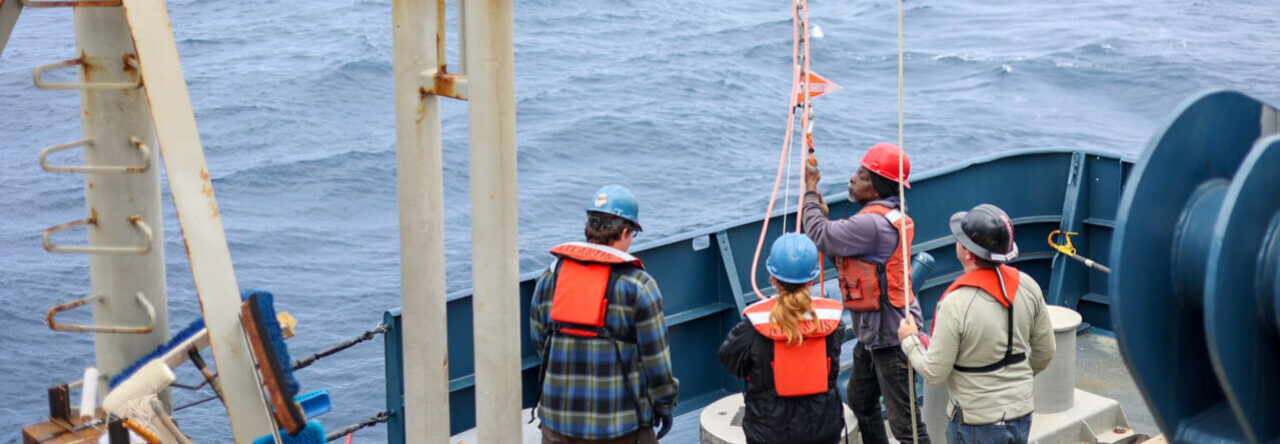
The two biggest issues we ran into at the very beginning of the cruise was the deck winch stand that tows the ISIIS plankton imager stopped responding and then, so did the MOCNESS. The data provided by these two instruments is the heart of this operation and so losing both of them was going to potentially be the end of the cruise. Thankfully, we were close enough to shore that the Chief Scientist was able to call the technician and communicate the error codes so we could get it back up and running. The scientists still end up losing communication with some regularity during a tow, but at least we can now recover and re-launch without issue.

Photo credit – Mark Farley, OSU
The MOCNESS has proved more of a challenge. Not only is it a beast to get in and out of the water, but the 0.680 electro-mechanical cable that allows us to talk to the unit cut in and out for the first two days. Getting it permanently back on line was quite an experience. We carefully inspected and isolated each sensor connection. We made sure the calibration profile for each sensor was correctly entered in the software program the scientists were using. We found some water damage and re-spliced cables and also used new cables. We re-terminated the connection at the instrument 4 separate times. We traced the entire circuit through the ship and ran continuity tests and insulation tests at various points junctions and noted when polarity was reversed to the MOCNESS. We spent a few hours doing a hard re-termination of cutting off the outer and inner steel cables, making a new FIJI fitting, and then putting it through a stress test using a dynamometer and some lifting straps. Needless to say, it was a real triumph to finally get it back up and running.

Photo credit: Mark Farley, OSU
Next up to fail were (simultaneously) the -80 chest freezer, CTD hydraulic power unit, dip net pole, and MilliQ clean water system. Thankfully, these fixes took less than two hours to completely rectify and were back up and running for the scientists that needed them before the next station sampling. Through it all, ResTech Kelsey has held it together very impressively and even kept us on schedule to potentially finish all of the sampling requirements before the end of the cruise. This is a good thing, as we are (naturally) about to hit some rough weather, which will likely slow down operations.

My post for next week will be composed from my own living room. I have a 9-day vacation coming up between this cruise and when I will be off on my next adventure aboard the USCG Healy en route for the Chukchi Sea in the Arctic Ocean. More soon!
– Emily