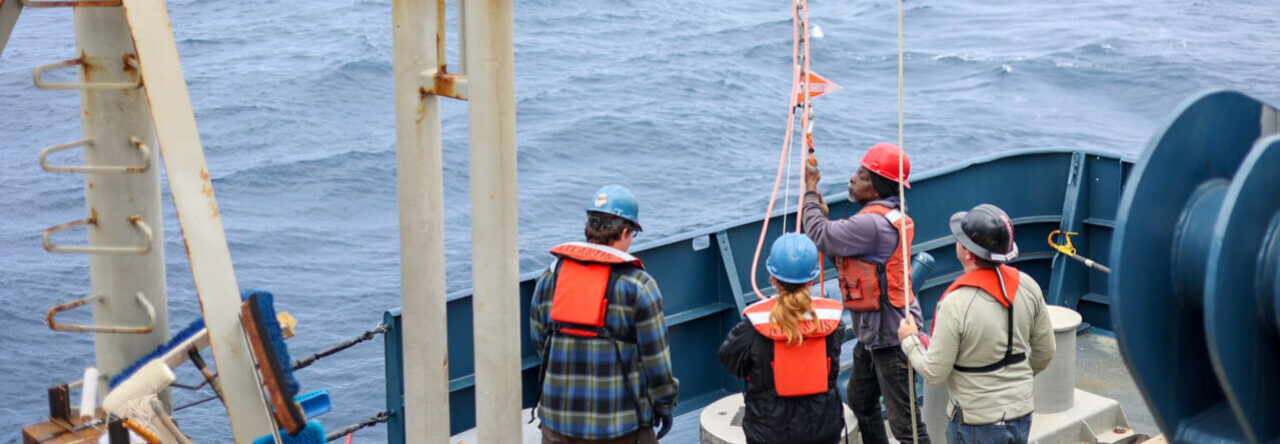
Something that no one tells you about research voyages is that most plans are ever changing. Our research cruise has been ahead of schedule in accomplishment of the science mission. There are multiple additional goals that have been added, on a rolling basis. However, I do not know much of the details, and usually wait until a planning meeting prior to the evolution. Other than assisting science I keep myself busy by learning different skills of a marine technician. There is no single task that marine technicians do that would define them. Rather, the job requires working knowledge of a thousand little things that are necessary for continuous data collection. So far I’ve tried my hand in terminating CTD cables, deploying CTDs, computer networking, meteorological data acquisition, and an endless list of instruments and software that a MarTech is responsible for.
Sometimes I find it difficult to keep up with all the nuanced details that I have to learn. There is a sense of panic that I experience whenever asked to do something that I don’t know how to do. I guess one of the best ways to learn something is to figure it out as I go along. Sometimes I feel nervous while at work, maybe it’s something all newcomers experience when they enter a professional field. Other times I want to rush into a task and get it done as soon as possible. I have to remind myself to slow down, breathe, and listen to my superiors tell me how to do it right. As the coast guard likes to say “slow is smooth, smooth is fast”. But I’ve been doing alright, taking my time and learning. There are some things that I feel very confident in, such as: deck work, basic electronics, basic mechanical fixes. Yet there are other tasks that challenge my understanding. Most software, advanced electrical troubleshooting and computer networking prove to be quite a challenge. Much of the concepts behind something like computer networking are very abstract. Luckily there are multiple team members within STARC and the science party that can explain how to communicate with instruments, and how to direct data flow to the Healy servers. Information technology and its application to marine science is interesting in its own way. Yet it is also very much a background process. By design, IT systems are hard to notice and often overlooked by an untrained eye. So far I’ve been familiarizing myself with the IT nomenclature, such as: Dynamic Host Configuration Protocol, Domain Name System, Random Access Memory, etc. Sometimes it takes going over the material a few times before it starts to make sence. Lucky time is something I have quite an abundance of while out here. Just after a few days of studying the subject I can communicate with other devices on the network from my computer, route cables, and most importantly; understand what is going on. One of the main learning objectives that I had for the MATE internship was to learn system networking and its application to ocean instrumentation. During many application processes that I’ve underwent prior to the MATE internship I was always lacking the skill in system networking. Other than system networking I’ve also learned the details of CTD operations.
Throughout the cruise, we’ve been performing a CTD cast at every mooring deployment site. CTD, or Conductivity, Temperature and Depth instrument is the most fundamental of all marine technician responsibilities. From my prior research cruise experience, CTD casts are the bulk of a scientific mission. However, since the objective of this science mission is to deploy moorings, there has only been a few CTD casts. The responsibility of the marine technician is to maintenance and operate CTD instrumentation. With the assistance from the STARC coordinator, I’ve had to opportunity to disassemble and reassemble the CTD instrument, colloquially known as the “CTD fish”. It’s the fine details, of knowing which sensor requires a two pin or a three pin cable, what is the angle of tygon tubing connecting the seawater pumped to the conductivity sensor, that are the purpose of my internship. In science, precision data collection is guaranteed by equally meticulous attention to detail in instrumentation. While on this particular cruise, the CTD cast are specifically targeting physical properties of the ocean. There are no Niskin bottles installed on the rosette. It’s probably a better training environment since the task is not rushed by the demands of water sampling by scientists. I’ve been able fix small issues that I find on spare parts of the CTD, slowly putting together all of the details taught to me throughout this internship.
Our research cruise is about half way through the mission. Majority of the goals have been accomplished, and now additional projects are added to fill up the time on the Healy. With each day aboard I learn something new, even if it is stressful at times.


