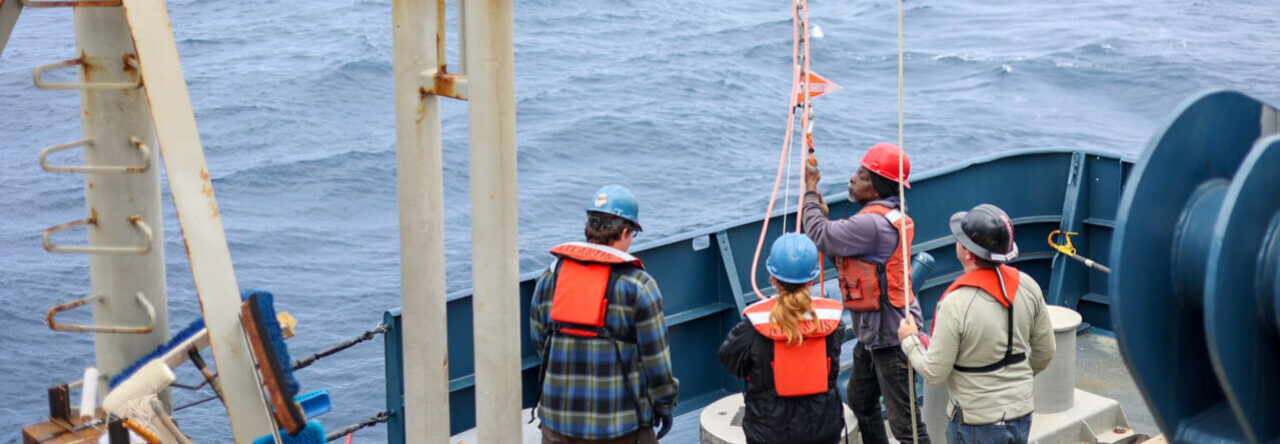
After returning from the first cruise on September 12th, we decided to reterminate the CTD cable because it was very rusty. This was a really fun and useful procedure to learn because it utilizes a variety of skills. First, we cut out the rusty protion of the cable, about 50 meters beginning at the CTD and working back. Then, the outer jacket of the cable is dremeled away slowly, so as not to damage the insulation. Once the 3 conductors inside the cable are accessible, they are spliced with heavy duty connectors. We did not use heat shrink around the splices, because we pour a mould around the conductors that should fill in any gaps, and we did not want bubbles trapped inside the heat shrink. The mould set overnight and the cable was ready to use the next cruise.

Here I am using the dremel to remove the cable jacket.
After the weekend, we left on Monday for a two day cruise to Hydro station. The cruise was scheduled to leave on Tuesday, but in anticipation of Hurricane Humberto we left early. Joining us on the cruise was a student group from Oxford college, most on their first research cruise. We did several CTD casts, and a plankton tow which all went very smooth.
After our return, we began to prepare for the hurricane mostly by turning of many of the computers that were not essential for ship function. We did leave our meterological sensors running so that we could see the wind, pressure, and rainfall as the storm progressed. The rest of BIOS and the crew were busy removing small boats from the water and tying things down. The hurricane finally arrived on Wednesday evening after a slow build up all afternoon. The ship was the best place to be, as we did not lose power and were tied up to the dock. Even our satellite internet connection remained strong during the storm! The most incredible part of the hurricane was the wind, and how much water was blown around off the reach where the ship is docked. On land, many trees were down, and power was lost. See some pictures below:

The middle plot shows the wind speed in knots, from the anemometor on the ship. The strongest gust we saw was 110 knots, but winds were sustained at about 75-80 knots during the hurricane (22:30 – 00:00).


The view from the bridge on a normal day (left), and during the start of the hurricane (right). Swells in the reach were about 4 feet high.


The reach from the main deck on a normal day (left) and during the hurricane (right).
After the hurricane passed, we restarted all of the electronics aboard, and spent half the day fighting to connect the computer to the CTD. In the end, a new install of the SeaSave software from Seabird solved the problem. I also continued to inventory the underwater cables, and test the custom built cables to create pin-out drawings that display the connections.
Overall, week 2 was a bit slower, but it has been a good time to think about the different skills and components of the ship that I want to learn more about. Next week, we are schedueld to head to Puerto Rico and back on an 18 day cruise, but may be delayed due to Hurricane Jerry.
Until then!