Month: May 2026 Page 1 of 2

Loomings etc.

It’s been a great week of getting comfortable with the rhythms of the ship (and the ocean). I’ve always heard that the swell period in the Pacific tends to be longer than the Atlantic and after pulling out of port, I could instantly feel it under my feet.

For the first few days we assisted in final prep in the port of Lautoka, Fiji. We engaged in the most sacred of intern duties: carrying things for people. We lashed all the Ocean Bottom Seismographs (OBS) to the deck, cleaned and secured deck plugs, and got a lot of practice zip tying chords for various instrumentation connecting them from the deck to the computer labs in the ship. 

Once we departed port, we almost immediately fired up the multi-beam echosounder and sub-bottom profiler to collect bathymetry in the fore-arc of the Mathew-Hunter Trench south of Fiji’s main island, Viti Levu. I have some prior experience with echosounders so it was nice to have something familiar, but the depths of the bathymetry we’re looking at are hard to fathom—4000-5000m down! Please forgive the pun. 

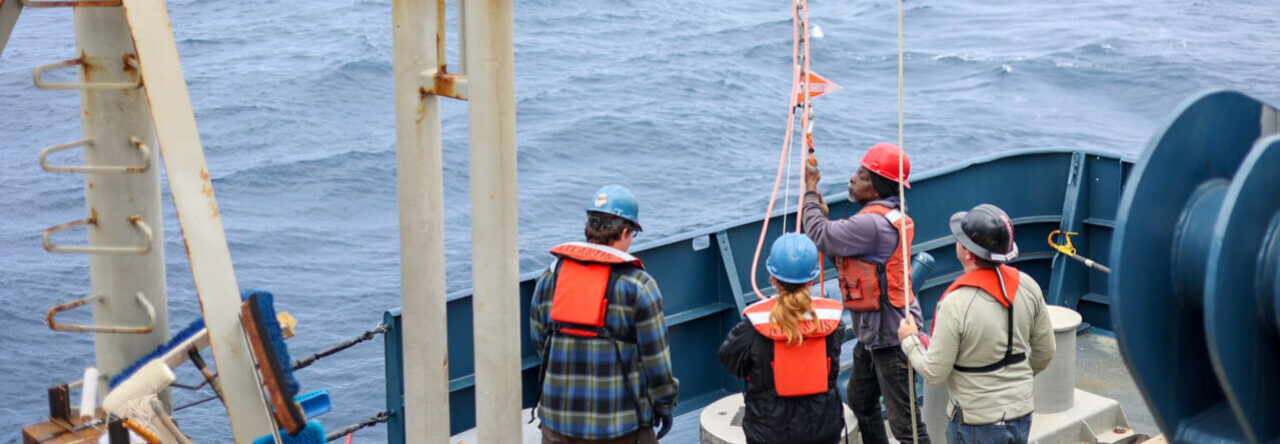
Additionally, we deployed a magnetometer to measure fluctuations in Earth’s magnetic field to pair with the bathymetric data. This small, orange, torpedo-shaped device spools out 300m behind the ship in order to get a clear reading. It also happens that this device has given us the most trouble so far. During our first deployment, our magnetometer gave us wildly varying readings so we had to reel it all the way back in and swap it out with our backup. This was made all the more charming because it takes a couple minutes to spool it all the way out and it was pouring rain on us. Fortunately our tropical location meant that it was more like a nice shower…unfortunately water got in my boots and they took a few days to fully dry. I love wet socks! 

Our survey has been punctuated by deploying OBS off the side of the ship. These rigs sink to the bottom where they will record earthquakes and small shifts in the plates over the next 15 months. Then another cruise will pick them up and they’ll have a bunch of seismic data to analyze. We’ve been assisting the OBS technicians in prepping each package for deployment. It’s been incredible to see how methodical the checklists are for preparing the devices. After all, there’s no changing things once the ship’s crane plucks them off the deck and swings them over the side. After they are deployed we use acoustics to lock into the position of the OBS and track it as it falls to the ocean floor. 

Overall, it’s been an awesome first week. I’ve loved getting to know the crew and other science party members. My shift is from 16:00-2:00, so it’s been fun lurking in the late night and drinking more coffee than I should. 

Looking forward to more lovely sunsets! 

Gone Overboard (Professionally)

Hello again!

I can’t believe it has already been a week since I stepped off land. It took about a day to get used to the seas and the maze that is the R/V Thompson, but I instantly felt at home.

We have successfully deployed eight of the 20 Ocean Bottom Seismometers (OBSs) which will live on the seafloor recording earthquake activity over the next 15 months.

Big yellow things = OBSs

I’m now well-versed in the Marine Magnetics SeaSPY2 Operation Manual, as we spent a full day troubleshooting the two SeaSPYs onboard. After seven failed deployments and numerous deck tests, we are up and running again! If anyone is wondering, I am pretty sure it was the addition of plumbing tape at the main tow connector that finally did the trick. I also spent a morning helping fix the magnetometer winch, which is now back in action.

Magnetometer deployment. Winch pictured bottom right.

The first deployment of the magnetometer occurred during a deluge (see packing list below). Otherwise, the weather has been great! Swell around eight feet and decreasing, temps around 24°C, and about 80% humidity.

The galley crew has been serving up some amazing meals: fish, scallops, steak, grilled cheese, BLTs, hamburgers… My favorite so far was an asian lunch with glass noodle salad, fried rice, egg rolls, crab salad, and chili sauce.

Free time has been filled with Monopoly Deal, fiber arts, and learning how to splice cable on the aft deck.

Things I wish I packed: foul weather gear, waterproof steel toe boots, peanut butter.

Stay tuned for another week at sea!

Avery

Watch Out

It has been a week since we left port in Lautoka, Fiji and science on board is well underway.

My days starts at 0100 when I wake up to get ready for watch. I head to the computer lab around 0145 to relieve Benny. We go over what happened during his watch and anything to keep an eye on for the next 8 hours. Now that all science operations are underway, watch standing can vary, but typically we monitor the incoming data for the multi beam, the sub-bottom profiler, and the magnetometer. So far, we have mapped over 900km of the seafloor and measured the Earth’s magnetic field over large segments of this track. 

The Computer Lab, where we live data streams come in and can be monitored

If you squint, you can see a rainbow lands right on the magnetometer winch. We were very hopeful this was the good omen we needed after a full day of troubleshooting the instrument.

Watch during OBS deployments looks a bit different. A couple hours before the estimated time of deployment, I help the OBS technician on watch set the instrument clock and configuration and ensure the sensors are properly recording. We then tackle the acoustics, checking that communication with the instrument is functional. 

45 minutes to half an hour before the ship reaches the deployment site, we assemble and mount the recovery aids and enable the acoustics. Once we are sitting on the site, the OBS is deployed over the side and sinks to the seafloor. We track the drop rate of the instrument from the main lab using the acoustics that were enabled just before the launch and a deck box that communicates with it. This is also how we survey the position of the OBS and determine its final location. 

When the OBS surveys are completed, we get to deploy the magnetometer, which get recovered before the OBS deployments, and start monitoring the magnetic field strength. This week, the magnetometer gave us some trouble, but after troubleshooting and relaying our issues back to shore, we were able to get the instrument functioning and recording accurate readings once again.

My watch overlaps with breakfast so my watch mates and I take shifts eating and monitoring the data just in case one of the instruments starts to misbehave. 

Breakfast tends to be my second meal of the day as it is served 6 hours after I wake up. My first meal is around 0230 when I raid the leftovers fridge like a raccoon and discover what was for dinner the night before. 

Bagged noodles have become a new staple of my diet!

At 0945, I turnover with Avery and give her a rundown of the morning events and any other information that could be helpful while she stands watch.

At 1000, I am set loose and free to wreak havoc on the ship or take a nap. For the most part, I choose sleep.

Week 3 – R/V Sikuliaq Made It to Dry Dock!

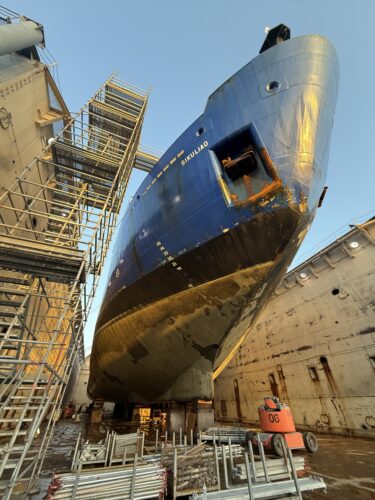
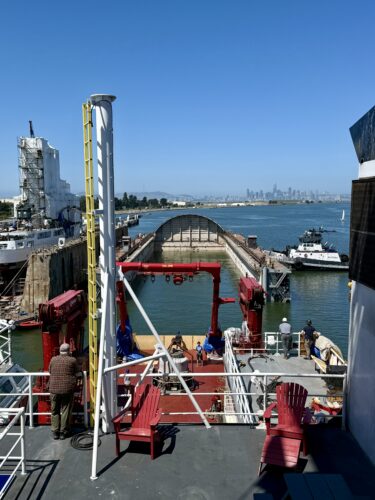
We have officially made it into drydock! Early in the morning, a group of tugs helped push R/V Sikuliaq off our docking into the submerged drydock structure. The drydock is a large structure designed to lift large ships out of the water by pumping water from a submerged platform beneath the ship.

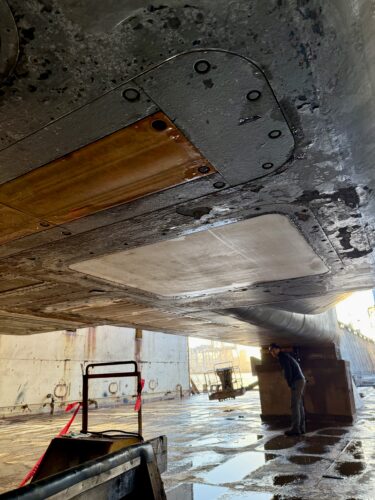
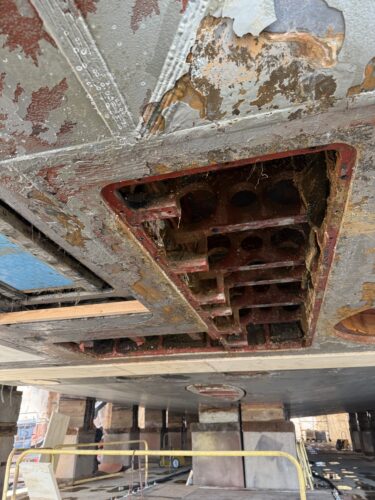
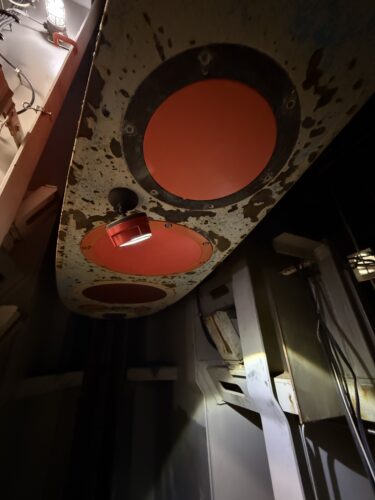
Getting out of the water has allowed the team to move forward with many projects. In our first few days dry, we were able to remove all of the ice windows and sonar systems from the flat region of the hull dedicated to sonar systems. This area is called the sonar flat. We removed the 75 kHz ADCP, OS 150 kHz ADCP, EM 302 multibeam transducer array, EM 710 multibeam transducer array, and TOPAS PS-18 parametric sub-bottom profiler. The transducers and the ice windows that protect the scientific equipment from polar ice impacts are both extremely heavy and extremely sensitive. There is just over 5 ft between the hull and the dock, leaving very limited room to work. We had to support the heavier instruments using wooden dunnage and support the lighter sonars by hand.

(Above) Sonar flat with ice windows and transducers still in place.

(Above) One portion of the EM 710 multibeam transducer array was removed.

All of these sonars are synchronized through a system called K-Sync, preventing the sonars from pinging at the same time. I have really enjoyed seeing how this system is physically connected throughout the ship. Working directly with the instrumentation has helped me clarify the transition of a sonar ping from physical signals to electrical signals that are carried to the lab through carefully considered cable routing.

-Paige FitzPatrick

Cate McLeod – Introduction

Bula from Fiji!

I’m Cate McLeod, one of the 3 MATE Interns aboard the R/V Thompson for the next few weeks. I will be helping out the science party on this upcoming cruise to examine the early phases of subduction along the fault within Ocean Bottom Seismographs (OBS), multibeam surveys, and magnetometer tows!


I’m originally from the Northeast and have spent all of my life around if not on the ocean. I graduated with a B.S. in Geosciences with a concentration in Geophysics from Scripps Institution of Oceanography at UC San Diego. During my undergrad, I participated on my first research cruise aboard the R/V Atlantis and since then, have found myself sailing with the science parties on various other cruises and ships. I love being at-sea and getting to know the amazing people who make oceanographic research possible.


We will be in port for another couple of days, mobilizing the oncoming science equipment and I cannot wait to set sail with the rest of the science party aboard cruise TN-453.  I’m looking forward to aiding the science party and learning what I can from the marine technicians about their role on the Thompson!

-Cate

Benny Adler — Introduction

Hello!

I’m one of the interns on an upcoming research cruise on the R/V Thomas G. Thompson. In a few days, we’ll be sailing out of Fiji to investigate subduction initiation in the Mathew-Hunter Trench.

I’m a recent graduate from Bowdoin College, where I studied Earth & Oceanographic Science and minored in History. I have some background working on scientific and hydrographic survey vessels, but this will be by far my longest cruise to date. I’m excited to get to know the crew, science party, and learn voraciously in the upcoming month.

Candidly, I hope I can make an appearance on the Thompson’s awesome Instagram account.

See you next week with an update!

— Benny

Intro: Avery Wilson

Hi!

I am an upcoming intern onboard the RV Thomas G. Thompson as it transits from Suva, Fiji to Noumea, New Caledonia along the Matthew-Hunter Trench. The research cruise will spend a month study the ongoing subduction initiation processes occurring within the region.

I am a Colorado native who loves both the mountains and the ocean. I moved out east for a bachelors degree in Earth Science (Oceanography) from the University of New Hampshire. During my undergraduate studies, I also completed a minor in marine biology during a semester at James Cook University in Australia, as well as a minor in Ocean Engineering.

Outside of the classroom, I was on the club sailing team at UNH and spent many summers as a boat driver on Catalina Island. I am a big enjoyer of nature, music, and food—follow along for a peak into meals onboard a research cruise!

I’m looking forward to sharing more about this journey, the science onboard, and the experience of working at sea in the South Pacific!

-Avery

Week 2 – Winches, EK 80 Trancievers, and Domes

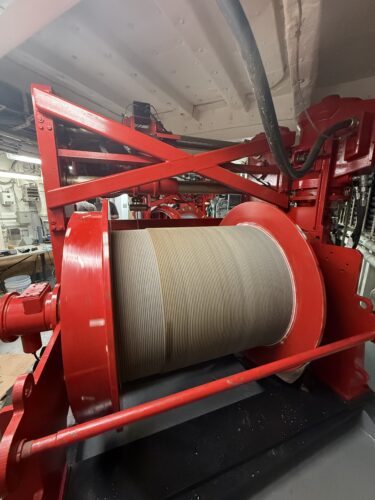
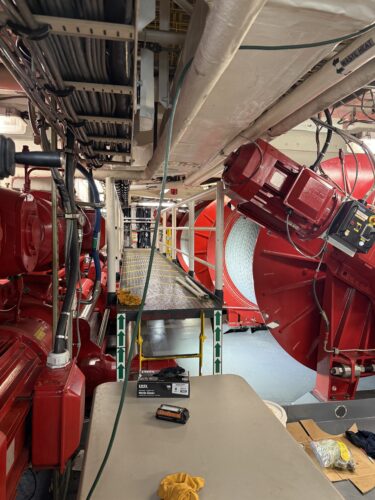
Week two onboard R/V Sikuliaq has primarily featured maintenance on the advanced system of winches. R/V Sikuliaq has an oceanographic traction winch system and two hydrographic winches to support a wide variety of scientific research expeditions. Winch systems play a critical role in oceanographic research. They are responsible for suspending heavy equipment from the ship into the depths, often carrying data directly to the laboratories onboard. This week, we unspooled the winch wires for re-lubrication and maintenance. This required a spooling system on the dock to take up slack and communicate with the winch system onboard. To prevent damage to the wires and to ensure proper wire spooling in the winch drum, tension was kept between the onshore spooling device and the ship’s winches. The many moving parts of this operation required direct and clear communication. If the onshore spooling device continued to run while the onboard winch stopped, the wire could snap. Our team was able to successfully lubricate our winch systems, ensuring proper functionality during upcoming research cruises.

We additionally checked the integrity of the wire insulation using a megohmeter. This test applied a high voltage to the winch wire to measure the amount of leakage coming through the wire’s insulation. We tested both the winch wire and the slipring that connects the rotating winch drum to the data cable leading to the ship’s laboratories.

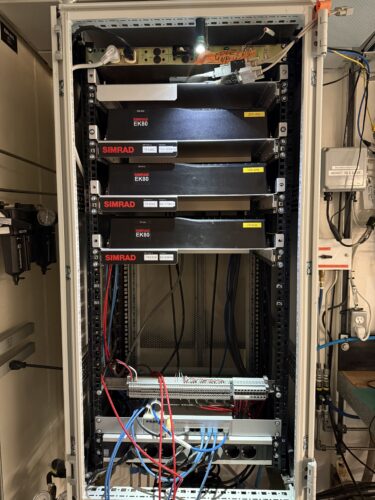
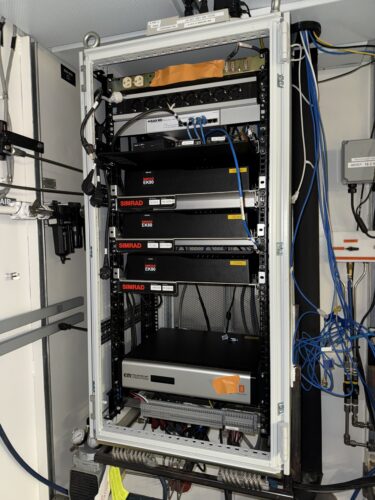
One of my additional projects this week was rearranging the aft mainlab LAN (local area network) rack.

This rack houses the EK80 sonar system transceivers, shown in black. These devices transmit and receive information from the transducers located in the centerboard shoe. To rearrange this rack, I removed the transceivers, power strip, and din rail. I reinstalled the equipment with a more streamlined approach to improve equipment accessibility. Additionally, I installed a new drawer for the Raspberry Pi computers housed in this rack. This quired CAD drawing and 3D printing of a component to secure the shelf to the LAN rack.

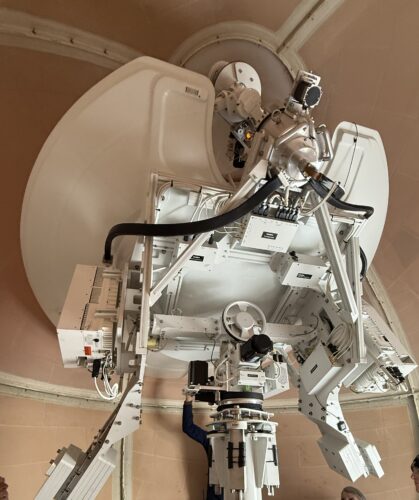
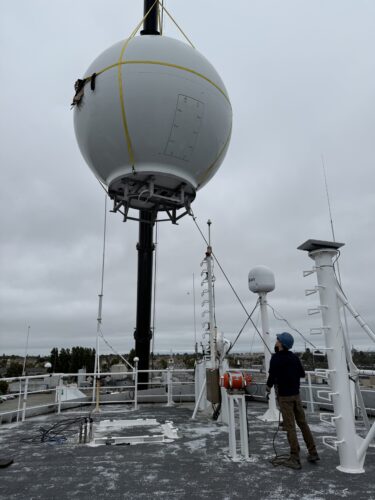
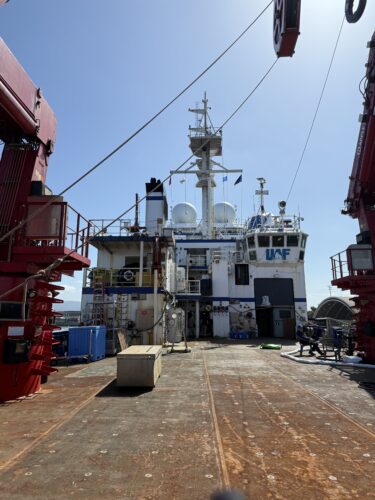
Lastly, we removed the domes! The domes formerly housed a HighSeasNet satellite communication dish. The ship is moving to a OneWeb system, utilizing a low earth orbit (LEO) satellite constellation for our redundant global internet access system.

Connecting how systems send and receive messages has been a critical learning component of this week. I have found it very interesting to see how the software interface operated at sea interacts and connects to the physical sensor units we are servicing at drydock.

-Paige FitzPatrick

Week 1 – Preparing R/V Sikuliaq for Drydock

Hello everyone!

I have completed my first week onboard R/V Sikuliaq as a MATE intern! Getting an introduction to the vast array of scientific equipment onboard has been an incredible first-week experience. One of my favorite things to learn about R/V Sikuliaq is how her equipment is specialized to face harsh, icy conditions in the Arctic and the Antarctic. We are currently docked in Oakland, California. This week was all hands on deck, preparing the ship to be lifted out of the water. One of our major projects was the removal of the EK80 sonar system transducers from the centerboard shoe. The centerboard is a large retractable structure within the hull of R/V Sikuliaq that houses sensitive sonar equipment. The centerboard extends beneath the hull when the equipment is in use, gathering high-quality seafloor mapping and acoustic data. When the instruments are not in use, and particularly when the research vessel is facing icy seas, the centerboard retracts within the hull. The centerboard shoe is the housing at the bottom of the centerboard that holds the transducers.

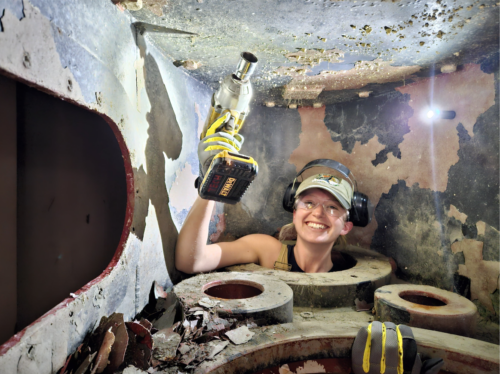
Working inside the centerboard shaft is a very unique experience. The centerboard shaft almost resembles an elevator shaft. A metal grate is placed in the area beneath the retracted centerboard. The ocean lies beneath the grate, with the centerboard looming overhead. It is not a place to fear heights or confined spaces. We were able to successfully remove the transducers, requiring very careful use of tools to pry the instruments from their seats. The face of the transducers is very sensitive and has to be handled with extreme care.

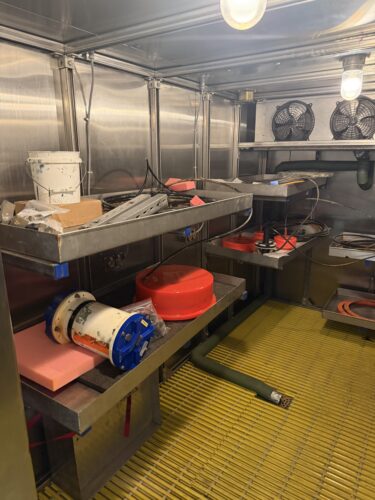
Above is a photo of me inside the centerboard shoe after the removal of the EK-80 transducers. The space is very small, but I feel right at home! Below is a photo of the removed sensors, stored in an unused refrigerator.

Other smaller projects included designing and printing new caps for the upward and downward facing sky temperature and sea surface temperature sensors, climbing to the top mast to inspect the meteorological equipment, studying how instruments communicate throughout the ship, and exploring Alameda Island. It has been a great first week with the crew!

-Paige FitzPatrick

Week 3 – “Leave Her Johnny” [HNL:MAJ]

–Underway from MAJ–

For the final week of this internship (May 1-9) we finalized our pending tasks of installing all the new phone lines in the portable labs along with several internet access points and a few more SOFAR Buoy deployments.

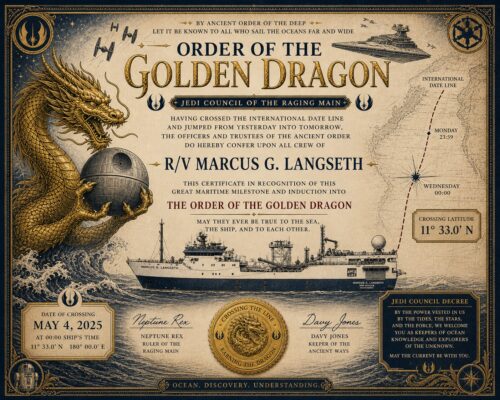
Before that however, we crossed the anti-meridian and successfully completed the “Order of the Golden Dragon” sailor’s merit, which just so happened to occur on May 4th and inspired Cody to create a commemorative print out (with some minor adjustments).

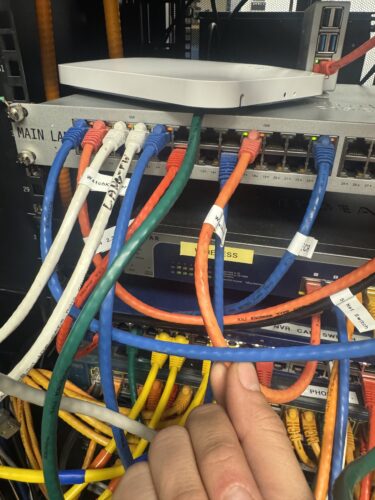
The first part of this task included setting out 6 sets of CAT5e cables, each measuring approximately 15 fathoms of length. After setting these cables and terminating both ends, we fed the lines into our port lab switch box before inserting 2 cables into each of the DICE portable lab transits.

After troubleshooting a faulty port in the main lab server rack, all lines responded well to our internet access point modems and phones which lead us to wrap up our work and close the transit. For our remaining work, we assessed a previous gravity tie and land tie in order to determine our delat and rate of change between previous readings, which as metadata could be used to determine if e would need to have the gravimeter recalibrated soon. We also had enough time before reaching Majuro to set up another CAT5e cable in a POE termination pattern for the aft IFR camera, which will serve as a useful tool for supervising seismic gun operations and ensuring no sealife are around high risk sections. Finally, I also had the opportunity to practice XBT launches, which will add a new incredibly relevant skill to my professional summary.

–Arriving to MAJ–

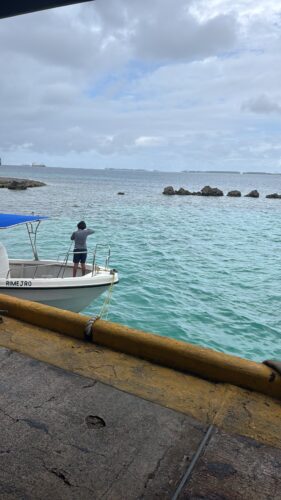
We arrived to Majuro a short while after finishing our work, and I was able to spend some time ashore speaking with the incoming technicians and science team, in fact, Theo (previous MATE intern and current field scientist aboard the R/V Langseth) and I got to meet up and talk about how much this program has changed our careers.

–Final Thoughts–

As this program comes to a close, I want to thank the R/V Marcus G. Langseth’s crew for being so welcoming, and I especially would like to thank Jacob Greenberg and Cody Bahlau’s tremendous guidance throughout this program. The UNOLS-MATE program has made me a much more confident scientist, oceanographer, and maritime technician, and will surely lead me to a successful career in the near future, for now however I say farewell and hope to have even more stories to tell some day, whether online or in person when we recognize each other in a remote part of the world.

Yet for now, fair winds and following seas!

-Conrado A.B.

Page 1 of 2

Powered by WordPress & Theme by Anders Norén