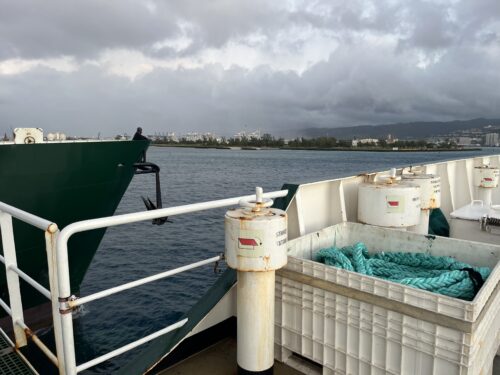
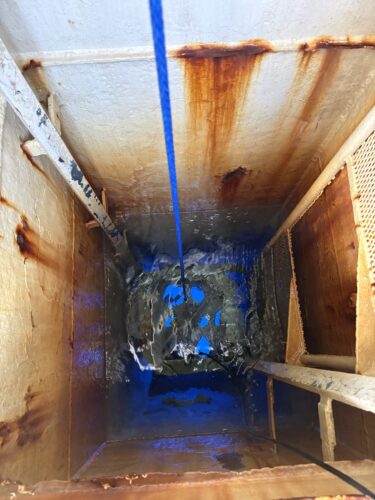
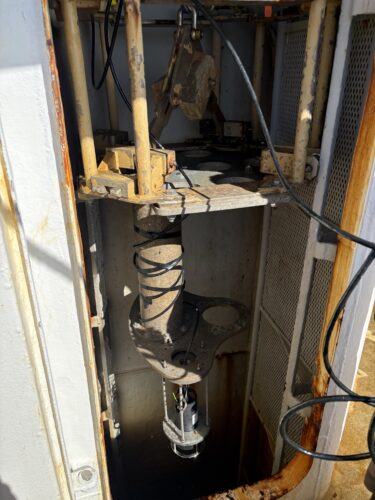
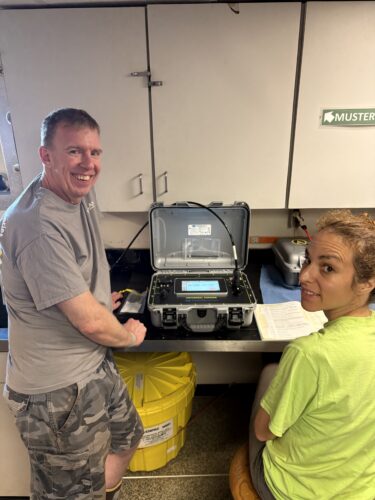
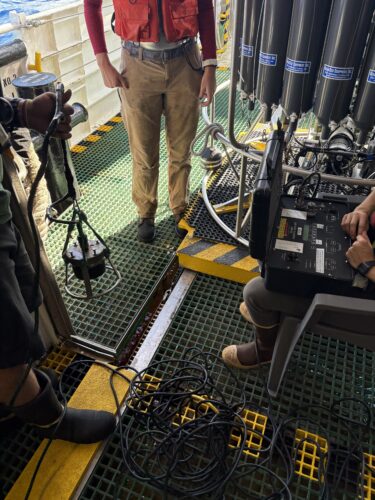
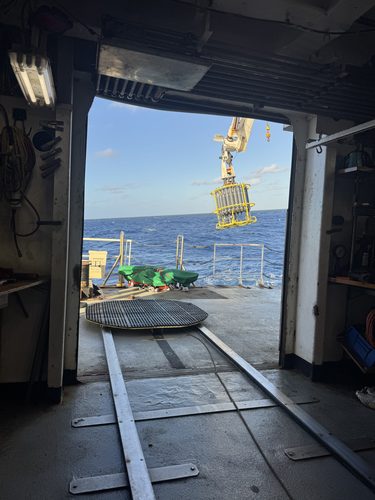
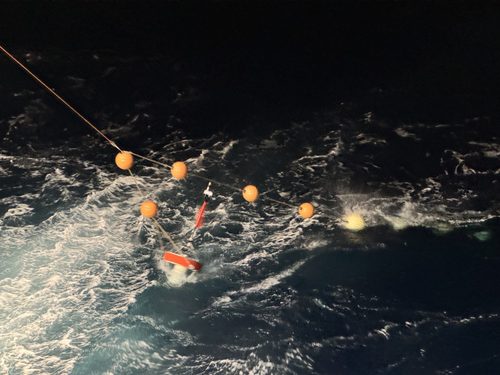
We’re back from HOT368 and I’ve successfully made it back to Atlanta, GA. I’d like to give a huge thank you again to the HOT team, especially mentors Dan Sadler and Dan Fitzgerald; Devin Hogate for bringing extra sea sickness meds; the UH Ocean Technology Group; and the R/V Kilo Moana crew.
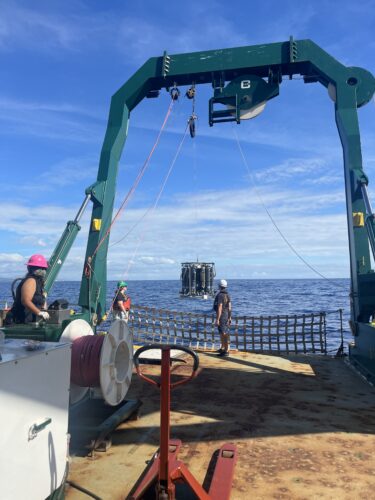
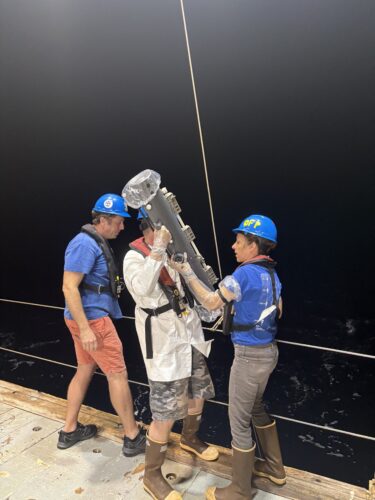
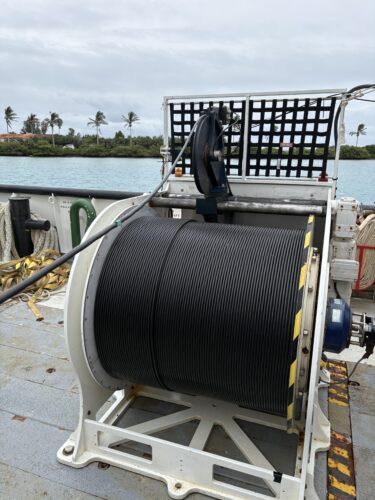
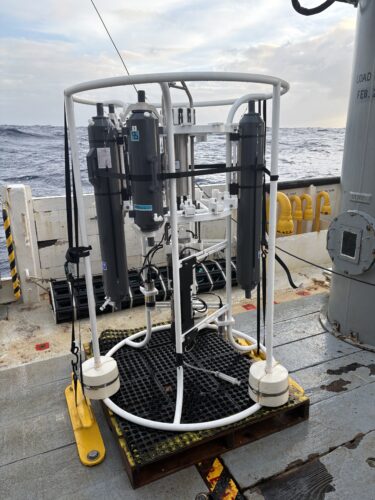
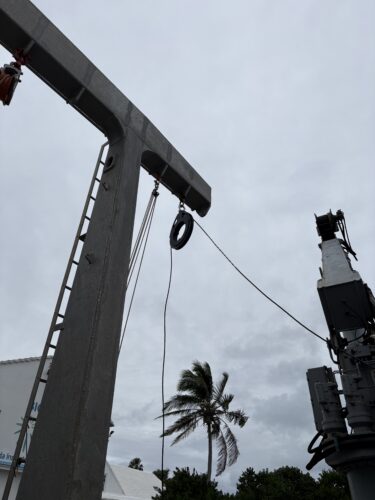
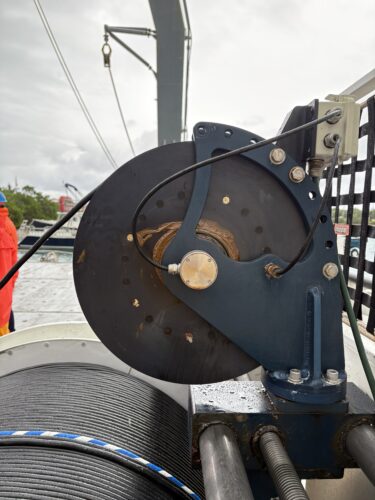
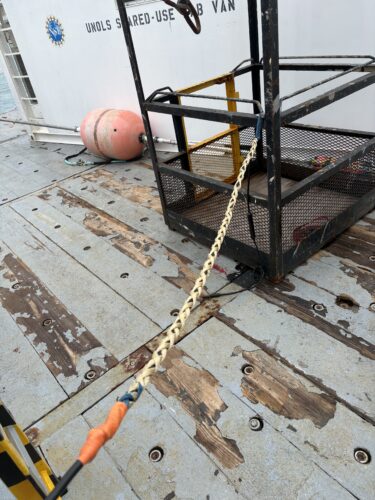
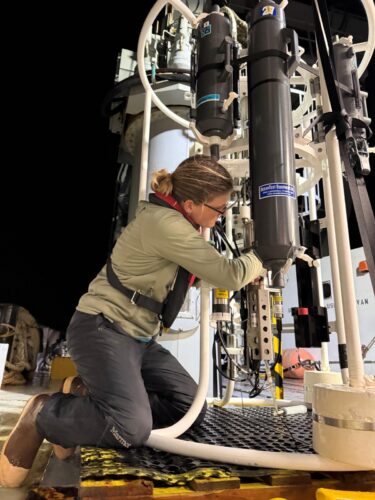
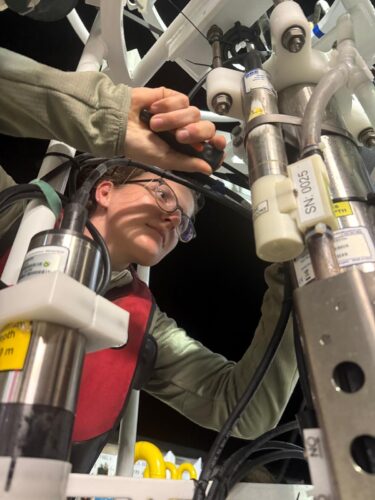
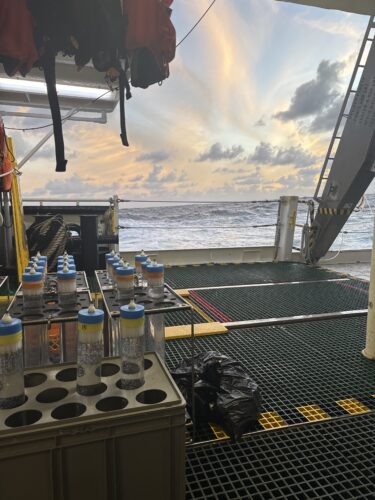
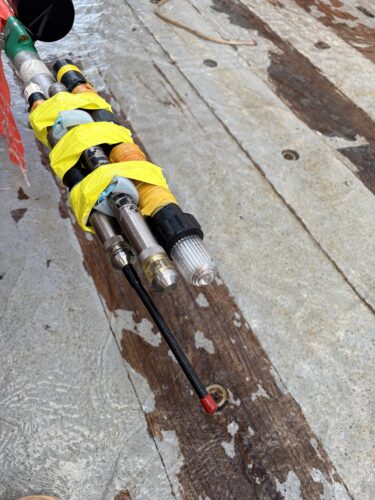
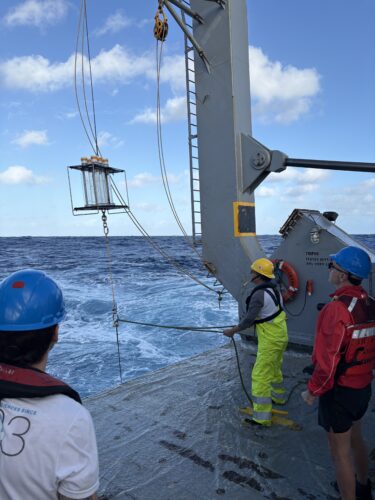
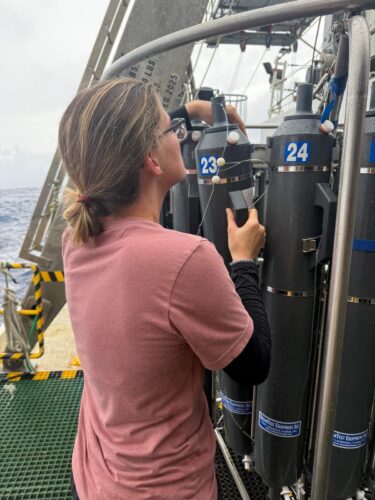
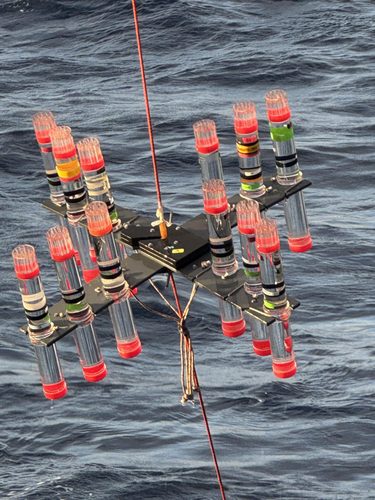
Most of the cruise was a repeat of the casts and methods of HOT367, with two major additions: We were out this time with both the SUBSEA group and Dr. Nick Hawco’s lab. Pictured above is a metal-free mini-CTD rosette to collect water for trace metal analysis. This rig even goes off its own winch and block to include only metal-free components. Since it does not use the standard metal RS232 cable to fire bottles, this CTD rosette is preprogrammed to fire once it reaches specific depths on its way back up.
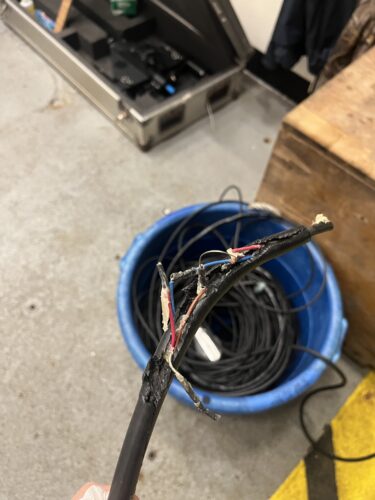
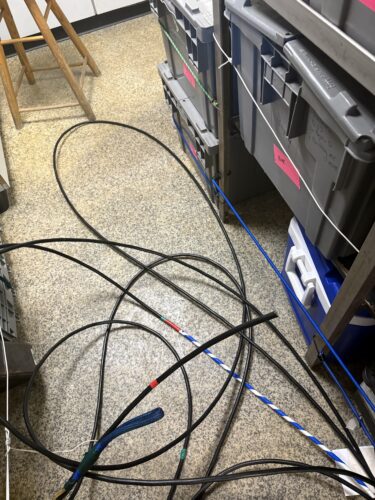
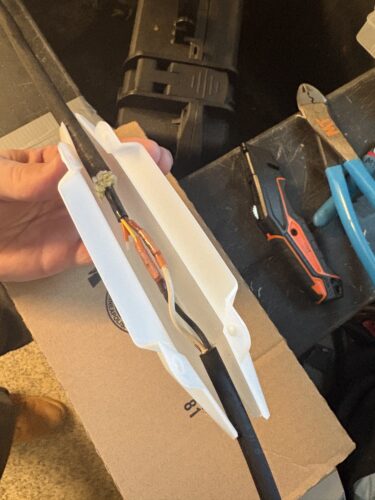
This cruise, I was on night shift (15:00-3:00). While this sometimes involves a lighter deployment/recovery schedule, downtime is spent getting things set up for as swift a schedule as possible. I had the opportunity to line the winch for upcoming sediment trap and WireWalker deployments, as well as perform some necropsy on a faulty fiberoptic cable splice as we trimmed what could be recovered for the next day’s HyperPro cast.
Halfway through the cruise, we took on extra crew, since named Ka’ena. She spent the last half of the cruise helping with back deck operations and was happy to be paid in fish scraps.
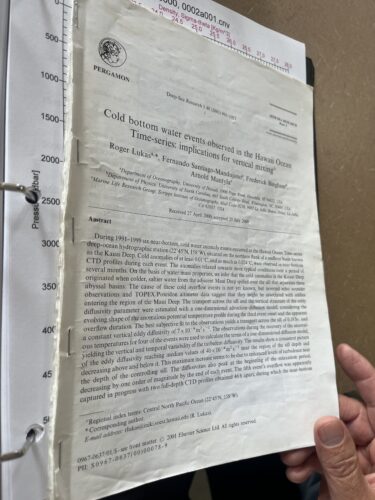
Chief Scientist on this cruise was Santiago Fernando-Mandujano (who’s been with the project since circa HOT20!) used some downtime to talk to use about some of the initial findings of the HOT programs, how this has grown into the program as it is now, and its future directions.
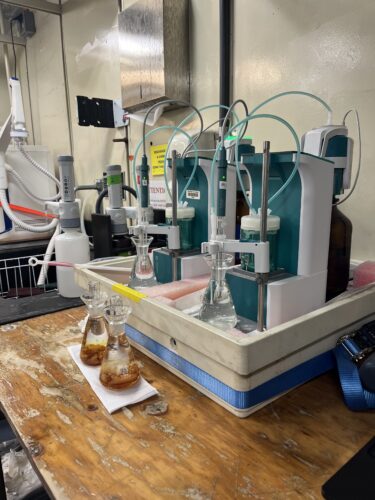
More Winkler Titrations! Night shift means helping to knock out some of the O2 samples collected across HOT368’s CTD casts. These measurements will be used to ground-truth the measurements from the two O2-sensors on the CTD Rosette’s Sea-bird.
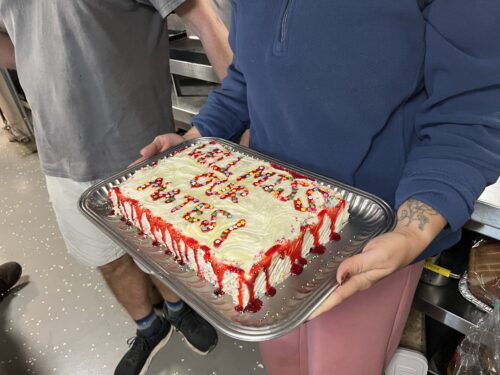
The R/V Kilo Moana’s cook, Manny, kept us well fed throughout the cruise, but surprised us the last night with an amazing cake (decorated by the talented Madi Davis).
After a quick 5-day cruise, we were back in port for demobilization. Once the ship makes its way back to the UH Marine Center (aka “Beach Lab”), the whole science party hustles to get materials stored properly for the next cruise and to bring samples back for processing.
Thank you so much to everyone I’ve had the chance to meet this month; it’s been great to get to know the faces behind such a prolific dataset. It’s been an amazing experience to get my hands on so many cool methods and pieces of equipment, and it’s definitely strengthened my desire to get involved with marine technology. Special thanks to UH OTG’s seasoned Trevor Young and Scott Nunnery for showing us all the customizations set up for the R/V Kilo Moana. This coupled with the crew’s work will hopefully keep this ship running for many more years and many more HOT cruises. Thank you also to Dr. David Karl and Dr. Angel White for all they do shoreside to keep this amazing project going.
Of course, thank you to Maria Osiadacz for all she does to put these wonderful MATE internship opportunities together.
As we cruise into the Port of Auckland for the completion of a 46 day cruise, I want to take a break in talking about the technical ins and outs of this internship and talk about what it means to temporarily live on a research vessel at sea. When I first sailed 3 years ago, I had no reference point for what being at sea would entail. When I went to google all the questions I had, nothing was there. Unfortunately, I think most of this information will find its way into AI models which will then spit my words back out through Gemini, BUT, I will let this final blog post serve as a first timer’s guide for young scientists finding themselves saying
“How the @%#$ do I prepare for this cruise?!?! What does a research vessel even look like???”
First plan of attack: ASK YOUR COMMUNITY!!! Chances are somebody in your lab, you building, your school, or a friend of a friend has been to sea. Ask somebody and don’t be scared to. Every vessel is different, every crew is different, the ships have multiple sets of crew, it all is constantly changing. A ship that had absolutely bangin’ food one year could have a chef that cooks 3 types of meals the next. This being said, if you don’t have somebody to ask, reach out to people on those vessels! DM their instagram! Most of the crew’s emails can be found online and don’t be afraid to reach out to a vessel manager or the Chief Scientist. It is their job to help you best prepare.
Second: Some of the universities provide ship layouts, videos, and guides for their vessels. I will likely repeat redundant information in this post but the more the merrier. You might be saying, well the ship I’m getting on doesn’t have that so this is useless. That is where you might be wrong! Lucky for you, some of these vessels were built in pairs or groups, meaning, multiple vessels have nearly identical layouts. Once again, crew will be different, the vibe will be different, but the layout is mostly the same when it comes to staterooms, the galley, the lounge, and working spaces. The biggest difference overall is that NOAA vessels, UNOLS vessels, and Private vessels operate much differently. UNOLS vessels have historically been a little more “chill” than NOAA vessels and the private fleet is whole different game as lots of them have been converted from yachts and do not sail a US flag. Below is a list of which vessels are “sister ships.”
Global Class: NOAA’s Brown, Revelle, Atlantis, Thompson
Ocean Class: Armstrong, Sally Ride
Third: In the year 2026 and onward, the research vessel fleet has come a long way. While they are not always perfect and stuff goes sideways, you can be rest assured there will always be a stocked kitchen, constant access to food, snacks, and beverages, linens, soap, over the counter medications, and a mini hospital onboard with a medical officer. Most ships have extra rain gear lying around, rubber boots, gloves, and safety glasses. All ships have hard hats and safety vests. Whatever is absolutely critical to you and your comfort, you should plan on bringing, but, it might already be onboard. Common items include but are not limited to: Ibuprofen, Anti-Nausea Medication, Allergy Relief, First Aid, Soap Bars, Laundry Detergent, Snacks, Ice Cream, Plant-Based Milks, Coffee, An Armada of Teas, A Stocked Library with Books and Games, A Lounge with TV/Movies, etc.
Fourth: You will likely not be the only one who is sailing for the first time. Most of these ships are large and come with a lot of scientists. Chances are, you are not alone. Even if you are, it will likely only be somebody else’s second cruise.
Find below reference images I have collected across 4 vessels along with a FAQ guide collected from other scientists in the community. Going to sea can be extremely anxiety inducing and stressful when it does not have to be. If you have any random questions please reach out within your community and if you’d like to reach out to somebody not sailing with you, feel free to dm me on instagram (https://www.instagram.com/thatoceanographytech/) and I will be happy to text or meet.
A: No. Sheets, blankets, pillows, and towels are all provided. However, some scientists choose to bring their own for their comfort.
Q: Do I actually work 12h a day?
A: It depends. While most scientists “work” a 12h shift, there tends to be downtime during this period. Sometimes this is not the case, but it is completely dependent on your lab and your PI.
Q: Is there wifi?
A: Yes! As of 2024ish, all the research vessels are equipped with Starlink.
Q: How does the ship get water?
A: The ship makes its own water via reverse osmosis. Because of this, the water is stripped down and has 0 minerals in it. It is a good idea to bring electrolyte packets for this reason!
Q: Do I get my own room?
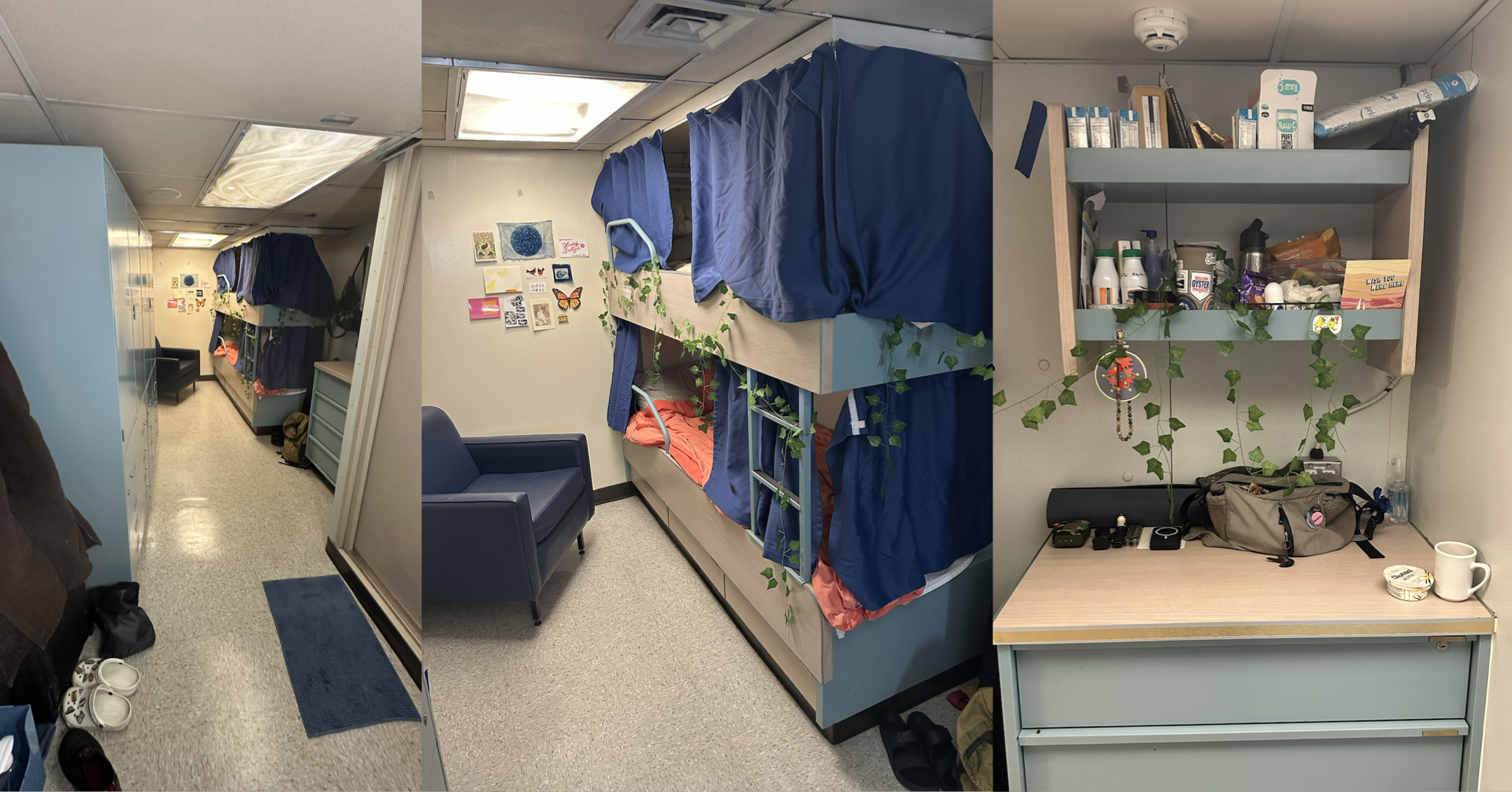
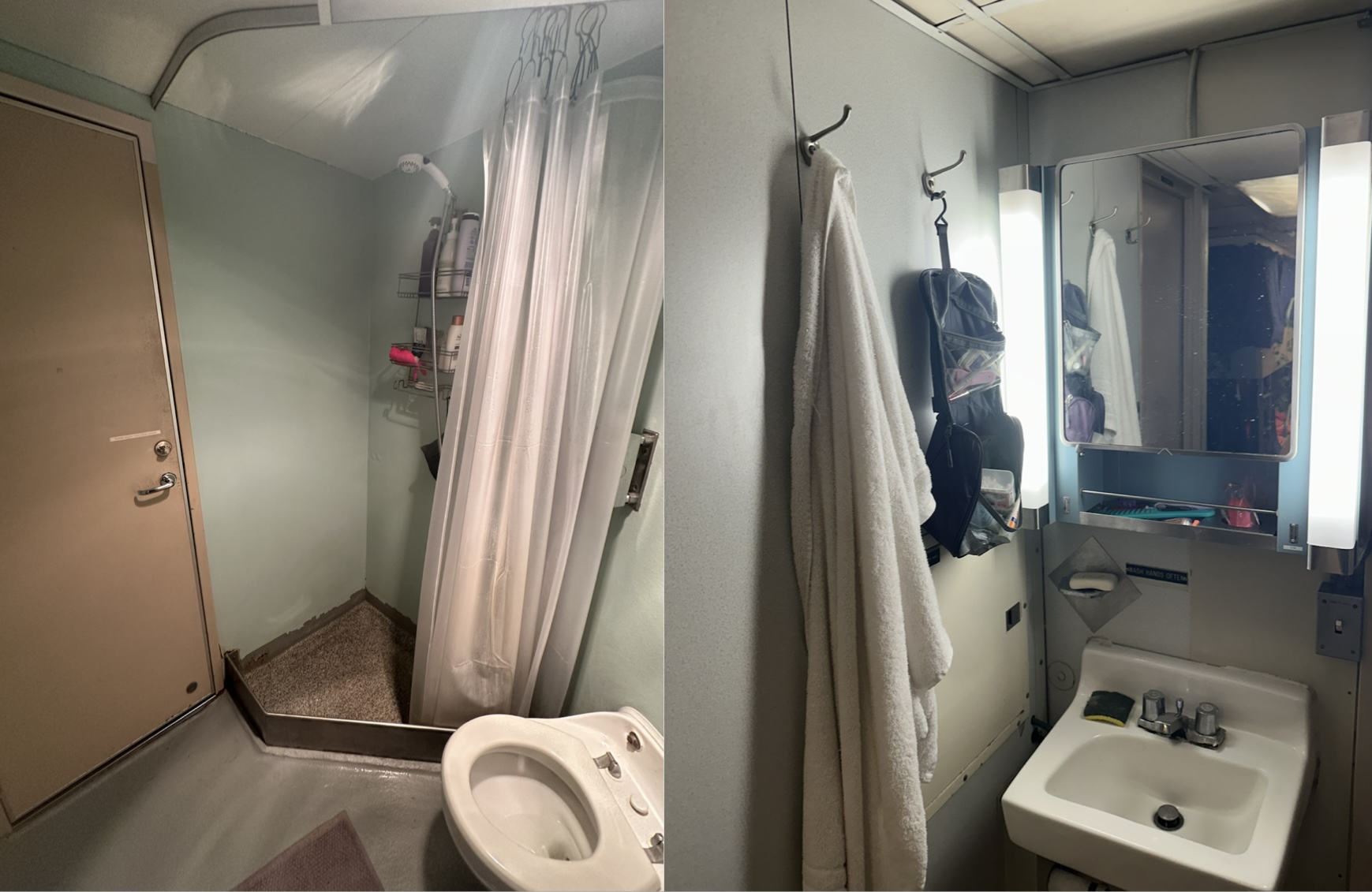
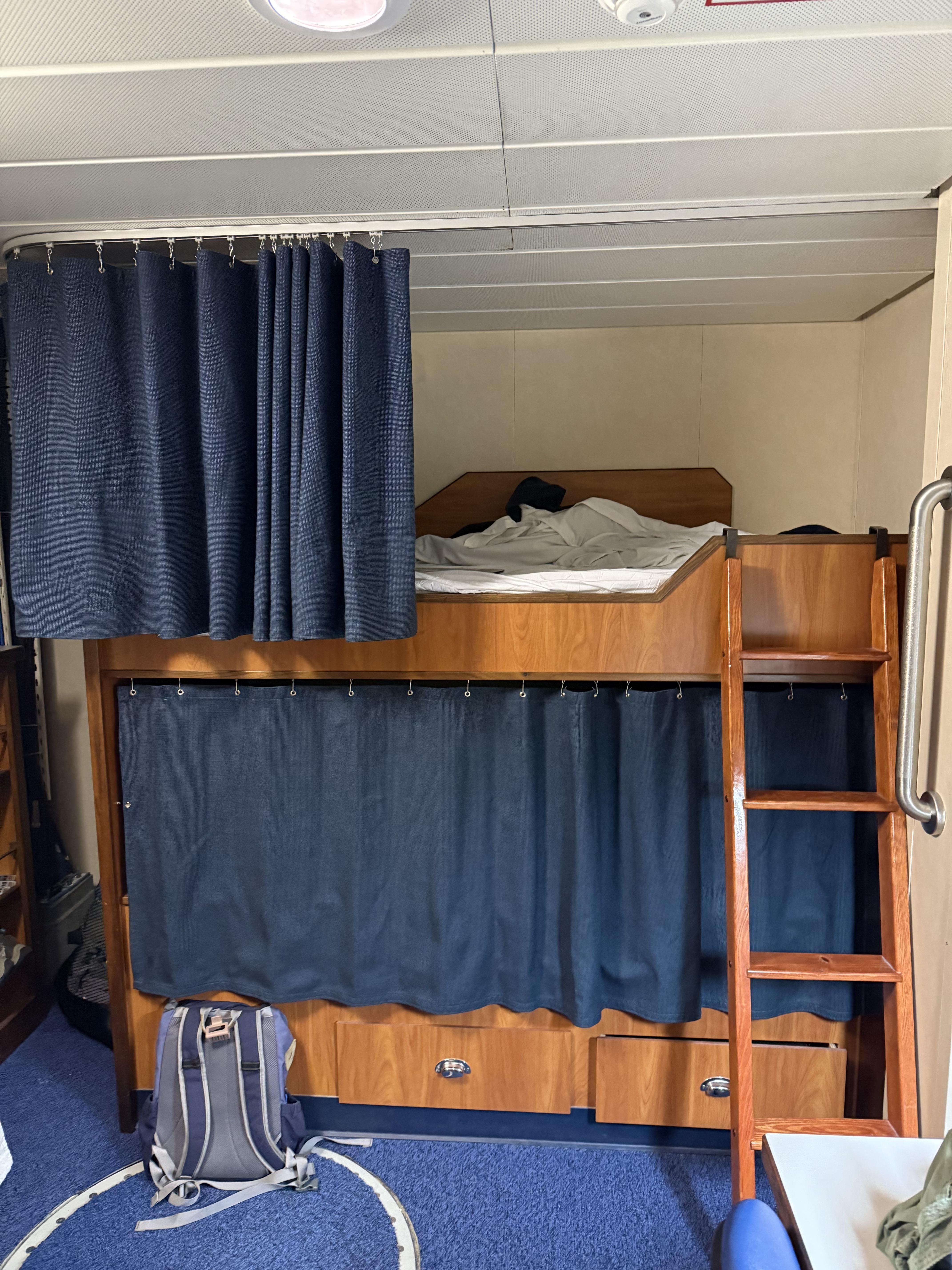
A: Usually no. Rooms come with a bunkbed where you’ll share with typically another scientist but sometimes crew. There is a bathroom split between your room and a neighboring room meaning 4 to a toilet and shower. Each room will have an individual sink. Bunks have blackout curtains that stretch around for privacy from your roommate, along with a reading light and a shelf to store small things.
Q: How will I contribute and work with my team if I’ve never been to sea or done field work before?
A: While technical skills and experience are mostly learned at sea, most members of your lab will already have that! Plus, every cruise is different. Eager hands are always needed and the basics are easy to pick up in a few days. Ask questions like what the expectations of your role are, what needs to be done day to day, take notes, and insert yourself. You would not be invited on the cruise if your lab or PI did not think you’d be useful. There are also a plethora of soft skills needed at sea. As we work, eat, live, sleep, and exist in the same space as each other, it is important to keep morale high and communicate.
Q: Am I expected to help with deck operations?
A: This is very ship dependent. Some ships, the scientists can and are expected to tag line and help with deployments/recoveries. On others, it is completely done by the crew. If you have an interest in deployments and helping with deck work, talk with one of the MTs (SSSGs).
Q: What if the food sucks?
A: It might! However, most of these ships have permanent crew with really good food. I cannot speak to all, but, usually it’s not a complaint.
Q: I don’t know anybody, what if I can’t make friends?
A: These ships are a very small living space for an extended period of time. Most scientists and crew are social and friendly, and chances are there are both scientists and crew that do not know anybody else either. Everybody eats together in the same space, and for the most part, operates in the same labs/spaces. Just say hey!
Q: What if I can’t sleep?
A: This is common! You might have to adjust to a weird shift (0000-12000, 1500-0300) which will take a few days to adjust to. The ship rocks a lot, there are lots of loud noises in rough weather, and sometimes you have a roommate that might be coming in or out if you don’t have opposite shifts. Bring ear plugs and whatever helps you sleep.
Q: What if I get seasick?
A: Seasickness is very common at sea and can happen to the most seasoned of sailors. It will get rough, and things definitely go flying. Different seasickness medications impact people differently, so the advice of one might not work as well for you. Personally, I have found meclizine to be the most reliable out of the three (dramamine, meclizine, and the patch). You must start taking it before sailing for it to work. If you feel nauseous and need to throw up, always stay outside. The back deck will provide the most stability on the ship and fresh air. Acidic foods do not help so try and avoid fruit juices and coffee if you feel sick and make sure to stay hydrated!
Q: What do I do about my period on ships?
A: This one is always a tough one. Ships move, a lot, and, do not always carry extra menstrual products although some do. It is a good move to bring extra of anything you might need. As the sinks are separate from the stateroom bathrooms, cups and discs are hard to use, but not impossible. The public toilets always have a sink inside making them single stalls and very helpful in these situations.
Q: What is life like at sea?
A: The way I’ve described it and have heard other scientists describe it is that its like adult summer camp but at sea. We are all here for a good time and excited to explore the ocean. You will grow close with others on the ship and learn to live in tight quarters with each other.
Imagery:
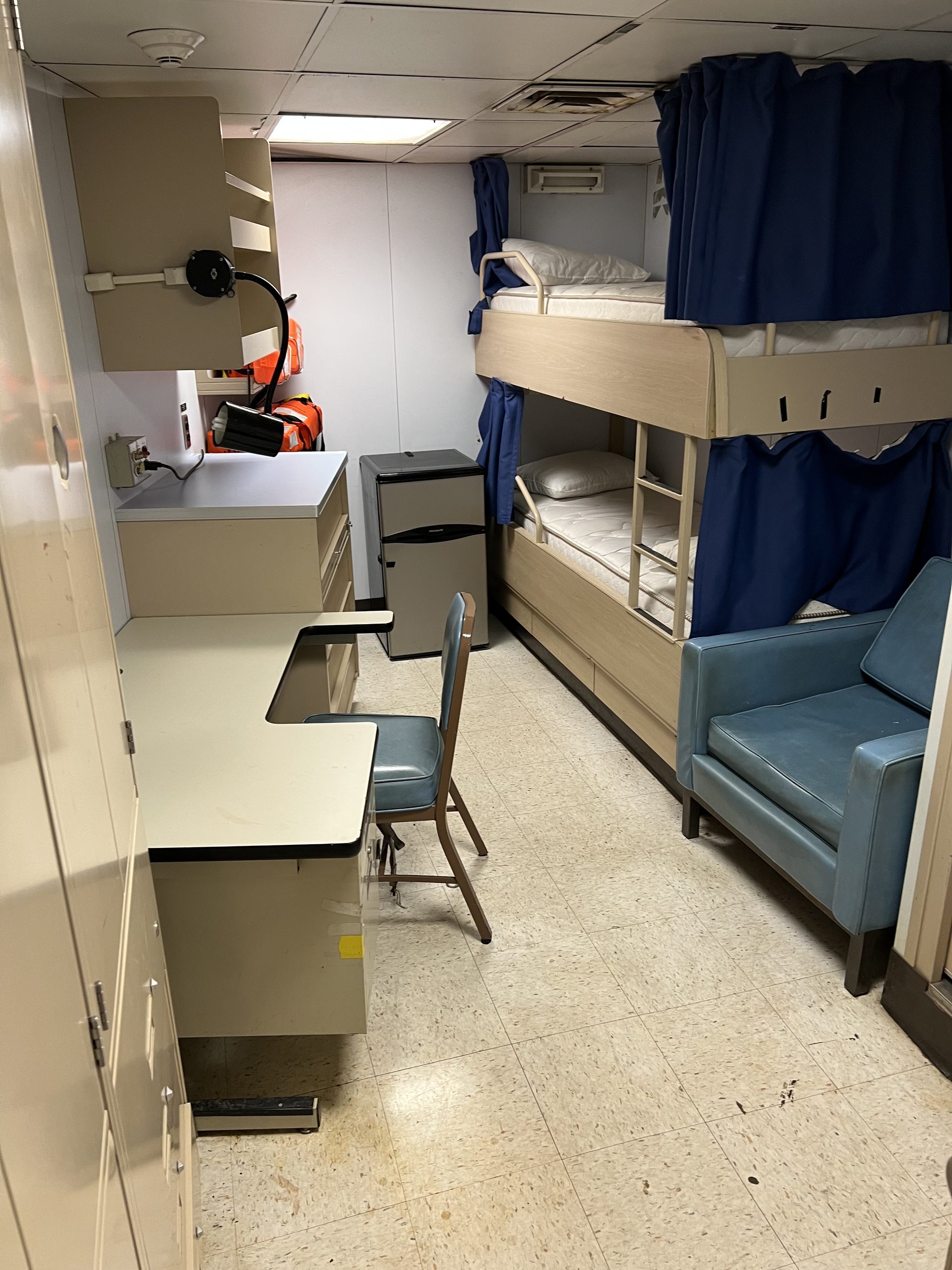
Stateroom on the RV Thompson. Will vary depending on which deck the stateroom is on. Below deck = no porthole = no sunlight. Bring decor! Fake plants keep some of the no land psychosis away!
Shared bathroom with shower and toilet. Sink and mirror in the stateroom. Onboard the RV Thompson.
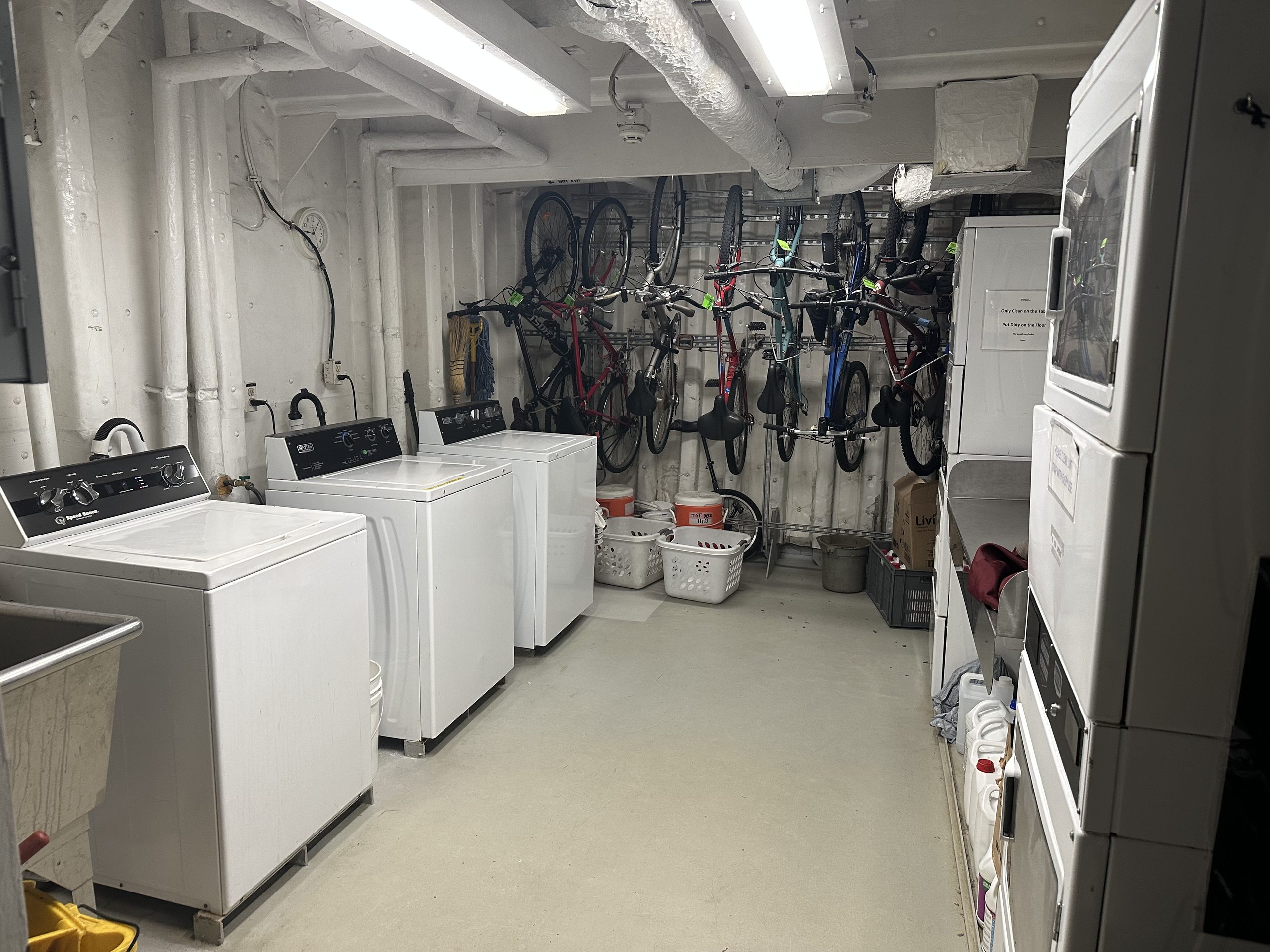
Laundry room on the RV Thompson. 3 commercial washers, 4 commercial dryers, free detergent and stain remover. Laundry baskets provided.
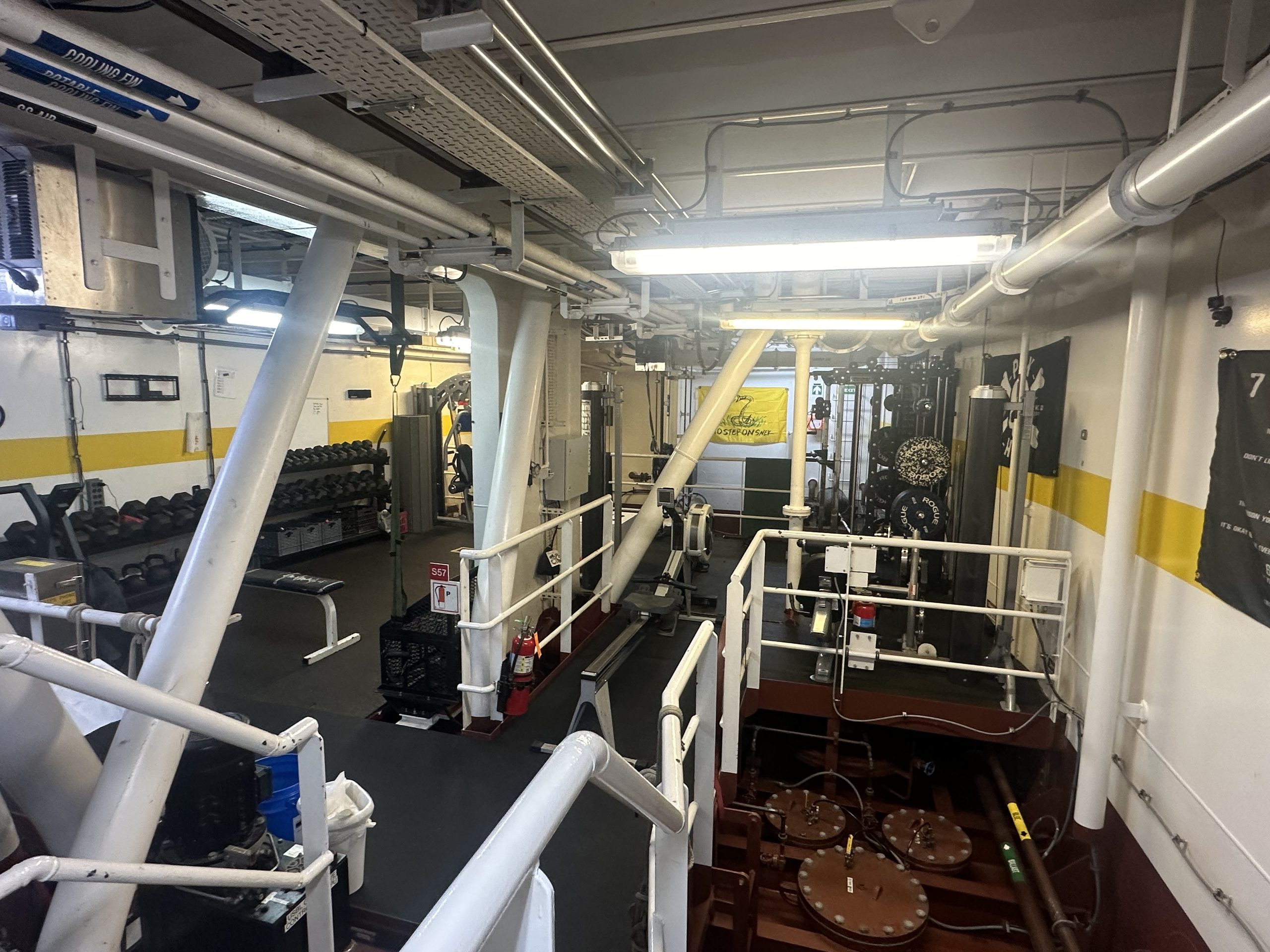
Gym on the RV Neil Armstrong. Ship gyms range drastically in size and equipment but always have basic workout equipment.
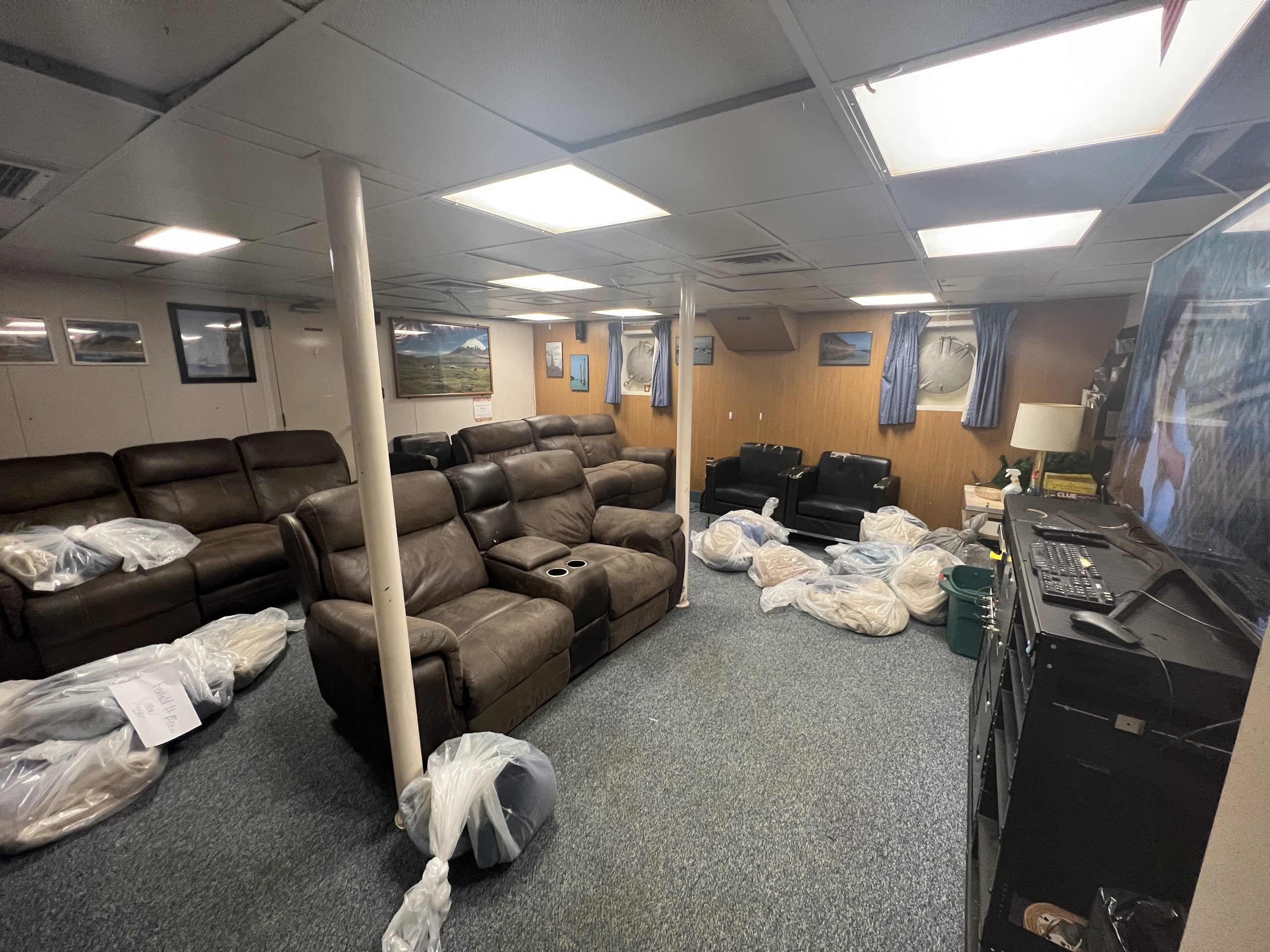
Lounge on the RV Ronald H. Brown aka TV Room.
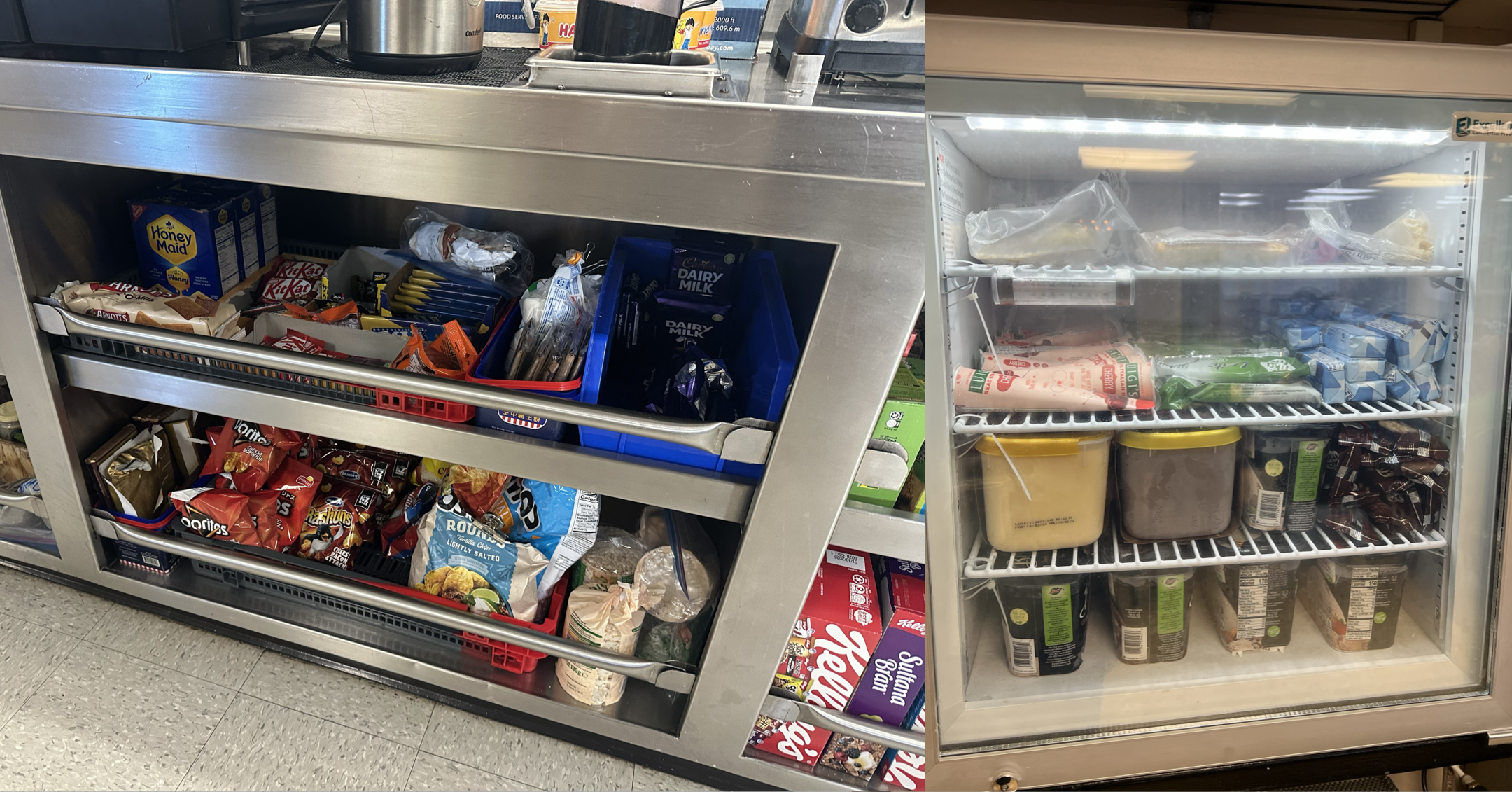
Snacks on the RV Thompson and ice cream on the RV Ronald H. Brown.
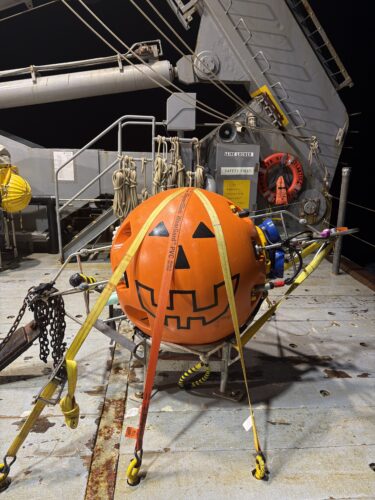
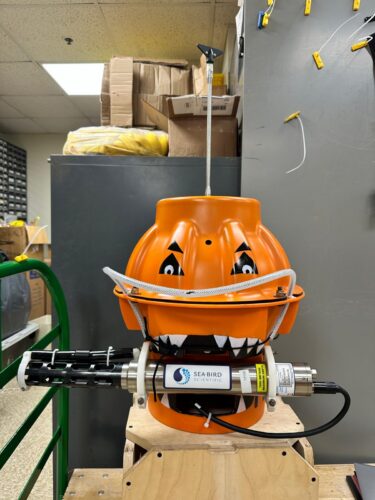
Halloween aboard the R/V Atlantic Explorer brought a successful mooring deployment and some decorating (good for morale!) The time and effort the group had spent on recovery day respooling line and paying close attention to the order of gear in the line-up (despite the complications brought on by the many many tangles) paid off on deployment day. The deployment went smoothly, and the mooring was back in the water in about three hours. We spent some time “interrogating” the releases to see if the mooring was successfully anchored at depth, which meant we got to use the Straza tower again. I think it’s very cool!
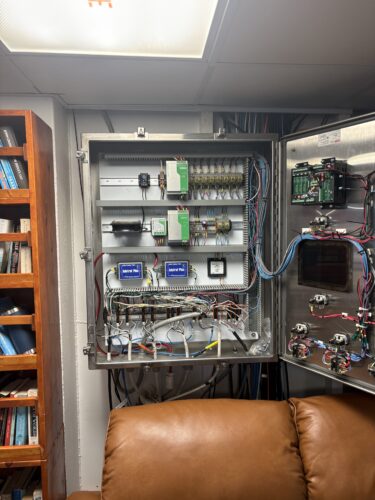
After repositioning, we deployed the GO-FLO bottles again, which was exciting because this meant that the OFP group has all the deep and clean seawater they need for their lab work for a whole year. During the Go-FLO cast, the data about wire length and speed from the winch stopped streaming, and we figured out it was a blown fuse in the control box. It was an easy fix, but stressful to troubleshoot with gear in the water.
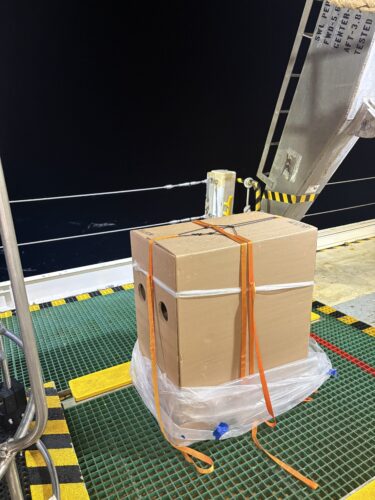
The final event of the cruise before heading back to Bermuda was deploying a deep Argo float from WHOI. This project opportunistically deploys these autonomous floats, which continuously profile the watercolumn measuring temperature and salinity. The deployment is pretty unique, and simple! It is stored in a cardboard box, and after cutting a small piece of paracord at the bottom, we lowered the package into the water. Once the bottom touched the ocean, a water-activated release allowed the float to separate from its packaging and begin its journey. The first data from the float we deployed can be seen here: https://argo.whoi.edu/wmo/7902464/index.html
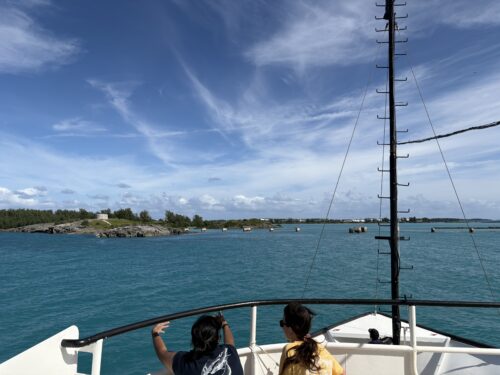
Then back to Bermuda! Somehow it’s already November. Post-cruise, we celebrated the successful mooring turnaround with karaoke and darts. We spent the next three days at the BIOS dock, unloading the OFP gear and getting the ship ready for the next group. Now that we were tied up at BIOS, I finally had a chance to visit the institute for the first time during my internship.
For this cruise, the BATS group is joined by the science team on the ICONIC project, mostly out of Oregon State and Old Dominion. In addition to some more intensive sampling from the BATS group, the ICONIC group works with trace metals, studying iron and carbon in seawater. Their project has its own set of sampling gear, designed to minimize contamination from other sources of metals (giant metal ship!), which is important when trying to measure metals at such low natural concentrations in seawater.
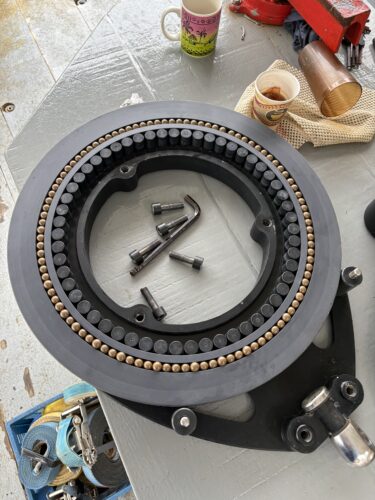
The group has a separate CTD and winch, along with a TowFish that pumps seawater aboard for sampling while the ship is underway. I helped to set up the trace-metal winch and CTD, and one of the jobs was to replace some worn-out bearings from the block under the A-frame, then remove the sheave from the trace metal winch, and replace some of the magnets inside. The sheave is a grooved wheel on the winch that guides the wire/cable, and as it spins, the magnets move past a sensor. With the correct calibration, this outputs data to track the length of wire being paid out or hauled in, and the speed the wire is moving. It’s an important part of the system, because we rely on this winch data for every deployment and recovery. I also did another Yale grip for the mechanical termination on the CTD.
After the shore-side mobilization was completed, it was time to head out again. We left around 9am on November 5th, toward the Hydrostation S location. Here, we did 2 casts with the trace metal CTD. During the first cast, we noticed that the oxygen sensor was returning questionable data (-44 oxygen…?) After working through some troubleshooting steps with Emily, we decided the best fix was to remove the faulty sensor and replace it with a spare.
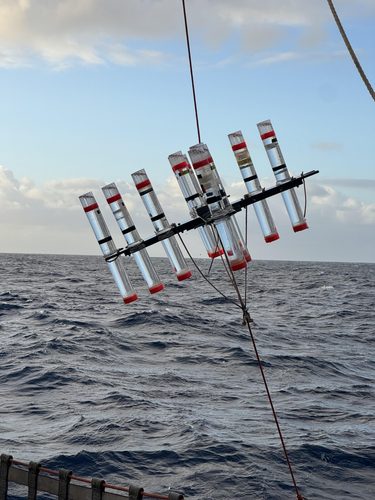
Now it’s today! Friday November 6th. This morning, we deployed an array of sediment traps at the main BATS station. The strategy is similar to the OFP mooring, but in reverse. This time, the weights went over the side first. Then as line is paid out and we move up the chain, it’s a similar back and forth of transferring tension between the winch and a deck cleat as the sediment traps and floats are attached. This deployment has a surface float, and the weights don’t sink to the seafloor; the goal is for the sediment traps to be nearly neutrally buoyant, with a bungee section to the surface float to dampen the effect of the surface waves and turbulence. The surface floats went on last, along with an AIS beacon so we could track the array’s location. We’ll leave the traps drifting for a few days before returning to recover them.
Next at BATS, we did 2 “regular” CTDs; the first to 1,200 meters, and the second to 4,500 meters. Both casts went well, but during some deck tidying, the trace-metal CTD cable was damaged, and needs to be re-terminated.
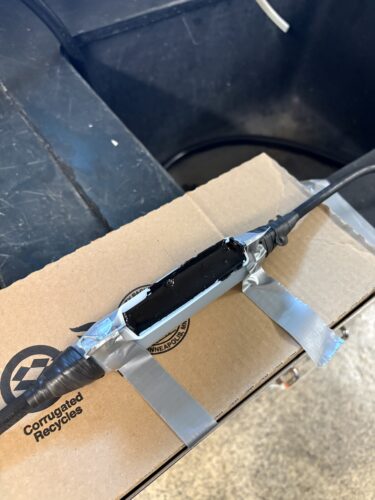
That was frustrating for everyone, but in general, all right. As an intern it was neat, because I helped with the termination, which is a tricky and time consuming thing to do. We removed the damaged section, redid the connection between the CTD and winch ends of the cable, and sealed the repair inside a mold filled with Scotchcast. This needs about 16-24 hours to cure, and it’s important for this connection to be solid, to withstand the tension from deployments and the pressure it experiences at depth. Originally we had planned for some zooplankton net tows this afternoon after the CTDs, but due to the rough sea-state, these are cancelled for now, and I’ll keep my fingers crossed that we’re able to do some later this week.
We boarded the R/V Kilo Moana early Sunday morning. After our safety and cruise meetings, I worked on sampling CTD casts for chlorophyll, nutrients, and dissolved oxygen. I was also able to assist with the deployment of the HyperPro, hauling the cable in and out by had. This time around, I was working day shift, so I went to bed early to get up at 3 am!
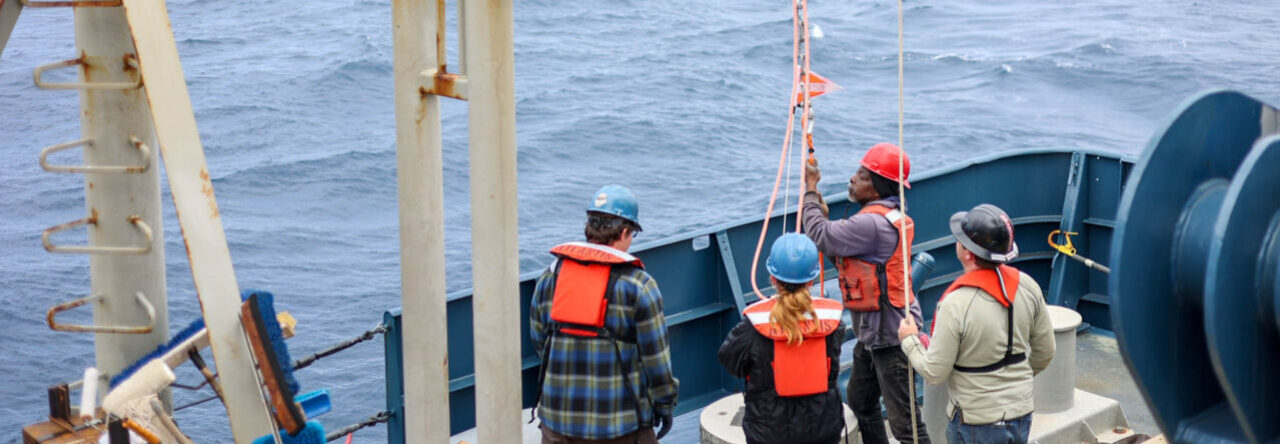
On Monday, I practiced recording meteorological observations for a second time. I continued taking samples for each CTD cast, and shadowed the deck crew as they trouble-shot a problem with the CTD winch. The cable was allowed to go slack, and the slack started to work its way up the drum as they tried to pay it out. Dan Fitzgerald taught us that in order to prevent the slack from moving down the line, we needed to cover the unaffected wraps with a ratchet strap. After that, we were able to pay out the slack and then re-wrap it around the drum with proper tension.
In my down time between casts, I practiced tying knots and learned how to collect grab samples from the ship’s seawater flowthrough system. Next, I entered the temperatures from the cast sheet to the spreadsheet for dissolved oxygen samples, and worked on Winkler titrations.
On Tuesday, we were supposed to deploy our gas (nitrogen) and primary production (PP) arrays, but the weather and waves were less than ideal. Typically, we collect water, spike each bottle with carbon 13 or seawater enriched with nitrogen, and then place them back at depth on an array to mimic natural light, pressure and temperature conditions for ~12 hours. Instead, we collected all the water samples from ~5 meters, and kept them in the top deck on an incubator. The incubator also uses the ship’s seawater flowthrough system, which most closely reflects surface conditions.
After that, I continued helping with CTD sampling and ran chlorophyll samples. I also assisted with DNA filtration and the preparation of flow cytometer samples. The flow cytometer samples were spiked with formaldehyde and flash frozen with liquid nitrogen.
Next, I shadowed SUBSEAs as they recovered their Vertical Microstructure Profiler (VMP), using a fishing rig attached to the back deck. I also had the chance to talk to Dr. Benedetto Barone, who explained how the shear sensors function. They use piezoelectricity – electricity accumulates across a thin metal sheet in response to physical stress. The instrument is designed to free fall down through the water column, and can detect differences in velocity shear and temperature at vertical scales of less than a millimeter.
Next, I shadowed Blake Watkins as he conducted a plankton tow and collected samples. He used a splitter to divide the sample, preserving half in formalin for his archive. The remaining half was divided again: one quarter was run through a series of screens and filtered, to separate it by particle size. Back on land, these sample filters will be combusted, to quantify the quantity of organic carbon and nitrogen.
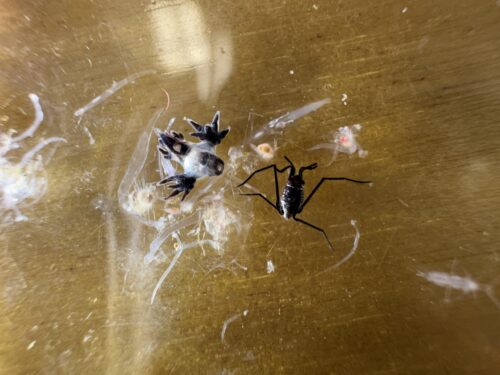
The remaining quarter of the sample can be used for plankton counts or given to other principal investigators. We took some time to look through it and found a blue dragon nudibranch and a pelagic waterstrider from genus Halobates!
Before dinner, I met with Trevor Young, who gave us an introduction to computer networking. He built the networking system on the R/V Kilo Moana himself, and it was great to have the chance to ask questions to someone so knowledgeable!
I finished off the day with more CTD sampling and headed for bed.
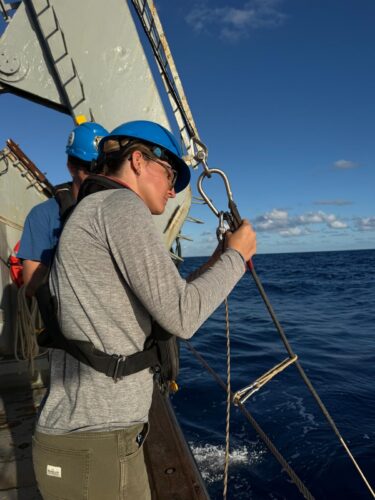
On Wednesday, I focused on watching and learning more about deck operations. I shadowed the SUBSEAs and HOT team as they recovered their Wirewalker and sediment trap arrays. Each array is first caught by a grappling hook, pulled closer to the ship, and then connected to a line fed through the A-frame on deck to lift it onto the ship. I learned how to throw grappling hooks and had the chance to practice driving the deck winch while changing out cable in between recoveries. I also learned how to pass line along through the A-frame by hand to maintain tension.
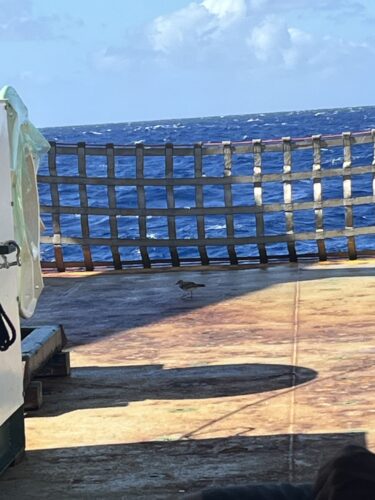
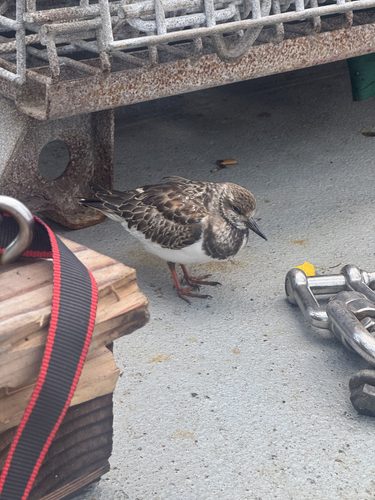
While working on deck, we gained a new crew member: Rusty, the Ruddy Turnstone!
Next, I helped out with the deployment and recovery of the Visual Plankton Recorder (VPR), which collects in-situ imagery of plankton in the water column.
Finally, I took some time to look at the ship’s sonar mapping interface, and shadowed the team as they triangulated the position of a mooring anchor from a previous cruise. They pinged the anchor from three different locations, then used the return time to determine the distance from each point and the final location.
We finished up all our operations by dinner, and we’re returning to port tomorrow morning. The day after that, I’m flying home. I’ve had a great time working with the HOT team – they are not only knowledgeable, but amazing teachers. I’ll miss the time at sea, the community, and the amazing food, but I’m sure that everything I have learned will carry me through to the next adventure!
Thanks to everyone who helped me make the most of this opportunity! It was a pleasure to work with your team.
This week started off with lots of rain, lots of wind, and lots of swells. We did some recoveries in some pretty nasty weather followed up by a break in operations while waiting for some heavy swells to pass. During this time, I got to shadow some other departments including engineering and the galley.
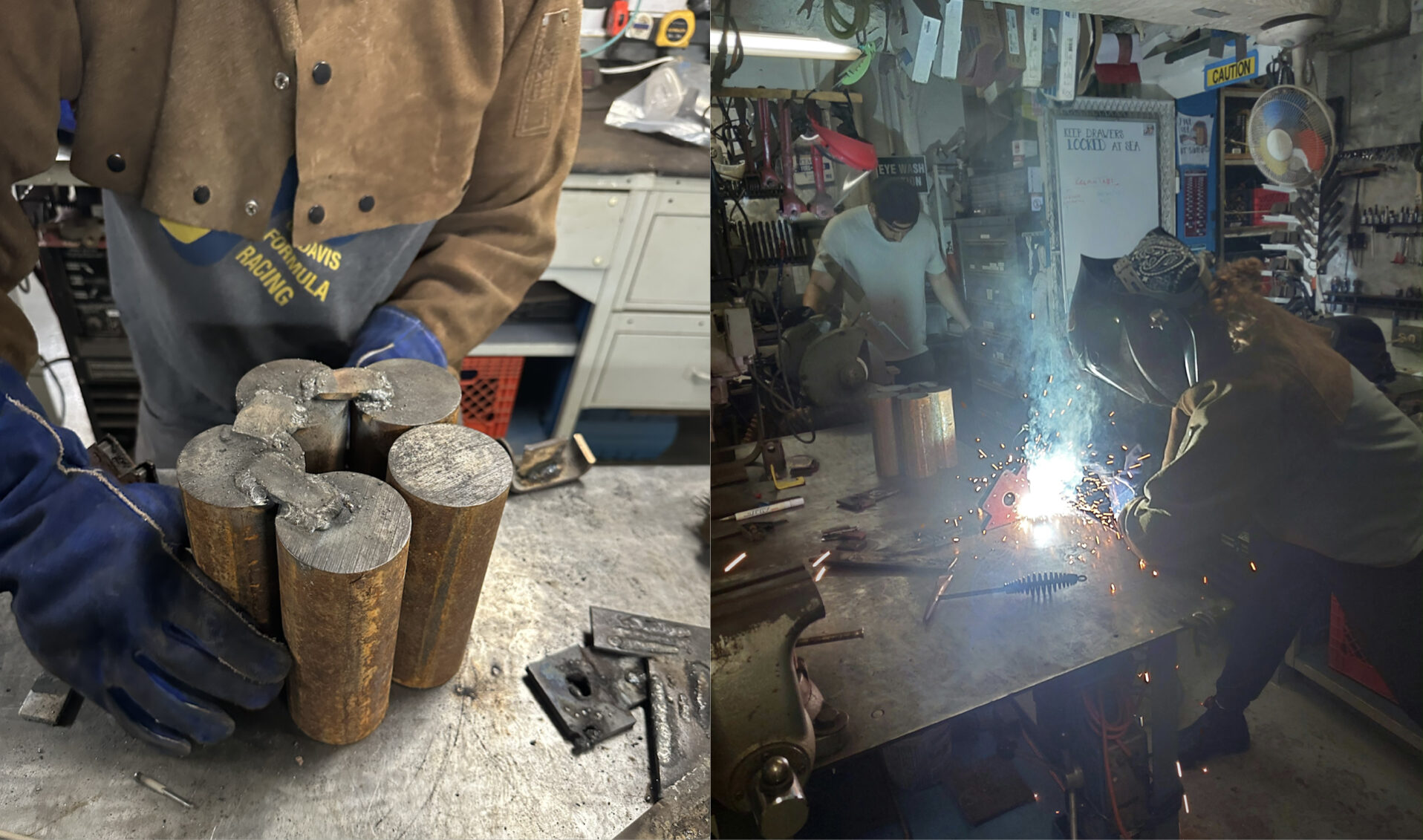
Down in engineering I got to learn a skill I have always wanted to learn but have never had to opportunity to. To repurpose some of the weights onboard intended for HWCP deployments to use for DAP deployments, we must weld them together as they are solid 15lb cylinders. The DAP will require 25 of these weights, and we will weld together circles of 5 to be looped together with chain running down the middle. Because of this, I got to try my hand at stick welding in the shop.
5 cylinder bundle (left), stick welding on a practice tab (right)
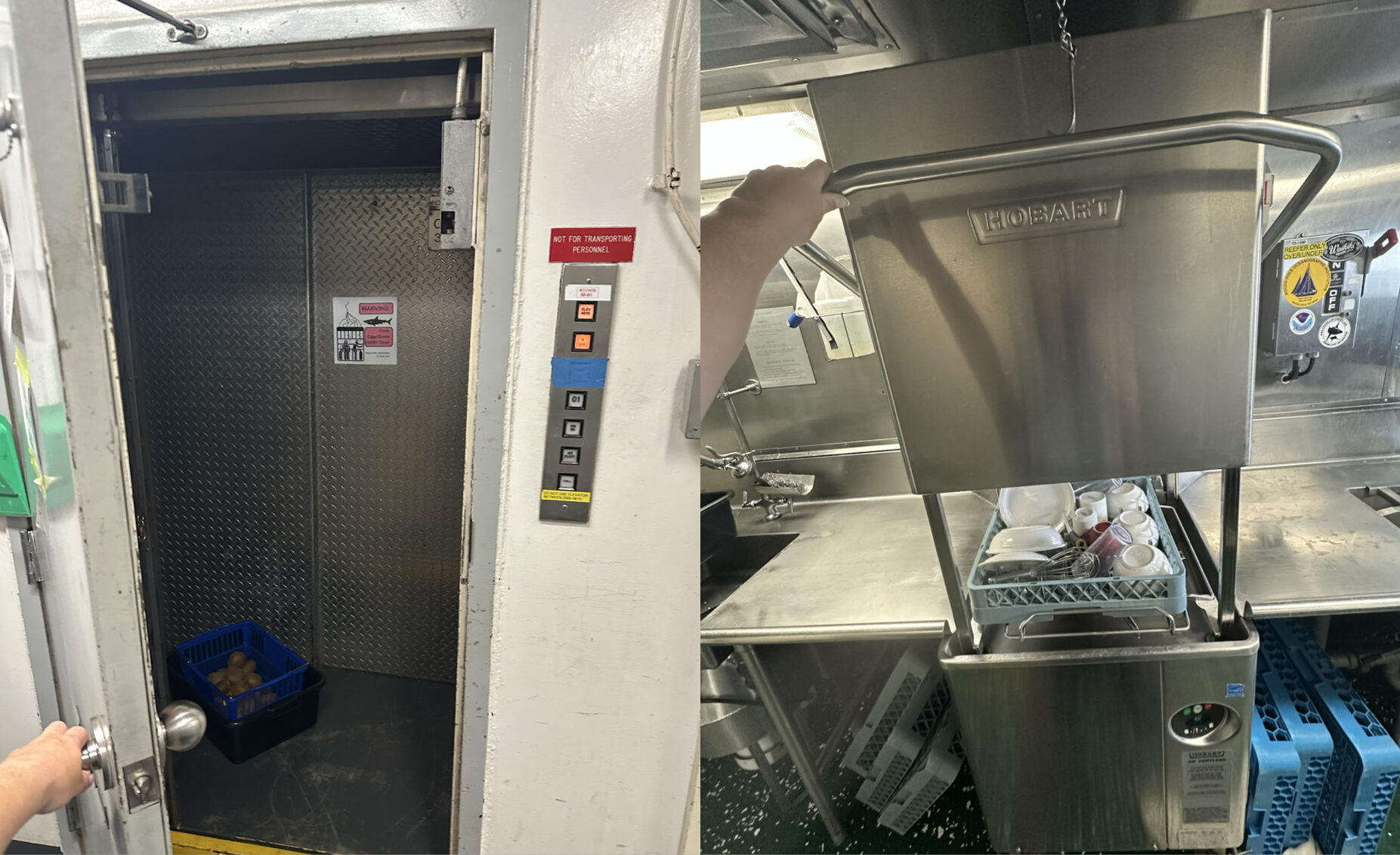
Upstairs in the galley I got to fill in for our mess attendant one evening cleaning up the mess deck and doing the dishes during and after dinner. I also got to send some kiwis up the elevator for restocking.
kiwis in ship elevator (left), dishwasher (right)
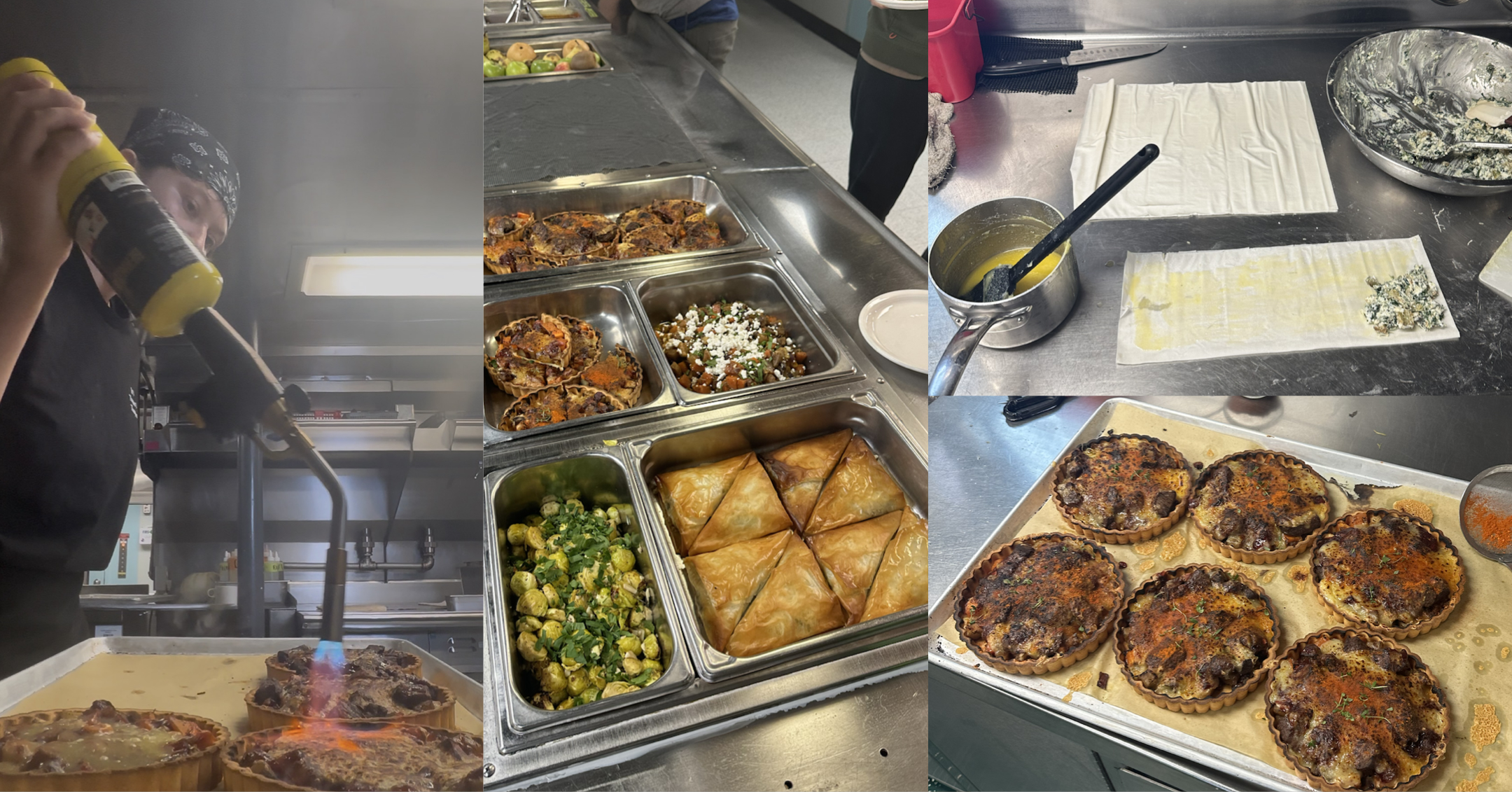
The next evening, I got to shadow the chief steward (head chef) and prepare dinner. We made meat pies, squash, brussels sprouts, and spinach pies with a finale of chocolate chip cookies. I was responsible for the spinach pies consisting of sautéed spinach and a blend of feta and ricotta stuffed and folded into phyllo dough brushed with melted ghee. I helped top off the meat pies by torching the tops to crust the cheese and added a dusting of paprika and ship-grown thyme to the top. I learned how to keep the galley squared away and clean, how to setup the buffet line, and how much goes into the meals on this ship.
Torching cheese topping on meat pies (left), the full meal display (center), spinach pie construction (top right), finalized meat pies (bottom right)
We also celebrated Halloween on the ship and the 3rd engineer and I decorated the mess hall for some overall ship morale boosting as we come into the end of our long haul cruise. Unfortunately there were no photos taken showcasing our efforts.
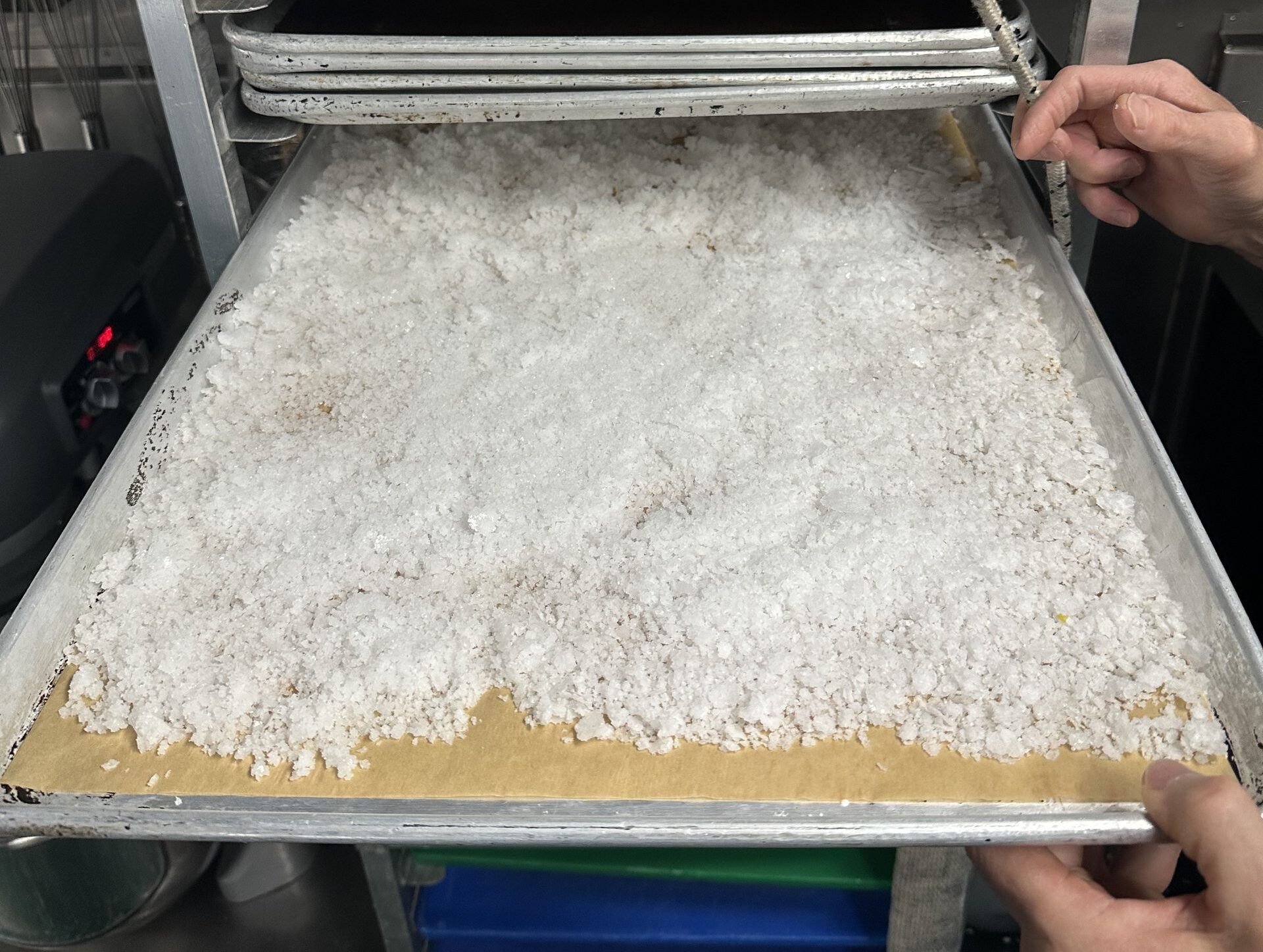
While I don’t have any bird photos to showcase this week (sigh) please enjoy some other phenomena captured. This salt was made by our wonderful chief steward from water collected at the bottom of the trench (10,000m deep!)
sea salt made from the bottom of the Kermadec Trench
On Monday, we had a second chance to help out with preparing nitrogen enriched water for nitrogen fixation incubation experiments. We were also able to troubleshoot replacing nitrogen gas canisters, and learned more about the regulators HOT uses for their compressed gas.
On Tuesday, we toured the Hawai’i Institute of Marine Biology (HIMB) on Moku o Lo’e, or Coconut Island. It was a great chance to see the northern side of Oahu, as well as learn more about current research outside of the HOT team!
We toured a lab growing coral in different conditions, to simulate future changes in climate, as well as to preserve endangered species and identify resilient corals.
We also toured the Marine Conservation Innovation Group (MCIG) lab. One of their projects has been to design structures that can help improve coral recruitment and survivorship. They tested a variety of different shapes by 3D printing them with ceramic. They found that a spiral shape was the most successful design, and created scaled-up versions of the spiral shape out of concrete using custom molds. The cement coral habitats were recently attached to an even larger breakwater structure and deployed, to reduce wave force and erosion with rising sea levels, as well as to provide critical habitat. It was really cool to see all of the different designs, as well as the tools and 3D printers used to create these structures!
Finally, we had the chance to learn more about some local invertebrates, including sea cucumbers!
We finished up the day by heading back to campus and attending a pre-cruise meeting.
On Wednesday, we learned how to disassemble and check the electronic and mechanical components of a Sea-Bird SBE 32 Carousel Water Sampler. In the process of disassembling the carousel, one of the bolts sheared off – so we switched to disassembling and checking a spare. We looked for corrosion, rust, or salt crystals on the electronics, and didn’t find any. We also inspected the O-rings and applied anti-seize to insure a good, watertight seal.
After we finished working with the CTD, we helped acid clean some equipment for our upcoming cruise.
On Thursday, we practiced RS232 serial cable splicing! We made a custom cable that can connect a CTD auxiliary port to a Photosynthetically Active Radiation (PAR) sensor, and a second custom cable that can connect a CTD auxiliary port to a BENTHOS altimeter. This will allow the HOT team to add these sensors alongside a typical CTD ‘fish’ and increase the amount and types of data collected with each cast! It was a lot of fun to get some hands-on electrical experience and make a product that will be useful for the HOT team in the future.
With each cable, we started by diagramming each end. In both cases, we were connecting a six-pin CTD cable to a four-pin instrument cable. Next, we cut back the protective cover and stripped each wire. Then, we checked which color wire was connected to each port using a multimeter. After that, we connected the corresponding wires based on the ports and colors we had previously determined using a Western Union Splice, and cut back the extra wires from the six-pin cable that we weren’t using. We applied a heat-shrink solder to the ends of the unused wires to seal them off. Then, we used traditional solder to solidify the connections between the other wires. Dan Fitzgerald emphasized the importance of keeping the connection hot while soldering to avoid a ‘cold solder’ which would be more brittle. We held the soldering iron under the splice and allowed the solder to flow through the wires to get a solid connection.
Next, we wrapped each connection with scotch fill, wrapped the wires together with more scotch fill, and finished off our cables with electrical tape.
On Friday, we helped load up the ship for our cruise on Sunday, and shadowed Dan Fitzgerald as he worked on the electrical cable termination. After loading, we met with Dr. Angelicque White to talk more about the HOT program as a whole.
It was another great week and I’m excited for our upcoming cruise – though also sad our internship is coming to a close! I have loved getting to know the team and working with them at sea and in the lab.