Category: R/V Rachel Carson

Week 7

We have reached the final station of the cruise. Our plan is to sit tight and sample here for the next day or so, then make our way back to Seattle. With only a few days to go, the chief scientist loses his balance during a roll and tumbles headfirst into the steel doorway of the ship. Todd sees him take the fall and is by his side in an instant. We head for shore.

We all sit around the galley, John in the corner with a towel pressed on his wound, and trade head injury stories to pass the time. Turns out, every decade or so, John hits his head. It’s been fifteen years since the last one, so he laughs and says he was overdue. The guy has had dozens of staples in his head, and by the end of the day, he will have nine more.

After an injury occurs, there is a twelve hour window for stitches. We are due in Neah Bay at 0200, leaving just four hours to get John to the nearest hospital. It takes the whole team, both on shore and at sea, to make arrangements to dock in Neah Bay, get a shoreside crew member to drive from Seattle to the peninsula to pick John up at the dock, make the bumpy back road drive to Port Angeles, find a hospital, seek treatment, get breakfast, and get John back on board at 0900. By some miracle, it all comes together, and we are off again.

Our last day on board is spent navigating among the San Juan Islands. The water is clear and green as sea glass. We glide past cliff sides covered in evergreens above and mussels below. With the underway pumping system chugging away on its own, the entire crew and science party are out on deck, taking in the smooth seas and sunlight. At slack tide we make it to Deception Pass, Todd tells me of the insane currents he has encountered here, and of the time he once flooded a fishing boat trying to make it through at the wrong tide. But the water is calm enough right now, and as we coast along we wave to the onlookers standing on the bridge above, who eagerly wave back. Sunset hits as we head south on a run behind Whidbey Island. The Cascades and clouds turn pink as our cruise comes to an end. 

Week 5

This cruise, so far, has been quite eventful. After beginning our journey back North, we decide to turn up the Columbia River and head inland. The transition to calm water is a relief, and I am happy to have a break, however brief, from the constant rocking and rolling of the boat. A few miles upriver, we decide to lift up the boom that has been deployed over the side of the boat for a quick inspection. As the crane lifts the end of the pole up, it bends and snaps in half.


Either end of the boom was anchored by cables at the bow of the ship, which left the length subject to the weight of our forward momentum and the ocean’s waves, allowing it to bend like the flex of an archer’s bow as it is drawn. Over time, at the center of the pole, the aft end of a welded joint began to split, until only a sliver, about an inch long, was left holding it together. We had caught it just in time.

As a testament to the strength of the team here at UW, it takes us twelve hours to find a dock, find a welder, take the whole thing apart, fix it back up, and put it all back together. By one in the morning, the only thing stopping us from going back to sea is the tide. We wait till morning.


We depart the Columbia with the ebb, with the aim of surveying the river effluent as it mixes into the Pacific. As we skirt the edge of the river plume, the water changes back and forth from a muddy turquoise to a deep, clear blue. The salinity jumps between 20 to 30 parts per million, which brings the science party unbelievable excitement. They have renamed our mission “Plume Chasers” and insist that we’re the next big Discovery Channel hit. We follow its track South until all traces of the river disappear and all that’s left is endless salty blue ocean.


I awake the next morning to Brian knocking at my stateroom door. I hear him say “orcas” and I am up on deck before my eyes are even open. A pod of about a dozen whales rides in our wake. They surface, one or two at a time, and then all together at once. A few juveniles breach and playfully rub against the adults. Farther behind, a massive dorsal fin rises slowly from the sea and a dark body with two white eye patches emerge, pointed directly towards us. It must be the alpha male, taking up the rear of the pack. Words cannot describe the sense of wonder I feel. I have never interacted with animals this large before, and my heart jumps with waves of nerves and excitement. For a moment, I am no longer the apex predator, and I feel as if I am being preyed upon. Watching the family move with coordination and intention, it becomes clear that these animals are highly intelligent. I am completely overcome with admiration for these creatures, and I am reminded that the ocean is truly a humbling place to be.

Week 4

For the past few days, we have been working our way down the coastline, following a zig-zag pattern as we follow the current south. We cruise with ease, with the wind and waves are at our back. The days are mostly grey and smooth, with the occasional whale spout or pod of dolphins breaking up the endless ocean.


The group of scientists on board are studying the presence and fate of methane in our coastal waters. They extract the gas from the surface of the ocean as we cruise by, and then compress it into gas cylinders for further analysis. Methane is a greenhouse gas, with a much greater ability to retain heat than its better known cousin, carbon dioxide. This means a relatively small amount of methane may have a large affect on the global climate. This research project aims to understand the role of methane in coastal ocean processes, and then using computer modeling, project how these processes contribute to the climate on a global scale.


Initially, we planned to sail all the way to central California. To everyone’s dissappointment, the forecast is calling for a storm just around the corner of Cape Blanco. If we choose to continue, a nine foot swell awaits us, and we’ve already been struggling through less. With our hopes of eating chowder in the Golden State dashed, we turn tail and head North.


With this sudden change, we need to come up with a new game plan that fits within the limits of the weather, tide, and time. We all gather around the navigation computer, the science team points out other locations they would like to sample, shooting out new research ideas and case studies on the fly. We manage to pull together a plan that everyone seems to be happy with, and I walk away pretty amazed at everyone’s flexibility and ability to improvise on such short notice.


This kind of experience makes it clear that the nature of fieldwork taught in class just doesn’t reflect reality at all. I have yet to see a single research cruise where things go as planned, where scientists walk off the boat with the exact data and samples they expect. It is almost unfair to lead undergraduates on with the idea that fieldwork may be accomplished with a printed handout on a clipboard, and the option of a rain check if bad weather arises. The truth of it is that when the boat has been rolling nearly 180 degrees for three days straight, when your equipment keeps falling over no matter how many bungee cords you strap around them, when the prospects of weather gets even worse, you work through the nausea and figure out something better. The truth of it is, as Liz likes to say, research at sea is fast and loose.

Week 2

Our first cruise is a short one. Since the R/V Rachel Carson is operated by the University of Washington, a portion of the cruises are for undergraduate and graduate classes and research. This two-day cruise is a field section for a fisheries class, where students take what they have learned in lecture and have the opportunity to apply it in real life. They get to witness a fisheries boat in action, deploy and recover the nets they have heard of, and handle and identify the ocean creatures they have studied in their books. As a graduate from a college located nearly two-hundred miles from the ocean, I’ll admit, I am a little jealous.

We transit over to Shilshole, a marina at the mouth of Lake Union, to pick up the students. The lake level is kept a few feet higher than sea level by a set of watertight gates in the canal. So, I get to experience travelling through locks for the first time, which I am thrilled about, to the amusement of the crew. We arrive at Shilshole and the boat is suddenly flooded with students and instructors, outfitted in lifejackets and hardhats. We cast off and head West to the other side of Puget Sound.

The plan is to deploy an Otter Trawl across four set tracklines of varying depths to sample for abundance and variety of fish species over the course of twenty-four hours. Contrary to how it sounds, an Otter Trawl is not designed for (nor is it likely capable of) capturing otters. The unique net bears a set of doors, which were traditionally wooden, that kept the mouth of the net out and open as it dredges the bottom of the ocean floor. Old-time Bostonian fishermen butchered the word “outer” that described the purpose of the doors, and the name “otter” stuck.

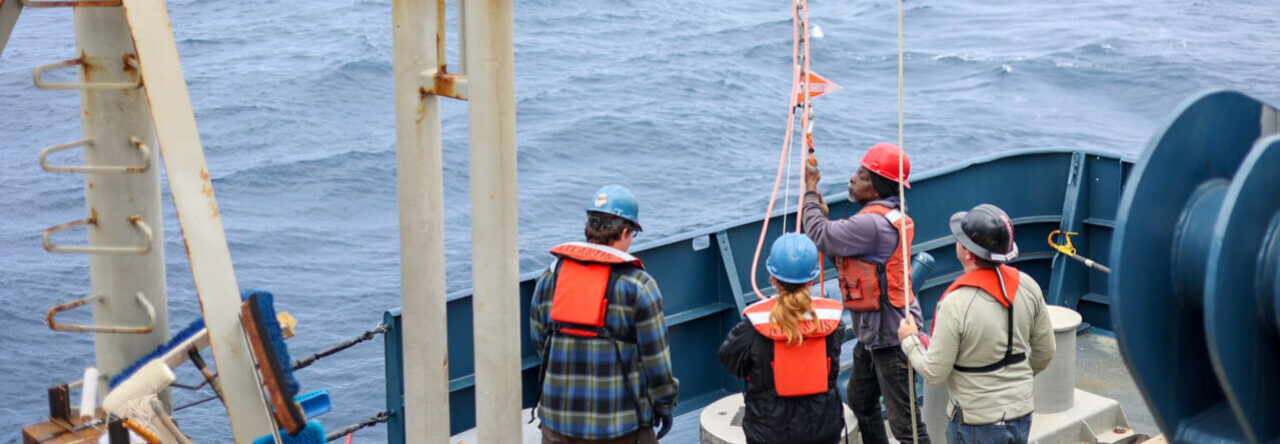
Our first few attempts at setting the trawl end in a tangle, as it is our first time using this sort of net on RC. Figuring it out takes some troubleshooting and practice. With a line attached to each door, we raise the net off the deck and above our heads. As the net is cast of the back deck and into the water, we guide the top of the net as it swings 180 degrees. The winch lowers as the net begins to pull behind us. As the doors sink below the surface, the water catches them like a parachute. The mouth of the net opens and for a moment, the top line of floats raise to the surface, then the whole of it sinks into the darkness.

We tow for fifteen minutes, then winch the net back to the surface. As a biologist, I am enchanted by the strange and diverse creatures that our trawls have unearthed from the bottom of the Sound. But the ecologist in me knows that this survey is damaging to the benthal ecosystem, and I struggle with the pros and cons of this kind of experiential education. We release another netload into the sorting tables. Amidst a heap of algae and shrimp, a crusty old beer bottle rolls out, and an octopus emerges from its mouth. It has suddenly found itself in an alien world, being poked and prodded by dozens of academic fingers, surrounded by smooth blue walls and bright light. It turns white, then dark red. It darts back and forth and inks a couple of times before settling into a corner of the tank.

Operations continue throughout the night. I take rest during the third section of the cruise, but I am quickly reminded that it takes me a couple of days to acclimate to sleeping on board a moving and noisy vessel, so my sleep is brief and restless. At sunrise, I am back on deck.


It is Saturday, and sunrise over Seattle is gorgeous. The Olympic mountain range stands to our West. The air is cool and clear and smells of salt. Today is the first day of shrimp season, and the Sound is littered with dozens of small boats casting their pots and sitting by their buoys. In the distance, sailboats gather for a race. As we begin the final shift of our cruise, Liz gives me permission to lead the deck. The deployments and recoveries are simple enough, and it’s a good opportunity for me to get back into the swing of things and get a better feel of how operations go on a new boat. It is a good first cruise for me, and I am looking forward to all the new things that are soon to come.


Week 1

When I arrive in Seattle, I find the city in full bloom. It is sunny and clear and warm, the opposite of what usually comes to mind when I think of the Pacific Northwest. It seems that I am here at the best time of the year. 

I have been given directions to the dock, and a phone number to call when I get there. Liz finds me when I pull up to the gate and brings me over to the boat. Aora was initially a fishing vessel from Scotland that was refitted for research a number of years ago. When University of Washington purchased her, a donor fronted the funds on the single condition that she be renamed in honor of their favorite ecological hero. The R/V Rachel Carson is painted on the bow in large black letters, although I can still make out the name Aora above it. At 19 meters long, she is the smallest research vessel I will have been on; Liz calls her adorable

Others call her The Metric Wonder, a title that has come to describe the bane of the crews’ and techs’ existence. As a European boat, RC is outfitted with European power and hardware, rendering our knowledge and hardware incompatible. As a result, some things that should be simple become complicated: the coffee maker had to be custom ordered to fit the power supply, the crew hoard pipes from the boat for their fittings, when I ask Brian, the ship’s mate, about the foreign outlets he throws me a converter and remarks, “we’ve been giving these out like popcorn”. 

I spend most of my first week getting the lay of the land. I am quickly figuring out where things are, and who to go to when I am unable to find something. I am settling in quickly, and looking forward to being back out at sea. 

Powered by WordPress & Theme by Anders Norén