Our first cruise is a short one. Since the R/V Rachel Carson is operated by the University of Washington, a portion of the cruises are for undergraduate and graduate classes and research. This two-day cruise is a field section for a fisheries class, where students take what they have learned in lecture and have the opportunity to apply it in real life. They get to witness a fisheries boat in action, deploy and recover the nets they have heard of, and handle and identify the ocean creatures they have studied in their books. As a graduate from a college located nearly two-hundred miles from the ocean, I’ll admit, I am a little jealous.
We transit over to Shilshole, a marina at the mouth of Lake Union, to pick up the students. The lake level is kept a few feet higher than sea level by a set of watertight gates in the canal. So, I get to experience travelling through locks for the first time, which I am thrilled about, to the amusement of the crew. We arrive at Shilshole and the boat is suddenly flooded with students and instructors, outfitted in lifejackets and hardhats. We cast off and head West to the other side of Puget Sound.
The plan is to deploy an Otter Trawl across four set tracklines of varying depths to sample for abundance and variety of fish species over the course of twenty-four hours. Contrary to how it sounds, an Otter Trawl is not designed for (nor is it likely capable of) capturing otters. The unique net bears a set of doors, which were traditionally wooden, that kept the mouth of the net out and open as it dredges the bottom of the ocean floor. Old-time Bostonian fishermen butchered the word “outer” that described the purpose of the doors, and the name “otter” stuck.

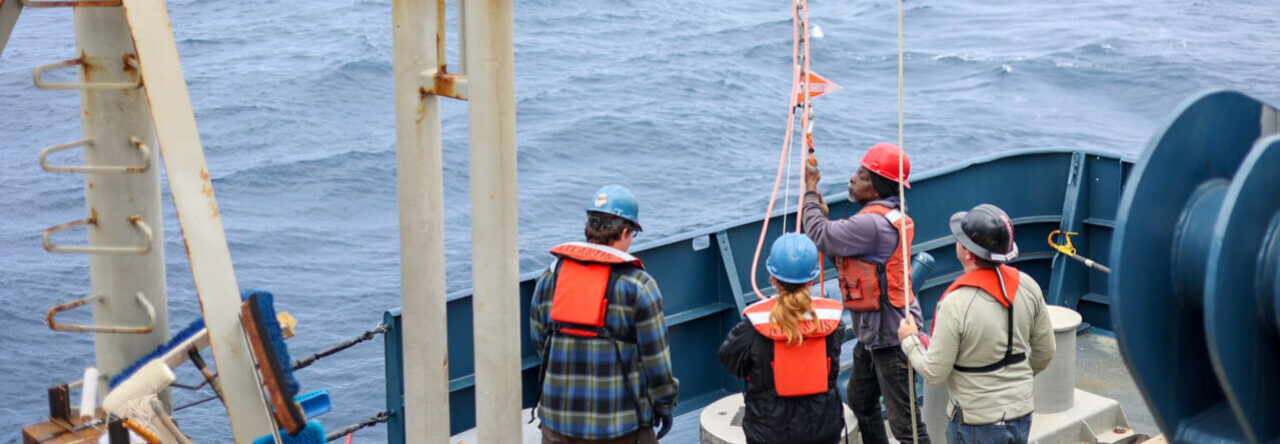
Our first few attempts at setting the trawl end in a tangle, as it is our first time using this sort of net on RC. Figuring it out takes some troubleshooting and practice. With a line attached to each door, we raise the net off the deck and above our heads. As the net is cast of the back deck and into the water, we guide the top of the net as it swings 180 degrees. The winch lowers as the net begins to pull behind us. As the doors sink below the surface, the water catches them like a parachute. The mouth of the net opens and for a moment, the top line of floats raise to the surface, then the whole of it sinks into the darkness.
We tow for fifteen minutes, then winch the net back to the surface. As a biologist, I am enchanted by the strange and diverse creatures that our trawls have unearthed from the bottom of the Sound. But the ecologist in me knows that this survey is damaging to the benthal ecosystem, and I struggle with the pros and cons of this kind of experiential education. We release another netload into the sorting tables. Amidst a heap of algae and shrimp, a crusty old beer bottle rolls out, and an octopus emerges from its mouth. It has suddenly found itself in an alien world, being poked and prodded by dozens of academic fingers, surrounded by smooth blue walls and bright light. It turns white, then dark red. It darts back and forth and inks a couple of times before settling into a corner of the tank.

Operations continue throughout the night. I take rest during the third section of the cruise, but I am quickly reminded that it takes me a couple of days to acclimate to sleeping on board a moving and noisy vessel, so my sleep is brief and restless. At sunrise, I am back on deck.
It is Saturday, and sunrise over Seattle is gorgeous. The Olympic mountain range stands to our West. The air is cool and clear and smells of salt. Today is the first day of shrimp season, and the Sound is littered with dozens of small boats casting their pots and sitting by their buoys. In the distance, sailboats gather for a race. As we begin the final shift of our cruise, Liz gives me permission to lead the deck. The deployments and recoveries are simple enough, and it’s a good opportunity for me to get back into the swing of things and get a better feel of how operations go on a new boat. It is a good first cruise for me, and I am looking forward to all the new things that are soon to come.
