Author: Paige FitzPatrick

Week 7 – Working aloft & New Centerboard Shoe Sonar Installation

I am certainly getting used to living in protective gear. Much of the drydock work requires full PPE – respirator, safety glasses, hard hat, gloves. Now I can add a harness to my list of working gear. This week, I ascended the forward mast to uncover our forward meteorological sensors and give the forward mast bolts some TLC. This required two days working aloft.
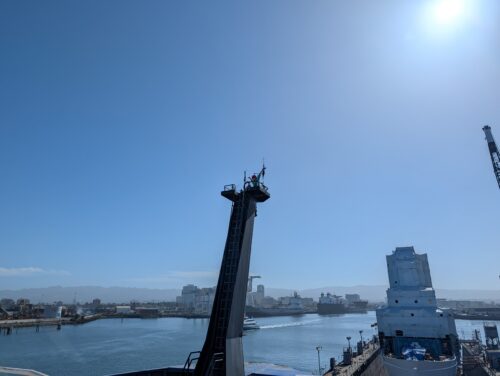
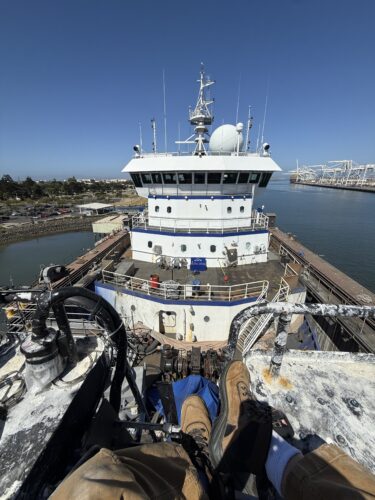
That’s me up there!
View from the top of the forward mast

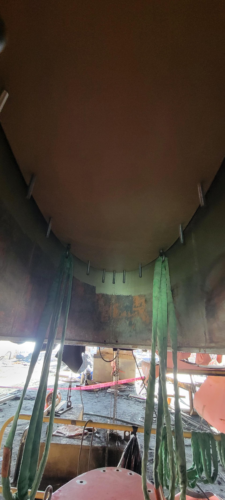
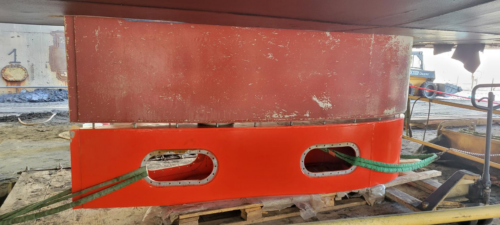
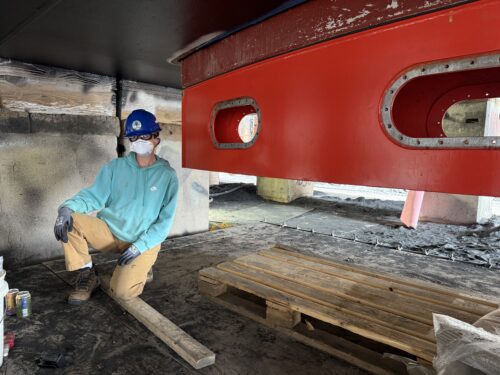
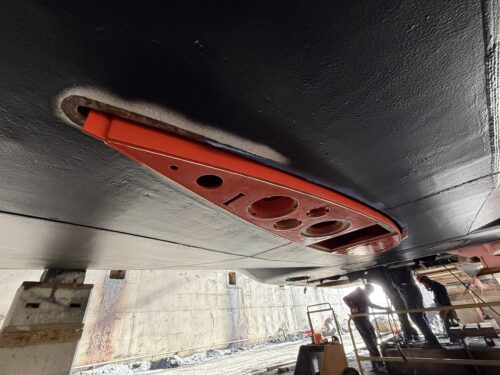
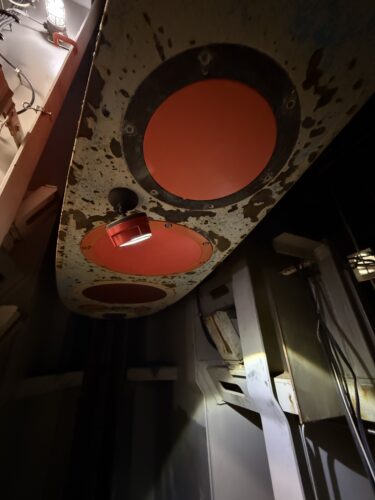
This week, the Sikuliaq team also tackled the physical installation of the sonar suite and EK2042 shallow water multibeam on the new centerboard shoe. This project required lots of creative problem-solving and careful cable management within the shoe. The team had to drill out and align a new bolt pattern for the EM2042 installation. We also installed 3 zincs inside the shoe to prevent galvanic corrosion. The new shoe houses a Tonpilz transducer, EM 2042 shallow water multibeam echosounder,150 kHz ADCP, EK 80 sonar suite including a 70 kHz transducer, 120 kHz transducer, and 200 kHz transducer.
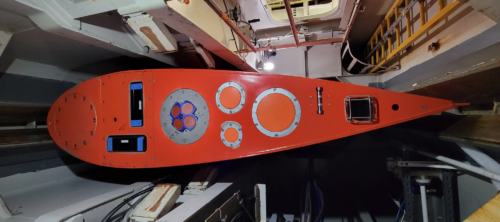
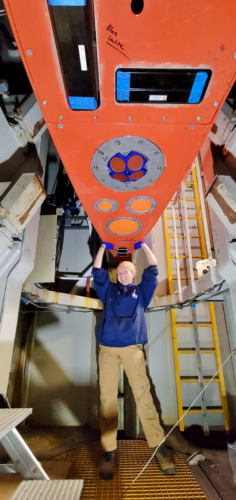
Newly installed centerboard and sonar equipment
Matching colors with the transducers

Installing sonars on a giant moving platform was a learning experience in correctly managing cables. Additionally, this project took away a lot of the mystery in how data is transmitted from the sonars to our computer systems. Much of the installation process also required working in a very tight environment (see window plate installation below).
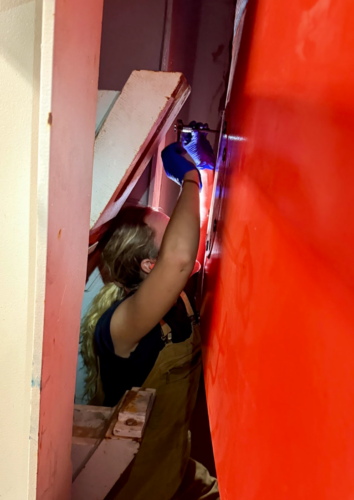
Installing the window plates on the centerboard shoe

The new shoe is looking great with the sonars installed. Next step: testing & troubleshooting.

-Paige FitzPatrick
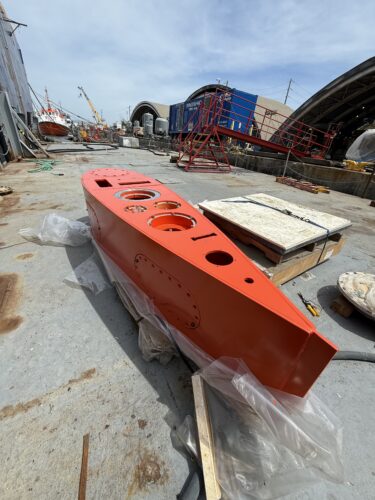
Week 6 – New Shoe!

Week 6 in drydock has come to a close. This week has been focused on installing the new centerboard shoe. The centerboard shoe formerly housed an EK80 system of sonars, acting on a retractable platform to protect the sensors from ice damage. The new shoe is upgraded with the EM2042 multibeam sonar, specialized to map out shallow water regions.

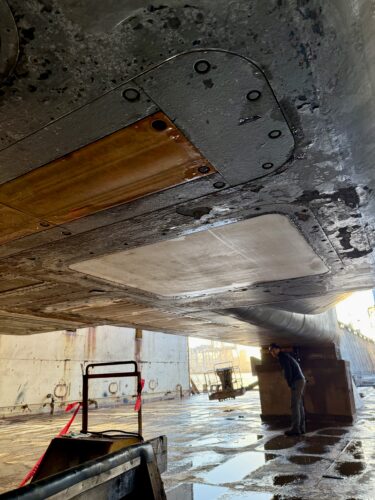
To install the new shoe, weighing around 2,700 pounds, we first had to align and drill the bolt pattern of the old shoe into the new shoe. This bolt pattern was not included in the original drawing, though it is critical to the functionality of the shoe. Facing this problem included using the old shoe’s bolt pattern as a stencil. To confirm the alignment was correct, the new shoe was maneuvered beneath the centerboard, allowing the Sikuliaq team to ensure the new shoe would fit. Maneuvering the centerboard was a great challenge underneath the hull, where there is only about 5.5 ft between the drydock floor and the looming hull of the vessel. A rubber gasket was additionally placed betweent the new shoe and the centerboard.

Overall, this was a process of trial and error. In many situations, it seems there is no real guidebook on how to accomplish a very challenging task. We had to figure out how to install an extremely heavy steel object in a space with too low a ceiling for a forklift. Thinking creatively, using tools wisely, and working as a team are all essential in successful scientific research missions.

With the shoe installed, the team can start installing the new multibeam system and EK80 sonar suite.

-Paige FitzPatrick

Week 5 – Cables, who knew?

A lot of this week has been learning the basics: cables! Though cables may not be the most eye-catching blog post ever, they are an extremely important part of marine research and are essential in the proper functionality of research equipment. This week, I developed wire mapping skills using a LinkRunner AT-2000. My goal was to trace the unlabeled cables running through our main patch panel to their instruments, effectively filling the gaps in the labeling system. This took me all over the ship – bridge, electricians workshop, mainlab, ect.

I also gained experience this week pulling and running a new cable for the OS 150 ADCP sonar system. Running a new cable is harder than it may appear – passing the cable through roxtec units designed to prevent any water penetration through bulkheads can be complicated. Additionally, I learned the importance of avoiding cable attenuation, particularly in cables transmitting sensitive data that can easily lose resolution. The Sikuliaq team accomplished replacing the OS 150 cable, running a smooth route through the ship to the transducer flat. The amount of cables onboard a research vessel can be staggering. Knowing how to map and trace their patterns really helped me put together how data is transmitted from one system to the next.

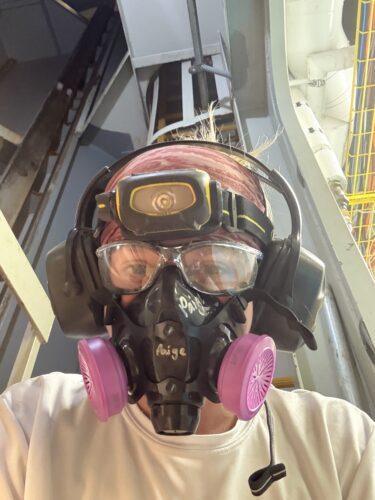
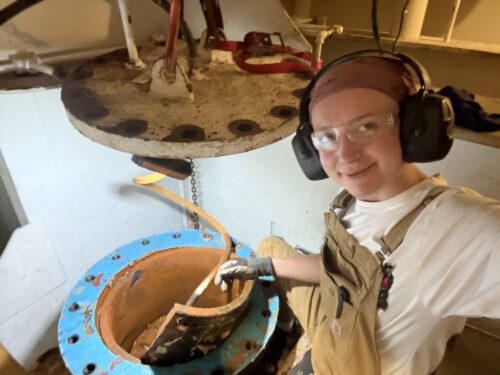
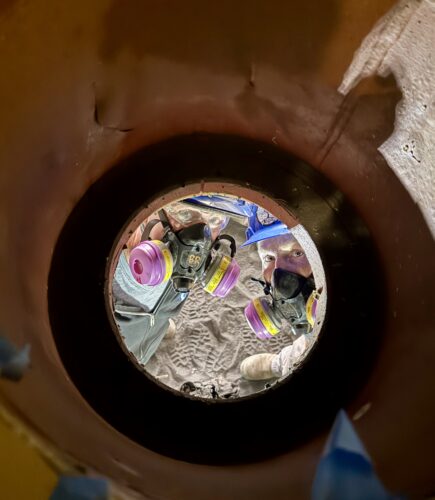
Additionally, this week I prepped the top of the centerboard for welding a new reference position mark. This required full PPE and working in a very tight environment (see photos below for PPE and a view of the workspace before wire wheeling/primer). I wire wheeled the surface of the centerboard to ensure it was smooth, and I will be adding a coat of primer next.

This was a challenging work environment. However, I now feel confident that I know how to properly utilize PPE and accomplish difficult tasks in tiny spaces. Wire wheeling rust away can also be very satisfying.

-Paige FitzPatrick

Week 4 – Hello from the Transducer Room

Hey everyone!

The highlight of this week has been working on the Ocean Surveyor 150 ADCP sonar transducer well. Sonar wells allow access to the transducer from inside of the hull. These wells must be completely watertight as the sonar can only operate effectively in water. We first removed the lid from the well, using a chainfall to lift the heavy lid above the well to give us access to the transducer. The OS 150 transducer was unplugged from its cable and lifted from the well for cleaning. I prepared the well for a fresh gasket to ensure a watertight seal when the ship goes back in the water, using a wire wheel and a fresh coat of primer to create a smooth gasket flange and well. I cut the new gasket and additionally prepped inside the well with sound-dampening corporene material using 5200 marine-grade adhesive.

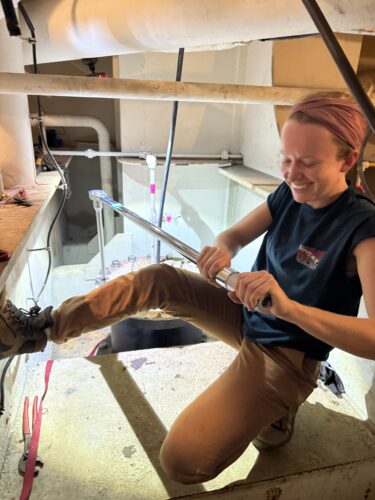
Learning to work with equipment that must create a water-tight seal has been a very valuable learning experience. Additionally, using socket wrenches that are more than half my height has given me more confidence in taking on more challenging engineering and technology tasks (see giant socket wrench pictured below).

Choosing the right tool for the job is half the battle.

-Paige FitzPatrick

Week 3 – R/V Sikuliaq Made It to Dry Dock!

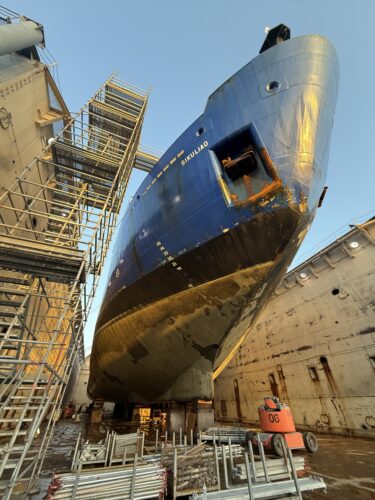
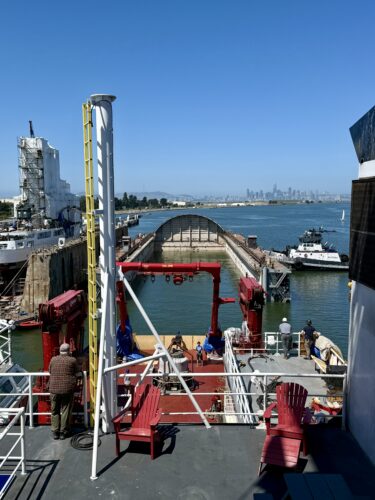
We have officially made it into drydock! Early in the morning, a group of tugs helped push R/V Sikuliaq off our docking into the submerged drydock structure. The drydock is a large structure designed to lift large ships out of the water by pumping water from a submerged platform beneath the ship.

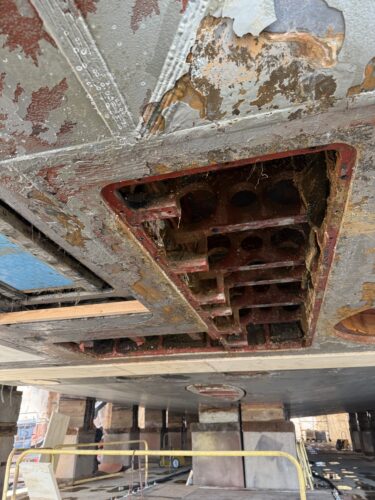
Getting out of the water has allowed the team to move forward with many projects. In our first few days dry, we were able to remove all of the ice windows and sonar systems from the flat region of the hull dedicated to sonar systems. This area is called the sonar flat. We removed the 75 kHz ADCP, OS 150 kHz ADCP, EM 302 multibeam transducer array, EM 710 multibeam transducer array, and TOPAS PS-18 parametric sub-bottom profiler. The transducers and the ice windows that protect the scientific equipment from polar ice impacts are both extremely heavy and extremely sensitive. There is just over 5 ft between the hull and the dock, leaving very limited room to work. We had to support the heavier instruments using wooden dunnage and support the lighter sonars by hand.

(Above) Sonar flat with ice windows and transducers still in place.

(Above) One portion of the EM 710 multibeam transducer array was removed.

All of these sonars are synchronized through a system called K-Sync, preventing the sonars from pinging at the same time. I have really enjoyed seeing how this system is physically connected throughout the ship. Working directly with the instrumentation has helped me clarify the transition of a sonar ping from physical signals to electrical signals that are carried to the lab through carefully considered cable routing.

-Paige FitzPatrick
Week 2 – Winches, EK 80 Trancievers, and Domes

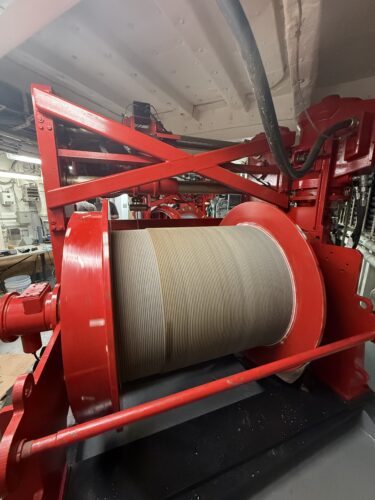
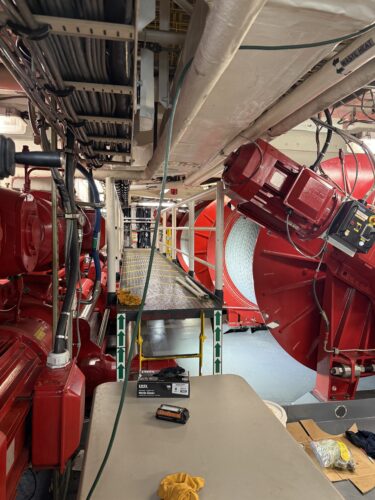
Week two onboard R/V Sikuliaq has primarily featured maintenance on the advanced system of winches. R/V Sikuliaq has an oceanographic traction winch system and two hydrographic winches to support a wide variety of scientific research expeditions. Winch systems play a critical role in oceanographic research. They are responsible for suspending heavy equipment from the ship into the depths, often carrying data directly to the laboratories onboard. This week, we unspooled the winch wires for re-lubrication and maintenance. This required a spooling system on the dock to take up slack and communicate with the winch system onboard. To prevent damage to the wires and to ensure proper wire spooling in the winch drum, tension was kept between the onshore spooling device and the ship’s winches. The many moving parts of this operation required direct and clear communication. If the onshore spooling device continued to run while the onboard winch stopped, the wire could snap. Our team was able to successfully lubricate our winch systems, ensuring proper functionality during upcoming research cruises.

We additionally checked the integrity of the wire insulation using a megohmeter. This test applied a high voltage to the winch wire to measure the amount of leakage coming through the wire’s insulation. We tested both the winch wire and the slipring that connects the rotating winch drum to the data cable leading to the ship’s laboratories.

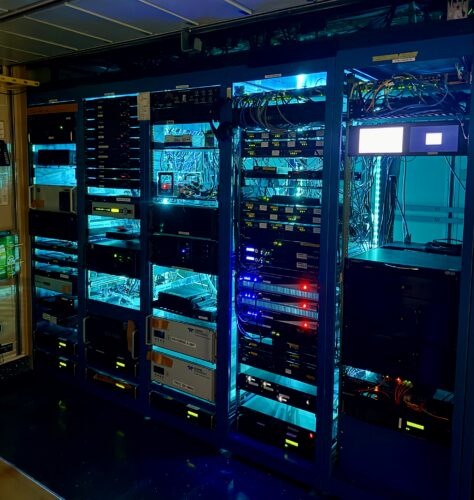
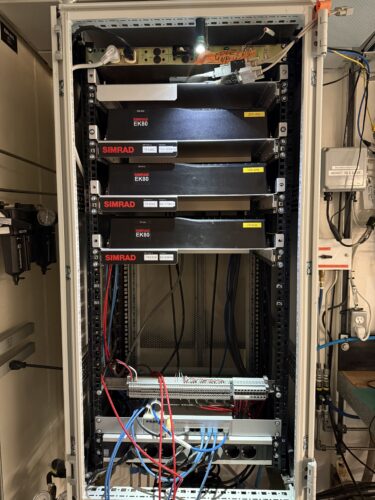
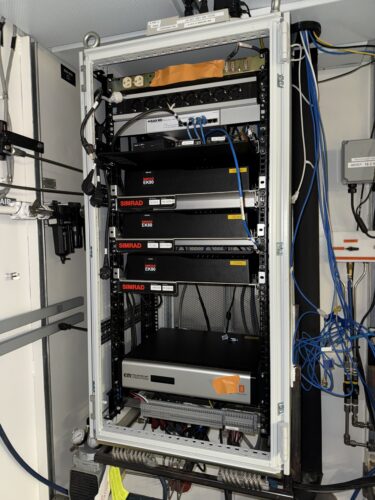
One of my additional projects this week was rearranging the aft mainlab LAN (local area network) rack.

This rack houses the EK80 sonar system transceivers, shown in black. These devices transmit and receive information from the transducers located in the centerboard shoe. To rearrange this rack, I removed the transceivers, power strip, and din rail. I reinstalled the equipment with a more streamlined approach to improve equipment accessibility. Additionally, I installed a new drawer for the Raspberry Pi computers housed in this rack. This quired CAD drawing and 3D printing of a component to secure the shelf to the LAN rack.

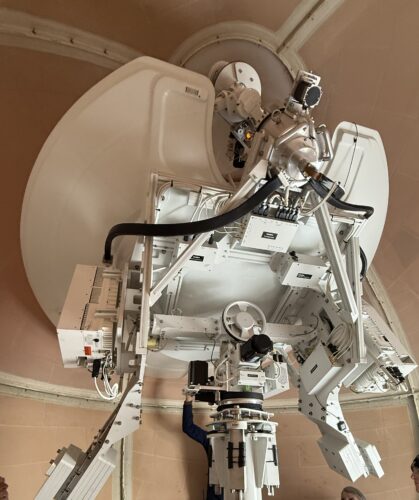
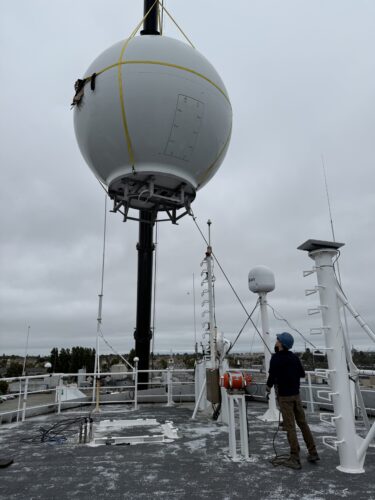
Lastly, we removed the domes! The domes formerly housed a HighSeasNet satellite communication dish. The ship is moving to a OneWeb system, utilizing a low earth orbit (LEO) satellite constellation for our redundant global internet access system.

Connecting how systems send and receive messages has been a critical learning component of this week. I have found it very interesting to see how the software interface operated at sea interacts and connects to the physical sensor units we are servicing at drydock.

-Paige FitzPatrick
Week 1 – Preparing R/V Sikuliaq for Drydock

Hello everyone!

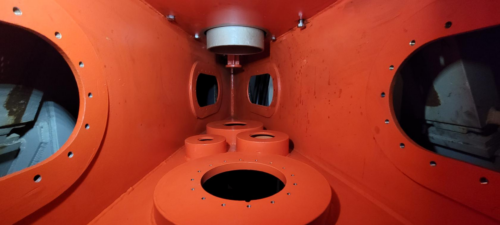
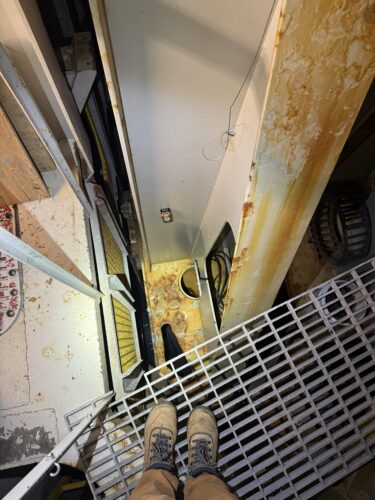
I have completed my first week onboard R/V Sikuliaq as a MATE intern! Getting an introduction to the vast array of scientific equipment onboard has been an incredible first-week experience. One of my favorite things to learn about R/V Sikuliaq is how her equipment is specialized to face harsh, icy conditions in the Arctic and the Antarctic. We are currently docked in Oakland, California. This week was all hands on deck, preparing the ship to be lifted out of the water. One of our major projects was the removal of the EK80 sonar system transducers from the centerboard shoe. The centerboard is a large retractable structure within the hull of R/V Sikuliaq that houses sensitive sonar equipment. The centerboard extends beneath the hull when the equipment is in use, gathering high-quality seafloor mapping and acoustic data. When the instruments are not in use, and particularly when the research vessel is facing icy seas, the centerboard retracts within the hull. The centerboard shoe is the housing at the bottom of the centerboard that holds the transducers.

Working inside the centerboard shaft is a very unique experience. The centerboard shaft almost resembles an elevator shaft. A metal grate is placed in the area beneath the retracted centerboard. The ocean lies beneath the grate, with the centerboard looming overhead. It is not a place to fear heights or confined spaces. We were able to successfully remove the transducers, requiring very careful use of tools to pry the instruments from their seats. The face of the transducers is very sensitive and has to be handled with extreme care.

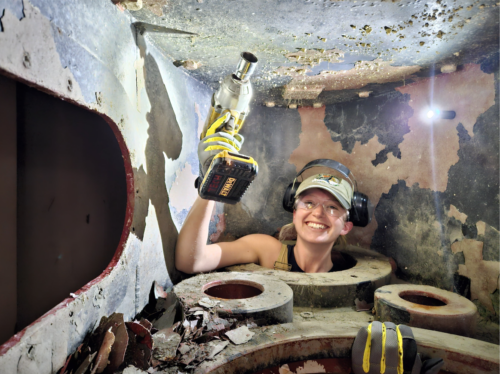
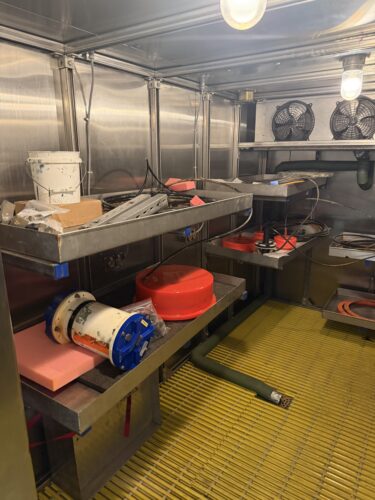
Above is a photo of me inside the centerboard shoe after the removal of the EK-80 transducers. The space is very small, but I feel right at home! Below is a photo of the removed sensors, stored in an unused refrigerator.

Other smaller projects included designing and printing new caps for the upward and downward facing sky temperature and sea surface temperature sensors, climbing to the top mast to inspect the meteorological equipment, studying how instruments communicate throughout the ship, and exploring Alameda Island. It has been a great first week with the crew!

-Paige FitzPatrick
Intro: Paige FitzPatrick
Hello everyone!

My name is Paige FitzPatrick, and I am the new UNOLS-MATE intern onboard R/V Sikuliaq! I will be training with the team of marine technicians during the upcoming drydock period.

I love creative problem-solving and am very interested in fabrication in marine science. I learned seamanship skills as a scuba instructor before studying a degree in Marine Affairs at the Rosenstiel School of Marine, Atmospheric, and Earth Sciences (RSMAES) with the University of Miami. In my time at RSMAES, I developed a passion for 3D printing, marine research, and vessel operations. I completed my undergraduate degree studying Marine Affairs both onshore and at sea with the crew of R/V F.G. Walton Smith, training in marine technology and shipboard engineering. I earned my 100-ton USCG Captain’s License and QMED Marine Engineering License in this position. I was able to research 3D printing applied to subsea instrumentation with the Makers Marine Technology Fabrication Laboratory, further inspiring my passion for this field. I am always excited to better my seamanship skills and expand my knowledge.

You will most likely find me on my paddleboard outside of work. I love photography and being on the water, ideally with a pair of binoculars for spotting cool birds. I am so excited to be training with the incredible team onboard R/V Sikuliaq and am grateful for the opportunity to join the MATE internship! This program will help me take the next steps in achieving my goal of becoming a seagoing marine technician.

Powered by WordPress & Theme by Anders Norén