
Our ship has crossed the Chuckchy Sea, and the Beaford Sea, and now we are in the vast Arctic Ocean. Most days are cloudy and unremarkable in scenery, but when the clouds are gone, and the sun shines through the clear blue sky onto the sea ice, the scenery is breathtaking. When we first saw ice the whole crew ran onto the bow, some without coats or hats, just to the see the first ice of our voyage. There is no wave action in the arctic, sea ice dampens the energy transfer from winds to waves. Yet when the ship hits ice, you can feel the shaking, and the hallow thumps of ice chunks crashing against the steel hull. Moving through the ice feels less like a ship at sea, and more like severe turbulence in an airplane. Throughout last week the watch standers on the bridge have spotted Arctic animals, a walrus and a polar bear. While I got to the see the walrus up close, about ten feet from the port side of the ship, the polar bear could only been seen from binoculars. I don’t have any good pictures of the animals to post, for a couple of reasons. One is that the fauna is mobile and most often seen in a blink of an eye. And more importantly, I’d rather enjoy the experience myself, without attempting to take a blurry photograph on my phone. We’ve transited for a four days, and as we approached the first science station, all the commotion began.
A whole week of scientific work. I feel like I’ve learned more about oceanography in the last week than in last year of college. There is so much to learn, so much to see, everyday is like a semester of material crammed into twelve hours. My day starts around five o’clock in the morning, with a vigorous reading of instrument manuals. For me Its much easier to spent hours upon hours reading while at sea than while on land. Maybe perhaps its due to regimented lifestyle while at sea, or less responsibilities, or maybe just because there is just simply much less of distractions.
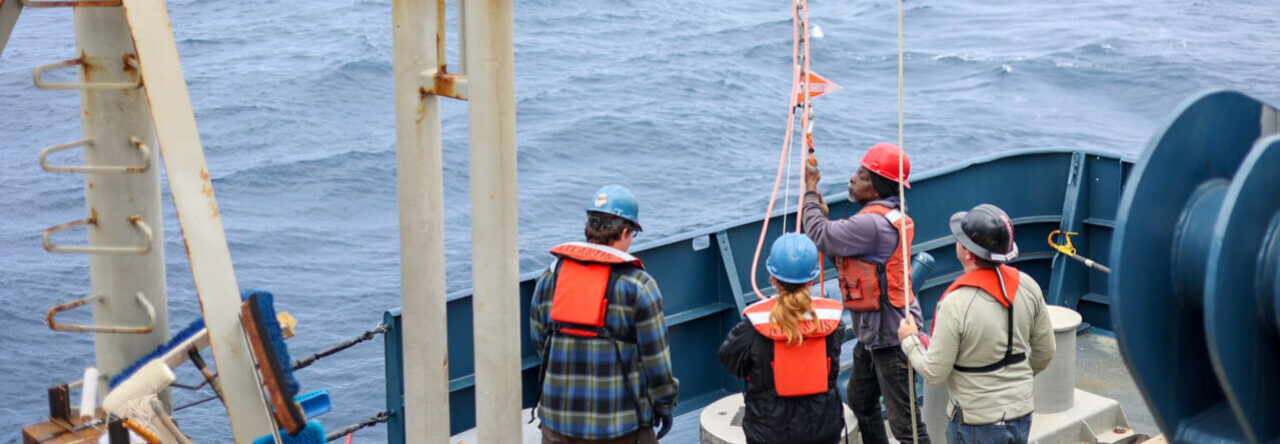
By nine o’clock there is an updated plan for the days operations. So far I’ve had the opportunity to finally see mooring buoy retrieval and deployment. The amount of calculations and hard manual labor that mooring buoys require is astonishing. Every little detail has to be accounted for; From the location of everyone on deck to the position of a small temperature probe installed on the wire. But I’m getting ahead of myself. In general, a mooring buoy is an anchored buoy with a wire that stretches from the ocean floor to the near surface of the ocean. The wire is riddled with different sensors, mostly pressure and conductivity sensors, temperature probes, ADCP units, and numerous other instruments depending on the aspect of ocean properties the scientific group is interested. The current scientific project utilizes many acoustic instruments, with a sound source on one of the moorings and receivers installed on others. Moorings themselves are designed and redesigned every year to account for different environments and missions. During the morning briefing the course of action is planned out for the day’s operation. From what I’ve seen; There is no usual course of action for a mooring operation. There is a general plan of how the operation is going to go, but the circumstances are constantly evolving, often with sudden, abrupt changes to the procedures. It takes years of experience to understand every possible detail affecting the operation. Some of the scientific personal have been doing mooring operations for over forty years. After all the planning has been discussed, and risk assessment has been agreed upon, the scientists and BM’s (Boatswains Mate’s) go out on deck. I do not have to be there, but I join the science party on deck anyway. I really enjoy working on deck, the differences between the coast guard and scientists are quickly dissolved during difficult tasks as such. A mooring operation can take anywhere from four to eight hours. Most of the crew rotate their positions with shift changes, scientists stay out for the entirety of the operation. After all is set and done, the ship departs the mooring and transits to the next station. There are many steps that I’m leaving out, partly because I don’t fully understand them yet, and partly because even though they are important, they aren’t exciting to write about. In fact, there is so much going on between the science lab, technicians office, and deck department that I have yet to learn and see. By now I feel comfortable with my duties and responsibilities, I would say I’m rather invested in the work we’re doing out here. Day by day I feel more and more comfortable working with the STARC, even though I am new to this industry.