11/7
After a relaxing weekend at home, I returned to the ship, rested and ready to work! This week began with prep for the upcoming OOI cruise. The main lab hadn’t seen any scientists for a few weeks, so we began cleaning and organizing the space, and plans were made to make some of the tools more accessible to the scientists. We took a field trip to the Smith lab, where all ordered supplies come in for the techs to pick up.
I then spent my afternoon putting my recently acquired knowledge on terminating coax cables to use, helping to terminate the new cables for the main lab. Sonia and I terminated for what felt like hours, and finally at the end we had six new cables to run the length of the lab.

11/8
We woke to an issue with the pCO2 system, all tests indicated that the systems were fine but that it was an issue with the server. After running all the logical tests, the system fixed itself and we were left wondering what went wrong in the first place. An issue for the future!
Sonia and I ran the new coax cables in the main lab and over to the new J box. The science crew started to move aboard and the lab setup began. The techs and I continued with random tasks for the rest of the morning, purging broken equipment (chucking it into the dumpster) and working with the CTD track motor (confirming that it still needs to be rebuilt in the winter). After all this excitement the techs and I attended the weekly SSSG meeting in person. Its nice to finally put some faces to the names I’ve been seeing over Zoom!
I closed out the day by helping troubleshoot issues with the ship’s camera system, starting with the one at the top of the A-frame with Emily!

Luckily I’m not afraid of heights because two stories up may not seem like a lot from the ground, but it certainly does while you’re up there! We continued troubleshooting the cameras for the ROV people and ended up doing more terminations of coax cables that were thought to be fine, but under closer inspection were looking shifty.
11/9
The ship had to wait for a slack tide to leave, which meant we had time for some last minute errands on shore before departing close to 1100. The techs had me work on some of the starting cruise procedures, including turning on the ADCP, the 710 multibeam, and lowering the SSV probe (this time without shearing off any screws). We initially had issues starting the Knudsen echosounder, and were more confused when everything checked out fine with the servers and the Knudsen itself, after some thinking it turned out to be a harmless permissions issue. This was easily fixed by logging off, and logging back in on the account with the correct permissions to run the Knudsen. The techs and then I joined the science crew for safety and abandon ship drills.
One of the many great things about this internship is how flexible it is! The techs asked me what area I would like to observe during this science cruise, we had been told that most CTD casts would be done at night, so I asked to be put on a night ‘shift’. I was not strictly in charge of anything but I got to stay up with the tech on duty and work independently when there were no issues, and jump into action with them when something came up. After showing me the launch and recovery procedures for the CTD, the techs left me to it along with a grad student from the science party.
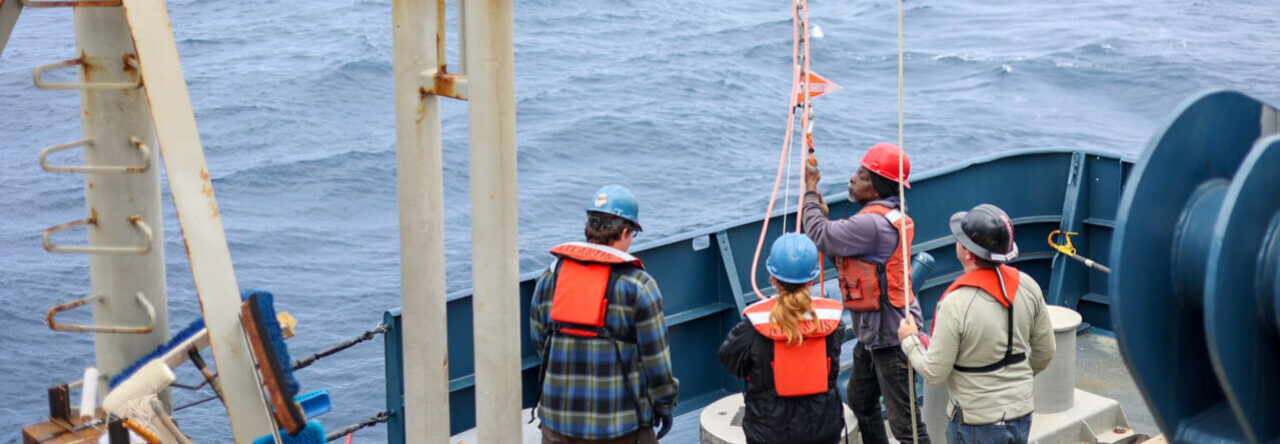
As the mission was outlined, this first week-long leg would be to recover the three large surface buoys and their anchors, and most of the gliders for the array. For a glider recovery, the scientists are able to tell the glider to stop and come to the surface, then those coordinates are sent to the watch officer who then takes the ship to that area. What follows is everyone looking around for the single, small blinking yellow light on the glider, which is pretty hard to spot at night or in the day! The glider will have some kind of line or attachment point for someone on deck to hook it with a line attached to a crane to hoist it up on deck and safely into a cradle. This is considered to be a relatively easy recovery, as in, not requiring the A-frame and multitudes of lines as is needed for the larger moorings, hence why many of the glider recoveries were slated for the evening.
I began my first evening shift with the first glider recovery, which came with a small school of Mahi,

…and then my first CTD cast! The grad student, Lukas, and I worked well together and were able to do several casts before the midnight EK80 survey.
11/10
I slept in through breakfast this morning, but caught lunch and started my day prepared to be up late for my shift. While I slept in they recovered a large surface buoy and its accompanying risers. By the time I went out on the deck to watch, they were on the last stage of the mooring recovery, pulling up the anchor! This ended up going a bit awry, with the recovery line breaking part way through pulling up the anchor, meaning an ROV mission is now needed to reattach the anchor.
I joined the tech meeting in the afternoon before the OOI crew recovered two more gliders, and did more CTD casts at each site. Meanwhile I continued my catalog of the CTD sensors, now figuring out the calibration dates and which ones are past due.
With the upcoming hurricane Nicole, plans are kept flexible while the crew watches the storm, expected to hit us Friday night into Saturday. Ultimately it was decided to head back north to Martha’s Vineyard to hide while the worst of the storm passes over us. With the adjusted schedule, Lukas and I were able to complete many CTD casts for his research again, stopping at midnight for an EK80 survey.
11/11
Another morning, another buoy recovery! This time I made sure to get up early to see it happen though. It is amazing how small these things look out on the water, but on deck you could open the hatch and climb right inside! The deck operations for the recovery are very interesting to watch, as this group has sailed on this ship for maintenance on the OOI array nearly every six months, they work like a well-oiled machine, carefully capturing the buoy, leading it up with the A-frame and then gently guiding it on deck and into position for the transit back.

After a nap I woke to hear that the recovery of this buoy’s anchor went better than yesterday’s, and with the change in plans due to the hurricane the ship steered over to pick up a smaller buoy in the vicinity before heading north to Martha’s Vineyard. These smaller buoys were mostly slated for the second leg of this trip, but with the interference of the hurricane (now downgraded to a tropical storm thankfully) it was determined that we might as well do what we can with the time out here we have.
As I post this I’m looking forward to at least six more CTD casts tonight while I’m on watch helping out!