11/19
Morning operations were successful as the mooring group recovered the last small coastal profile buoy, with its accompanying sensors and anchor. They also recovered an anchor that was left behind from last week. The wind picked up to a constant 30 knots and our destination that day had us steaming into the waves and pounding down for most of the afternoon. This influx of bubbles under the hull is a very big problem to say the least, as it disrupts the ship’s array of transducers. Not only transducers though, the constant supply of sea water being pumped for the main lab supply and to run through some other instruments was heavily disrupted by all the slamming. Emily and I worked to troubleshoot the PCO2 sensor which seemed to have an array of issues stemming from the interruptions in flow. We initially thought we were successful by replacing a drip sensor that had become corroded, but the system kept emergency stopping itself and the drip sensor was not the biggest problem.
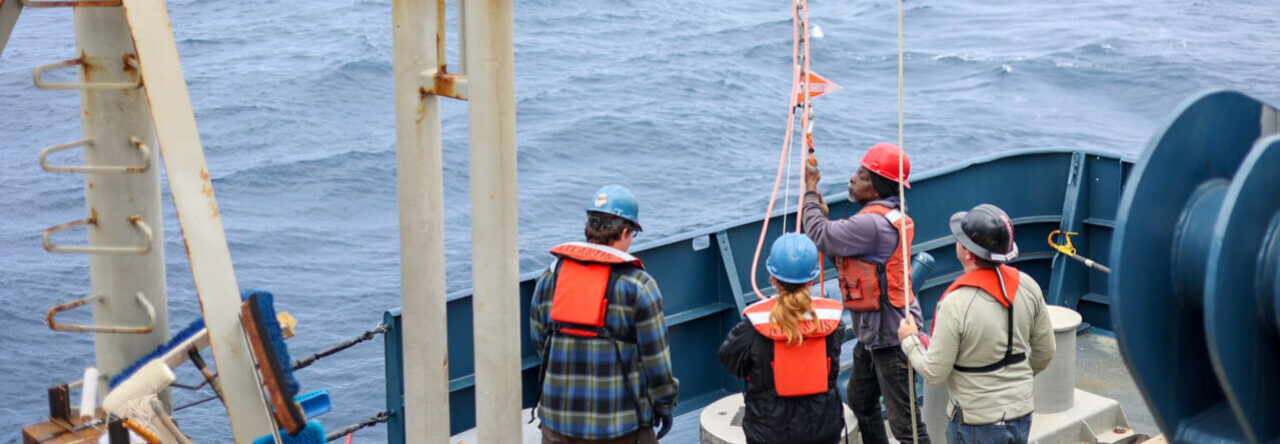
The evening was taken up by a battery of CTD casts, where we would steam (pound) north for half an hour, and then go out on deck and launch the CTD while trying not to get pummeled by waves coming over the side. In between casts I emptied and organized the cabinet in the HIPAP area, which was suffering from poor labeling and the internal lights for the cabinet were low on charge, making it very difficult to find anything. Many (most) things in there were networking pieces of technology I had never seen before, so I did have to bring Sonia in several times for the game of, ‘what is this and do we need to keep it onboard?’ This cleaning also doubled as a purging of equipment in time for the INSURV inspection, where anything superfluous will be removed from the ship. In the end, I was very pleased with the results!

(Also here is the promised CTD bolt cover final print!)
11/20
The weather remained the same but the CTD casts were done in daylight today, which gave you more light to see the waves crashing onto the deck!
The evening brought a break from CTDs, as the EK80 was turned on for a long transect survey. Meanwhile Sonia started me on a coding journey, first showing me some resources to learn the basics, then setting me up with a virtual computer to test out what I was learning. This was lovingly titled “Intern Playground”, and it’s a place for me to get comfortable with a system similar to the ship’s, while also being safe from killing any of the ship’s systems.
11/21
The weather gave us a break for the ROV operations, but not before giving us another taste of a bumpy night. Everyone was extremely motivated to finish up though, and the first dive of the day brought up the anchor claimed by the crabs last week.
The SSSGs had many meetings concerning an upcoming cruise in December, new ideas for upgrading the email system for the WHOI ships, and the upcoming ADCP installation after INSURV. These meetings ended just in time for us to go back into the main lab and watch Chris snag the final stubborn anchor. This one had fired off it’s linepack, but it had snagged somewhere on the way to the surface, so he had extra line to avoid getting tangled in with the ROV. This final anchor meant the last of deck operations, and the ship turned north to head back home. There were a planned group of CTD casts along the way, but the weather had turned against our favor and by the middle of the night, CTD casts were called off.
11/22
No one got much sleep as the ship rocked and rolled its way back to port. I was personally attacked by all the items on my desk, in my vanity when it swung open and emptied all contents, and my desk chair when they all went flying during various rolls. I did not, however, fall out of my top bunk, which is an accomplishment.
No sleep and a bumpy ride makes for a low-spirited crew, but everyone was bolstered by the fact that we accomplished all of the OOI array goals, picking up all of the equipment and doing many CTD casts and surveys along the way. We came into the dock at WHOI around 0900 and quickly the deck and science crew began unloading.
As with the last demobilization days, the SSSGs mainly stick to going through end_cruise work, moving data to the correct places and shutting systems down. This involved the techs all together to figure out what was wrong with the PCO2 sensor. In the end it was a drip sensor that kept stopping the system, but because with all the air in the systems from the ride, the pressure differences caused spontaneous releases of sea water in weak places in the tubing system.
The end of the OOI cruise doesn’t mean an end to the work, as now we can fully turn our attention to the INSURV inspection. This meant for these days leading up to the holiday, zip ties were our best friend, as we have to secure all cable runs. This is just one of the many steps for the SSSGs before INSURV, and all other departments on board will be working through the next week and a half painting, cleaning and securing.
11/23
Our first full day back on shore was a busy one as the demobilization efforts continued. All the moorings and associated equipment are removed, as none of it can stay for the inspection. Speaking of inspections, many different aspects of the ship need to be looked at, including the fume hoods in the lab spaces, and the hull itself, as we had snagged a lobster pot on our bow thruster on the way back. (No there weren’t any lobsters, we asked.) The divers also exercised the bolts on the sea chest plate. You may say this sounds like a lot of exercising for this project, but they take opening holes in the ship very seriously. For our purposes we aren’t opening a gaping hole to be exact, but the outside plate of the sea chest will need to be removed if we are to install a transducer on an elevator and don’t want to hear it go ‘bump’ on first deployment.
On the topic of the new ADCP transducer, one of the scientists on the team stopped by in the afternoon, and the techs met with her to discuss the install. For a few days the team had been emailing back and forth about an issue with the cable bend. After discussing many solutions over Zoom, this scientist who visited agreed that the cable bend was not ideal, but likely workable, as the instrument is only planned to be onboard the ship for a year of at-sea testing. For us this means we can continue with the installation plans, as again, we can’t start this project and have it unfinished during INSURV, so it must be started directly after.
11/24
Happy Thanksgiving! I am fortunate to be spending the holiday weekend at home, and I hope everyone has a great holiday and eats lots of good food!
I did bring a small project home with me, modeling out two more small parts, one to cover a missing outlet (think a protector you have for a baby, but for a hollow outlet strip) and the end cap for those strips of outlets. I will update progress on the parts next week!

