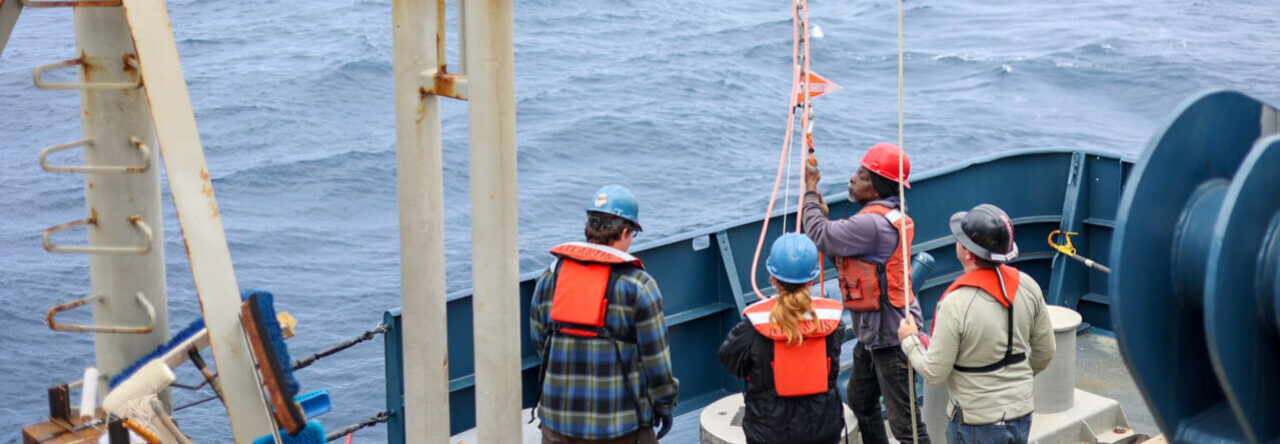
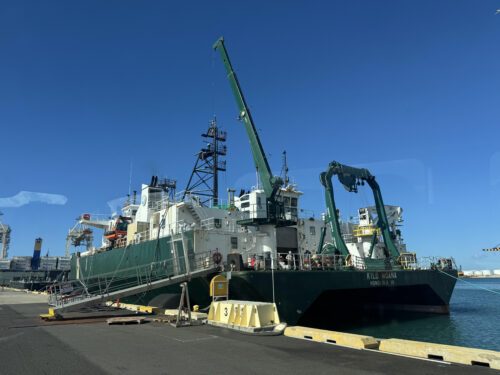
We embarked on HOT Cruise 367 early Sunday morning. After a little time to unpack, we completed our safety drills and left the harbor.
We practiced sampling a CTD for oxygen, chlorophyll, and nutrients on our first cast, and recorded the surface temperature with a thermometer over the side. We also shadowed a HOT technician while they prepared and analyzed pH samples from the CTD. Each sample was placed into a specialized container with a set amount of pH indicator dye, and run through a spectrophotometer. In order to ensure accuracy, the pH of the dye was tested and adjusted before use, and samples were kept at a constant temperature using a water bath.
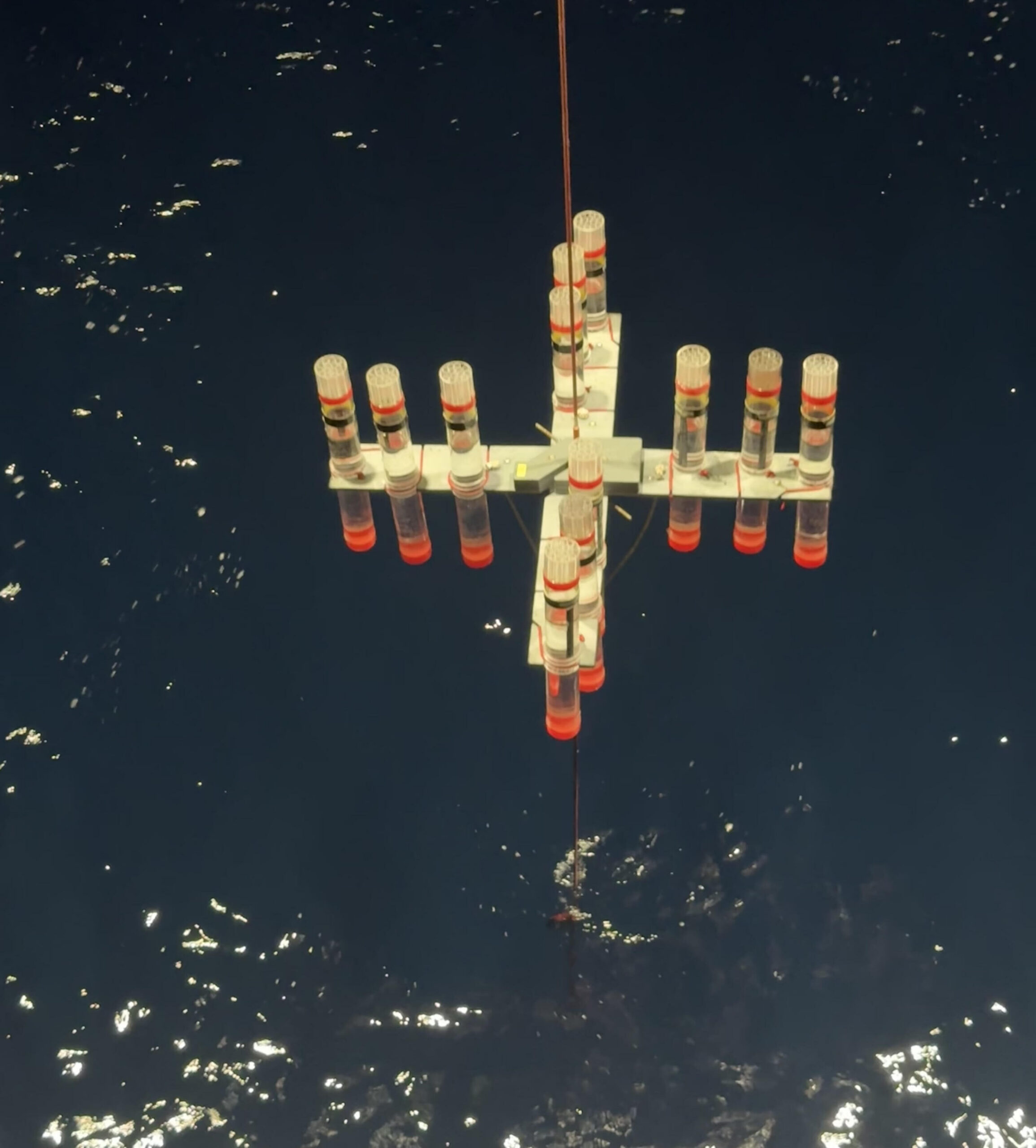
Next, we got started preparing sediment traps for deployment. The first step was preparing the ‘HOT sauce’: a mixture of formalin, seawater, and salt to fix sediment samples and keep them in place. After filling each sediment trap, we deployed them over the side on a cross.
Finally, we learned how to record meteorological observations. Every four hours, we recorded latitude, longitude, atmospheric pressure, and humidity. We measured the humidity manually using a psychrometer on the ship’s bow.
After my shift, I had the chance to go star gazing, and saw beautiful views of the Milky Way!
On Monday, we focused on sampling our CTD for particulates, including carbon, nitrogen and phosphate (BPO4).
For particulate carbon and nitrogen, we collected large carboys of water from each CTD bottle, then filtered each carboy using positive pressure (nitrogen gas). Some carboys took longer to filter than others – another HOT technician noted that certain depth ranges (~175 m) had more material in the water and clogged up the filters more quickly. Once each carboy finished filtering, we collected the filters for further processing. Back on shore, each filter will be combusted – thermal conductivity sensors can be used to determine the composition of carbon and nitrogen present on each filter. The filters themselves are made of glass microfiber and will not burn – in fact, they are combusted before use as well, in order to remove any contamination.
The process of collecting particulate phosphate (BPO4) samples was similar to collecting particulate carbon and nitrogen – large carboys were filled with water and filtered. However, the preparation and analysis is conducted differently. BPO4 filters are acid cleaned as well as combusted before use. After BPO4 found on the filters is combusted and converted into orthophosphates, they are dissolved in various acids to create a colored solution that is then measured with a spectrophotometer.
On Tuesday, we learned how to sample for ATP – a useful method to estimate microbial biomass (excluding viruses). First, we filtered the seawater from our CTD using negative pressure (a vacuum pump). This step captured ATP associated with living biomass but not ATP dissolved in the water, which passed through the filter. Next, each filter was boiled in a test tube containing Tris-buffer, to extract the ATP, before being frozen to preserve each sample for further analysis.
ATP samples are analyzed using the firefly bioluminescence assay, where the enzyme luciferase (found in fireflies) catalyzes the oxidation of ATP dependent D-luciferin to oxyluciferin, and emits light. The amount of light emitted is proportional to the number of enzymes activated, which is in turn proportional to the available quantity of ATP in each sample. By measuring the amount of light generated with a luminometer, we can measure how much ATP is present. I was super excited to learn about this method, which was new to me!
Next, I learned how to fix and flash freeze samples for microbial analysis. First, we added a low concentration of formaldehyde, and then we dipped each sample tube into a dewar of liquid nitrogen.
We continued taking samples from our CTD water. We sampled for chlorophyll, by filtering seawater and placing filters in test tubes with acetone to extract pigment. We were careful to wrap each chlorophyll sample with tinfoil to prevent the pigments from degrading with exposure to light. We collected water to test for salinity in order to ground-proof the conductivity sensors on the CTD.
I also shadowed a marine engineer while he collected zooplankton samples, and observed the plankton under the microscope.
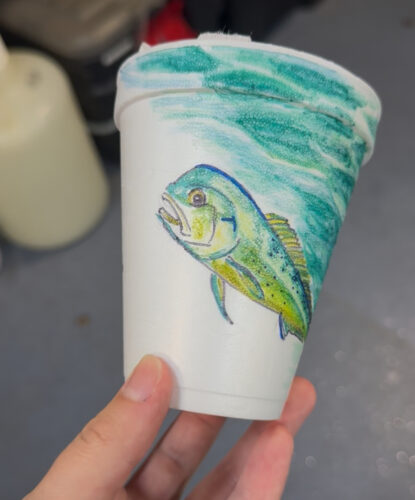
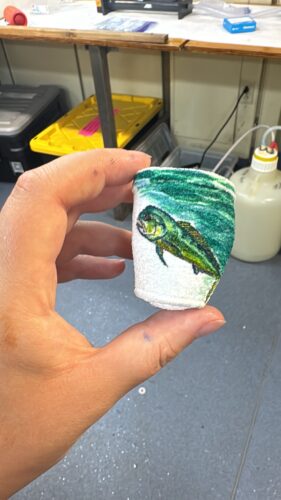
Finally, we deployed our CTD on a deep cast to 4725 meters, and sent along a bag of Styrofoam cups! When we recovered the CTD, the Styrofoam cups had all shrunk in size due to the pressure at depth.
On Wednesday, I was trained on conducting Winkler titrations to determine the quantity of dissolved oxygen in a water sample. After my training, I worked on running titrations for the rest of my shift. I was excited to practice some chemistry!
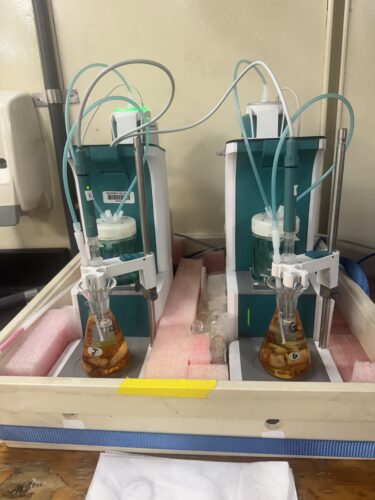
On Thursday, I took a tour of the engine rooms belowdecks and finished up the rest of the oxygen titrations. I also spent some time familiarizing myself with the various instruments and data streams coming through the computer monitors in the CTD lab, including the ADCP. Near the end of my shift, a storm petrel flew into the loading bay and had to be relocated!
On Friday, we returned back to port in Honolulu. After packing up and cleaning our rooms, we unloaded all of our cruise gear and samples, and put them away back in the lab.
I loved spending time at sea, and I can’t believe my first cruise with the HOT team is already over! I learned so much about different instruments and sampling techniques, and I can’t wait to continue my work over the next couple of weeks.
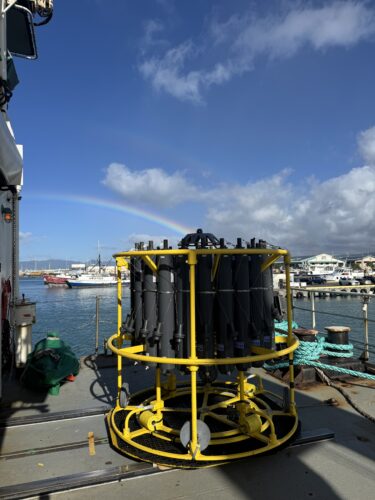
The weather was beautiful as we unloaded and we had a little bit of a rain shower. Apparently, the real treasure at the end of the rainbow is a CTD!
Leave a Reply