Hi all! It’s been a busy, busy week and a bit. Sorry for the irregular blog schedule, it turns out that 5° is not a great place for satellite internet coverage when crossing the Atlantic. Anyway, this week all the fun really began. We left Bridgetown, Barbados the morning of Thursday the 27th for a three-day transit to our first station.

Bye Barbados! The last land we’ll see for 3 weeks
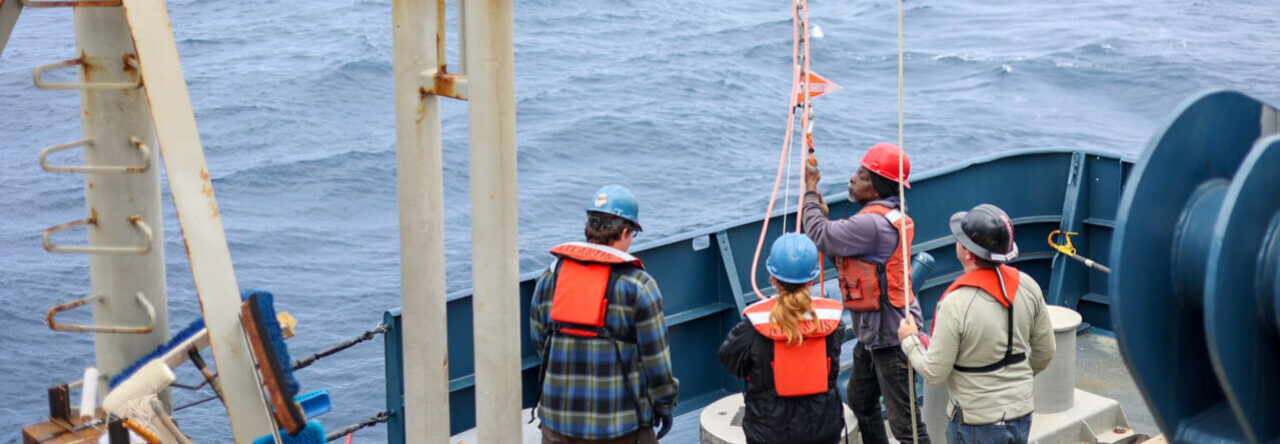
The main object of this cruise is to look at black carbon from biomass burning in Africa as well as heavy metals and PFAs in the atmosphere, water, and sediment. For the air sampling, the science party runs 4 high volume air samplers on the level above the bridge and one above that. For the water sampling, the scientists run filtrations all the time with our flow-through seawater system to look at water near the surface. These systems are always on while we’re in transit and are only shut off when it’s time to stop for a station to do deep water and sediment sampling. Over the course of the cruise, we’ll be stopping for between 10 and 12 stations. At each, we start with a CTD cast. On the way down, we get to see the profile of the water concerning temperature, salinity, oxygen content, fluorescence, and more. Then on the way back up, we trigger bottles to fill with water at depths of particular interest, like the maximum depth, maximum oxygen content, or right below the surface. At some stations, we’re just interested in the top 1000 meters of water, and at others we will do the CTD to full depth.

Directing a CTD cast. That’s me with the blue hard hat by the rail [Photo by Sam Katz]
Following this, it is time for the main object of the cruise – to get mud. We have time to do up to 2 or 3 casts at each station using the MC800 multicorer or the Soutar box corer. The MC800 is a notoriously tricky piece of equipment. It has a large outer frame and a central portion that holds the core tubes. The outer frame will sit on the bottom while the central portion gets pushed down into the mud. Then as it pulls out of the mud, it triggers lids and feet to flip shut on all of the tubes and capture the sample. The problem is that sometimes it gets triggered too early by motion in the water column and sometimes it doesn’t get triggered at all. The Soutar is simpler in its triggering mechanism, but requires enough tuning that we keep it as the backup in case we’re having no luck with the MC800 and so far, we’ve only had to use it once when we failed to collect samples with the MC800 twice in a row (we didn’t have success with the Soutar either).

Setting up the MC800 multicorer. You can see the bottles, feet, and finicky triggering mechanisms [Photo by Sam Katz]

The box corer getting it’s turn. That’s me on the A-Frame [Photo by Sam Katz]

Lots of nerves in the room as the corer gets close to touching down [Photo by Sam Katz]
One of the big projects that I’ve been working on so far is a small camera system called DEEPi developed at URI. A previous iteration of the camera had been tested to depths of around 1100 meters and during this cruise, we were hoping to test it at greater depths and use it to determine what was causing our multicorer to trigger early. During a 3300 meter cast at the second station, I put the camera on for the first time. That cast ended up going poorly with an early trip and no mud collected and the camera was able to show us just how early the mechanism tripped. At a depth of 3300 meters, the pressure is nearly 330 times more than what we experience and this turned out to be enough to kill the light that we used with the camera, but not the camera itself.


The DEEPi camera, the full system undergoing thermal testing, and all set up to watch the multicorer [Center photo by Gabe Matthias]
A couple of additions to the list of things I wish the Endeavor has are LEDs and lots of clear epoxy, but I was able to harvest some LEDs from a flashlight and found a couple tubes of five-minute epoxy. That plus some resistors and a lovely duct seal sacrificed to form a mold yielded a light to let us continue testing. I had some trouble with the epoxy not hardening well and my attempt at a vacuum chamber went poorly. But, we decided to put it in and see what happens. Bubbles are a big problem at the depths we’re talking about, but I figured that it would yield good data even if it lasted for only the first few hundred meters.
Unfortunately, the DEEPi did not survive its second cast, to a depth of 4645 meters. It’s cause of death is from some combination of the super high pressure itself and possibly some water ingress, but it’s a bit hard to tell with everything buried in epoxy.

Despite the unfortunate foreshortening of its life, the camera was able to capture the bottom of the ocean. That’s the slightly browner smear near the bottom of the frame.


The light that died. The light that survived. The one on the left is not rated to 3300m and the one on the right is, surprisingly, okay at 4645m.
We are currently at Station 8 and have 4 more before reaching port around March 17. I’ll try to post another blog before then to talk a little more about the different things we’re up to and for now enjoy the stern at dusk.
