Author: Norman Chung

Week 2: Seep Searching

Hello again, everyone!

It’s Norman again with my second and final update from the R/V Roger Revelle after two weeks at sea. Last time, I talked a lot about my work on preparing the AUV Sentry for its seafloor survey. This time, I’ll talk about how the data collected by Sentry has guided the ROV Jason’s dives as well as the work I’ve done after Sentry’s dive.

While underwater, Sentry collected multibeam data, which the Sentry team used to generate a bathymetric map of the topography in the area where Sentry completed its mission. Simply put, multibeam sensors emit sonar waves underwater and collect two pieces of data to generate the maps: the time it takes for the sound wave to return to the sensor, and the intensity of the sound at the time of its arrival at the sensor. The arrival time tells us how far away the seafloor is, and the intensity tells us about the seafloor material where the sound wave reflects back. Just so you can visualize this, here’s an image created using the ship’s multibeam sonar. The vertical, orange feature there is a seep.

By “sweeping” the seafloor with multibeam sound waves, Sentry generated maps of the seafloor and picked out the seafloor seeps we wanted to find. 

And seeps we did find! Sentry found signs of seeps at certain locations, and it was then up to the Jason team to send Jason down to those seeps and get a closer look at them. The Jason team’s operations astounded me. A few hours after watching Jason go into the ocean, I entered Jason’s control van and was reminded in many ways of a NASA mission control center. I loved looking at the seafloor through Jason’s cameras and watching the delicate movements of Jason’s robotic arms slowly but surely performing scientific experiments at the seafloor. The many aquatic animals that came to watch Jason work were fascinating in their own right. Finally, I was simply in awe watching scientists and engineers come together that night to learn something new about the ocean.

I enjoyed watching Sentry and Jason in action over the last week, though I am a little bummed I only got to see Sentry go into the water once. Regardless, the resulting spare time taught me a lot about all the important work that gets done even when Sentry isn’t in the water. Over the past week, I’ve cleaned out and refilled old oil containers, de-rusted multiple tools in the Sentry van, organized a bunch of components in Sentry’s van, and helped out with the end-of-cruise cleaning aboard the Revelle. I’ve also helped get seawater out of Sentry’s thrusters and prepare a spare sea bladder for Sentry for future cruises. Even when Sentry’s out of the water, there’s always some way to help ensure that future Sentry missions go as smoothly as possible.

I’ve had fun working on Sentry aboard the Revelle for the past two weeks! I learned a lot, and yet I feel like there’s still a lot I have to learn about marine field work. Hopefully, I’ll get to go out to sea and meet the wonderful people I met again one day. With that, this internship comes to an end.

Thanks for reading!

Norman

Week 1: The Human Orchestra

Greetings from the Gulf of Mexico, everyone!

It’s Norman from the R/V Roger Revelle with my first update. It’s been about a week since I first got on this ship, and I’ve already picked up a lot about life and work at sea. As a refresher, I’m working with the AUV Sentry team from Woods Hole Oceanographic Institution (WHOI). Both the AUV Sentry and ROV Jason teams from WHOI are here on the R/V Roger Revelle, and the two robots are working together to look at seafloor hydrothermal seeps in the Gulf of Mexico. The plan is to have Sentry survey the seafloor for seep locations within the area we’re interested in, then have Jason enter the fray and take a detailed look at the seeps we find.

A lot of my work so far has focused on getting Sentry prepared to take its underwater survey. So far, I’ve helped re-attach Sentry’s fins and propellers, attach various sensors and related components onto Sentry, and cleaned out some small O-rings to keep certain compartments watertight. I figured I would get to help maintain the robot at the start of the internship, but I was surprised by just how much work also goes into setting up the spaces needed to run Sentry. Alongside my work on the robot, I’ve helped run ethernet cables across the ship, secure tables and equipment down within lab spaces to keep the ship’s motion from tipping them over, and de-rusted, cleaned, and organized lots of the tools in Sentry’s work van.

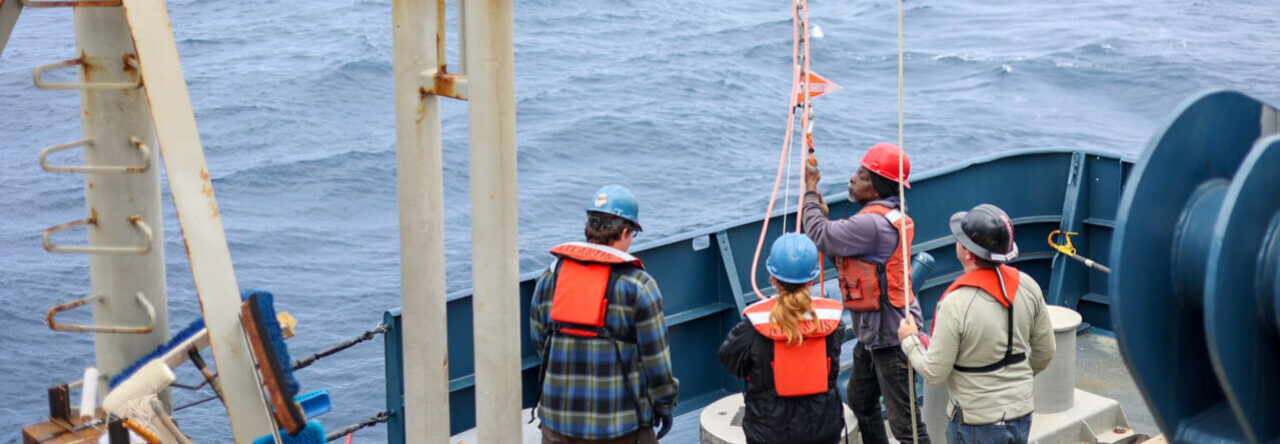
All of the Sentry team’s work has paid off. I felt exhilarated as I watched the Sentry and Jason teams work alongside the Revelle’s crew to get Sentry over the ship’s starboard side and into the ocean. I saw firsthand how the Sentry team watches over the robot as it performs its deep-sea mission, and I even did a mini-watch stand in the morning right before it was time to recover Sentry! The recovery process was just as exhilarating to watch as Sentry’s deployment. After a bit of math, we moved the Revelle to its recovery position at the perfect time. I then climbed up to the bridge to help lookout for the surfacing robot, and I rushed down to the deck soon afterwards to help get Sentry out of the water and back into its cradle. I’m happy to say that Sentry is safely secured and ready for some post-dive maintenance!

I’ve been impressed by a lot of stuff on this cruise so far, but nothing marvels me more than thinking about how many hands have come together to make a cruise like this one possible. I see the mass of electronics, wires, nuts, and bolts within Sentry and Jason and wonder how many hours of human effort went into making these behemoths work. I’ve watched the Revelle’s crew working and appreciate how their efforts got us out to and into the sea. Finally, I’ve thought about the scientists whose research gave us reason to go out into the Gulf of Mexico and look at hydrothermal seeps in the first place. It’s a gargantuan, concerted effort which in my mind I dub “the human orchestra.”

As we enter the second half of the cruise, I’m excited to watch Jason in action and to see what’s lurking around the bottom of the ocean through Jason’s eyes. Here’s hoping everything goes smoothly.

Thanks for reading!
Norman

Introduction – Norman Chung

Hi everyone!

My name is Norman Chung. I graduated from Caltech with a double major in mechanical engineering and geophysics last June, and I’m currently a first-year master’s student in Ocean and Resources Engineering at the University of Hawai’i at M?noa. I’m currently doing research in marine robotics, and I’ll be on the R/V Roger Revelle this May as a UNOLS-MATE intern working with the AUV Sentry team from Woods Hole Oceanographic Institution. Engineering and earth science are two topics near and dear to my heart, and I’m beyond excited to learn more about both topics while doing marine field work for the first time. In my free time, I enjoy cooking tasty food, doing Muay Thai, and spinning poi to music I like.

Stay tuned for my fun, little updates from the R/V Roger Revelle! 😀

Powered by WordPress & Theme by Anders Norén