
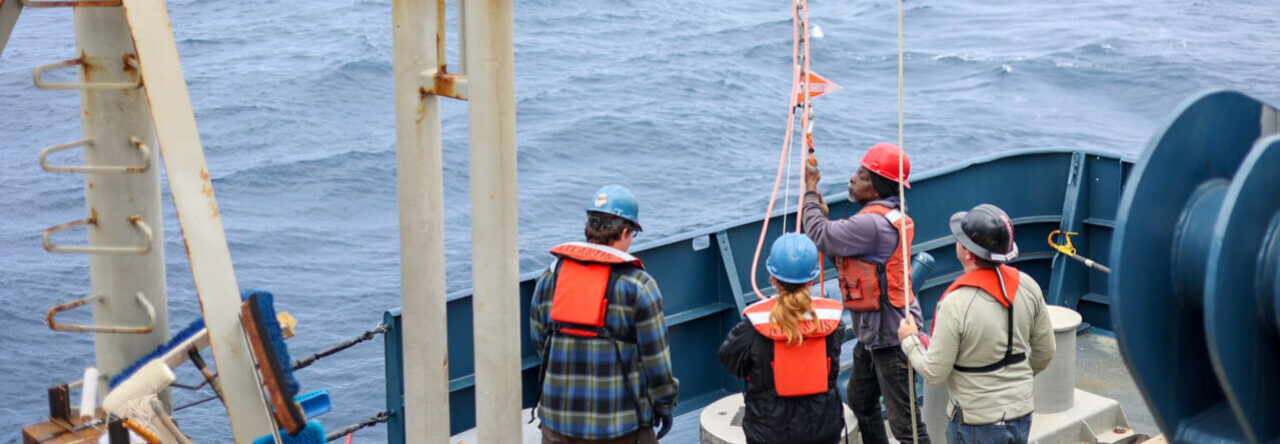
The schedule of our last few cruises was moved around in response to hurricanes, and I was very lucky to get to go on one extra cruise for this internship. This morning, we finished our one and only cruise mission. In fact, my internship came full circle, because we recovered one of the lost mooring lines from my first cruise with our visitors from NIOZ. The buoy started communicating its position not too long ago, and it turns out that it drifted very far from its deployment site. It took 20 hours from Bermuda just to get to the mooring. Recovery took place this morning, and it’s nice to see the familiar face of these big orange buoys on deck again.

One of NIOZ’s buoys
I am also grateful for the two extra days of my internship, since it’s given me more time to work on my personal project. In an earlier post, I had mentioned the project but added no specifics because the whole thing was giving me a headache. By chance, I managed to find a component that was absolutely necessary for the project’s completion, one which I thought we didn’t have. I’m extremely thankful that it showed up just in time.
The project, in summary, was to connect a data logger to a weather transmitter, which senses several meteorological parameters like wind speed, temperature, and humidity, and sends them back to the logger. The sensor had, at some point in the past, been reconfigured to communicate in a way that was incompatible with all other devices on board that we could use to talk to it. There was no way to get through to it until I found an RS-422 to RS-232 converter. The converter takes the sensor signal I can’t read and changes it to one I can. From there, I was able to reconfigure the device’s settings so it could talk to the data logger. I even found a way to deploy it just outside the ship’s bridge.

Weather sensor deployed on ship
Right now, it’s collecting data, and what I’ve seen has been consistent and accurate, so I’m very happy with the state of the project. If I can find time, I will plot the data over the collection period and compare it to data from other ship-board sensors.
We are currently headed back to Bermuda, and I will depart from BIOS soon afterwards. I am going to wrap up my project and, importantly, document as much of it as I can in case someone else picks up the same weather sensor and needs help communicating with it. I’ll leave some parting words on this blog site once the internship is over and I’ve had some space for reflection.


