Howdy all,
It’s been a minute since my last post and I have some big updates to share! After a two-week break and a lengthy flight, I touched down at the Bermuda Institute of Ocean Sciences (BIOS) station to kick off the second leg of my internship! Over the first few days I was at BIOS, I met the marine tech team, sang karaoke with the crew of the R/V Atlantic Explorer, and connected with the Bermuda Atlantic Time-series (BATS) techs through a glow worm light show. In addition to meeting everyone and getting acquainted with BIOS, I helped with some light cruise prep, like setting up WiFi access points and relocating a rain gauge with the tech team.

–The R/V Atlantic Explorer
For those unfamiliar with BATS, here’s some good information for ya. The BATS study is a time series of ocean physical and biogeochemical data that has been maintained since 1988. Scientists and technicians try to conduct a BATS cruise every month of the year to consistently observe trends in oceanographic data, much like the Hawaii Ocean Time-series does in the Pacific. In oceanography, some research requires decades of data, so the length and quality of these time series are extremely valuable to the global ocean research community. Some topics of research that BATS addresses include how the ocean responds to increased levels of atmospheric carbon dioxide, surface ocean nutrient concentrations, phytoplankton blooms, ocean acidification, modeling, biogeochemical cycling, and much more!
The BATS/BATS validation (BVAL) cruise I am currently on is an extended version of their typical four-day cruise. Once a year, the BATS team samples at multiple stations between Bermuda and Puerto Rico to better understand the mesoscale and large-scale variability of the region surrounding the regular BATS sampling station. At these BVAL stations, technicians collect ocean physical and biogeochemical data using net tows, CTD casts, in-line pumping, optical sensor casts, and the ship’s flow-through system. Working under BIOS marine tech pros Lydia Sgouros, Emily Tate, and Jace Innis, I have had the opportunity to assist with the preparation, execution, and troubleshooting of these operations. Lydia and Rory O’Connell have also thrown me various projects to do in my free time. Each of these projects has presented a new challenge and learning opportunity.

– A Manta net tow, used to filter out microplastics at the ocean surface by skimming across the water

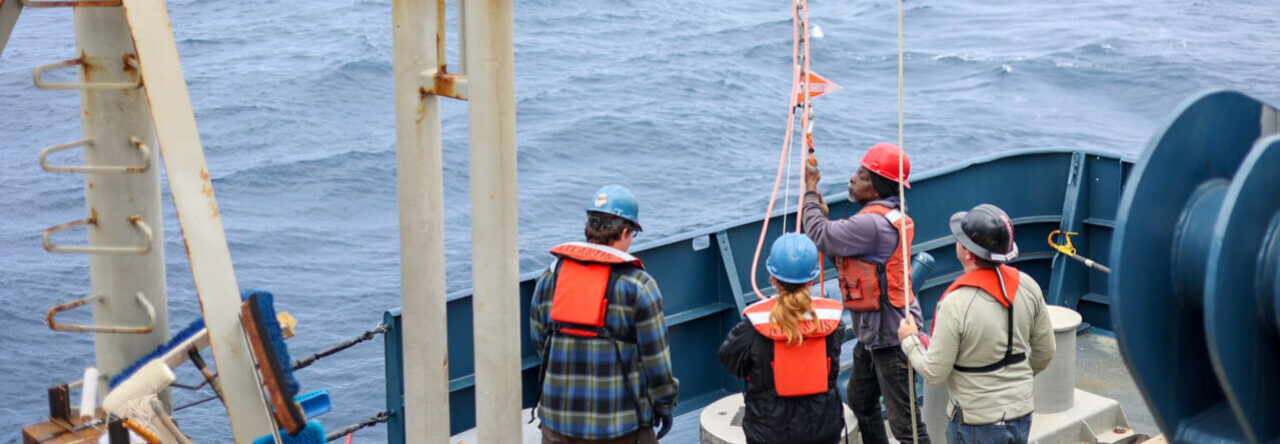
– Deploying CTD using tag lines and the ship’s starboard A frame

– McLane pumps being deployed through the ship’s aft A frame to sample specific proteins from different depths in the water column
Over the last two weeks, I’ve tackled everything from deploying and retrieving instruments like the CTD and Manta net to wiring LED lights for freshwater tank monitoring. I’ve also linked various meteorological sensors to a CR1000 data logger and set up CCTV hotkeys for easy camera switching for crew and winch operators. So yeah, I’ve been doing a little bit of everything (which is awesome). Working with the BIOS team so far has been a great opportunity to get hands-on technical experience at sea and expand my project portfolio – all in just the first two weeks!

– Making a project box to hold LED light strip battery and button at the tech bench

– LED strips are used to illuminate the inside of these freshwater reservoir tanks to make checking fluid levels easier for techs
After a quick stop in San Juan, Puerto Rico for some sightseeing and downtime, we’re now homeward bound to BIOS in Bermuda. On the way back, I’ve been working on some of my projects, helping out with deck operations, and learning as much as I can from the pros. Stay tuned for more updates. I can’t wait to share more from BIOS in my next post, which will be coming your way in about two weeks!

– Leaving San Juan
All the best,
Hunter