Author: Hunter Adams Page 1 of 2

Journey’s End, Career’s Beginning

Howdy all,

What a journey it’s been since my last post! We safely reached Tahiti, completed a mapping cruise while managing a suite of underway instrumentation, and concluded my long-term MATE internship. As this is my final blog post, there’s plenty to share.

Arriving in Tahiti marked the end of one of the most significant research cruises I’ve ever participated in. After so long at sea, it was a welcome change of pace. Our team of scientists and crew celebrated our successful cruise by unwinding in beautiful Papeete. I had the chance to relax with friends, go freediving in Moorea, and explore the islands. However, after just two days of recovery, it was back to work for our next cruise.

On our return journey to Honolulu, the Kilo Moana embarked on a cruise to map understudied seafloor regions. This survey utilized ship systems such as a multibeam echosounder, subbottom profiler, and magnetometer. For OTG, this suite of instruments operated fairly autonomously, requiring only light deck work for the magnetometer, consistent monitoring of mapping software, communication with the bridge about ship heading, and ensuring data upload to our remote researchers. In addition to mapping, this was also a cruise of opportunity for optical seawater measurements. Working alongside Dr. Ali Chase, Briana and I helped maintain and troubleshoot unique instrumentation measuring different spectral properties of surface seawater and the atmosphere. The primary goal of this data was to validate satellite-derived data. By the end of the cruise, Dr. Chase had collected valuable data, while Briana and I gained more troubleshooting and hands-on experience with high-sensitivity optical instrumentation.

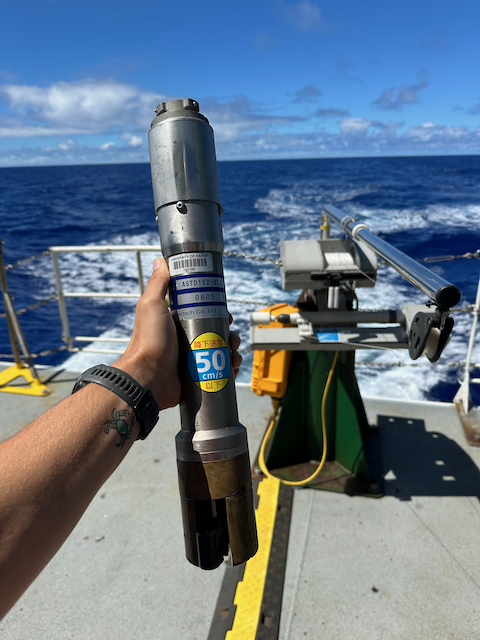
The beauty of this cruise’s operational schedule was that it didn’t require 12-hour shifts. This allowed me time to work with Ben and James, learning about the ship’s network architecture and how OTG members leverage VOID Linux and the MQTT publish-subscribe communication protocol to manage the ship’s network and connected instruments. Over a few sessions, they taught me to operate a Void Linux machine, configure a network switch, interact with the ship’s network, and connect a sound velocity probe for data acquisition and storage. As IT and networking skills become increasingly important for marine technicians, this was an invaluable learning opportunity for me.

The remainder of our transit back to Honolulu was relatively uneventful, save for a rogue glider recovery. This successful multi-hour operation involved locating, backing down on, and tagging a glider with a dog catcher wire loop – a great way to conclude our cruise. Soon after, we returned to Honolulu and demobilized, marking the end of my long-term MATE internship.

So what can I say other than that the past several months have been nothing short of an amazing adventure.  Across two MATE internships sailing aboard the R/V Hugh R. Sharp, R/V Atlantic Explorer, and R/V Kilo Moana, I’ve had the incredible opportunity to grow as a technician and interact with a community of hardworking, passionate, and like-minded people. These internships provided more than just technical training; they offered lessons in adaptability, teamwork, and problem-solving. Working with exceptional technicians who encouraged initiative and provided constructive feedback, I learned to safely tackle challenges with attention to detail. Each leg of this journey was a unique learning experience that not only grew my technical skills but also developed and affirmed my passion for this field and the opportunities it holds. From performing deck operations to troubleshooting instrumentation, I gained hands-on experience that transformed me from a lime green novice to a more confident and capable technician.

As I transition into my current role as a SUBSEA project Ocean Technician at the University of Hawaii at Manoa, I carry with me the invaluable lessons and memories from this transformative experience. Over the last few months, I’ve traveled around the world, made new friends, gained a multitude of experiences, all while investing in my future.

I want to express my heartfelt gratitude to the amazing team who made this impactful opportunity possible. A special thank you to Maria Osciadacz for her constant hard work and dedication to the program’s success. Thank you to Dan Fitzgerald, Carolina Funkey, Tully Rohrer, Trevor Young, Ben Duncan, James Harris, Lance Frymire, Tim Deering, Christian Kernisan, Alex Dominguez, Rory O’Connell, Lydia Sgouros, Emily Tate, Jace Innnis, the crews of the R/V Kilo Moana, R/V Hugh R. Sharp, and R/V Atlantic Explorer, and all the scientists I’ve had the privilege of working with over the last year. My internship experience wouldn’t have been the same without any of you, and I am forever grateful for your mentorship and support.

Now, I look forward to contributing to this field as I work with the University of Hawaii at Manoa and Schmidt Sciences OBVI project to help research the unique biogeochemistry of the North Pacific and South Atlantic Subtropical Gyres. For those interested, you can follow this link to learn more about the OBVI and SUBSEA projects: Schmidt Sciences OBVI

Thanks for tuning in, and to any future MATE interns reading this – I hope to see you out there soon!

All the best,

Hunter
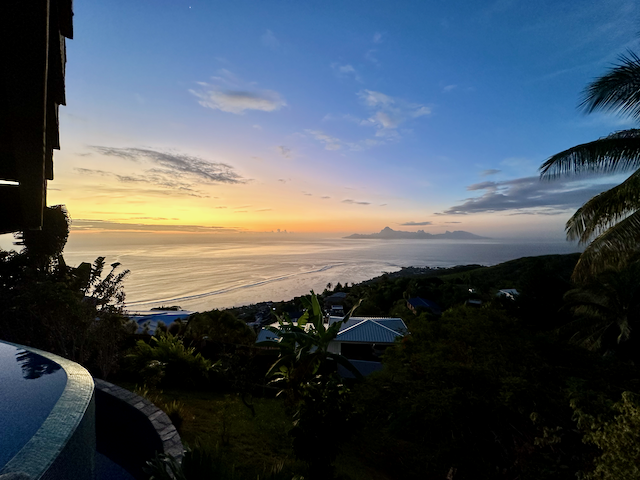
View of Moorea at sunset
 

– The KM at dock in Papeete
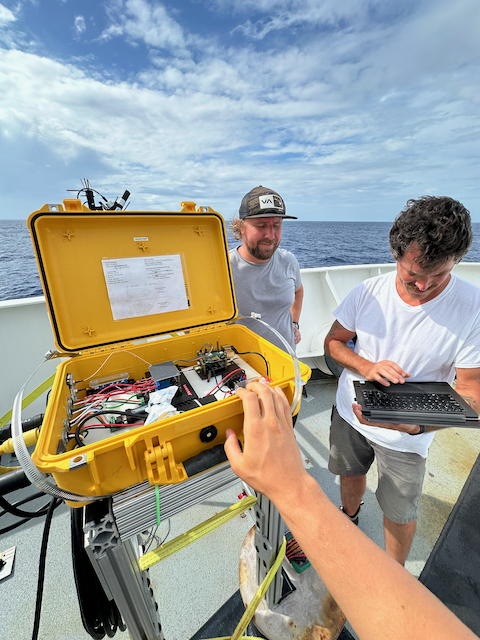
Day 1 of the mapping cruise. Troubleshooting the pySAS autonomous solar tracker and surface ocean radiometer system (ended up being a grounding issue for one of the relay boards).
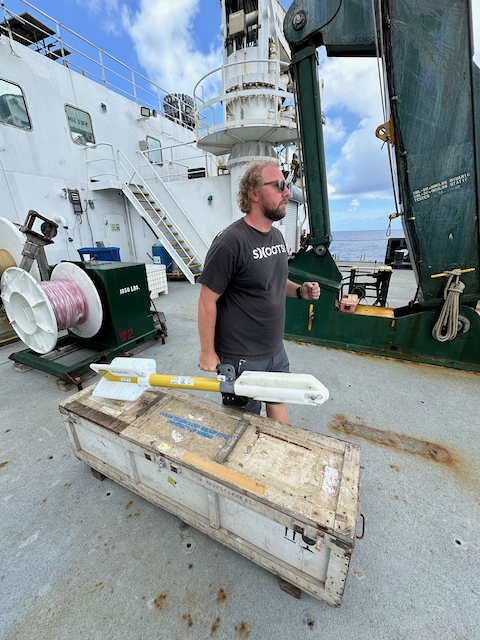
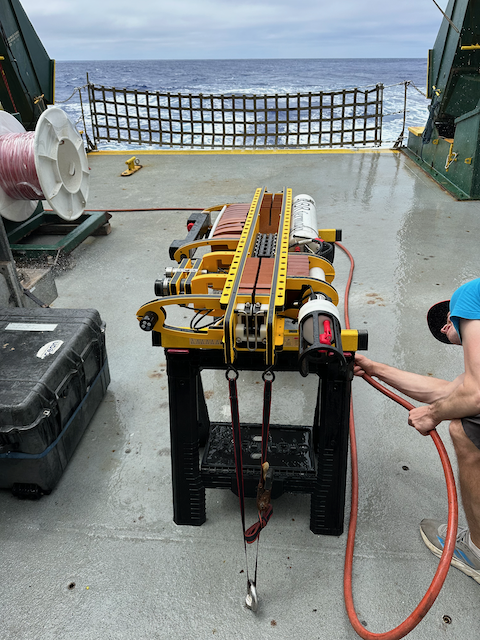
– The KM’s magnetometer. Ben for scale.
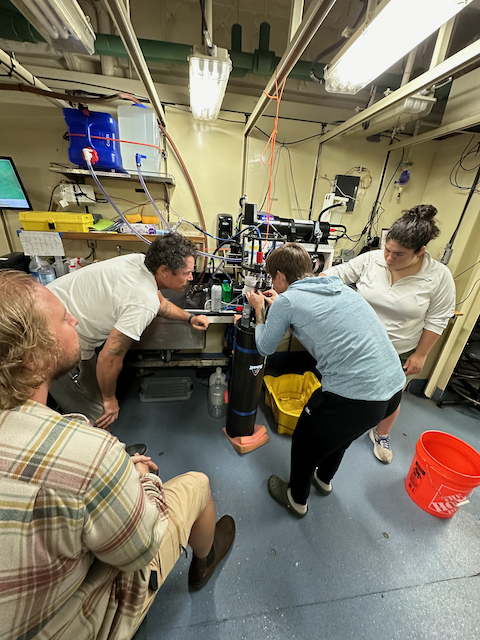
Troubleshooting the IFCB (an automated image capture microscope) for humiditiy warning
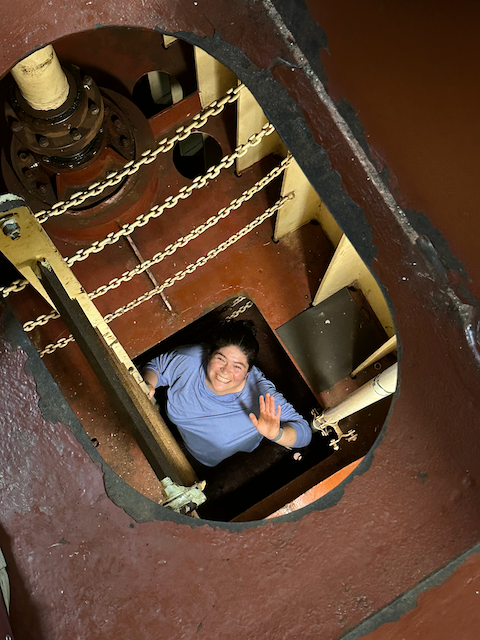
Briana exploring the engineering spaces of the KM
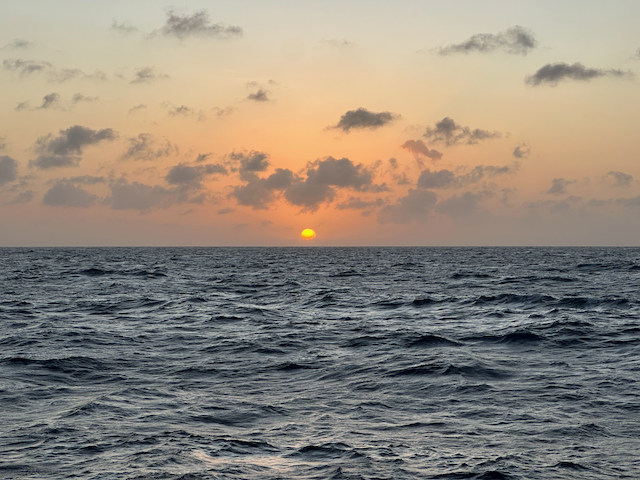
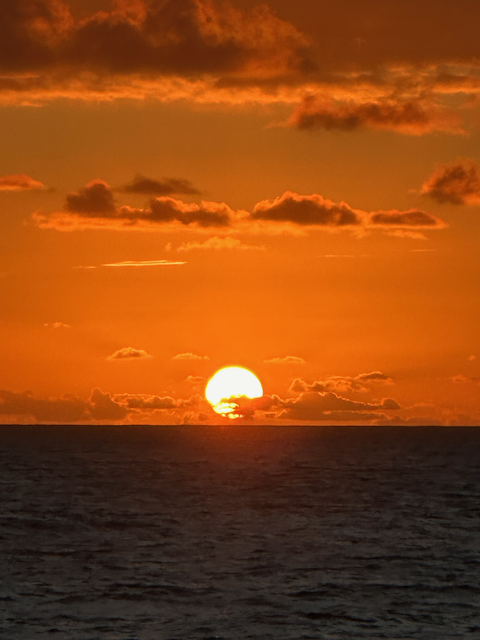
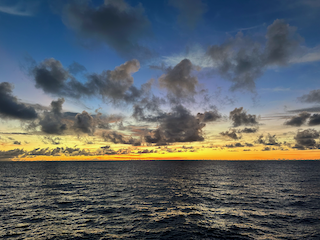
The last sunset of my MATE internship
L3W8: Swells and Station 13

Howdy all,

What an awesome journey we’ve had over these past two months of leg three! We’ve hit some major milestones over the last two weeks – completing all our long station sampling, wrapping up our uCTD casts, finishing the underway system collections, and getting the ship clean and packed up. Our next stop is Papeete, Tahiti, where we’ll resupply and exchange our crew and team of scientists!

Long Station 12 went off without a hitch with more successful deployents and recoveries of our CTDs and arrays. But Station 13 (appropriately named) threw us some curveballs. Our intended location for Station 13 was at 30° S location, but severe weather forced us to pivot to 27.5° S. Even there, we faced some of the roughest seas of our entire cruise. With high winds and large swells, deployments were more challenging and stressful for our equipment. Particularly pushing our CTD/rosette’s .322 electro-mechanical wire close to its safety limits.

Despite the challenges, Station 13 proved to be a triumphant finale to our main research operations. We successfully:

  • Deployed all ARGO and NKE floats
  • Secured all arrays
  • Collected, processed, and stored valuable hydrographic and biogeochemical data sets
  • Completed our 161st (and final!) celebratory uCTD cast

One of the most rewarding aspects of the SPOC cruise has been getting hands-on with our the various types of equipment. There was something special about not just operating but truly understanding and maintaining instruments like the LISST, UVP, uCTD, HyperPro, wirewalker, and various GPS beacons to name just a few. Developing this understanding has improved my confidence when working with this equipment and my technical abilities as a whole. 

We’re now transitioning into the final phase of my third leg- KM2419, an ocean floor mapping cruise from Tahiti back to Hawaii. The labs are cleaned and packed, ready for the transit home and subsequent HOT cruise. Stay tuned for updates for my experiences in Tahiti and the start of the mapping cruise!

All the best,

Hunter


– Sunset from Station 12

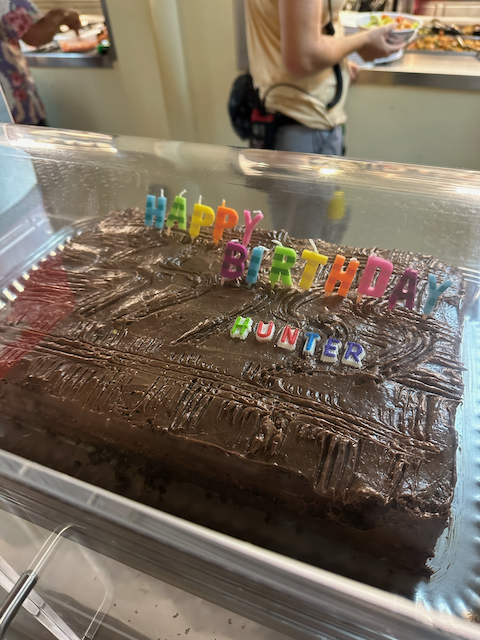
– The birthday cake that the galley crew was kind enough to put together for me

– One of the last uCTD recoveries near 30 degrees South complete with high winds and large waves

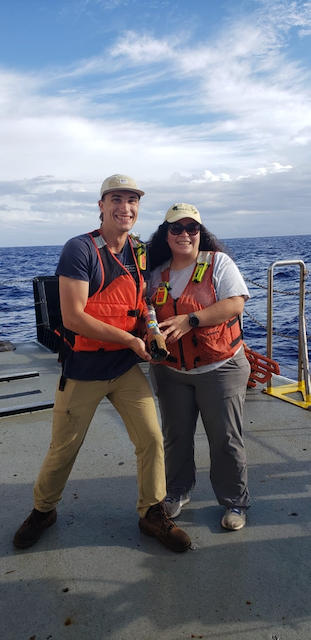
– Briana and I post uCTD #161 recovery

– The Wirewalker stripped down for cleaning before we packed it up

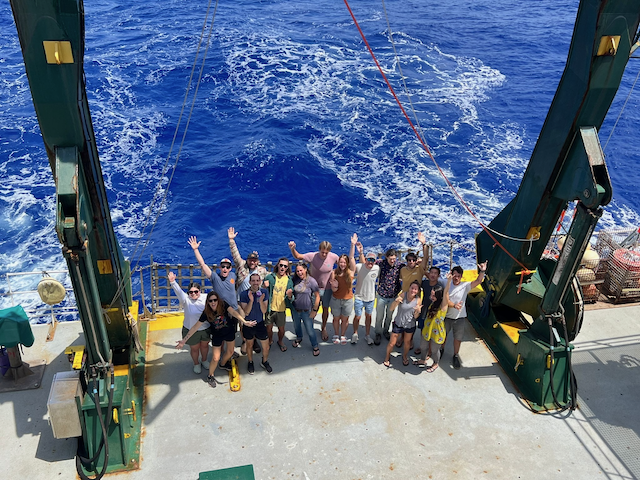
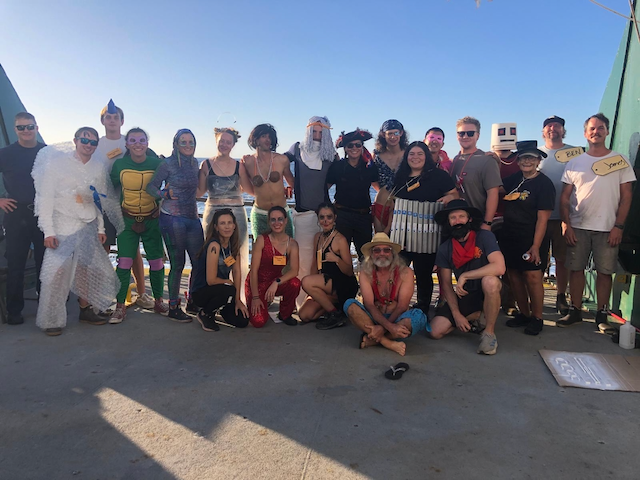
– A team of awesome people celebrating the conclusion of the SPOC cruise!


L3W6: Richard Simmons’ baby goes to Tahiti

Howdy all and welcome back,

Apologies for the later post, but the good news is there’s a lot to catch up on! We’re two weeks into the SPOC cruise and currently en route to 20° S Latitude. Since the start, we’ve been conducting various operations, including underway CTD (uCTD) deployments, ARGO float deployments, “short station” CTD casts, and “long station” array/CTD deployments. Our ultimate goal is to collect diverse data in the South Pacific, a critically understudied region, as we steam to 30° S. This data will primarily focus on understanding the rates and mechanisms of primary production and respiration in this area.

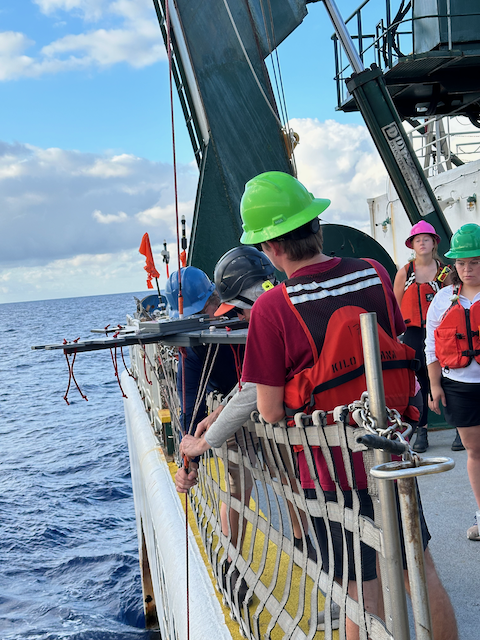
During transit between our five long stations, we’ve been using the uCTD to survey the surface 400 meters of ocean. This operation involves deploying a probe from the ship’s stern, equipped with sensors measuring dissolved oxygen, fluorescence, conductivity, temperature, and depth. The beauty of the uCTD is that we can continue cruising at 8 knots while collecting data on both the downcast and upcast. We’ve also been utilizing the Kilo Moana’s underway seawater flowthrough system to sample and analyze surface ocean water. Sprinkled in with these activities are Argo float deployments, contributing to an international ocean monitoring initiative that uses autonomous floats to create hydrographic profiles of the upper 2000 meters of the world’s oceans.

When not transiting, we’re on station performing CTD casts and free-floating array deployments. Before crossing the equator, we focused on performing short station CTD casts as weather was too variable and currents too strong to deploy the arrays necessary for a long station. These short stations lasted about an hour, and after we finished collecting our samples/data, we were underway again, so these stations were fast and furious. 

We officially crossed the equator on Halloween, which was a happy surprise! Of course, everyone dressed up in costumes (yours truly was a hero in a half shell), and we had a full equator crossing ceremony for the “polliwogs,” aka sailors who are crossing the equator for the first time. My given wog name was Richard Simmons’ Baby goes to sea. This ceremony involved proving our skill to the Court of Neptune in the form of a talent show (I did a skit with two of my fellow wogs) and if we displeased the court with our skills we were forced to fight the spirit of a sea monster (a pinata). Overall, it was a blast of a Halloween full of karaoke, candy, and dancing.

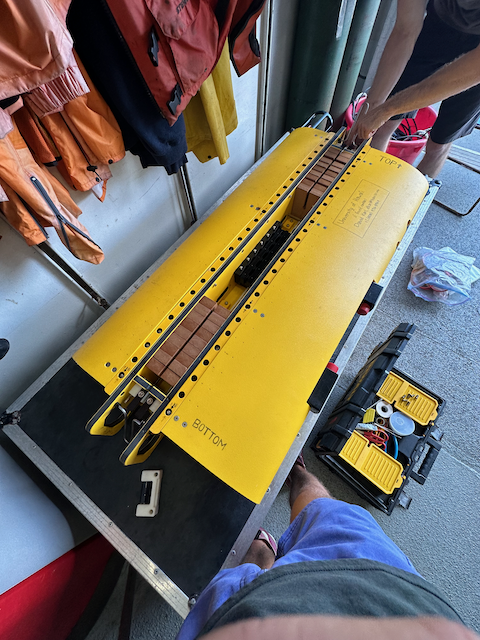
Shortly after crossing the equator the real work of the cruise began as we started to hit our first long stations. When we arrive at these stations, we deploy multiple arrays and run 24-hour operations for the next two and a half days. We deploy a sediment trap array, a primary production/gas fixation array, and a wirewalker array with each long station. The sediment trap array uses a series of tubes with formalin/brine in the bottom to capture and hold marine snow particles, aka sediments, that sink from the surface ocean. The primary production/gas fixation array uses C-14 enrinched seawater samples (collected on station) to determine the rate of primary production. The wirewalker array uses an ingenious design involving locking cams, positive buoyancy, and wave action to collect multiple sensor profiles from the surface ocean. Our latest wirewalker casts have produced ~120 profiles from each station (which is a lot). Array deployments and recoveries are some of the most exciting operations we’re doing on this cruise, as they involve a lot of coordinated deck work, and recoveries are conducted by grappling the arrays with grappling hooks! In addition to assisting with array deployments and recoveries, one of my responsibilities is managing CTD operations. This involves maintaining the senor suite aboard the rosette, downloading/processing data, and working with OTG techs/ship crew to collect water samples from different depths. Some of the new sensors I’ve been able to work with include a Underwater Vision Profiler (UVP) and a Laser In-Situ Scattering and Transmissometry (LISST) instrument. The UVP photographs small particles within a set volume of water and the LISST uses lazer diffraction to measure the size and quantitiy of suspeneded particles!

So far, we’ve hit long stations at 5°, 10°, and 15°, and besides minor issues with equipment and sample collection, the cruise has been going smoothly. This has been one of the most involved cruises I’ve ever participated in with nonstop ~80 hour work weeks but its been incredibly rewarding and I’ve had the oppourtinity to learn a lot. I’m now appreciating the importance of time management on long cruises like this, as it can be challenging to get enough sleep, eat well, exercise, and still have a strong attention to detail for 12-hour shifts. We have two more stations to hit before we can begin heading to Tahitit and the OTG techs, ships crew, and science team have all been working hard to collect this one of a kind data! By the time we finish up our last long station I’ll have my next blog post up so stay tuned!

Until then,

Hunter


– The underwater CTD and its “reel”

– The wirewalker. Inside the yellow covers there is a suite of sensors that measures the physical and optical properties of the water column. 

The sediment trap holder being added to the array line

– Crossing the equator on Halloween!

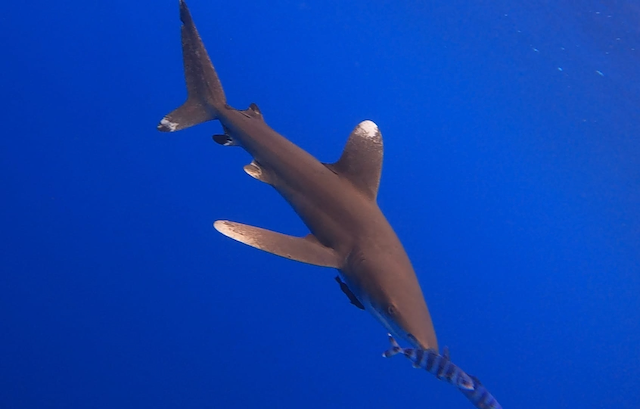
– One of many oceanic white tip sharks we’ve seen since stopping at long stations. Photo credit to one of the Kilo Moana’s ABs Stephanie for capturing this image with a GoPro on a string!

L3W4: Boats, Beasts, and Space Ice

Alohowdy, everyone! Welcome back to another blog post!

We’re officially one month into the third leg of my 6-month internship with the HOT and OTG teams aboard the R/V Kilo Moana. The past two weeks have been packed with excitement, including a fantastic HOT 354 research cruise, sightings of comets, whale sharks, falcons, and even an abandon ship scare. So, there’s plenty to chat about!

For those unfamiliar with the Hawaii Ocean Time-series (HOT) or who haven’t caught up on my previous posts (shoutout to my long-term subscribers), here’s a quick refresher. The Hawaii Ocean Time-series is a long-term study focused on the North Pacific Ocean at Station ALOHA, about 60 miles north of Oahu. Since 1988, this program has been working to create a comprehensive picture of the physical and biogeochemical properties of the North Pacific subtropical gyre by collecting and analyzing various data samples. This is neato because researchers worldwide use this data to understand long-term ocean changes due to factors like climate change. If this sounds familiar, it’s similar to what I wrote about BATS a few months ago. It’s been amazing to see how HOT and BATS compare from both research and operational perspectives.

– Sunrise from Station Aloha

Now, onto the 354th HOT research cruise! This four-day adventure focused on CTD casts, array deployments, and net tows. I had the freedom to roam without a set schedule (at large), which allowed me to observe all array recoveries and deployments—a major operation I’ll be assisting with on the upcoming SPOC cruise. I even got to try grappling an array for recovery for the first time (and almost got it first try)! I also helped with CTD deployments and recoveries, as well as sample collection and processing.

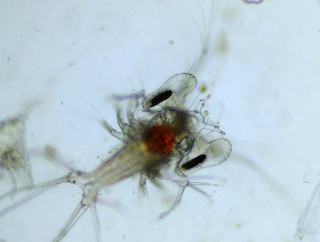
– A Lil Zooplankton we picked up from a net tow

Here’s a full list of what we deployed and recovered on HOT 354:

– Sediment trap array

– Primary production array

– Gas array

– CTD

– HyperPro

– Underwater Vision Profiler (UVP)

– Zooplankton net tows

– Video Plankton Recorder (VPR)

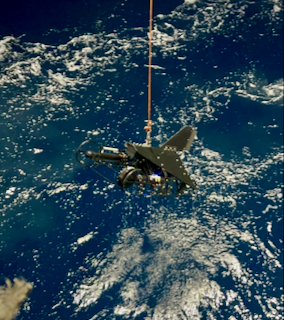
– The Video Plankton Recorder (VPR) being recovered

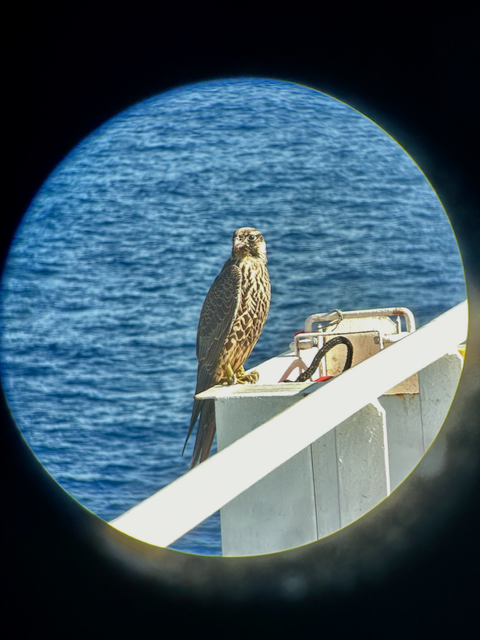
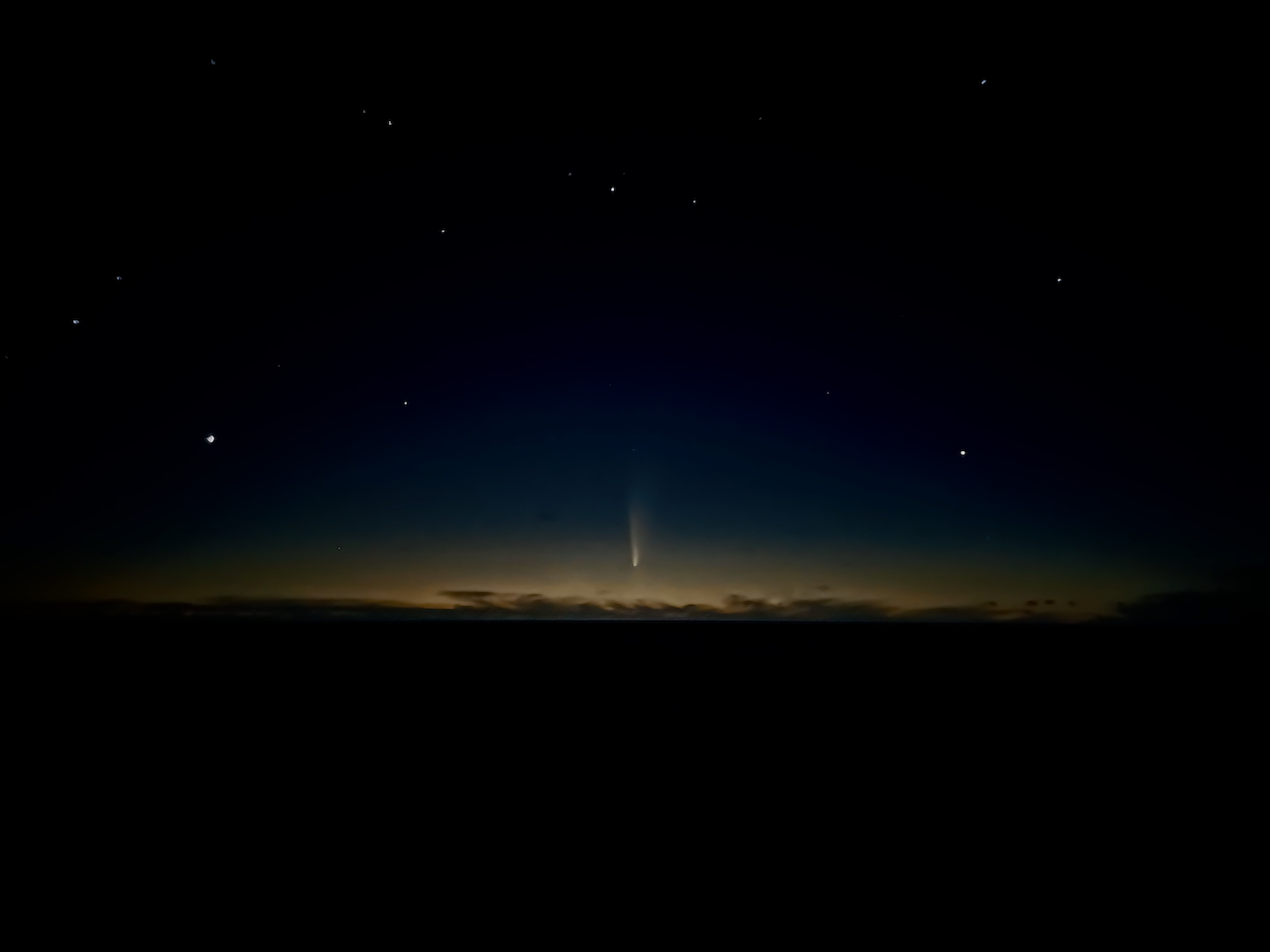
Besides all the exciting science operations, we were treated to some incredible wildlife sightings: oceanic white tip sharks, petrels, boobies, a whale shark (my first), a peregrine falcon (also my first), and even the Tsuchinshan–ATLAS comet (a first and last for all of us). It was a wonderful cruise filled with great people—thanks to all the volunteers, crew, techs, and scientists for making HOT 354 such a blast! I can’t wait for the next one.

– Our whale shark friend off the bow of the Kilo Moana. He ended up hanging out with us for around an hour or two!

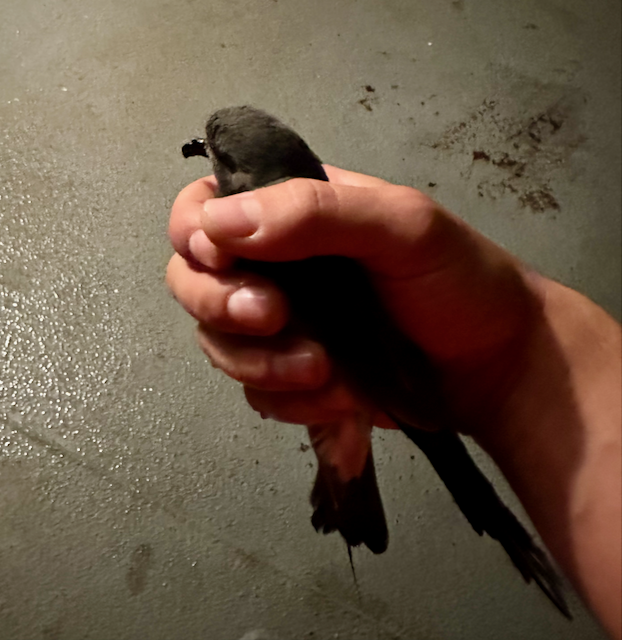
– Tom Petty the storm petrel (if you know you know)

– A peregrine falcon who decided to hang around the boat for a few days (if you know you know)

– Tsuchinshan–ATLAS from the back deck of the Kilo Moana at Station Aloha

After returning to Honolulu and unpacking, we enjoyed a few days of downtime before embarking on one of my longest scheduled cruises aka the South Pacific Ocean Cruise (SPOC). The purpose of this two month trip to Tahiti and back is to expand the measurments of oxygen- and carbon- based production and respiration rates across multiple biomes, throughout the euphotic zone, and over the full seasonal cycle. New technology has made big leaps in how we’re able to observe these rates and this cruise will be an excellent opportunity to expand the number of measurments made in the open ocean and also help validate satellite-based production estimates. The cruise will cover 18 stations between Honolulu and Papeete French Polynesia whith a mix of long (~2.5 day) and short (~0.5 hours) stations. 

This is a very exciting cruise to be on in terms of the science it aims to do and the operations it will conduct. I’ll learn how to use instruments like the underway CTD, wire-walker, and various floats. Plus, I’ll be running CTD casts with Briana on the opposite shift. We left port Saturday morning after completing our safety drills and successfully conducted the CTD test station near Oahu. However, shortly after that, the ship’s general alarm sounded—we had a “oh this is not a drill” moment as water was discovered in the starboard generator room. Thankfully, it was only a loose coolant hose, but we did have to return to Honolulu for repairs.

With everything fixed and checked over, we’re back at sea at the start of the SPOC cruise! My next post will be in two weeks once I’m more settled into my routine. I’m excited to share my experiences and everything I’ve learned!

Catch you in the next post,

Hunter

L3W2: HOT Times in Honolulu

Howdy and Aloha from Honolulu everyone!

I can’t believe I’m finally here for my six-month internship’s third and final leg. After the USCGC Cutter Healy had some technical issues delaying the scheduled October to December GO-SHIP cruise, I had the opportunity to come back to Hawaii and work aboard the R/V Kilo Moana for round two! It feels great to be back and I’m stoked to be working with the awesome Hawaii Ocean Time Series (HOT) and Ocean Technology Group (OTG) teams again.

 The R/V Kilo Moana (photo credit to Multibeam Advisory Committee, UNOLS)

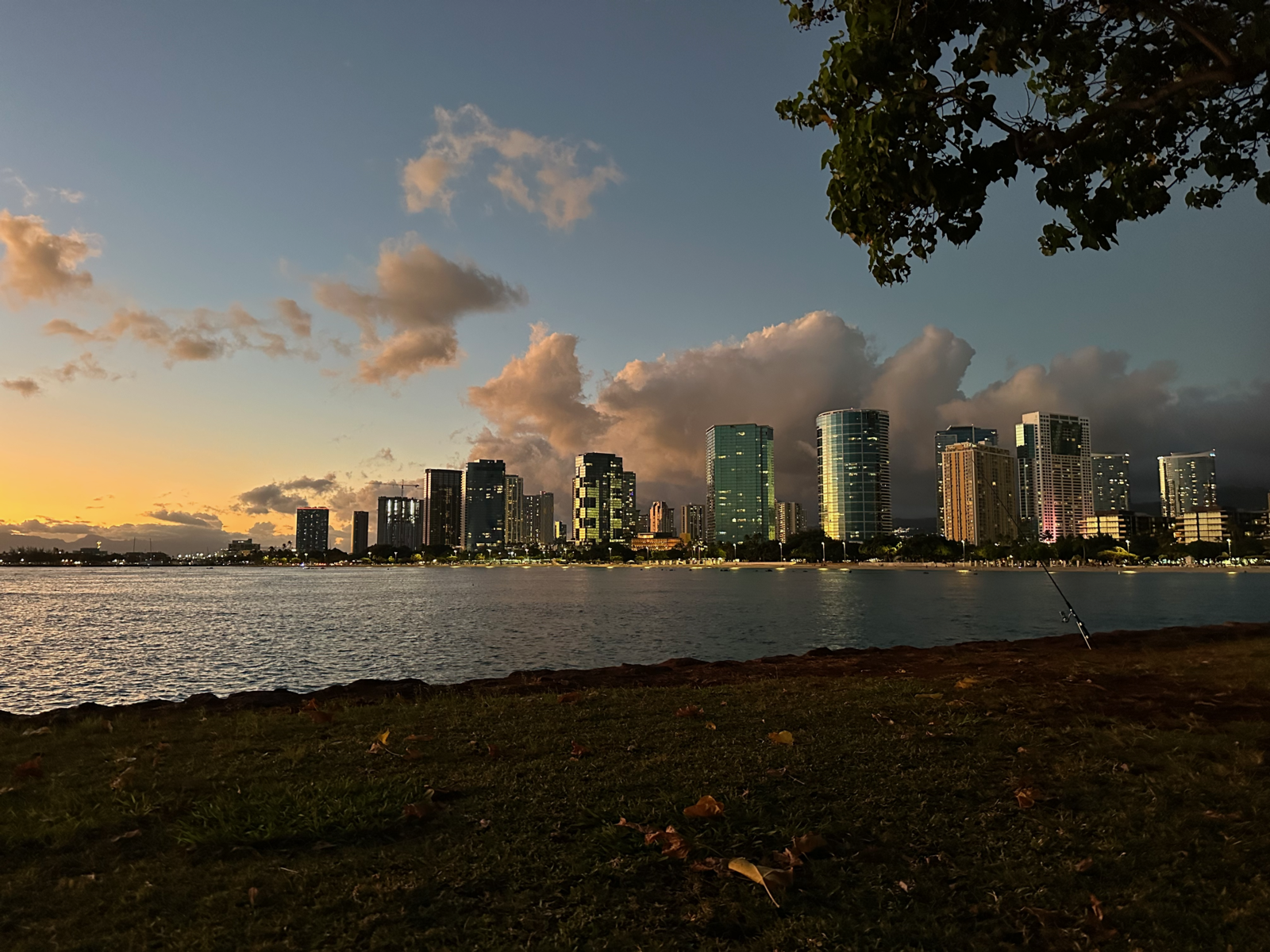
– Honolulu sunset from Magic Island

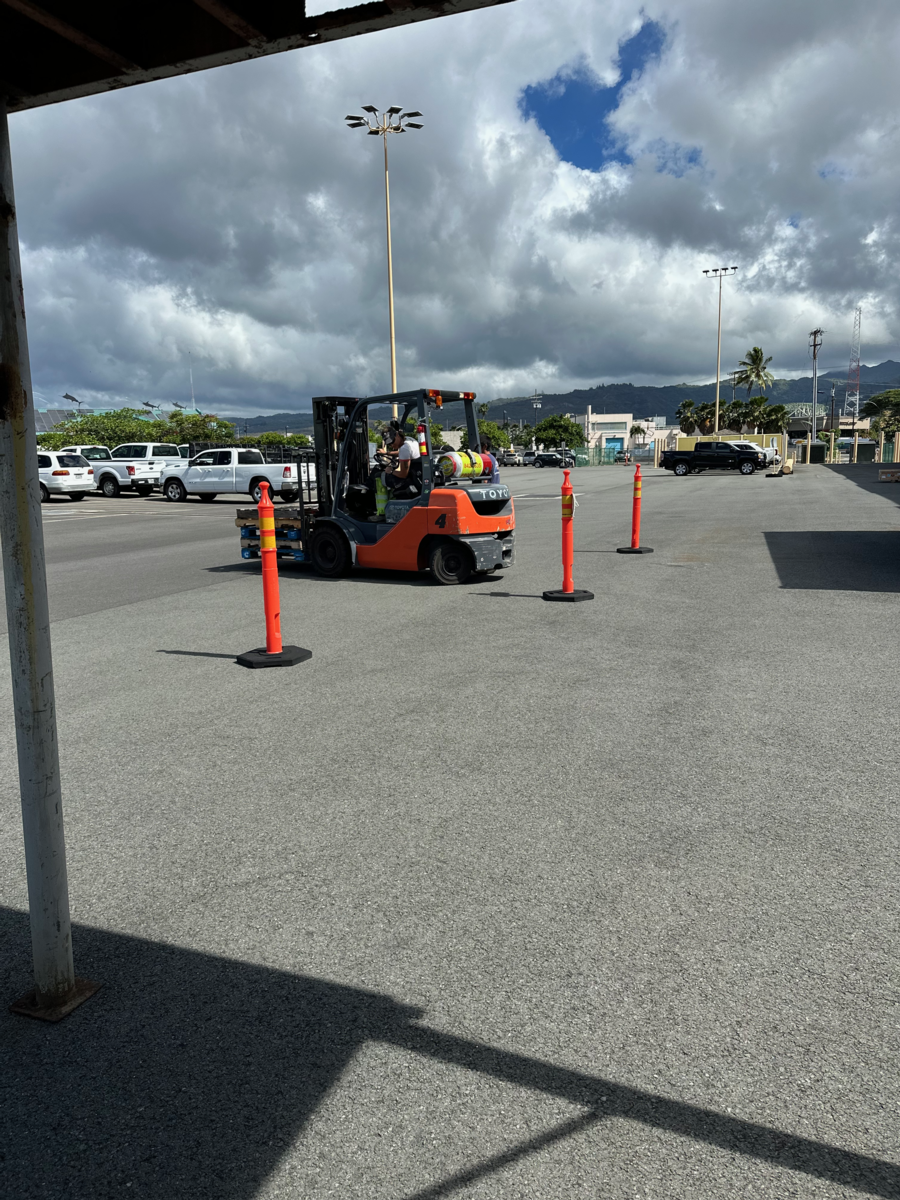
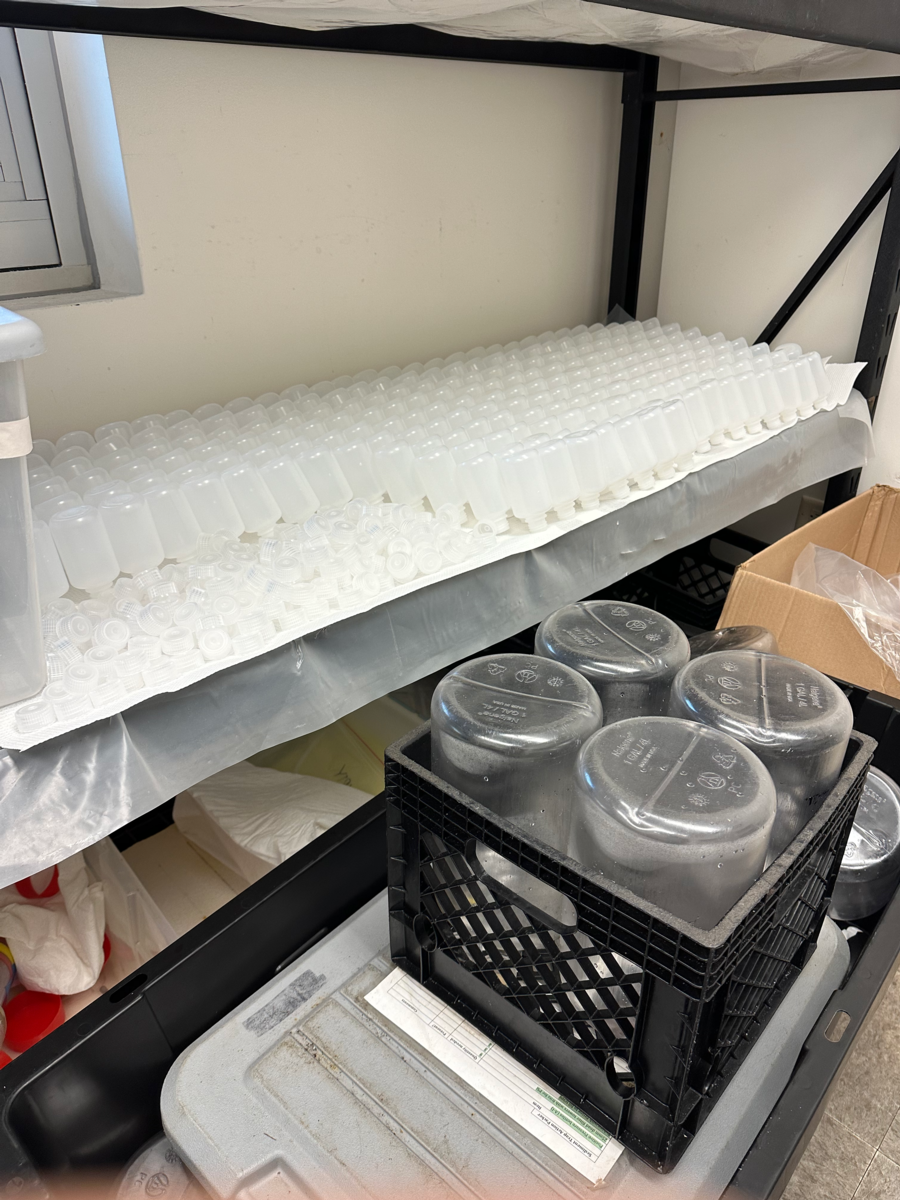
These past two weeks have been a whirlwind of activity as we gear up for some exciting science at sea. I’ve been assisting in the preparation of these cruises where possible and helping the researchers who are knee-deep in pre-cruise checklists (including old mentors such as Dan Fitzgerald and Tully Rohrer)! From maintaining instrumentation such as SBE 37-SM MicroCATs and CTD sensors on campus to helping with the tedious (but oh-so-important) task of acid-washing various sampling bottles at the UH Manoa Marine Center, I’ve been getting my hands dirty in the best way possible. Along the way, I’ve picked up some mad forklift and splicing skills! We’ve also been testing equipment, such as decade-old temperature incubators, to make sure we’re all set for our upcoming voyages. 

– Getting forklift certified with crew from the Kilo Moana

– A whole lotta 10% HCl acid-washed bottles drying

Speaking of upcoming voyages, fellow MATE intern Briana Prado and I have a packed schedule while we’re here in Hawaii. First up is a 5-day HOT research cruise – short but sweet and luckily something I’m experienced with from last year. It’ll be a great opportunity to review old operations (such as deployments/recoveries for CTDs, arrays, nets, VPR, and Hyperpro) and learn some new skills in preparation for our next cruise. The real adventure kicks off after that when we join a two-month South Pacific research cruise to Tahiti that aims to expand the measurements of primary production and respiration rates in open ocean regions. Two whole months at sea, can you believe it? I’m very excited to join this collaborative expedition between several research institutes and work with a variety of new equipment including wirewalkers, underway CTDs, and Argo floats! 

I’ve got to say, being back in Hawaii is just… *chef’s kiss*. It’s been great to reconnect with old friends and get back to doing what I love. And knowing that I’ll be contributing to important oceanographic research makes it all the more special. 

Please tune in for my next blog post which will include more details about the HOT 354 cruise! I’ll keep you all updated on my adventures as much as I can. Until next time, mahalo for reading, and catch you on the flip side!

-Hunter

L2W2: BIOS, BATS, and BVALiciousness

Howdy all,

It’s been a minute since my last post and I have some big updates to share! After a two-week break and a lengthy flight, I touched down at the Bermuda Institute of Ocean Sciences (BIOS) station to kick off the second leg of my internship! Over the first few days I was at BIOS, I met the marine tech team, sang karaoke with the crew of the R/V Atlantic Explorer, and connected with the Bermuda Atlantic Time-series (BATS) techs through a glow worm light show. In addition to meeting everyone and getting acquainted with BIOS, I helped with some light cruise prep, like setting up WiFi access points and relocating a rain gauge with the tech team. 

The R/V Atlantic Explorer

For those unfamiliar with BATS, here’s some good information for ya. The BATS study is a time series of ocean physical and biogeochemical data that has been maintained since 1988. Scientists and technicians try to conduct a BATS cruise every month of the year to consistently observe trends in oceanographic data, much like the Hawaii Ocean Time-series does in the Pacific. In oceanography, some research requires decades of data, so the length and quality of these time series are extremely valuable to the global ocean research community. Some topics of research that BATS addresses include how the ocean responds to increased levels of atmospheric carbon dioxide, surface ocean nutrient concentrations, phytoplankton blooms, ocean acidification, modeling, biogeochemical cycling, and much more! 

The BATS/BATS validation (BVAL) cruise I am currently on is an extended version of their typical four-day cruise. Once a year, the BATS team samples at multiple stations between Bermuda and Puerto Rico to better understand the mesoscale and large-scale variability of the region surrounding the regular BATS sampling station. At these BVAL stations, technicians collect ocean physical and biogeochemical data using net tows, CTD casts, in-line pumping, optical sensor casts, and the ship’s flow-through system. Working under BIOS marine tech pros Lydia Sgouros, Emily Tate, and Jace Innis, I have had the opportunity to assist with the preparation, execution, and troubleshooting of these operations. Lydia and Rory O’Connell have also thrown me various projects to do in my free time. Each of these projects has presented a new challenge and learning opportunity.

 A Manta net tow, used to filter out microplastics at the ocean surface by skimming across the water

– Deploying CTD using tag lines and the ship’s starboard A frame

– McLane pumps being deployed through the ship’s aft A frame to sample specific proteins from different depths in the water column

Over the last two weeks, I’ve tackled everything from deploying and retrieving instruments like the CTD and Manta net to wiring LED lights for freshwater tank monitoring. I’ve also linked various meteorological sensors to a CR1000 data logger and set up CCTV hotkeys for easy camera switching for crew and winch operators. So yeah, I’ve been doing a little bit of everything (which is awesome). Working with the BIOS team so far has been a great opportunity to get hands-on technical experience at sea and expand my project portfolio – all in just the first two weeks!

– Making a project box to hold LED light strip battery and button at the tech bench

LED strips are used to illuminate the inside of these freshwater reservoir tanks to make checking fluid levels easier for techs

After a quick stop in San Juan, Puerto Rico for some sightseeing and downtime, we’re now homeward bound to BIOS in Bermuda. On the way back, I’ve been working on some of my projects, helping out with deck operations, and learning as much as I can from the pros. Stay tuned for more updates. I can’t wait to share more from BIOS in my next post, which will be coming your way in about two weeks!

– Leaving San Juan

All the best,
Hunter

Week 4: Stinky Seeps and Robots

Howdy everyone,

Since my last update, a lot has happened. I’ve just finished the first leg of my 6-month MATE Internship!

When I last checked in, the R/V Hugh Sharp was waiting near Nantucket for a break in the weather in the sea scallop survey area to redeploy the (now fully operational) HabCam. After patiently waiting for days, we finally saw a potential break in the weather. We took the chance to head into the survey area to collect data. However, on the way, one of our seasick researchers helping with scallop annotations had a little run in with a desk and ended up with a rib injury. We were concerned about the severity of their injury, and with the realization that it was too rough to deploy the HabCam, we decided to head back to Woods Hole to get the researcher medical attention and wait for the weather to improve.

After dropping off our injured researcher, the weather finally cleared up. We safely returned to the survey area and managed to collect a full day’s worth of data, covering approximately 50 out of the 53 stations! By the end of the cruise, we had made up for the time lost waiting near Nantucket and gathered almost all the data the WHOI and NOAA researchers needed. I’m also happy to report that the injured researcher saw a doctor and is doing fine with just minor bruising. Despite the setbacks, including a broken HabCam, bad weather, and injuries, the crew and science team pulled through and made the scallop survey cruise a success! It goes to show that resilience and adaptability are crucial when working on research vessels and facing challenges head-on.

– The HabCam 30 minutes after it was deployed managed to catch some fishing gear (green rope connected at the shackle) which we had to cut off.

After wrapping up the HabCam cruise and enjoying a few days of well-deserved rest and celebration, the Sharp crew began preparing for our next adventure!

– A picture from inside the Sharp’s keel. The keel has removable “pods” that can hold a variety of scientific equipment. Right before this photo was taken we replaced one of the ships pods.

The focus of our next cruise was to deploy equipment and collect samples to help scientists gain a better understanding of seafloor methane seeps. For those who may not know, methane is a ridiculously potent greenhouse gas, and high concentrations of it in our atmosphere contribute to global climate change. It’s crucial to determine if these methane seeps impact atmospheric concentrations and whether oceans act as a source or sink for the gas. Understanding the range, oxidation rates, and quantity of methane released from these seeps is essential, and the data collected from these cruises plays a vital role in answering these questions.

The first task of this cruise was to recover a lander from a previous expedition that failed to release its sacrificial weight and float to the surface. We attached a small ROV to a weight and sent it over 300 meters deep to the ocean floor to search for the lost equipment, and fortunately, we were able to retrieve it. The next priority was to deploy landers near known methane seeps. We successfully managed to deploy two out of the three landers we brought, as one decided to act up. The last order of business was to collect sediment samples from the seeps using a weighted multicorer. This corer was lowered to the seabed to gather sediment samples for later analysis. 

One of the “landers” which measures methane oxidation rates near the seafloor methane seeps. Notice the steel plate on the left side. This plate detaches after sampling is complete and the lander receives a signal. The lander then floats to the surface and awaits recovery. 

– The “Mission Specialist Defender” ROV that was used to tag and recover the lost lander.

In just four weeks I gained experience with all of the following:

  • Knudsen Echosounder troubleshooting
  • LCI90i winch controller troubleshooting
  • Fiber optic troubleshooting and splicing
  • CTD maintenance and confile setup
  • Shipboard data acquisition system management and data backup 
  • Shipboard network architecture introduction
  • Instrument calibration record management 
  • A whole lotta different launch and retrieval deck operations (e.g. HabCam, AUV, Lander, multicorer, ROV)
  • Radio communication
  • Rigging techniques
  • Using USBL systems and recording their data
  • Cruise mobilization and demobilization experience
  • Troubleshooting one Sirius XM radio
  • Eating too much ice cream
  • Entertaining/distracting injured researchers with music and memes

Overall, working with R/V Hugh Sharp’s team was a fantastic opportunity to gain lots of hands-on experience and learn a ton of new technical skills. While learning these new skills was great, I think the real value of this internship comes from gaining familiarity with the work that marine technicians get to do. This familiarity promotes confidence and comfort with handling the many unknowns and stressors of this job.

So thanks to everyone at UDEL for the incredible opportunity! Now, I am enjoying two weeks off before I begin the next leg of my internship in Bermuda with the BIOS team! I look forward to writing the next post and updating you all in a few weeks.

Until then keep it cool and stay curious. 

All the best,

Hunter

– The last sunrise I got to see aboard the Sharp

Week 2: The Sharp and the Steel Photographer

Howdy all,

I have some exciting updates to share with you, so let’s dive in! For the last two weeks, I’ve had the privilege of working alongside ship crew, researchers, engineers, and fellow marine technicians to conduct a multi-leg sea scallop survey aboard the R/V Hugh R. Sharp. This survey aims to gather data regarding regional sea scallop populations, their maturity, and their range. It’s a joint effort involving the National Oceanic and Atmospheric Administration (NOAA), Woods Hole Oceanographic Institution (WHOI), and various other universities. The data we collect will help shape fisheries policy for years to come and is essential for understanding changes in scallop population trends!

– The R/V Hugh R. Sharp at port in Woods Hole, MA

To collect this data, we’re using some awesome tech on the Sharp, including a specially designed habitat camera (which looks like a giant stripped down derby car) and an autonomous underwater vehicle (which looks like a giant hotdog).

– The derby car aka habitat camera aka HabCam

– The hot dog aka autonomous underwater vehicle aka AUV

The HabCam is a large (and heavy) vehicle packed with a system of CTD sensors, cameras, flashes, sonar, and an altimeter, all wrapped in a sturdy steel frame that is towed behind the vessel. The HabCam is piloted about 2 meters above the sea floor, capturing three images per second. These images are transmitted to the Sharp via fiber optic cable and are immediately interpreted by two teams of annotators working 12-hour shifts. These annotators play a challenging game of Where’s Waldo as they search for and measure sea scallops in each image. As I write this post partway through Leg 2, some annotators have scanned through approximately 11,000 images!

-Piloting the HabCam! Notice the sonar, tension/payout graph, LCI90i winch controller (the cosole I have my hand on), and depth readout

The HabCam is essential for this survey, but it hasn’t been without its challenges. During Leg 1, moisture found its way between the fiber optic cable and its bulkhead connector, distorting the light data signal and causing a loss of communication with the vehicle. We had to interrupt Leg 1 and port in Woods Hole early to get the necessary parts and equipment for repairs. While this was an unfortunate setback, it did give me the chance to perform fiber optic splicing and troubleshooting. During our transit to Woods Hole, the AUV stepped up, capturing vital seafloor data and then meeting the boat after. Now in Leg 2, we’ve had a mix of successes and setbacks. The HabCam worked perfectly for the first few days, but high winds in the survey area have forced us to wait behind Nantucket for the last few days. These high winds are generating large waves that could stress the tow cable’s safe working limit, and we don’t want to risk losing the HabCam to rough seas! 

Besides troubleshooting and maintaining the HabCam system, I’ve gained a lot of hands-on experience under the guidance of Sharp’s marine techs, Alex Dominguez (a fellow MATE alumni) and Christian Kernisan (lead tech)! Since coming aboard, I’ve had the opportunity to troubleshoot LCI-90i winch displays and a Knudsen 3260 echosounder deck box, learn about the Sharp’s data management protocols, review the ship’s network architecture, pilot the HabCam, and perform a variety of deck operations, including the launch and retrieval of the HabCam and AUV. The only experience I’m missing during this cruise is dredging for scallops since this task was outsourced to another ship! This would have been a great (and tasty) skill to learn. The rest of the crew has been incredibly welcoming, and it’s been a fantastic opportunity to work with the engineers and researchers from WHOI and NOAA as well. One of my favorite parts about this job is the people you get to meet and this has been a great team to work with!

– Christian and Alex with some friends the HabCam picked up

-Gunnar, Christian, Zach, Cam, Huxley, Alex, and me (right to left)

In my next blog post, I’ll update you on the progress of my internship and dive into a little bit more detail about the hands-on technical experience I’m gaining and how I’m using it to be a better marine technician!

Until then,

Hunter

Week 0: Heya MATE it’s Hunter

Howdy reader,

My name is Hunter Adams! I have the privilege of being a 2024 MATE intern and will spend the next six months supporting three different research institutions on their missions to better understand our world’s oceans. I look forward to sharing this amazing experience with you through these blog posts and I hope I can get you excited for the awesome work that MATE interns get to do!

So what about me? What’s my background and why am I participating in this internship? Well here are some answers for ya: I graduated from Texas A&M University with a BS in Oceanography and an MS in Business in 2022 and 2023 respectively (Gig ‘em Aggies!). At TAMU, I spent three years studying methane and nitrous oxide concentration trends in the northern Gulf of Mexico and participated in multiple research cruises as a result. These cruises gave me a glimpse into just how rewarding work at sea can be and I learned how valuable marine operations can be for oceanographic research.  I furthered my interest in oceanography at Los Alamos National Laboratory, performing reduced biogeochemical modeling and preliminary model research over two summer internships. So yeah, I have a research-heavy background. Now you may be asking yourself, “Hunter, this is great and all, but if you love salty water science so much why aren’t you jumping into a PhD or the like?” I’m so happy you asked and I’ve got two answers for you! 

My first answer is that oceanographers and climate scientists worldwide need quality observational data from our oceans. With this data, scientists can better understand our Earth system, improve climate model development, and inform policy decisions (to give just a few examples). One of the best ways scientists get this observational data is by going out to sea and collecting it through research cruises. However, they can’t always be expected to operate the research vessel, troubleshoot instrumentation, manage data acquisition systems, or perform deck operations. That’s where marine technicians and crew come in! Together, crew and mar techs perform all these duties and more, ensuring that oceanographers get the data they need. Marine technicians are needed more than ever due to an ever-increasing demand for data, especially in the face of a changing climate. For this reason, I would like to contribute to oceanographic research as a technician as I feel there is a great need for the work! 

My second answer is that working as a marine technician is FUN! Marine technicians possess diverse skills, are dynamic problem solvers, work with passionate people, and get to travel to some of the most unique environments on the planet. Needless to say, the work can be incredibly engaging and rewarding. I owe my appreciation for this career to the 2023 MATE internship, where I spent five weeks working with the Hawaii Ocean Time-series (HOT) team and OTG techs at the University of Hawaii Manoa. Now, I’m participating in the long-term MATE internship to get as much hands-on experience as possible to become a more effective technician.

So, I hope you have a better understanding of my professional background and motivations for taking part in this internship! Some less-professional fun facts about me include that I like outside activities, motorcycles, Cajun food, memes, reading, and traveling. 

Over the next six months I hope you can get to know me even better through these posts and understand why I’m so excited for this opportunity. As I write this, I am flying to the University of Delaware and the R/V Hugh Sharp to begin the first leg of my internship. Over the next few weeks I will be assisting with a sea scallop and HabCam survey (which’ll be a brand-new experience for me). In my next post, I’ll talk more about my work, who I’m working with, and all the best parts of the internship so far! So stay tuned and don’t miss it!

All the best,

Hunter Adams

Week 5: HOT 346

Howdy all,

The fifth and final week of the MATE internship was another opportunity to work at sea on HOT 346. This cruise repeated the same operations performed during week one of the internship.

Once again after loading for the cruise on Friday and setting sail Saturday morning we were on our way to Station Kahe to perform our weight test cast, hyperpro casts, and trace metal cast. After these successful operations we were on our way to Station Aloha to start our main sampling operations. After having worked on one HOT cruise already I was much more confident performing deck operations, using radios to communicate, and getting more involved with whatever task was at hand. This included launching and recovering the rosette/CTD system, prepping for trace metal casts, performing hyperpro casts, assisting with net tows, launching/recovering arrays, launching/recovering the VPR system, and firing niskin bottles in the CTD lab. 

The cruise was going smoothly until a weather hold had to be issued because sea conditions were too rough to risk deck operations. For approximately 9 hours, all sampling and equipment deployments had to be halted for the safety of the HOT team, crew, and equipment. This delay forced the sampling schedule to be reworked to maximize the remaining ship time. Again, this was another opportunity to learn about the challenges of working at sea. Conditions such as this are not abnormal when working during the winter months around Hawaii and have to be accounted for. 

After the weather hold was lifted operations continued like normal and we were able to finish our sampling at Sttaion Aloha, the WHOTS mooring, and Station Kaena.  Upon returning to the marine center and unloading the equipment that was the end of the internship. HOT 346 was a great opportunity to actually practice some of the skills I had developed over the last cruise and over the weeks on land. Overall, the MATE internship was a positive experience that gave me valuable skills and insight I will need to work as a marine technician. 

Best,

Hunter

Page 1 of 2

Powered by WordPress & Theme by Anders Norén