Week Three: 6/23-6/29
Week three was spent collecting sediment from our station in the Newfoundland Basin. We arrived on station Sunday evening, and spent our first full day coring on Monday. We were also met with some challenges: a few cases of COVID, low success rates on core casts, a blip of foul weather, and a repair on a crucial turning block.
COVID cases springing up was a bit out of left-field, given we had been at sea for two weeks. Testing, isolation, and masking were parts of the (very calm and collected) response initiated by the captain, and by the end of the week things were mostly back to normal.
We kept up a steady pace of 3-4 casts per day, but each cast only produced one or two usable cores. Progress was slow. This was an interesting chance to experiment with the multicore, and adding wooden blocks on the bottom of the “spider” helped to produce better cores by keeping the multicore a little shallower in the sediment when it touched down.
One stroke of good luck was the weather we had been tracking mellowed out by the time it reached us, and we only missed a half day of work rather than the 2 days we initially expected. On either side of the poor weather, we enjoyed some warm, sunny days.
On Friday, Ayse noticed the main turning block (mounted on the A-frame, which the winch wire runs through), was starting to make an odd squawking sound, a lot like the sound of a mallard duck. After we finished that cast, the deck crew assembled some scaffolding to take a look at it. They quickly determined that source of the squawk was the inner sheave, which was starting to separate due to improper hardware. With the proper bolts in place, the duck was silenced, the block was fixed, and coring was resumed.
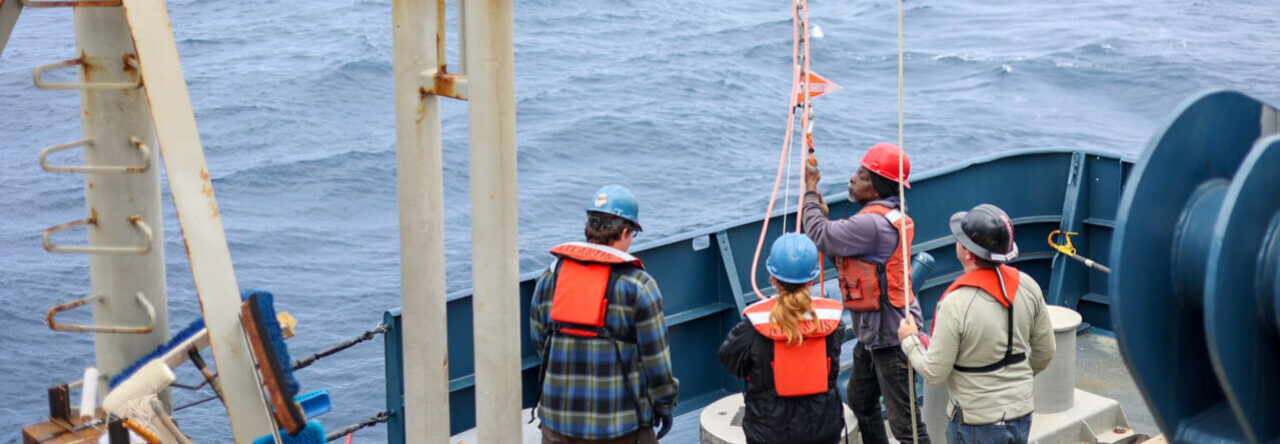
On Saturday morning, the morning shift completed the final cast at station 2 to send the CTD and Niskin carousel! Once the CTD was secure, they turned their attention to one of three wooden crates on deck. In each of these crates, there is an Argo float. These are robotic instruments that meander around the ocean, measuring CTD profiles as they descend and ascend, and send these data back to scientists. This is an international project that started in 2000. Today, there are 3908 active Argo floats taking these measurements. The Argo float was deployed off the stern, and we were on our way to station 3!