

Author: Eleanor Duva

Duva Week 6 R/V Langseth

Station 6 was east of Greenland and we arrived on Saturday the 13th and started coring on Sunday. One of those cores caught a piece of a sponge! We also were visited by a large pod of pilot whales on Sunday. There was a group of roughly 20 whales that were jumping and diving near the boat, and another group closer to the horizon.

Monday was a big day of coring and by Tuesday evening, we had finished the CTD cast and were headed onward towards station 7, our last station!

Usually transit days are more relaxed, but Wednesday and Thursday brought some excitement. First, we released our last Argo float on Wednesday, followed by an XBT probe to get water column temperature data from the location of deployment. XBT stands for Expendable Bathythermograph; “expendable” because the probe is launched into the water and not recovered. The probe is a small, torpedo shaped object that stays connected to the launching device by a delicate thread of copper wire which transmits the data back to the ship. Once we reach its maximum depth, you break the thin wire and are left with a temperature profile of the water column the probe fell through. XBTs are used on the Langseth for seismic, in which sound is used to map the ocean floor, and an XBT helps find the speed of sound through water, which is dependent on the salinity and temperature of the water.

A few hours later, we experienced some disruptions in power as one of the main engines had a kerfuffle. At this time, I was in the bridge and it was interesting to see how the captain and second mate managed the situation. After some troubleshooting, the engineering team were able to get everything back online.

On Thursday morning, we were notified by the Icelandic Coast Guard that we were the closest vessel to a sailing vessel in distress and asked to render aid. The sailboat lost its sails in a storm and was running out of fuel. We backtracked for a few hours until we were in sight of the sailboat. The second mate, third mate, and one AB went in the fast rescue boat to bring them jugs of fuel. It was a little unnerving to watch the little orange boat be rocked around in the cold waves, but they reached the sailboat safely twice to bring them about 50 gallons of fuel. The rest of the deck crew contributed to a successful deployment and recovery of the fast rescue boat.

Our excitement for Friday was crossing the Arctic Circle!! And it was Larkin’s (our awesome videographer/photographer/science communicator on board) birthday! We also had a meeting for planning demobilization once we reach port, which includes arranging for shipping containers, cranes, and forklifts.

We are expecting some big seas in the next few days and hopeful we still be able to find a weather window to get station 7 done before heading to Reykjavik. Home stretch!

Pod of pilot whales, photo by Lexi!

View from the bridge as the orange fast rescue boat crosses our bow.
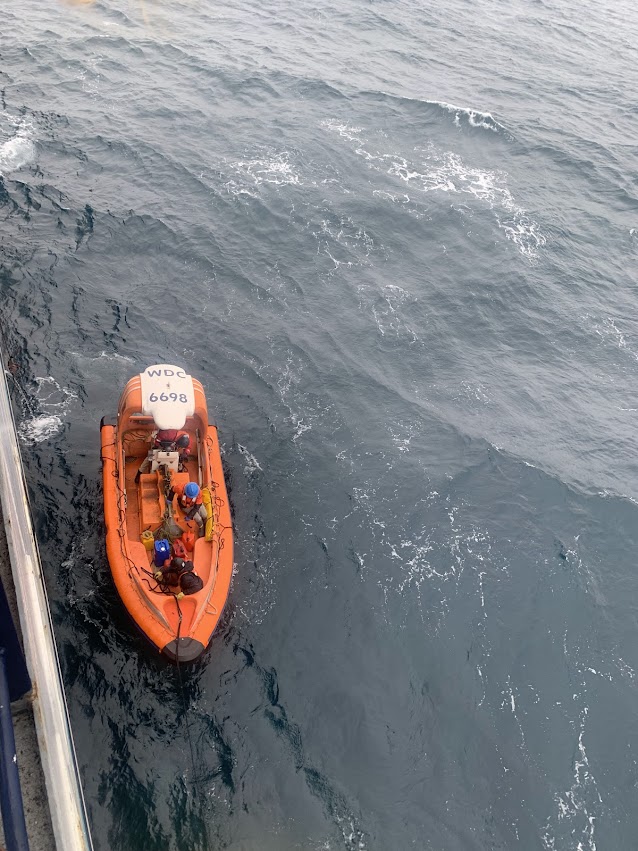
Fast rescue boat just after it was deployed from its davit on port side.
Duva Week 5 R/V Langseth

We started week 5 by arriving to station 5, located in the central Labrador Sea between Greenland and Labrador. We sent multi-core casts all day on Monday and Tuesday, and finished up station 5 with a CTD cast on Wednesday. Sunset is getting later as we continue northward.

Scores of northern fulmars and gulls kept us company at station 5, floating and flying near the ship. Fulmars spend almost all their days at sea, so they are not typically seen from land. Another lift to ship morale were two incredible nights of having Haagen Dazs ice cream bars for dessert.

During transit on Thursday, a group of us got a tour of the engine room. We saw the massive air compressors for seismic work, as well as the engines, shaft generators, aux generator, and air conditioning systems. In addition to catching up on projects and reading, I spent some time in the bridge while transiting.

By Saturday we were on station at station 6, east of Greenland. We resumed sample collection in about 2600 meters of water.

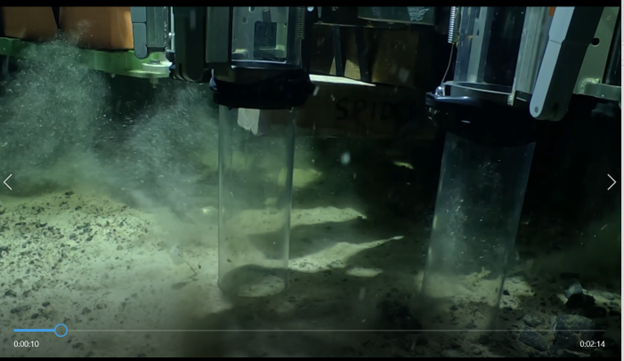
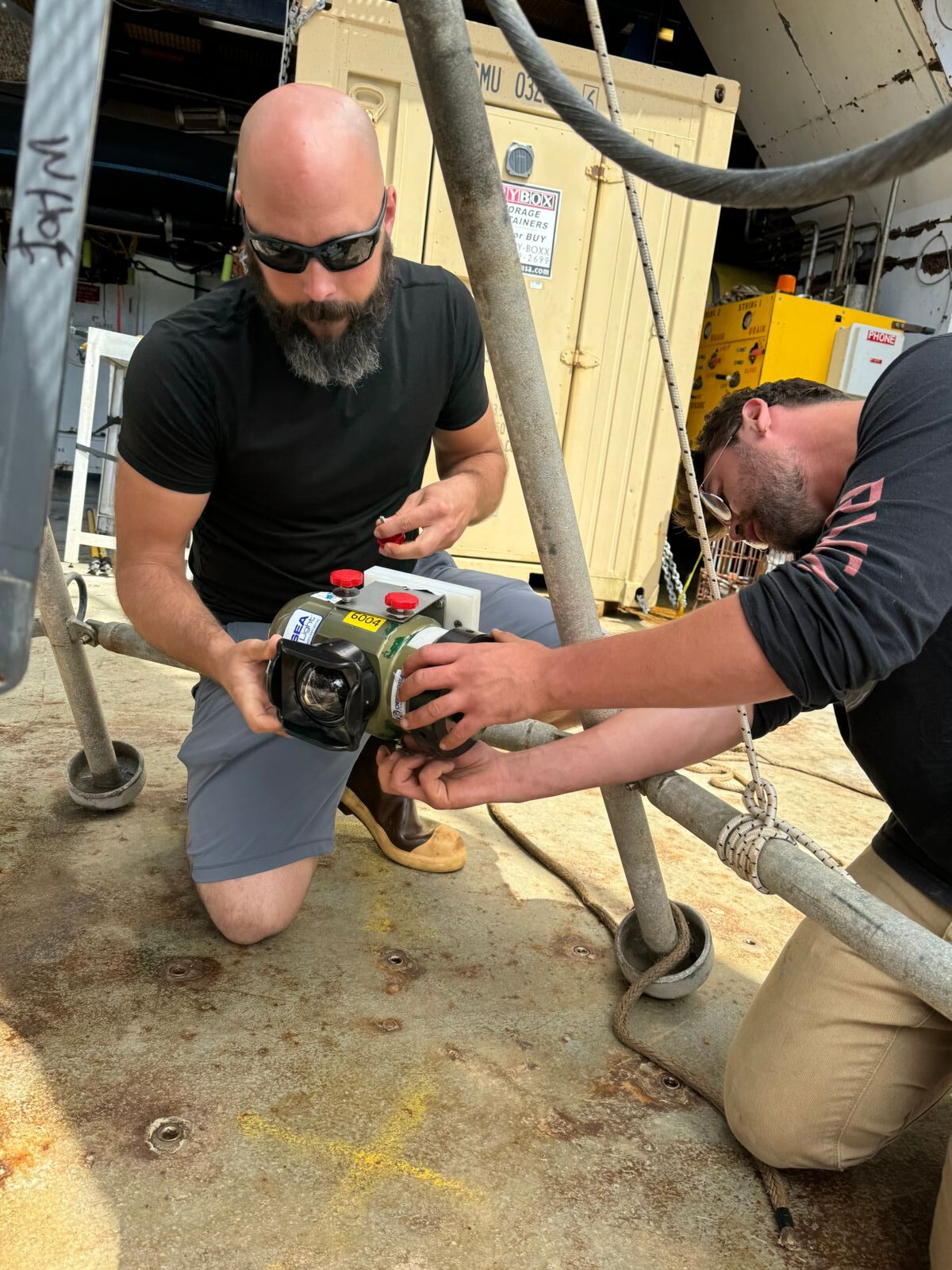
The multicore has two cameras on it, one of which is helpful for landing the corer on the seafloor and the other for troubleshooting sampling. One of the cameras we can view images from during the cast via the winch’s sea cable. Mounted near this camera is a light which we have the ability to turn off and on during the cast. The light is kept off for most of the cast, because it draws the most power and we don’t want to drain the batteries. All of the power for the cameras and light come from two batteries mounted to the frame of the corer, which get charged up overnight with a trickle charger. The second camera records the whole cast (which is mostly darkness) because it is a GoPro in a special metal housing. So we start the video recording then pack the GoPronto the housing and mount it on the multicore frame. The housing also has a highly specialized lens that corrects for distortion from the water.

Screenshot of a video from GoPro of a bottom landing

Techs attaching the GoPro camera inside its housing to multicore frame

Multi-core being recovered. Orange boxes on sides are batteries to power camera and light. Small white birds in background are fulmars


Duva Week 4 R/V Langseth

Week Four: 6/30-7/6

With our first three (00, 01, and 02) stations in the rearview, we started week four in transit to station 03 at Orphan Knoll, a feature of the ocean floor about 320nm off the coast of northern Newfoundland.

On Tuesday, we arrived to the site. The first core cast came up with 6 usable cores! Yay! However, by the time the second cast hit the deck, the science team has determined the structure of this sediment was not suitable for their project. It was too coarse-grained, which means it is advective sediment that water flows through rather than getting trapped in. Also, trying to centrifuge the water out of it doesn’t work as well.

We started steaming again and started fresh on Wednesday morning, now calling this site 4, just a little east of station 3/Orphan Knoll. The water is deeper here, which means more wire time and longer days, but hopefully better mud.

Wednesday and Thursday we cranked out four casts per day, pulling 5 or 6 cores off each of them. This sediment contained rocks! Which is exciting, if you like rocks. The rocks are all a sooty black color, until you crack one open to reveal granite or dolomite. This dark outer coating is manganese oxide. Dolomite is a very common bedrock where I live, so I got a nerdy little thrill out of holding pieces of it that we had pulled up through 4000 meters of seawater.

On Friday, we had collected enough mud after cast three of the day, yay! This site was our second of three designated places to deploy an Argo, so we sent that off the stern as we headed out. At first, the Argo laid flat in the water, but within a few seconds, it “came alive”, righted itself, and immediately began a “dive” to 2000m.

In the evening, we spent some time tracing wires and troubleshooting because our echosounder isn’t receiving data properly from the GPS. Then, we played some MarioKart. The following days in transit went similarly; projects and troubleshooting anything acting up, then MarioKart. On Monday we expect to be on station and coring.

Duva Week 3 on Langseth

Week Three: 6/23-6/29

Week three was spent collecting sediment from our station in the Newfoundland Basin. We arrived on station Sunday evening, and spent our first full day coring on Monday. We were also met with some challenges: a few cases of COVID, low success rates on core casts, a blip of foul weather, and a repair on a crucial turning block.

COVID cases springing up was a bit out of left-field, given we had been at sea for two weeks. Testing, isolation, and masking were parts of the (very calm and collected) response initiated by the captain, and by the end of the week things were mostly back to normal.

We kept up a steady pace of 3-4 casts per day, but each cast only produced one or two usable cores. Progress was slow. This was an interesting chance to experiment with the multicore, and adding wooden blocks on the bottom of the “spider” helped to produce better cores by keeping the multicore a little shallower in the sediment when it touched down.

One stroke of good luck was the weather we had been tracking mellowed out by the time it reached us, and we only missed a half day of work rather than the 2 days we initially expected. On either side of the poor weather, we enjoyed some warm, sunny days.

On Friday, Ayse noticed the main turning block (mounted on the A-frame, which the winch wire runs through), was starting to make an odd squawking sound, a lot like the sound of a mallard duck. After we finished that cast, the deck crew assembled some scaffolding to take a look at it. They quickly determined that source of the squawk was the inner sheave, which was starting to separate due to improper hardware. With the proper bolts in place, the duck was silenced, the block was fixed, and coring was resumed.

On Saturday morning, the morning shift completed the final cast at station 2 to send the CTD and Niskin carousel! Once the CTD was secure, they turned their attention to one of three wooden crates on deck. In each of these crates, there is an Argo float. These are robotic instruments that meander around the ocean, measuring CTD profiles as they descend and ascend, and send these data back to scientists. This is an international project that started in 2000. Today, there are 3908 active Argo floats taking these measurements. The Argo float was deployed off the stern, and we were on our way to station 3!


Duva Week 2: Langseth

Week Two on the Langseth has come and gone!

We finished up our first transit, and then spent a few days on station coring. We experienced a little kerfuffle with the new winch, and lost a few hours of work until we were able to devise a solution.

It took us 8 casts with the multicore to collect sufficient “mud”. It’s not actually the mud that the science team is after though; it is the water trapped between the fine grains of the sediment. This water is called pore water. To extract the water from the sediment, the science team does lots of careful scooping, centrifuging, filtering, and bottling.

 The multicore has eight tubes that are lowered into the sediment and then pulled back up (hopefully) full of a beautiful core of deep-sea sediment. So far, it is very rare to have a cast in which all eight cores are usable. A good cast for us has resulted in 5 or 6 “keepers” and subpar casts bring up 1 to 3 keeper cores.

The number of casts needed depends on many factors, including how “watery” the sample is (i.e. what the sediment is like) and the conditions of the ocean. It is easier to get a nice core in calm water.

After we wrapped up station 01 (not to be confused with station 00, which was our first stop), we transited about 800 nautical miles northeast. Transit allowed time for extra resting and project catch-up.

Now we’re at work getting samples here at station 02, where conditions have been more difficult; we have about 2 knots worth of current and we are retrieving only a couple usable cores from each cast. At this site’s depth of about 4830 meters, it takes about 2 hours to send the multicore down and 2 hours to retrieve it..it is a long way to go at a pace of about 45 meters per minute.

One night we enjoyed the sunset over very calm waters with the company of dozens and dozens of dolphins. Several pods over the course of a few hours swam towards the ship, under the bow, and along the wake. Very special!

Duva Week 1: Departure and First Station

Week One on the Langseth!

We had a busy start to the week as we prepared to depart from the Brooklyn Navy Yard. We faced some potential delays (engine parts, science gear), but ultimately decided to make our first, near-shore station (which was initially intended as a test site for our gear) a full research station. After completing work there, it was decided to proceed to the next station (rather than returning to NY to pick-up parts). So, the next land we see will be Iceland!

The new Okeanus winch passed its stress test, and we made a valiant effort at calibrating the Rugged Controls winch sensor as best we could. We finished rigging up the multi-corer and CTD/Niskin Rosette, then proceeded to make our first cast for cores! This site was relatively shallow at 2240m, and it takes about 45 minutes for the corer to reach the ocean floor at this depth.

The collection of the cores is controlled by the winch operator; once the corer’s feet land on the seabed, more cable is paid out to release the plastic core tubes into the sediment and gather the sample. We spent several days coring, with the science crew also working long hours to get all the samples processed appropriately. All of their work needs to be done in oxygen-free environments (nitrogen-filled glove boxes) so as not to alter the chemistry of the sediment.

After the science crew was happy with the amount mud/pore water we collected, we switched the winch cable to the CTD/Rosette and sent that over. It was cool to watch the CTD take a profile on the descent and then to fire the Niskin bottles to close at various depths on the way back up.

Driving the winch to land the multicorer on the seabed and assembling the CTD and using its software program (SeaSave) were some of my favorite tasks this week.

Since being in transit, I have also spent some time in the bridge standing watches. I learned a lot about the systems on board and the maritime field in general by talking with the deck crew and officers.

Today (Monday 6/17) we set our clocks forward by an hour to -3 UTC…the cities of Halifax and Buenos Aires both work as a correct time zones.

I am feeling very grateful that the ship has an awesome kitchen and steward team. We have been eating well, thanks to John and Insuk. In addition to the science party, the marine techs, and the kitchen and steward crew, the engine room and deck crews have also been working hard. It has been exciting to see how all these teams come together to make for a successful day.

Also, basking sharks and dolphins!

Thanks,

Eddy

Duva Week 0: Introduction

Hi!

My name is Eleanor “Eddy” Duva and I will be joining the R/V Langseth crew as a UNOLS MATE intern next week for a research cruise in the North Atlantic.

I graduated from the University of Vermont (UVM) and then spent some time working and living aboard sailboats. In the past year, I began working as a fisheries technician and vessel crew on UVM’s R/V Marcelle Melosira. I am looking forward to learning from all the folks on the Langseth crew, and particularly interested in learning about sediment coring gear and how they manage CTD data.

Outside of work, I like to be outside, read, and make stained glass pieces.

Powered by WordPress & Theme by Anders Norén