Week Two on the Langseth has come and gone!
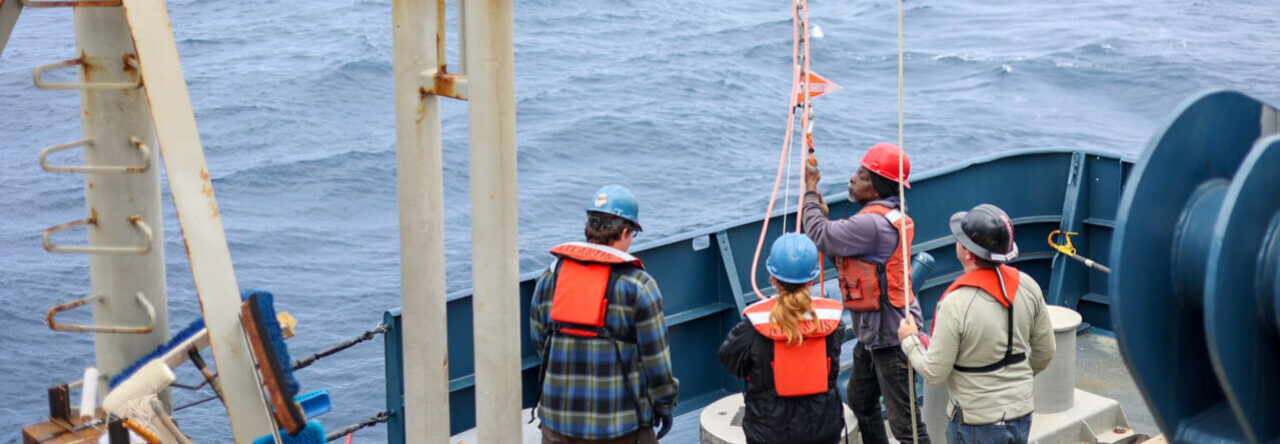
We finished up our first transit, and then spent a few days on station coring. We experienced a little kerfuffle with the new winch, and lost a few hours of work until we were able to devise a solution.
It took us 8 casts with the multicore to collect sufficient “mud”. It’s not actually the mud that the science team is after though; it is the water trapped between the fine grains of the sediment. This water is called pore water. To extract the water from the sediment, the science team does lots of careful scooping, centrifuging, filtering, and bottling.
The multicore has eight tubes that are lowered into the sediment and then pulled back up (hopefully) full of a beautiful core of deep-sea sediment. So far, it is very rare to have a cast in which all eight cores are usable. A good cast for us has resulted in 5 or 6 “keepers” and subpar casts bring up 1 to 3 keeper cores.
The number of casts needed depends on many factors, including how “watery” the sample is (i.e. what the sediment is like) and the conditions of the ocean. It is easier to get a nice core in calm water.
After we wrapped up station 01 (not to be confused with station 00, which was our first stop), we transited about 800 nautical miles northeast. Transit allowed time for extra resting and project catch-up.
Now we’re at work getting samples here at station 02, where conditions have been more difficult; we have about 2 knots worth of current and we are retrieving only a couple usable cores from each cast. At this site’s depth of about 4830 meters, it takes about 2 hours to send the multicore down and 2 hours to retrieve it..it is a long way to go at a pace of about 45 meters per minute.
One night we enjoyed the sunset over very calm waters with the company of dozens and dozens of dolphins. Several pods over the course of a few hours swam towards the ship, under the bow, and along the wake. Very special!


