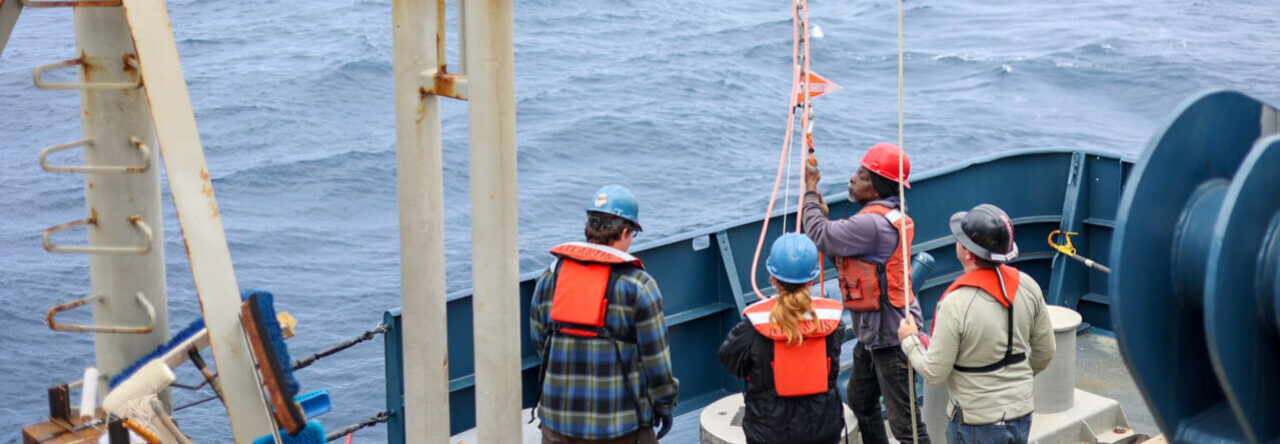
With the ice floes far out of our sight, we began the transit into port. Our days were spent waving the ice goodbye, cleaning up our work stations and preparing for seas. The weather was predicted to pick up and become quite sporty as we headed in, so we began securing gear.
On the day we came into port, I awoke to the familiar feeling of a tug pushing along the hull of the ship. The Healy always has the aide of a tug or two to help guide them into port, as often times a novice is behind the controls up in the bridge. A little bit of help never hurts! Our team stood above on the flight deck, to watch the masters of their craft navigate. A tug boat is something akin to a glorified floating engine, with the sole purpose to push and shove other vessels around. Even so, there can be no understating the importance of their work! They are responsible for helping an endless amount of ships safely navigate water ways, and assist them to avoid running aground.
Hello NOAA ship Oscar Dyson!USCG helo!Healy!
As we docked in the small marina of Kodiak, Alaska, I was taken aback by how beautiful it truly is. The mountains stand tall and imposing over the bay. From over the hills, helicopters and planes soar above in the clouds. Kodiak is a “Coast Guard City”, and has one of the largest coast guard bases in our nation. Once we docked, we finally got our first good look at the outside of the ship! When we boarded, it was via small boat shuttle, so there was no time for gawking at the sheer size of the Healy. Now, looking up from the pier, holy moly! As the largest cutter in the fleet, she is Big Red, large and in charge! She dominates the pier space, and comes uncomfortably close to the fishing ship astern to her. It was a treat to share dock space with the NOAA ship Oscar Dyson, though we sadly had no time for tours. As a NOAA nerd and lover, it is always very exciting to see them out and about! Oscar, if you ever see this, hit me up. We’ll tour and swap CTD horror stories or something.
Truly we were blessed with an awesome group of people. HUGEST shoutout to Tyler and Maya, the coolest mentors around! As they were both previously UNOLS Mate interns, it feels very full circle. From mentee to mentors, they stepped up to the plate in huge ways. Kaleigh is the coolest kat on the west coast, and it was a pleasure to sail with her! Best of luck to all three of y’all, and I am certain we will cross paths again as ships in the night (or rather, on ships in the night. It’s a small world after all).
With a spare day in port, everyone on board was given liberty. Time to explore! The town is bustling with a surprising amount of energy. We ate at local restaurants, walked by the fishing piers, and enjoyed the wild sights of mountains meeting ocean. Though we saw no polar bears, we were extremely excited to see bears on shore! They were out for a stroll, enjoying easy meals out of the dying salmon. Salmon are mostly anadromous and semelparous, which sounds fancy, but simply means two things: they begin and end their lives in fresh water, and die after spawning just one time. During the summer, they return to the river they were born in to repeat the cycle over again. After they spawn, they die, providing abundant nutrients for the next generation of salmon. It is a truly striking cycle that I have always been deeply stirred by, and witnessing it firsthand was touching. The bears and birds take advantage of the weakened salmon by scooping up some easy meals.
Though our time onboard the Healy is done, the memories made and work completed will remain. Invaluable lessons learned and lifelong friends made, I head home. Alaska, wild and enchanting, streams 30,000 feet below me. I’m sure to return.
Special thanks to the Healy, for facilitating us interns to sail with you! The crew, for dealing with our shenanigans and endless questions. To Maria and the entire UNOLS team for helping us each step of the way. To our mentors Tyler and Maya, for sharing their knowledge and encouraging our learning environment always. We are grateful beyond words.
Thank you to my family, for supporting my crazy dreams and believing in my abilities. Without their undying love and unconditional support, I would never make it to this point. Mom, Zak; I love y’all, and work everyday to make you proud! Kayla and Joyce, thank you for encouraging me so I could believe in myself. Love y’all always, my voices of reason.
It is currently day 24 aboard the USCG cutter Healy! We have successfully recovered and deployed all of the moorings that the science crew had set out to accomplish. What an achievement! The moorings we deployed will remain deep under the arctic ice floes, until the ship once again returns to repeat the process. The instruments attached will collect water column profiles, which, long term, can show trends and patterns in data. This enables scientists to predict future changes, as well as observe any changes over time. That’s a big deal!
We have officially passed the halfway point in our mission. With all of the moorings out of the way, we are shifting our focus to sea gliders! With a shift in mission comes a turnover of gear. The lab spaces on board are surprisingly small for such a large ship, and can get rather… crowded. The scientists are often awake into the wee hours of the night, tinkering away with their mechanical treasures. It’s difficult and precise work, but thankfully the Healy is very steady in all this ice. This may be the only ship where people set their things on a desk ledge with no worries of it tumbling off with each roll of the waves! Look’s as though the science crew has some cleaning up to do…
We have become quite accustomed to doing donuts out here in order to clear the ice, but the sight of it is always very interesting. We are still fairly far north, so finding open patches of water is a bit touch and go. When we can’t find one, we just have to make it ourselves! While watching the ice parting, and the patch widening, it is clear to see if someone with more experience is driving the boat, or if perhaps it is one of the greenhorns. Our experienced captains definitely hit the “circle” target bullseye, every time. The greenhorns however… well, they make some funky ovals, puddles, and other fun shapes, which I tend to appreciate more than the boring old circle. It’s art. Call that Picasso!
Everyone’s cups!My cups before…My cups after!
As the classic science nerds we are, we decided to make some shrunken cups! This is a relatively easy project, if you just so happen to have a way to get your simple styrofoam cup a couple thousand meters below the surface of the ocean. Easy peasy, right?!
Using markers, alcohol based such as Sharpies tend to work the best, decorate your cup to your hearts content. There are some astounding artists on board, and it seems as if every member of the crew made one! Once your cup is decorated, stuff it with a paper towel to keep it from collapsing in on itself. Place your stuffed cup into some sort of permeable bag, such as a mesh laundry bag or pillow cases (we filled two entire bags!), and attach it to something that will dive deep into the water. The obvious choice on a research vessel is the CTD rosette! Ziptied securely on for the ride of a lifetime, down down down they went. Into the inky abyss, all of the air within the styrofoam was compressed out, thus shrinking the cups. As an example, here are the cups I made, next to an example of what they looked like before. So teeny tiny! One of my turned out a bit wonky, but it’s all the more reason to love it. Peep the octopus! Cutting the cups before sending them down can make some really interesting shapes. Try it out if you get the chance!
From the same CTD cast, we decided to keep some personal water samples. Using empty hot sauce bottles we scavenged from the mess, the five of us are now the proud owners of arctic deep sea water. Though it may seem like a rather odd souvenir, it is a small sip of history as we know it. This water, while in the ocean, is extremely slow moving, and has probably been within the ocean basin for many, many years. Now, captured in water tight bottles, it wont enter back into the water cycle until the bottles are either emptied, or broken. How incredible it is, to have an encapsulated piece of the environment, and suspend this element in time. Of course, as all good oceanographers do, we simply just had to taste the water. Put your head under the rosette, and open up a spigot! The absolutely frigid water is extremely salty, and might even burn your mouth a bit. So, so worth it.
The floats are larger than I initially realized!There she goes…Just swim, bro!!
We have also deployed the remainder of our ARGO floats, chunking them out into the ocean to do their thang, solo style. To have the name ARGO float, they sure do sink pretty quickly… But don’t worry, once they wake up and get a little motivation, they begin their eternal journey of vertical migrations. They gently bob up and down the water column, until they eventually either fail or run out of batteries. Sigh, such is the sad, sad, life of an ARGO float. Their righteous self sacrificial mission is not in vain, as the researchers cherish the data that the floats have slaved over for so long. Once they have fulfilled their life mission, they aimlessly drift through the ocean. This cycle reminds me much of the mars rover, Opportunity. When the rover eventually ran out of battery, its final transmission amounted to: “My batteries are low and it’s getting dark”. I imagine the ARGO floats think much the same thing near their end.
Anywho, back to the lab! One of the laborious tasks the whole team has been pitching in on is inventory… dun dun dunnnn! This means enumerating, labelling, and testing just about everything on board. Maya and I spent all of one morning trouble shooting Adam modules, which is essentially a fancy signal converter for different devices. What should have been a quick, easy little project turned into hours of frustration and blatant confusion. The software used for trouble shooting was not interested in telling us anything, so we ultimately learned nothing about the current state of our spare modules. Are they still in usable condition? Who knows, but we’ve got ’em inventoried and put away in their proper place!
Go Kaleigh!Well hello there Maya!!
Happy birthday to the coast guard! In the spirit of Coast Guard day, Tyler and Kaleigh participated in a ship wide cornhole tournament, featuring our tech team lead Christina as DJ Oceans! It was right around bedtime for Maya and I, so sleepy as we were, Kaleigh and Tyler had the most monotone and unenergized cheerleaders you could ever want. Or I guess, not want? Unclear if I’m honest. This trivia crushing duo crushed cornhole only slightly less. But, if I do say so myself, they were the most spirited team on the flight deck! Read more about it over in Kaleigh’s blog! https://mateblog.unols.org/author/kaleigh/
One early morning, we were delightfully gifted with a pile of soft snow! Though it was rather chilly, we of course took our time to play and have a snow day. I mean, how couldn’t we? I made short work of snow angels and some little doodles in the powder, at the risk of freezing my fingers off. I may have even dared to throw a snowball at my mentor. Who knows! 😉
Look at her go!!Comin’ up!
Even through the snow, science must go on! We made it to our first glider operation, which was a recovery. The gliders are the same as the ones that I helped to deploy and recover in Thailand aboard the R/V Thomas G. Thompson. Shout out to Jen and Liz for all they taught me, I am seriously missing the tropical sun with you both right now!
This recovery was a bit different than how we ran things on the Thompson. Once we were ready to recover, the scientists communicated with the glider via software, telling it to come to the surface. Unfortunately, because of the ice, it is exceptionally hard to spot. The antenna is only 18″ long, and even though it is bright orange amidst calm water, it is nearly invisible. Once the glider surfaced, the bridge was bustling with spotters wielding binoculars, scanning the horizon for our little friend. This took considerable time!
Finally, after several ascents to the surface and constant searching, we had the glider in sight. Instead of driving the ship right next to the glider to make an approach, and reaching over the gunwale with a noose to snatch the glider as we did on the Thompson, the coasties actually deployed a small rib with science member Justin on board. They drove right up to the glider and hauled it out of the water like a prize tuna had just been caught. A short little ditty bop back over to the Healy, and they tied the glider to the A-frame wire. A simple little elevator ride up and the glider was back on board! So easy!
While we transit to our next stop, and dream of sea gliders soaring through the deep, we were gifted by the sight of one of the wonders of creation: a fog-bow! A sight I have always wanted to witness, and I am so blessed to have seen such an incredible display of God’s hard work of nature, physics, and light. Though this may seem insignificant to some, it has been on my techie bucket list since day one! Another one checked off. With time to go still, how many more can I mark off?! Stay tuned to find out!
It is currently day 16 aboard the USCG cutter Healy! I am constantly surprised by the vessel and its capabilities, as well as the incredible crew that staffs her. The Healy is a coast guard ship where many freshly enlisted members come to train. Being such a large ship, with a variety of missions going on at any one moment, it makes for a new environment each day. On the back deck, you can see a rainbow of hardhats- each of the different colors have a different meaning! The green hats are those with the least experience, and as you gain knowledge and skills, you move up to a blue, yellow, and eventually a white hat. In this photo, you can see a yellow hat teaching the other deck members how to tie a knot. Seamanship skills such as knot tying, splicing, and line handling are of the utmost importance to work on the deck. This ensures safety of personnel and also the effectiveness of the scientific mission.
We arrived on station for our next evolution right as our night shift began. Science waits on no man, so we got to work immediately. I am very excited to finally get some science action on the night shift! Though, honestly, you could never tell that this photo was taken at midnight- it is all sunshine all the time in the arctic.
For a mooring recovery, there is an order of operations that we more or less follow each time. Every instrument package varies slightly, but it is the same process.
Once the scientists locate the mooring via a GPS transponder attached to the top float, the ship cuts ice in the area for several hours. The science crew then uses a pinger to communicate to the mooring release. Since the ship has other echosounders running at all times, it is the responsibility of the marine technician on shift to power down our multibeam and ADCP devices. This ensures that no interference will effect the mooring release. Once the anchor is released, the floats on the top of the mooring line drag it to the surface.
At this point, the ship can make its approach. We line up to the floats, keeping them on our starboard side. This can take some time and fine adjustments from the bridge, so the deck crew stands by patiently. We must be careful to avoid running over the mooring line, as well as potentially navigating around ice floes as they drift by. Dynamic environments require constant focus from every crew member involved!
Once we are along side the floats, you can see that they are attached to one another via line. Our goal is to hook onto the line, to pull it towards the deck. The man in yellow made quite an impressive grappling hook throw, and snagged the line perfectly. I always love to see people who have mastered their craft hard at work. Some of the green hats attempted to throw the hook, and Mr. Yellows skill was undeniable. A grappling hook is heavy, and a rather awkward shape to try and heave. So we were all thoroughly impressed!
Once the floats are at our side, we can hook the topmost one onto the winch line. The line is brought from the A-frame block, and held around the quarter by the deck crew. Once the floats are tied on, we allow the ship to float slowly forwards, bringing the floats aft to the A-frame. It takes many hands to ensure the line does not become snagged on anything while we can walk the float back assembly line style. Once it comes to our stern, it is time for the Lebus winch to start pulling the immense amount of gear onboard.
First up, the floats! Once the winch pulls up enough line to suspend them, the A-frame operator brings the frame inboard to the deckhands reach. They make off the line below the floats, so that the gear still in the water stays attached to the ship. At that point, the floats are no longer weight bearing, and can be removed from the main line. Special float stands are carried on a palette jack, so the floats can be stowed without rolling around like pinballs on deck. Once they are securely fastened down, the weight bearing line is attached back to the winch to haul up the next section of the instrument package.
The VLF is the next to be recovered! This device, which operates on a ‘very low frequency’ (hance the name VLF), communicates with seagliders. If you’ve been following along with my blog posts, you may remember seagliders from my time aboard the R/V Thomas G. Thompson. Those little yellow rockets dive up and down the water column collecting data, all by their selves! The VLF is so huge because of the extensive batteries that it must carry. It’s hard work under the ice, so they need their energy to stay awake until we come back for them!
This scientific crew has previously sailed in the area to deploy seagliders and moorings, which is what we are here to recover. These devices generally stay out for 1-3 years, autonomously collecting data which is critical for oceanographic research.
The VLF was brought back on board the same way as the floats, by transferring weight bearing lines. After that, its just a mere 3500 meters of line to hoist up! This takes a good chunk of time, as the winch can only pull in line so quickly. After a couple hours of line winding, the acoustic anchor release is the bitter end of the line. Finally the deck crew can head back inside and warm up for a bit!
While still sitting on the same station, science requested a CTD cast. After all of the testing we have put the CTD through, its time to put it through the true ringer- a cast to a depth of around 3700 meters! Luckily I was still on shift, so I was able to prep the CTD for deployment. We opened all of the bottles, and prepared them for water collecting. There I am, on deck finally! Hi me! I removed caps from all of the sensors, and the plungers from the oxygen sensors. I stood back as the deck crew deployed the rosette over the side, to ensure everything on the rosette looked correct. Similarly to how the line recovered from the mooring, it takes some time for the CTD to reach the requested depth. So it’s back to waiting around for you, deckies!
Go Kaleigh!That’s me!Thermocline my beloved… <3
Once the CTD was 3700m below us, dangling into the dark arctic waters, it was time for data collection. This was right around our turnover time, so it was lucky that both Kaleigh and I were able to fire some of the niskin bottles. Look at us go! The computer program, SeaSave, is fairly simple to use. It graphs the water column data in real time, and makes some pretty neat charts. You can clearly see the thermocline here, which is a depth at where the temperature changes drastically. I am a nerd, so this is fantastically exciting for me! To some it may just be a few lines, but it is a visual representation of all of the oceanographic theory I have studied before. I love to see science in action!
After the CTD came back on board during the dayshift, we allowed the full niskin bottles to settle and test for leaks. And wouldn’t you know it… Sigh. It’s back to testing for us! In an unusual turn of events, many of the bottles are leaking from the screws, which is a new one for me. Some drip from the spigots as well. So, time to try something else!
The niskin bottles we use are as big as I am! These bottles hold 12 litres of seawater each. With 24 bottles on the rosette at any one time, we can grab 288 litres of sea water in a single cast! Seldom will the science group need all 288 litres, but it does give them plenty to work with. Science needed no water for this station, it was actually just for our own testing purposes. We wanted to let the bottles sit so we could detect leaks, and detect them we did!
We couldn’t just pour the bottles onto the staging bay floor, so we had to take the bottles down while they were full. One full niskin bottle weighs approximately 35 lbs, so as you can see, it was a bit of a wrestle to pull them off the rosette. We emptied them all into the floor drains, and got to work with our repairs.
I have worked with rebuilding a niskin bottle as part of a school project, but never this many! We documented which bottles had which issues, and began trying to solve some leaks. We ran an experiment to try and figure out a solution. We replaced one bottles O-rings, one bottles spigot, and one bottles lower screws. We filled them back up and let them sit for a little while again.
When we came back to check, the only bottle that showed improvement was bottle number 2, where we replaced the spigot. This involves wrenching the bottles open, removing the spigot disc, removing O-rings, and popping out the old spigot. So, we took a sit down on the floor and got busy switching out all of the spigots. It is a bit of a delicate and involved process, so this took us much of our shift to accomplish. Once we had swapped out all of the affected pieces, we cleaned up the mess we made and hung the bottles back onto the rosette. Try again!
Another facet of the scientific mission on this deployment is ARGO floats. You can find out more about the floats and their mission on their website! These devices are deployed over the side and act much like a drifter. They go out and do their thing, collecting precious, precious data! An excitable member of sci allowed me to assist in the deployment of this float, which was a bit underwhelming and a ton of fun. More or less, we simply wait for a break in the ice and toss ‘er over the gunwale! We are a bit more precise than that, using a piece of line to slowly lower the float into the water, but you get the picture… Thanks, Justin!
The first sasquatch sighting in the arctic…They look like ants!
Oh right, this is the Coast Gaurd! Back to official matters. An incredible training opportunity presented itself while we are in such thick ice. Ice rescue! We spent a considerable amount of time looking for an appropriate floe, and posted up beside of the piece. Once the bridge felt confident it was a good spot, the deck department craned the gangway onto the ice, and the first man was down that quick. One small step for man!
They walked as far from the ship as the fog would allow. Each man on the ice carries equipment that they might need while off of the ship. They place little orange safety cones on spots where there might be tripping hazards or questionable ice. They even have a team member dedicated to watching for wildlife! With the fog, it would be relatively easy to accidentally creep up on an unsuspecting polar bear. It was a delight to watch them trudge across the frozen snow, and fade into to distant fog as ships in the night. The going is slow, walking carefully on slippery surfaces and uneven terrain.
Splish splash! Hi Nina!That’s us!
Then it was the time for their true trials- surviving a fall into the ice! If they were to step through a thin spot of ice, or have any other reason to end up in the water, they need to know how to respond. Their suits have a base of neoprene, which keeps them dry, and a snowsuit that keeps snow and wind off of them. These suits float very effectively, so theres no need to try and tread water. While in the water, they practice manuevers for rescuing an unconscious team member, best practices for crawling back up onto the ice, and more. This training, though surely strenuous, looked like the most fun you could have! What a crazy feeling it must be, floating in an ice hole with nothing but 4000 meters (13,000+ feet!) of ancient arctic water below you.Only those training were allowed to get onto the ice, so it is a bummer I was not able to participate. But even just watching was incredible!
My mentor Maya and I were jealous of the coasties play time on the ice, but we enjoyed our time on deck watching just as much!
It was surreal to see the vessel at a stand still in the ice, and I got this insane view of the bow. The ship is unbelievably huge, and I am always in awe of her stature. Once the ice training was complete, the coasties scaled the rather steep gangway back onboard, and we were back to crushing ice in no time. As we continue our efforts, with many more miles ahead of us, we say so long and farewell to our northern most point.
Fair winds and clear leads to you scallywags back home.
It is currently day 10 aboard the USCGC Healy! Kaleigh and I have received the full onboarding experience, including donning our survival suits. These ones are extra nifty, and can even hook together so you don’t drift apart. They remind me of how otters hold hands while they sleep! Making sure that everyone knows exactly how to don a survival suit ensures that, in the event of an emergency, it is a quick process with no confusion. Reaction time makes a huge difference in dangerous situations at sea!
Along these same lines, we ran many drills. Most of them were for the sake of Coast Guard training, but they are vital for everyone on the ship. Man overboard, fire, gas leak, and medical emergencies are some of the various drills that are practiced frequently. Practice doesn’t make perfect, but it does make for efficient response times. Everyone knows their duty and where their muster station is. Confidence in ability is half the battle!
Coefficients, variables, offsets oh my!
The marine technicians onboard the Healy run 24hrs a day, in 12 hour shifts. I am on the midnight to noon shift with my mentor Maya, and Kaleigh is on the noon to midnight shift with Tyler. The tech lead of our team, Christina, is on watch from 0600 to 1800. Having this overlap ensures that our turnovers go smoothly, and adds an extra hand to the times when science is most likely to occur on the cruise. This setup does mean that I don’t get to participate as much in the science, but gives a realistic view into the life of a technician.
In this photo, Christina (left) and Maya (right) are troubleshooting one of the many softwares that keep science aboard running. On the wall of monitors, each system can be observed at a glance. Generally, green lights mean things are running well, and red ones mean things need to be checked. Hope you aren’t color blind!
Though having this many screens may seem overwhelming, it is an asset. Nothing can be forgotten when it’s right in front of you!
Gravimeter, don’t bring me down…
Being a marine technician has much to do with variety. Having a wide scope of skills and working with many different instruments means always learning. A new piece of equipment for me is the gravimeter. Measuring marine gravity is an interesting science, and a subject that I know little about. I won’t bore you with the details, but check out this short, informational video for more info. My mentor Maya walked me through the process of a weekly test called “Test points”, where we use a multimeter to check resistances. We track the numbers in a spreadsheet, as well as enter the numbers into the deck box for calibrations sake. Next week, it will be my turn to teach Kaleigh, our other intern, how to perform the test.
While on watch, we make several rounds throughout the ship, touring through any space that has equipment and instruments under our supervision. We inspect deck boxes and cables, and remain vigilant for alarms, red lights, or low fluids. One of those spaces is the gravimeter chamber where the unit lives. I have come to quite enjoy our rounds, as it is a nice break from the lab, and we occasionally are able to see others up and about in the dead of night.
That pesky vent screw.No bueno…Takin’ a leak…
While transiting to science stations, it is a perfect time to test equipment. The CTD was due for a thorough look over, bottles and all. The day shift was working on sensors and the CTD “fish” itself, so it was up to the midnight marooners to test the niskin bottles. First up: do they hold water? Well, they were all full already. So the easy answer was yes! We drained them all out, giving us the chance to test the petcock drain on each bottle.
Interestingly, one bottle refused to drain, even with the vent screw wide open. After dismantling the bottle trying to troubleshoot, we found that it was the fault of a defective vent screw. The vent screw had no vent! A simple replacement solved the issue.
One of the spare bottles had a small leak, and we identified a crack right at the base of the bottles handle. Unfortunately, there is nothing we can do to repair the bottle, so it is simply out of commission. All the other bottles got the A-OK, so I clambered back up into the hangar loft and got the bottles back onto their storage rack.
Babies first sea ice!The Arctic Circle!
After a couple long days of work, we spotted our first patch of ice. And then another, and another! It’s official, we have entered into the Arctic Circle! This is definitely the most unique and incredible environment I have ever had the pleasure of experiencing. The farther North we chug, the thicker and more consistent the ice becomes. As it scrapes along the side of the hull, it sounds like a wild animal trying to escape the steel. The slow push against the floes sends cracks racing down the surface, and pierces the quiet air as a bullet through the fog. No polar bears yet, but we’re on the lookout always. Kaleigh is keeping a polar bear count in her blog posts, so be sure to keep an eye out for her updates as well!
The ice has quickly become a target of my fixation, and I wind down every day by just watching it float by. As an ice breaker, the Healy is specially equipped to come to areas that other ships are seldom able to traverse. As the ships local biology nerd, I am on the constant lookout for wildlife. Besides the occasional bird following the ship, there have been absolutely no signs of life up here in the ice. The binoculars are getting their fair share of sea time while we endlessly search the horizon for a polar bear, whale, or even just a seal. It is impossible to truly capture the ice and its presence in a photo, but it doesn’t mean I don’t keep trying!
I guess I better act right, or they might put me in here…
Another stop that we make on our daily rounds is the Mica stores. I have yet to find someone who can tell me why the space is called that, but it gets my Micah Stamp of Approval! A huge variable to take into account with science in the arctic is the cold, duh. Things have a tendency to freeze up here in all this ice! One of the systems that keeps things running smoothly are these ‘head tanks’. This creates a glycol-water mix for filling the transducer wells, which prevents freezing. Our only responsibility here is to check the levels, and to alert the engineering crew if they look low. We noticed that a few were low, so once they were freshly filled, we added labels to the level with the current date, for future reference.
You’re telling me farfalle doesn’t come out this end? Are you sure?
Another new piece of equipment I have encountered is this Lebus winch. I have worked with other winch types of winches before, but this one looks akin to a pasta maker! This machine is especially good at pulling loads with long lines and heavy instrument packages. It has special ‘gates’ that can be opened and closed to allow shackles and thimbles to be wound through with no problem. I have not been able to see this winch in action much yet, but I am hopeful that one of our science stations will be on my shift in the upcoming week!
Spaghetti…
Ice breaking is simultaneously an exciting and a rather dull activity. Essentially, once we arrive on station, we do donuts in the ship, which leaves us with some interesting track lines. We break the ice sheets up while steering in concentric circles at varying speed, which leaves behind a nice slushy spot in the middle for us to conduct our scientific endeavors within. Occasionally, we may get lucky, and our operation will happen right amidst a pool of open water, which saves hours of ice breaking. Either way, the science must go on!
As the sun sits stable on the horizon and watches us slowly crush the ice sheets, that’s all I’ve got for you today. At a balmy 2 degrees Celsius, I am hiking up my longjohns and getting to work!