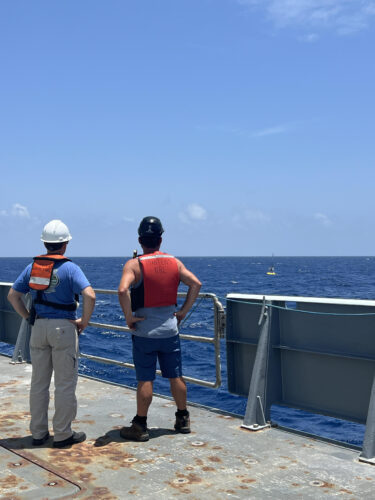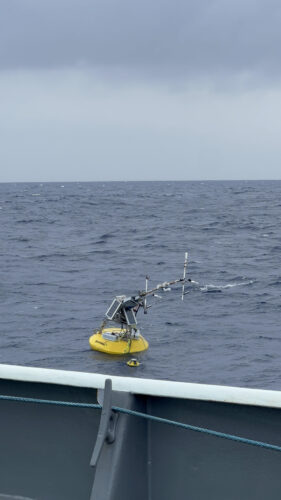

It is officially day 21 onboard the R/V Point Sur, and… wait, is that… Land ho, land ho! Though it is a bittersweet time, demobilization of the cruise is a certainty. The science crew has concluded their work, gear has been packed up, and the deck swabbed. The only things left to do are unload it all and wave our white handkerchiefs in goodbyes. What else is there for it but to get started!

Science brought aboard their own winch with matching block. It is no small endeavor to take it back down, requiring two men to climb the A-frame, one to operate the crane, and at least one more on deck to help facilitate. Equipped with safety harnesses, the climbers take to the frame and attach the crane hook to the extremely heavy block. Once detached, the crane can support said weight and lower it to the ground. The ships standard block is put back into its rightful home, and our courageous climbers can make their descent.

Hey, that looks like fun! Seeing the strength and importance of the crane for this operation gave my mentor Grace an excellent idea: “Let the new guy try it!”
Though I am certainly still hesitant, I can now confess that I have a rudimentary understanding of crane operations. I wouldn’t quite trust myself to move anything too important, but it is a skill I look forward to cultivating more in the future. Having a multitude of people on the ships crew that know how to operate machinery can be a life saver! This ensures that at any one time, you can find a crane operator that is both on duty and not actively involved in another operation.


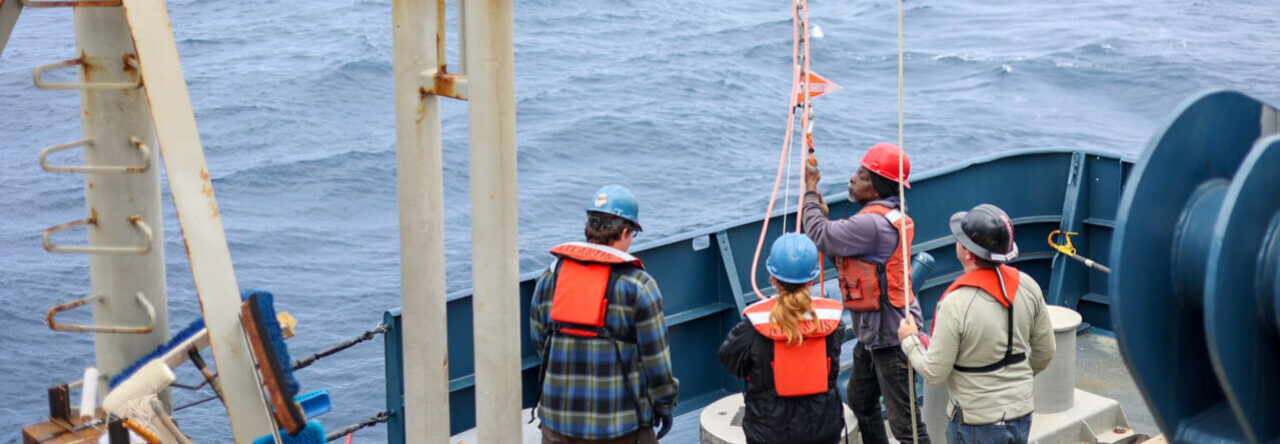
For deploying the ROV, the crew had attached a soft line to the end of the winch wire. While it worked perfectly for the operations of the cruise, it was no longer needed. For removing the line, we set up a clever little DIY station. All it takes is a boat hook and an empty spool, and spinning away we went! The line was coiled up for storage, and the tarp removed from the winch spool. All ready for the next cruise!


To complete our offloading, we needed a crane with a bit more power than the ones on board posses. We mosied on over to the port pier, where we could have some help with the lifting. This is the first time I have seen the forward crane used, to lower the gangway off of the bow. Unlike the crane on the back deck, this particular model has two ‘knuckles’. With two places to bend, it has a greater mobility but also requires greater skill to operate. Skilled crane operator mark slowly lifted and lowered the gangway to the pier, where forklift driver Grace could position it.

With demobilization of the cruise coming to an end, we began preparations for the next scientific mission. Part of our maintenance included cleaning! The whole boat gets a decent scrub down, and the tech lab gets a good polishing. We opened up some of the computers, and dusted out the insides with a high powered blower. The high seas have some serious dust!


A little back story no one asked for:
The Pt. Sur is the sistership to my school’s vessel the Cape Hatteras. A dream I always had while sailing on the Hatteras was to climb the mast, or the yellow ladder as we called it. For liability issues, obviously I was never able to as a student.
Though this mast did not include a yellow ladder, I finally was able to summit my mountain of the mast and had a little climb up while in port! Grace ensured I was harnessed in for safety, and up we went. It was a great view of the port from the top! Even though it is by technicality only, I can finally say I’ve seen my white whale.

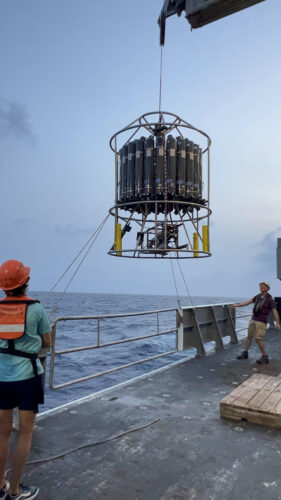
Now that mobilization of the next cruise had begun, gear was being moved to the ship in preparation. This is the primma donna of our mission- the Megacore. Even though the name sounds like something out of the Transformers movies, it has a fairly simple purpose. Mud is the name of the game, so much so that this science group refers to them selves as “The Mud People”. Equipped with 12 plastic tubes, this rosette sinks all the way to the seafloor to grab mud. All going well, we pull it back up with 12 perfect cores of mud. Fingers crossed!


The sight of this screen first thing in the morning makes you rub your eyes and wonder if you ever woke up in the first place! This seeming gibberish means that something is amiss within our software setup. It turned out to be a simple baud rate issue. Phew.
The lovely gentleman sitting next to Grace is Roy. He came aboard to help us set up the gear and ensure everything is working. Much like the previous trip, this group had brought a transducer to be mounted the the ships pole. This transducer specifically tracks the mud core as it sinks, which relays an accurate position of the mud sample. It takes a surprising amount of configuring to achieve this!


With all gear stowed, electronics set up, and science crew on board, it was time to head out! Even during transit, there is never any time to waste. The Megacore can be a finicky machine- every piece and part must be perfectly aligned and set in just the right way.
It was with baited breath and a stern glare that we deployed the core for the first sample of the trip…


The anxiety was well deserved, but as all things do, it worked out in the end. We successfully recover the core, and 11 out of the 12 tubes were full of delicious and delectable mud samples! Once the gear is on deck, it is an immediate all hands in to get the mud processed before the next station can begin.

The cores themselves detach from the frame, where they are photographed for documentations sake. Caps are added to each end of the tubes and sealed with tape to ensure no sample material is lost. One of the coolest aspects of these samples, in my uneducated opinion, is that the core also collects the water immediately above the sediment as well. This means that any benthic critters hanging out in the water come up with the mud! We got to see some polychaete worms in one tube, which are some of my favorite animals to witness. What a rare treat to see our wiggly little friends from the abyss!


The water is siphoned from the tubes for filter sampling, and then the mud processing begins. Some tubes are kept whole, to look at the layering of sediment, and some are chopped up into perfect 3 centimeter mudcakes. This allows the scientists to look through the material thoroughly. It’s messy work, but it looks pretty fun!

As the mud crew clean out their final cores for the day and turn to bed, a gorgeous sunset signals our time for the week has ended. Though a great deal has been accomplished, there is work yet to be finished! I’m hoping to find some wormy friends in the mud, and maybe even find friends in my fellow shipmates. Who knows! Until next week…
Micah Barton – God Bless – 09/24/2025