
And just like that folks, we’re back at it again! This time, I hopped aboard a flight headed for Gulfport, Mississippi! The flash temperature change from the arctic to the deep south has me feeling like a defrosting lizard, but that won’t stop me!

Ahh, what a lovely sight- I finally get to join the boat from a pier this time! My previous two journeys started with a smallboat ride and a sketchy climb up the Jacob’s ladder. This is the R/V Point Sur. Though I have not sailed on this ship before, I am all too familiar with it. The R/V Cape Hatteras, the ship I sailed on for my education, is an exact copy of the Point Sur; sister ships! It feels familiar and foreign all at once.

Work had already begun by the time I arrived. The crew was set about fabricating some metal mounting gear for the equipment that the scientists had brought on board. Crew member Todd will be wielding an oxyacetylene torch, ready for action!

The night is always young onboard a ship. As many people went off ship for dinner, I stayed behind to get settled in properly. No later than everyone left, an engine room alarm began blaring! I found this light blinking red, and sent a message out to the responsible parties. All was well, but you have to stay on your toes at all times! There is truly no telling when things can go downhill.

This cruise is focused on ROV operations. The remotely operated vehicle (ROV) will be sent to the seafloor, to collect samples and take a look around the area. Deep sea corals are the main focus for their research!
On the deck, you can see the configuration of their gear; Left is the ROV, which is attached to the yellow tether line. On the right, you have a weight package that is sent to the bottom to help control and sense the ROV. All three of these pieces are deployed together and work in tandem to complete the dive!

Our last night in port gave us a lovely sunset as we made our final preparations for sailing out to sea. We set our ‘sails’ out at exactly midnight, for a somber march out of the bay. Leaving behind the glow of the city for the inky black of the open ocean. It’s good to be back out at sea.

No time for poetry, you have a steaming plate of cable spaghetti to deal with! As an older ship, there are many bygone years of outdated technology being replaced. In the process of revitalizing the equipment, some cables get… let’s just say left behind! We installed some new monitors on the bridge for the captain to keep tabs on the ship, which meant running HDMI cables to each one of them. Many hours spent detangling, and the monitors are up and running perfectly.

Another facet of science on this trip is EDNA. Using the fancy gizmos and gadgets you see attached to our CTD, the scientists can extract environmental DNA from the water. Meaning, they can tell what critters went through the water! They can compare this data with ROV footage.

Speaking of ROV footage! Once the ROV was deployed and settled on the bottom, the real work began. Many eyes spent many hours watching the continuous stream of video. An incredible sight to behold! On it’s first descent to the seafloor, around 500 meters down, we landed right near this handsome fella- I have roughly identified it as a Gulf Hake, or Urophycis cirrata. I am by no means a biologist, but that is my semi-educated guess!

The ROV had just lighted onto the seafloor, when the operators noticed something was amiss. The systems weren’t operating as they should, and the team made the executive decision to recover immediately. Unfortunately, their suspicion was well met. A connection point on one of the attached components failed, meaning it completely flooded with water. This melted all of the components and wiring on the inside, which is something that is not repairable at sea.

After a few brainstorming sessions, adjustments to the ROV, and more than a couple prayers, the team found a temporary solution. The ROV was set up excluding the flooded components, which makes it usable but with greatly reduced function. Though it is less than ideal, it does at least mean the cruise can continue rather than heading back to port immediately.
On the second dive, the ROV was able to collect a few small coral samples and bring them back to the surface. The ‘arm’ you see pictured has an apposable hand that can be controlled from the ship, and a little container to drop samples into.

My mentor for this trip, Grace, instructed me during the first few CTD casts, and trusted me to operate the computer for the next one! Though I may have forgotten to take off my hardhat, we successfully recovered another batch of water samples. The water we bring up will be used for sampling and for storing the live coral recovered with the ROV.

During this cast, we found that bottle #9 did not close at all, meaning it came back completely empty. We investigated, and determined the bottle to be operating smoothly. The next step was to ensure that the firing mechanism worked! We disassembled the housing, and found corrosion on the magnet responsible for releasing the lid of bottle nine. A quick scrape removed the corroded material, and a deck test proved that the issue was solved. Huzzah! If only every problem was so simple…

Yikes… This is the interior of the flooded compartment from the ROV. As it turns out, delicate electronics don’t like saltwater! This not so simple problem could not be solved while offshore, as the parts and personnel necessary are simply not on board. A integral part of working at sea is repairing what you can, and working around what you can’t!


Even with some non functioning parts, the ROV process is still well underway. After each deployment and recovery, the science team jumps into action. They remove the sample compartments from the ROV housing as quickly as possible, as coral is extremely sensitive to temperature fluctuations, and they want their samples live. Once they are inside, they separate the samples into individual holding spaces, full of fresh seawater saved from the most recent CTD cast. These tubs go directly into a refrigerator, where the temperature is set to the same as their natural environment. It’s cold in the deep sea! This gives the animals the best possible chance at survival for testing and studying.

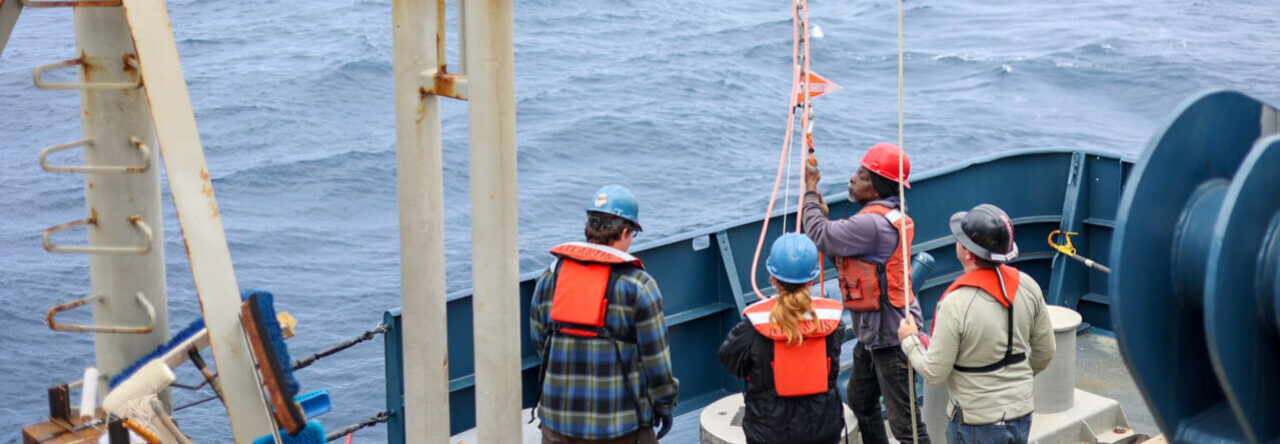
Oh hey, I know her! During ROV operations, my job has been between operating the A frame, and adding tension to the winch wire (pictured). This ensures the wire spools correctly, and makes every elses lives a bit easier. Well, my first week on the Point Sur has been busy and very exciting! I’ll be out here getting grease everywhere and pulling the line tight, while the scientists decipher hours of ROV footage; I know you’re jealous, but fear not! There is to be a public broadcast from the ROV team. Please join us to see some of the action live!
Deep Sea Corals – YouTube Live Video
Thursday, September 11th, 2pm central/3pm eastern
Micah Barton – 09/09/2025 – God Bless
Samantha Flounders
Micah, thank you for sharing your postings! This was so much fun to read and recap our recent adventures on the Pt. Sur. We look forward to all your upcoming adventures and will be following along! Fair winds and following seas to your sweet salty sailor soul.
Micah Barton
You’re too kind! Thank you so much for an incredible cruise, I hope we cross paths again soon! ~Micah