Tag: Update

Mobilization, Megacore, Mudpies, oh my! – 15 – Micah B.

It is officially day 21 onboard the R/V Point Sur, and… wait, is that… Land ho, land ho! Though it is a bittersweet time, demobilization of the cruise is a certainty. The science crew has concluded their work, gear has been packed up, and the deck swabbed. The only things left to do are unload it all and wave our white handkerchiefs in goodbyes. What else is there for it but to get started!

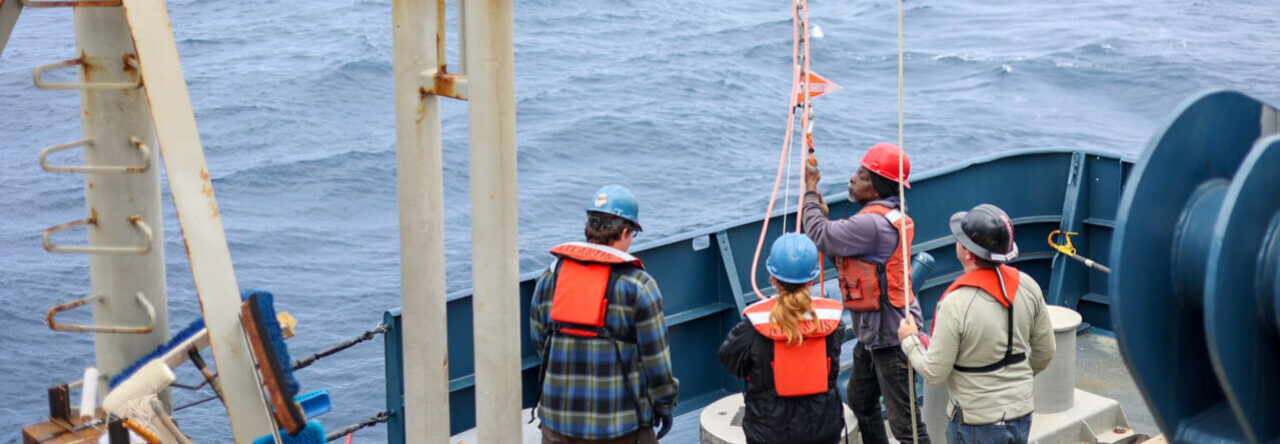
Science brought aboard their own winch with matching block. It is no small endeavor to take it back down, requiring two men to climb the A-frame, one to operate the crane, and at least one more on deck to help facilitate. Equipped with safety harnesses, the climbers take to the frame and attach the crane hook to the extremely heavy block. Once detached, the crane can support said weight and lower it to the ground. The ships standard block is put back into its rightful home, and our courageous climbers can make their descent.

Hey, that looks like fun! Seeing the strength and importance of the crane for this operation gave my mentor Grace an excellent idea: “Let the new guy try it!”

Though I am certainly still hesitant, I can now confess that I have a rudimentary understanding of crane operations. I wouldn’t quite trust myself to move anything too important, but it is a skill I look forward to cultivating more in the future. Having a multitude of people on the ships crew that know how to operate machinery can be a life saver! This ensures that at any one time, you can find a crane operator that is both on duty and not actively involved in another operation.

For deploying the ROV, the crew had attached a soft line to the end of the winch wire. While it worked perfectly for the operations of the cruise, it was no longer needed. For removing the line, we set up a clever little DIY station. All it takes is a boat hook and an empty spool, and spinning away we went! The line was coiled up for storage, and the tarp removed from the winch spool. All ready for the next cruise!

To complete our offloading, we needed a crane with a bit more power than the ones on board posses. We mosied on over to the port pier, where we could have some help with the lifting. This is the first time I have seen the forward crane used, to lower the gangway off of the bow. Unlike the crane on the back deck, this particular model has two ‘knuckles’. With two places to bend, it has a greater mobility but also requires greater skill to operate. Skilled crane operator mark slowly lifted and lowered the gangway to the pier, where forklift driver Grace could position it.

With demobilization of the cruise coming to an end, we began preparations for the next scientific mission. Part of our maintenance included cleaning! The whole boat gets a decent scrub down, and the tech lab gets a good polishing. We opened up some of the computers, and dusted out the insides with a high powered blower. The high seas have some serious dust!

A little back story no one asked for:

The Pt. Sur is the sistership to my school’s vessel the Cape Hatteras. A dream I always had while sailing on the Hatteras was to climb the mast, or the yellow ladder as we called it. For liability issues, obviously I was never able to as a student. 

Though this mast did not include a yellow ladder, I finally was able to summit my mountain of the mast and had a little climb up while in port! Grace ensured I was harnessed in for safety, and up we went. It was a great view of the port from the top! Even though it is by technicality only, I can finally say I’ve seen my white whale.

Now that mobilization of the next cruise had begun, gear was being moved to the ship in preparation. This is the primma donna of our mission- the Megacore. Even though the name sounds like something out of the Transformers movies, it has a fairly simple purpose. Mud is the name of the game, so much so that this science group refers to them selves as “The Mud People”. Equipped with 12 plastic tubes, this rosette sinks all the way to the seafloor to grab mud. All going well, we pull it back up with 12 perfect cores of mud. Fingers crossed!

The sight of this screen first thing in the morning makes you rub your eyes and wonder if you ever woke up in the first place! This seeming gibberish means that something is amiss within our software setup. It turned out to be a simple baud rate issue. Phew.

The lovely gentleman sitting next to Grace is Roy. He came aboard to help us set up the gear and ensure everything is working. Much like the previous trip, this group had brought a transducer to be mounted the the ships pole. This transducer specifically tracks the mud core as it sinks, which relays an accurate position of the mud sample. It takes a surprising amount of configuring to achieve this!

With all gear stowed, electronics set up, and science crew on board, it was time to head out! Even during transit, there is never any time to waste. The Megacore can be a finicky machine- every piece and part must be perfectly aligned and set in just the right way. 

It was with baited breath and a stern glare that we deployed the core for the first sample of the trip…

The anxiety was well deserved, but as all things do, it worked out in the end. We successfully recover the core, and 11 out of the 12 tubes were full of delicious and delectable mud samples! Once the gear is on deck, it is an immediate all hands in to get the mud processed before the next station can begin.

The cores themselves detach from the frame, where they are photographed for documentations sake. Caps are added to each end of the tubes and sealed with tape to ensure no sample material is lost. One of the coolest aspects of these samples, in my uneducated opinion, is that the core also collects the water immediately above the sediment as well. This means that any benthic critters hanging out in the water come up with the mud! We got to see some polychaete worms in one tube, which are some of my favorite animals to witness. What a rare treat to see our wiggly little friends from the abyss!

The water is siphoned from the tubes for filter sampling, and then the mud processing begins. Some tubes are kept whole, to look at the layering of sediment, and some are chopped up into perfect 3 centimeter  mudcakes. This allows the scientists to look through the material thoroughly. It’s messy work, but it looks pretty fun!

As the mud crew clean out their final cores for the day and turn to bed, a gorgeous sunset signals our time for the week has ended. Though a great deal has been accomplished, there is work yet to be finished! I’m hoping to find some wormy friends in the mud, and maybe even find friends in my fellow shipmates. Who knows! Until next week…

Micah Barton – God Bless – 09/24/2025

FISH! – 14 – Micah B.

Welcome back everyone! It is now my second week aboard the R/V Point Sur. Morale on the ship is high as science is rolling smoothly, the weather has calmed down, and we all wear our matching Hawaiian shirts on Fridays! Let’s take a look at the week, shall we?

To get my day kicking, I always like to go straight for the power tools! Yippee! The winch wire is more than just a long line of tough metal- it’s special metal. On the inside of the slightly rusty exterior, is an electrical communication cable that is able to send data back and forth to equipment and sensors. This enables whatever we send into the water to communicate with us in live time! To connect the wire to equipment, we must make a connecting end called a termination. This process is begun by dremelling off the hard exterior layers as you see pictured. (Hi me!)

After the metal is removed, you reveal the inner wires which are coated in rubber insulation for protection. Once you have your winch wire and the cable for your equipment ready, you begin the process of joining them together. The wire is soldered together, and tested for communication. Once it is confirmed they can ‘talk’ to each other, you have to make a semi-malleable shell to protect this connection. It’s going in the ocean after all! 

Heat shrink, many layers of hot glue, and electrical tape are the ingredients in this special recipe. These onion like layers work in tandem to offer protection from water, cross talk between cables, mechanical strength and shielding, and ensure that the termination lasts for many, many casts.

The ROV, affectionately named “Mohawk” by the team, has been swimming nonstop these days. While piloting over a smooth seafloor with limited obstructions, the ROV team decided it was a safe place for test drives! Anyone who wanted to was allowed to pilot the ROV and get a feel for the operation of the machine. With a simple videogame style joystick, Mohawk can move in 3D. Being covered in cameras and lights, the vehicle is surprisingly nimble and well equipped to navigate the dark and often murky depths.

Deep sea ROVs have been a passion of mine for quite some time, and piloting one has been on my science bucket list forever- CHECK! A huge thank you to the Mohawk team for allowing me to achieve one of my science dreams!

This screen may look like gibberish- and that’s because it totally is! This is a classic “blame the intern” moment, but allow me to back up a bit. When performing a CTD cast and sending the rosette down, we get a live stream of data from the sensors. The instrument package is connected to the winch wire with the same hot glue termination as previously displayed, allowing data to stream back to the computers shipside. This screen is where we watch the data come in, see how deep in the water the rosette is, and any other information we need to know while operating the machine. Those wide streaking lines however, are not normal. Why is my graph broken!

In this CTD software, there are a few steps that must be taken prior to launch. One of those steps includes turning the water pumps on. You know, the one that pushes water past all of the sensors. Kind of the important part. Yeah, so I forgot to turn those pumps on. My bad team.

When we recovered the CTD, we noticed this- a busted O-ring! My arch nemesis returns, the faulty niskin bottle… thankfully, its a quick little swap and all is well. Daily checks and routine maintenance are an often overlooked aspect of keeping life at sea running, but they are ever so important! Making immediate repairs, and ensuring all equipment is working well with each use keeps the malfunctions and disasters at bay.

Oh yeah, we’re doing ROV ops! One of my jobs on the back deck is to keep a wrastle hold on the winch wire as mentioned in my last blog. This is a much thicker winch wire than what the boat usually has onboard. When in use, these wires must be heavily greased for corrosion resistance and for smooth recovery and deployment. This makes handling the line a bit of a sticky situation. The science crew brought their own pair of sacrificial grease gloves for me to use, which keeps my normal work gloves looking spick and span in comparison!

Let’s take a better look at whats happening when we deploy Mohawk. The winch wire I have been handling comes out of a large pulley hanging from the A-frame at the top, just like the empty one that is hanging in the picture. It is raised and lowered with the winch spool by the winch operator.

Attached to the end of this thick line is the “clump weight”. Pictured in my previous blogs, this weight acts as a landmark for the ROV, and is covered in lights and additional sensors. From the weight, the ROV has maybe a hundred meters of tether line attached to it. This keeps the ROV communicating, and ensures that we can’t lose the little guy even if steering and propulsion of the vehicle fails. We could just drag him up by his tail, worst case scenario! 

When we deploy, we first send the ROV into the water and allow the tether to ‘pay out’, or unspool into the water. After the ROV is driven away from the ship as far as it can reach, we can safely send the weight to the seafloor. The two sink down to depth together, holding hands. Once the weight is settled securely, and the ROV operators have their bearings, it’s off to explore!

The ROV has spent considerable hours in the water this trip which has been an absolute delight. The Mohawk teams focus is mainly on this white coral, that really loves to take over these shipwrecks. They collected a huge assortment of samples for studying! 

Other important places to see are the yellow markers. They are named and cataloged, and every time they visit they redocument the same place. Over time, they are able to see how the feature shifts and changes, and how the animals grow or die.


The ship wrecks may be one of the most fascinating things I have seen on my adventures so far! This little guy is called a Blackbelly Rosefish, or Helicolenus dactylopterus. He is sat right on an old bollard of the ship, like a king on his throne! We saw many of these guys and a wide assortment of other spectacular species.

Once the ROV is back on deck, the science crew has a field day with their samples. They are examined, photographed, cataloged, and stored properly. The lab becomes a busy space when samples are being processed! I have thoroughly enjoyed watching the limitless passion and curiosity driven brilliance at work on board this cruise. It is inspiring to see so many intelligent people coming together in big ways.

Many ships have the ability to install what is known as a “transduer pole”. Thie is simply a large metal pipe, that can swivel up and down over the side. At the end, the scientists can attach any transducer they need to have in the water for their operations. This allows for a very easy installation of sensors, rather than trying to find a way to mount them to the hull of the vessel. For this cruise, we used the pole for one small transducer, which helped with positioning of the ROV.

 When the pole is in the water, we have to reduce our travelling speed for vibration and drag. Meaning, when it is time to steam to the next site, we use the crane to lift the pole from the water and secure it upright. As we wrapped up this cruise, we secured the pole out of the water, and science was free to remove their transducer from it.

With ROV operations finished for this cruise, we began steaming back to the dock. When we arrive, busy days of offloading the ship will begin, and the next science crew will come aboard. I can’t wait to see what the next cruise will hold, so come along with me!

Micah Barton – God Bless – 09/17/2025

A Familiar Silhouette – 13 – Micah B.

And just like that folks, we’re back at it again! This time, I hopped aboard a flight headed for Gulfport, Mississippi! The flash temperature change from the arctic to the deep south has me feeling like a defrosting lizard, but that won’t stop me!

Ahh, what a lovely sight- I finally get to join the boat from a pier this time! My previous two journeys started with a smallboat ride and a sketchy climb up the Jacob’s ladder. This is the R/V Point Sur. Though I have not sailed on this ship before, I am all too familiar with it. The R/V Cape Hatteras, the ship I sailed on for my education, is an exact copy of the Point Sur; sister ships! It feels familiar and foreign all at once.

Work had already begun by the time I arrived. The crew was set about fabricating some metal mounting gear for the equipment that the scientists had brought on board. Crew member Todd will be wielding an oxyacetylene torch, ready for action!

The night is always young onboard a ship. As many people went off ship for dinner, I stayed behind to get settled in properly. No later than everyone left, an engine room alarm began blaring! I found this light blinking red, and sent a message out to the responsible parties. All was well, but you have to stay on your toes at all times! There is truly no telling when things can go downhill.

This cruise is focused on ROV operations. The remotely operated vehicle (ROV) will be sent to the seafloor, to collect samples and take a look around the area. Deep sea corals are the main focus for their research! 

On the deck, you can see the configuration of their gear; Left is the ROV, which is attached to the yellow tether line. On the right, you have a weight package that is sent to the bottom to help control and sense the ROV. All three of these pieces are deployed together and work in tandem to complete the dive!

Our last night in port gave us a lovely sunset as we made our final preparations for sailing out to sea. We set our ‘sails’ out at exactly midnight, for a somber march out of the bay. Leaving behind the glow of the city for the inky black of the open ocean. It’s good to be back out at sea.

No time for poetry, you have a steaming plate of cable spaghetti to deal with! As an older ship, there are many bygone years of outdated technology being replaced. In the process of revitalizing the equipment, some cables get… let’s just say left behind! We installed some new monitors on the bridge for the captain to keep tabs on the ship, which meant running HDMI cables to each one of them. Many hours spent detangling, and the monitors are up and running perfectly.

Another facet of science on this trip is EDNA. Using the fancy gizmos and gadgets you see attached to our CTD, the scientists can extract environmental DNA from the water. Meaning, they can tell what critters went through the water! They can compare this data with ROV footage.

Speaking of ROV footage! Once the ROV was deployed and settled on the bottom, the real work began. Many eyes spent many hours watching the continuous stream of video. An incredible sight to behold! On it’s first descent to the seafloor, around 500 meters down, we landed right near this handsome fella- I have roughly identified it as a Gulf Hake, or Urophycis cirrata. I am by no means a biologist, but that is my semi-educated guess!

The ROV had just lighted onto the seafloor, when the operators noticed something was amiss. The systems weren’t operating as they should, and the team made the executive decision to recover immediately. Unfortunately, their suspicion was well met. A connection point on one of the attached components failed, meaning it completely flooded with water. This melted all of the components and wiring on the inside, which is something that is not repairable at sea.

After a few brainstorming sessions, adjustments to the ROV, and more than a couple prayers, the team found a temporary solution. The ROV was set up excluding the flooded components, which makes it usable but with greatly reduced function. Though it is less than ideal, it does at least mean the cruise can continue rather than heading back to port immediately. 

On the second dive, the ROV was able to collect a few small coral samples and bring them back to the surface. The ‘arm’ you see pictured has an apposable hand that can be controlled from the ship, and a little container to drop samples into.

My mentor for this trip, Grace, instructed me during the first few CTD casts, and trusted me to operate the computer for the next one! Though I may have forgotten to take off my hardhat, we successfully recovered another batch of water samples. The water we bring up will be used for sampling and for storing the live coral recovered with the ROV.

During this cast, we found that bottle #9 did not close at all, meaning it came back completely empty. We investigated, and determined the bottle to be operating smoothly. The next step was to ensure that the firing mechanism worked! We disassembled the housing, and found corrosion on the magnet responsible for releasing the lid of bottle nine. A quick scrape removed the corroded material, and a deck test proved that the issue was solved. Huzzah! If only every problem was so simple…

Yikes… This is the interior of the flooded compartment from the ROV. As it turns out, delicate electronics don’t like saltwater! This not so simple problem could not be solved while offshore, as the parts and personnel necessary are simply not on board. A integral part of working at sea is repairing what you can, and working around what you can’t!

Even with some non functioning parts, the ROV process is still well underway. After each deployment and recovery, the science team jumps into action. They remove the sample compartments from the ROV housing as quickly as possible, as coral is extremely sensitive to temperature fluctuations, and they want their samples live. Once they are inside, they separate the samples into individual holding spaces, full of fresh seawater saved from the most recent CTD cast. These tubs go directly into a refrigerator, where the temperature is set to the same as their natural environment. It’s cold in the deep sea! This gives the animals the best possible chance at survival for testing and studying.

Oh hey, I know her! During ROV operations, my job has been between operating the A frame, and adding tension to the winch wire (pictured). This ensures the wire spools correctly, and makes every elses lives a bit easier. Well, my first week on the Point Sur has been busy and very exciting! I’ll be out here getting grease everywhere and pulling the line tight, while the scientists decipher hours of ROV footage; I know you’re jealous, but fear not! There is to be a public broadcast from the ROV team. Please join us to see some of the action live! 

Deep Sea Corals – YouTube Live Video

Thursday, September 11th,  2pm central/3pm eastern

Micah Barton – 09/09/2025 – God Bless

Alvin Post Cruise/Post Internship

On the 1st of July, we completed our final dive operation and started on post cruise tasks. Instead of rolling the sub all the way back into the hanger, we rolled to the middle of the deck and pulled off all the skins (large fiberglass panels that cover the exterior systems). Laying all of the skins on the deck of the ship, we began spraying down every inch of the submersible with a special titanium safe detergent solution. We used large scrub brushes to clean the syntactic foam surfaces and the removed skins. After the cleaning, we reinstalled most of the skins and rolled the sub back inside the hanger.

The Alvin submersible getting a thorough post cruise cleaning.

The next morning, we arrived back in Dutch Harbor and continued our post cruise duties. One of my roles during this period was to prepare all of the sub’s hydraulic and oil compensated systems for hibernation. This involved hooking up a vacuum pump to every junction box reservoir and hydraulic system one at a time. I then slightly drain down the fluid level in each volume. For humidity sensitive systems, such as the 2 main junction boxes, I would replace the oil as it was drained with nitrogen gas, ensuring no humid air would be introduced into the new atmosphere. Draining down these systems ensures temperature changes during transit and other expeditions will not build excess pressure inside the delicate boxes.

Beautiful morning arriving back into Dutch Harbor
Port side Main junction box (left), and battery contactor box (Right), both drained down a few inches.

Once all systems were prepared, we installed the huge blue car-style canvas cover, ensuring Alvin would stay nice and clean while not being used.

Alvin under the big cover.

The day of July 3rd, we finished tidying up all of the Alvin work spaces and buttoned down the equipment that won’t be used for a while. We then spent the next few hours cleaning our rooms and packing up all of our belongings, getting ready to disembark the Atlantis. In the early afternoon, I disembarked for the last time and got a ride to the grand Aleutian hotel! The Alvin team and I didn’t fly out of Dutch Harbor until the 5th, so we had a few days to explore the breathtaking landscape.

After we left Dutch Harbor on the 5th, we landed in Anchorage. I stayed another two days there with a few members of the Alvin team, exploring the area.

The following section is basically a photo album of my favorite pictures and fondest memories, including my adventures in Dutch harbor and anchorage.

Work in progress photo of my hand painted helmet!
The 2 most incredible dive day sunrises.
An awesome picture taken by Lance Wills. The picture shows the Alvin submersible being brought in by the tow line. The person standing at the right corner of the ship is me watching the recovery!
A silly picture of Myself, Alex on the left and Colten on the right. Two members of the ship’s crew.
Mt Cleveland left and Mt Carlisle right, two of the incredible volcanos that make up The Islands Of The Four Mountains.
One of the Aleutian islands emerging from the fog during a rainstorm.

Moving onto my land based adventures, there were many! From hiking to the summit of one of the Aleutian mountains to hanging out around a bonfire with some of the incredible folks that call Dutch Harbor home.

3 photos I captured from the peak of Amaknak Island Unalaska.
An incredible view and a snowmelt pond near one of Unalaska’s peaks.
A few of my favorite rock stacks I made on a beach in Dutch harbor.
Sitting around a bonfire behind the Norwegian Rat Saloon, after the cruise.
Resting in a meadow after a hike in anchorage, with some of the Alvin team. Wren, Molly, Janna, and Nick.
Two more pictures from our adventures in Anchorage.
Lastly here is a photo of me! This photo was taken the night we first arrived in Dutch harbor after the 11 day transit from San Diego.

This adventure has been one of the most incredible experiences of my life. The opportunity to work on the Alvin team as a mechanical technician, even for a month, is something truly unique and an adventure I won’t soon forget. Thank you for reading my blog posts! I hope you enjoyed my adventure, because I certainly did!

Alvin Dive Operations.

Since my last post, I have concluded my technical internship aboard the R/V Atlantis. Now that I’m back home, I can take some time to update my blog and tell the story of Alvin Dive operations.

Departing Dutch harbor on June 15, we set sail further west along the Aleutian chain.

Pilot boat pacing alongside the Atlantis waiting to pick up the Pilot.

Arriving at our first dive location on the 15th a few miles off Bogoslof island, my job was to arrange the science basket by installing and moving around push cores and bio quivers, attaching Niskins, and securing bio boxes. I would meet with the Alvin Pilots frequently, getting feedback on equipment position and making changes to ensure the instruments were in optimal positions for the robotic arms to access.

Science basket prepared for first dive operation

The morning of the 16th at 5:30am, we started completing the first pre-dive checklists of the expedition. My role as a mechanical technician that morning was to top off all of the compensated volumes on the vehicle. These are oil filled volumes that enclose various critical systems including the main junction boxes, battery contactors, and solenoids. There were 3 main types of oils that I would top off: bray, carnation, and hydraulic. Topping off these volumes included plugging in a portable pump sprayer, with the desired oil, into one of the the fill ports on the vehicle and connecting a drain bottle to the opposite end of the system. I would then lightly pressurize the system, monitoring the fluid entering the drain bottle, ensuring there were no air or waters pockets within the system. This process was repeated for each of the 14 main oil compensated volumes on the port and starboard side of the sub.

Taking a short break from pre-dive tasks to watch this breathtaking sunrise over the Bering Sea.

My morning tasks would vary by day. Sometimes I would polish and inspect the windows while other days I would spend most of the pre-dive making basket adjustments, ensuring all the sample collection devices were arranged how the science team and pilot preferred.

Testing the port side manipulator to ensure all joints are functioning properly.

Next, we would roll the sub out onto the back deck, and install the drop weights. These six weights are the main form of major buoyancy adjustment. All six attached allows the sub to descend fast, release two weights to achieve neutral buoyancy, and release an additional two weights to ascend to the surface. The last two weights are reserved to allow additional weight loss, in case extra buoyancy is needed to resurface. These weights are installed using specially designed hand carts that lift them using a hand-crank style forklift mechanism.

Installing steel drop weights alongside Alvin Mechanical Technician, Wren Sakai.

Deploying The Submersible

After all pre-dive checks are completed and signed off, the sub is attached to the LARS (launch and recovery system). The sub is attached to the LARS by several points: a tail line to prevent rotation, a main line wrapped around a titanium T-shaped lifting point, and a large hook that actuates downwards, locking into the lifting T. The pilot and scientific observers enter the submersible, and the hatch is sealed. Two divers are positioned on top of the submersible, and the vehicle is lifted off the deck of the ship. Once the vehicle is over the water, the main line is tightened, allowing the hook to release the vehicle. The main line then lowers the vehicle into the water. Once the sub is floating, the swimmers detach the main line and the tail line, allowing the sub to drift away from the ship. After some final checks, the basket support lines are removed, and the sub is ready to dive. The work boat picks up the swimmers, and the sub floods its ballast tanks, allowing the vehicle to begin sinking.

LARS moving into position to be hooked up to the Alvin sub.

Recovery Operations

After the science dive, we would stage the deck for recovery one hour before the sub surfaced. This included ensuring the tow line was ready to be deployed, and laying out various tools such as drills used to loosen the subs panels and drain bottles for fluid inspection.

The recovery would begin by first lowering the work boat into the water off the side of the ship. The work boat then cruises ahead of the ship to meet the Alvin sub as it surfaced. The boat drops off two swimmers who prepare the vehicle for recovery. When the vehicle is ready to be picked up, one swimmer stays on the sub while the other swimmer boards the work boat. The boat drives back to the ship and positions itself behind the Atlantis, as the ship slowly approaches the sub. We then lower the rear lifelines and prepare to throw the tow line to the work boat. Passing the tow line to the work boat was sometimes my role during the recovery. Once the sub was halfway past the ship, I would toss the heavy rope and floating hook to the work boat. The heavy rope attached to the center-back of the ship would pay out line, and I would monitor the amount of line remaining while communicating with the recovery coordinator. The work boat then intercepts the submersible as the tow line swimmer dives off the work boat, attaching the tow line to the back of the sub. The swimmers then deploy a sea anchor, a sort of underwater parachute secured to the submersible. This allows the sub to be held in tension behind the ship as it is reeled in like a big fish. Once the sub is directly behind the ship, the tail line is lowered and attached to the sub, soon followed by the main line. The sub can then be lifted out of the water and the swimmers dive off the side of the sub to be recovered by the work boat.

Swimmers diving off Alvin as it’s lifted from the water.

One of my frequent jobs was to remove the tow line from the back of the sub after it had been lifted over the deck and as it was being lowered. I would then immediately move into post dive tasks.

One of the Alvin technicians, Scott, removing the tow line as the sub is being lifted onto the deck

Post Dive

Once the sub landed on deck, the Alvin team and I would move in with pins to secure any remaining weights, install life lines, rinse down the sub with fresh water, and place protective covers over the windows.

Me rinsing down the windows and cameras post dive.
The work boat being lifted out of the water right after recovery.

During the majority of post dives, I would sit beside the sub right after it landed on deck and check every oil volume for traces of water intrusion. I would plug a waste bottle into 19 different oil volume drain lines, one at a time, and inspect for water or abnormalities. During this time, the scientists and pilot climb out of the sub and are welcomed by an applaud from the crew and science team. We then roll the sub back into the hanger and finish an extensive list of post-dive inspections and tasks. My usual job was working the scientists. I assisted in removing various equipment and samples from the basket, so the scientists can begin their analysis and packaging of specimens.

My perspective of checking compensated volumes for water.

This formed the pattern that most days followed with the occasional excitement where I would be asked to repair or inspect components that had failed during the dive. These tasks meant anything from reinstalling damaged mounting brackets on the science basket to disassembling and re-compensating large brushless thruster and hydraulic motors.

One of the large brushless motors partially disassembled and filled with WD40 to drive out any possible moisture.

The 18 day science expedition proved to be a big success! Despite several dive days being canceled due to weather conditions, we were still able to accomplish nearly all of the 13 dives we set out to complete.

Keep an eye out for one more blog update describing the post cruise activities including preparing the Alvin for its next few months of rest and even the non-work related adventures I was able to go on while in Alaska.

Powered by WordPress & Theme by Anders Norén