My second week on the Healy! And still no science- mostly. Our long, long transit nears conclusion, but we’re still in the scientific doldrums. Thus far the science party’s just been preparing their equipment, although a couple small buoys have been literally tossed over the side with zero fanfare. If this sounds unenthralling, it’s anything but.
WE’RE IN THE BERING STRAIT!!! The last few days in the Bering Sea have been beautiful. Not clear, but the reflection of the hazy sun on gray waters turns the sea into quicksilver, and if you’ve read my last blog post, then you know how I feel about the nights here. Looking over the prow, I can see fat puffins failing to get airborne as they half flap, half flail away from the ship. Moon jellies, lion’s mane, and sea nettle jellyfish zoom by us just below the ocean’s surface with surprising frequency.

This morning we passed Nome, and I’ve been watching OpenCPN, which tracks our ship, as we neared the Diomedes and the narrowest stretch of sea in our journey north. We were still ten miles away when Brendon encouraged me to look on deck. I bundled up, and was astounded to see Little Diomede to our port side, Big Diomede peering out of the gloom behind it. We’re quickly entering fog, but the haze only consumed the island tops in that moment. Fairway Rock, or Ugiiyaq, south of the Diomedes, shone in a runaway beam of sunlight.


Although it’s been four years since I moved to Alaska, the sense of wonderment still hasn’t eased. Climbing frozen waterfalls, watching Denali’s shadow piece the clouds during sunset, or even just dodging a moose on campus strikes me with awe and disbelief, with a Wow! I’m really in Alaska!
I got that sense as I stood on the flight deck, the last retreating rays of golden sun giving the world a hazy, heavenly feel. Disbelief at where I’ve come in life, from the dry desert, and immense gratitude to everyone who encouraged and helped me get here. I wished they could join me as I stood on the edge of the world, sailing farther north than dreams could reach. These Wow! I’m really going to the Arctic! feelings strike every time I step out on deck, and I treasure this experience and everything it offers.
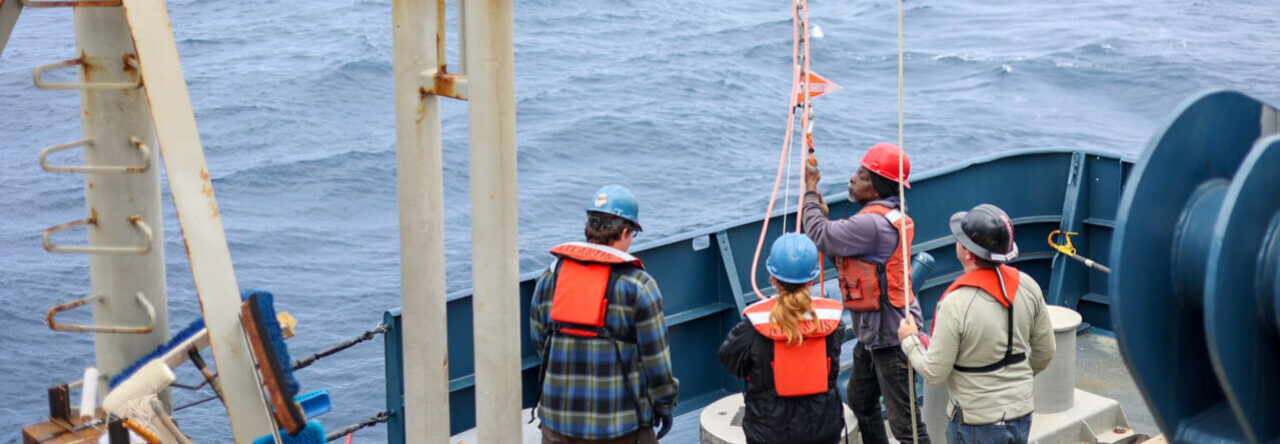
And while the science party waits in anticipation for our approach to their sites, STARC has been active: troubleshooting, repairing, and, for me, getting the hang of things. Our CTD checklist is complete. Niskins have been re-gasketing, springs re-tensioned, bottles re-placed when nothing else worked. Brandon (not Brendon) walked me through the tech of the CTD, and him, Cora and I teamed up for a final blitz, rewiring and reattaching sensors.

We also tackled disassembling the multicore a few days ago. Unfortunately, the multicoring aspect of this cruise was cancelled last minute, but the multicore was already assembled on deck. It sat there like a giant spider on the back deck, gray and mourning the Arctic sediment it wouldn’t collect, for a week or so before we decided it was time to take it apart. Brandon, Cora, me and the deck crew attacked it in a flurry of activity one calm morning, and within a couple hours it was was returned to its coffin-like wooden storage boxes. I’ve done a lot of sample collected from multicores, so it was cool to get familiar with the hardware itself.

I’ve been getting familiar with the sonars lately, watching as a land based technician remotely battles the EK80, a bottom-finding sonar determined to freeze when synced externally with other sonars. I read a short manual for our multibeam, but mostly have been playing with the Knudsen Echosounder, which gives a two-dimensional profile of the seafloor as we pass over. On a previous cruise, I’ve used it (as in watched, while a martech adjusted the settings) to make crisp sub-bottom profiles, but at our high speeds, when it isn’t the primary sonar, the Knudsen doesn’t look so great. So much so, in fact, that Brendon was concerned something was wrong- maybe heave compensation? Brandon and I traced the “serial string data” of the ship’s heave all the way to the Seapath 330, one of the positioning programs, but couldn’t find an error, and we were finally forced to admit it’s probably just our speed, and the fact the Knudsen doesn’t do to well in the shallow, muddy Bering. We won’t be here much longer, and I look forward to learning the sonar settings in deeper waters- and ice!
Onward north! Cheers, Wil