It feels kind of odd to say that it’s only been two weeks since I left, but I found that being on a vessel tends to screw up your sense of time. I’m sure the other members of the crew agree with me.
We’ve had a total of five dives so far, and dredged up plenty of interesting things. The dives for yesterday and the day before were cancelled due to unfavorable weather conditions, but it went somewhat back to normal today so we got to have a pilot-in-training dive, albeit the deployment was later than usual.
There’s a wide variety of samples that we collect on this specific cruise – sometimes we take water samples of the hydrothermal vents using isobaric gas-tight samplers (IGTs) which help keep contents pressurized when the scientists are doing experiments on the nitrogen-cycling properties of the microbes in the water. Sometimes we also bring up freaky little creatures like tube worms and this scale worm in the picture below!

Depending on what kind of samples we want to collect, naturally we would have to change tools for the job. The basket in front of the HOV Alvin typically holds all the equipment needed to complete the dive objectives of the science team for a dive, and it is our duty as the maintainers and technicians of Alvin to swap these out as needed per dive.

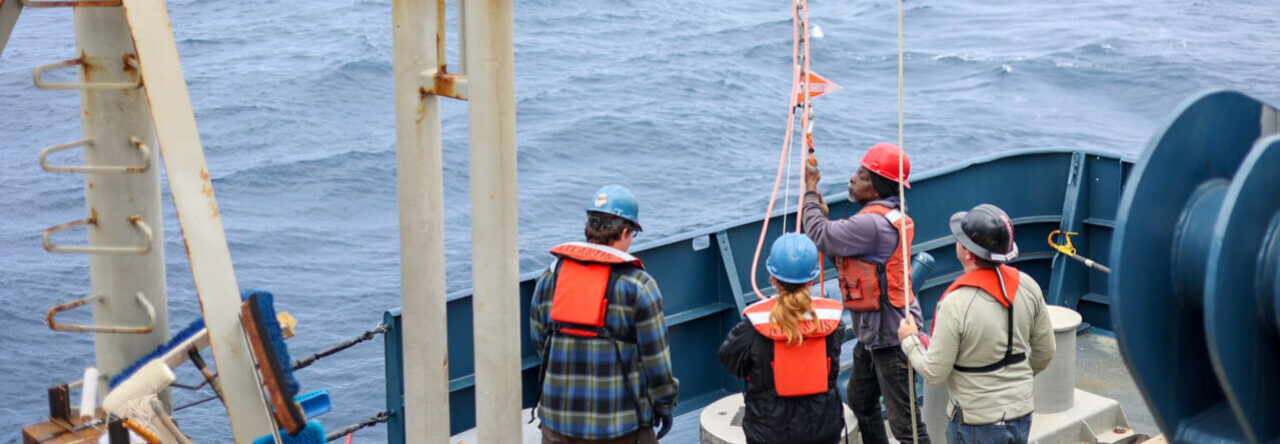
As an intern, my daily routine usually consists of getting up early start helping the team with pre-dive checks – making sure that cameras are striped, calibrated and properly cleaned, ensuring parts on the HOV are secured, refilling CO2 scrubbers, etc. We roll Alvin out on the tracks leading to the A-Frame at the aft of the ship, where we attach stacks of ballasting weights to it and put the pilot and observers in before we send it into the water.

Once the HOV is in the water, swimmers on a smaller boat will go to it and do some last minute checkups like unhooking safety lines and verifying communications are good to go. The phone the swimmers use to talk to the passengers of the sub is actually not waterproof, so while they’re verifying comms they also have to be very careful not to get it wet. The design is kind of counterintuitive, but the fact that the phone does not need to be powered independently makes the drawbacks worth it. Still, it is pretty comedic to see the swimmers make their way back to the little boat raising what looks like an old landline phone above them the whole time.

After the sub goes down, we have someone in the top lab to monitor GPS position and to maintain communications with it every so often. Us interns usually take this time to clean up our messes from the morning of deployment, and then it’s time to muck around until we get the signal to get ready for retrieval.


During retrieval, we finish up with post-dive tasks like hosing down the sub to wash off the saltwater and securing him back in the hangar for safety and in case bad weather starts rocking the boat around. We usually get some sort of report from the pilot about equipment or components that didn’t work so well and may need to be fixed or replaced, and our evenings are pretty much occupied with post-dive and fixing up the sub for tomorrow’s dive.
Of course, if the weather conditions are unsafe for swimmers or pilots we may have to call off some of our dive days. The swells were pretty big yesterday and the day before that, and we used the time not diving to finish up any maintenance that we’ve been putting off – fixing of lasers, replacement of important wires to the propellers that route inside the sub, things like that.

I’m learning lots of things out here. I haven’t needed to do any of this in my daily work, but the crew and the Alvin team taught me a whole array of knot-tying techniques which I’m sure is going to come in handy someday…? During downtime I also try to see what the other departments are up to, like bothering the scientists in the lab to find out what they’re doing with the water samples we bring them, or pestering the bridge about navigation. It’s been lots of fun, but it’s also starting to feel like I already spent a month or two at sea. Time is not real on this vessel.

I’ll be back next week.
Aidan