Category: Vessel/Laboratory Page 71 of 89

WEEK 5- Canceled Cruises, Funeral For Our Fallen Brother

WEEK 5
August 7-13

 So far, August has been fairly uneventful. Initially, there were two 10 day cruises planned for this month working with the US Navy, and I had been looking forward to these projects. Unfortunately, though, the cruises had to be postponed and R/V Walton Smith was unable to accommodate the changes.
  One of these involved assisting with an exercise referred to as shock trials.  When the Navy produces a new design of a warship, they take it out to sea and detonate 10,000 pound ordnance near it, (fully manned), in order to gather data on the effects of the blasts regarding structural integrity, etc., and reevaluate before sending into full production.
  The research vessel’s function is to ensure that the location for the tests is relatively free of sea mammals. If they are present, the operation is moved to a different location. After the testing is completed, the research team then surveys the site for damage to sea life.
  Just before I arrived on board, the Walton Smith had participated in one of these operations. It was initially kept secret until reports of an ‘earthquake’ off the coast of Jacksonville begin to roll in. At that point the US Navy was forced to disclose details about the operation.
  Another cruise that was cancelled involved a project known as USWTR, Undersea Warfare Training Range.  This is a network of sonar and other various acoustic sensors located 50 nautical miles of the coast of Jacksonville.  This subsea network processes and displays tracking data for ships, submarines, targets, weapons, and unmanned undersea vehicles.
  During my first week aboard the ship, I was informed that schedules change quite frequently, but I still was disappointed not to be able to take part in these exercises. 
  As a result, we remained alongside and tended to the deck tie-down socket testing.  This must be performed once annually.  For each of the sockets, three separate load tests must be conducted: vertical, 45 degree, and horizontal. 
  I was also tasked with creating a document as per UNOLS Safety Standards, Appendix B, that describes the process in detail for each of the three tests.  This included a list of tools needed, step-by-step details, and photographs.  This document is then filed in the ship’s records for reference in future testing.
  As I mentioned in last week’s report, R/V Walton Smith sadly lost our Second Mate, James Sauers, to a boating accident last week.  On Saturday, the ship’s crew, along with the entire Marine Operations staff, attended his memorial in Coral Gables.  It was a heart-wrenching event, but the sight of all the green UM Marine Ops shirts that lined the outer perimeter was an inspiring sight.  The family expressed their deep gratitude and appreciation for the show of support, and I was truly proud to be included in the ranks.
  James was a great man and this tragedy will surely weigh on us all for a long time to come. (photo below)

Return and Reflect

10/08/16
Blog 7- Return and Reflect

I have finally returned home and am writing from far inland. Now that I am hundreds of miles from any ocean I can only reflect upon the many photos, memories, and the box of seafloor rocks I shipped home from Seward. This internship has been truly fantastic and I consider myself very lucky to have been able to participate. I learned alot about the life and work as a marine technician and had a blast doing so. There are no more winch line terminations or soldering to do. No more ROV dives to watch. No more troubleshooting and making things up as you go along. But at this point I think there will be in the future. 

I would like to extend many thanks to Mackenzie, Larry, Croy, Steve, Sarah, and scientists of Chukchi Borderlands 2016. Thanks to the US Coast Guard and crew of the Healy. And thank you Nandita and the MATE program. Good luck to the other MATE interns as well. I’ll enjoy reading your posts!
 

Nick

Week 4- Downtime and Tragedy

  Back in port this week after three back-to-back cruises, it was time to dive into some much needed maintenance on the R/V Walton Smith. During last week’s 5 day South Florida Ecosystem Restoration cruise, more than 80 stations were monitored while involving extensive utilization of the ship’s seawater flow-through system, along with the CTD. As a result, it was time to service the Turner C6 multi-sensor platform, which carries 5 Cyclops sensors to measure turbidity, CDOM, chlorophyll, phycocyanin and phycoerythrin.  Fortunately, the slot for crude oil wasn’t being utilized at this time.

  After separating all the components, meticulously cleaning them, and reassembling, the unit was reinstalled to ensure there were no leaks.  The next few days included fork lift certification training and general cleanup. 

  The next task was to begin testing of the main deck tie-down sockets.  In previous years, each socket required an entire page to document the testing results, which made it cumbersome to flip through page after page in order to find the document you were looking for.  To remedy this, I fired up Microsoft Excel and created a document that would incorporate up to 25 deck sockets per page, making it much easier to reference at a glance.

  UNOLS Research Vessel Safety Standards dictates proper standards for most shipboard operations performed, and in line with this we created a step-by-step procedure specific to the Walton Smith to be followed in the future regarding vertical, 45°, and horizontal load testing.

  As my many years as a union stagehand taught me, there’s no doubt that adventure and excitement (and in this case, on the high seas), frequently requires not so glamorous behind-the-scenes preparation, so I didn’t mind spending some time getting my hands dirty in the blazing sun.

  In the short time I’ve been Miami, I already feel like the Walton Smith is my home and the crew my family.  When I arrived, the ship had just taken on another new crew member, 2nd Mate James Sauers.  He and I hit it off immediately and quickly became good friends.  He was always quick to share his extensive seamanship knowledge with me and to crack a joke.  I watched and learned with admiration and tried to pick his brain for tips any time I had a chance.

  On Monday August 1, James failed to show, which was unlike him.  When he didn’t arrive the next day, we were concerned, but that afternoon we received word from his wife that he was OK, but that he had been in a boating accident in his sailboat and would be absent a few days.  Although he had suffered a head injury and was in Intensive Care, he was responsive enough to appreciate the card we had sent later in the week.  We were anxious for him to be released from ICU so that we could visit, which the doctors said should be the first part of the following week. 

  Early today, Monday August 8, barely a week after the incident, the Director of Marine Operations came aboard and called us all into the mess lounge for a meeting.  The room fell horribly silent as he explained how he had just received word that James had suddenly and unexpectedly succumbed to his injuries and passed away. 

  It is amazing how some people can make such an enormous impact on you in such a short time, and James certainly did.  I’m sharing this so that you all can know what a wonderful human being he was, and to say that we should appreciate and cherish those around us.  We are fortunate to walk the earth for a while with friends like this, and never should it be taken for granted.

  James leaves behind a loving wife and two young daughters, and I’ll never forget the time I had to work, laugh, and sail with the likes of him. I’m proud to have had the privilege of calling him my friend. RIP James. (photo below)


Week 3- South Florida Ecosystem Restoration Cruise


Along with a team of scientists from NOAA, we set out early Monday July 23rd from Miami with gorgeous weather and calm seas.  We were on a course that would take us west through the Florida Keys and up the coast of Florida Bay.  The mission was part of a greater effort referred to as South Florida Ecosystem Restoration.

  South Florida’s Everglades have been in grave danger, beginning in the late 1800’s, when humans began digging canals to drain the land so that it could be populated.  All through the Twentieth Century, up until the late 1980’s, these efforts continued on a large scale.  The projects were successful, but the precious ecosystem paid a terrible price.  As a result, the Everglades have shrunk to less than half the original size.  Approximately 90% of the native birds that were once abundant have disappeared, along with countless unique wildlife species.  Of the ones that remain, almost 70 species appear on the federal list of endangered or threatened wildlife.

  In 1993, the South Florida Ecosystem Restoration project was formed in order to curtail the damage being done and to attempt the reversal of the destructive process.  The initiative consists of federal, state, and tribal entities working together in effort to restore the priceless wetlands.

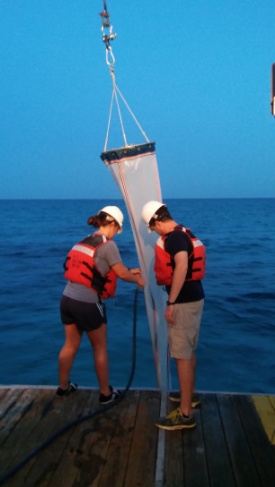
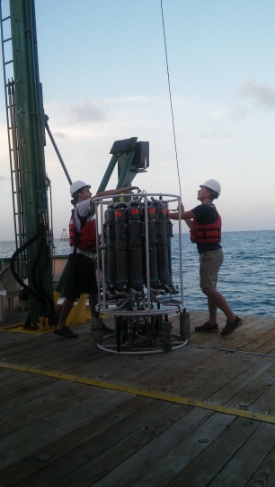
  NOAA’s role in the initiative is to monitor some 80+ stations throughout the Florida Keys and coastal regions of Florida Bay and Southwest Florida Shelf.  On this 5-day cruise we collected water samples around the clock at each of these locations using the ship’s CTD rosette, along with the on-board seawater flow-through system.  


  Lead Scientist Lindsey Visser explains, “The seawater was analyzed for chlorophyll, nutrients, and dissolved inorganic carbon as part of ongoing water quality monitoring that has occurred for decades in this region.  We also used nets to collect phytoplankton and zooplankton in order supplement chlorophyll levels measured in the seawater.  This dataset is used to analyze everything from the transport of nutrients and chlorophyll from the Mississippi River through the Gulf Stream off the east coast of Florida, or the conditions that are conducive to Harmful Algal Blooms off the Southwest Florida shelf.”

  Another one of the issues being monitored by NOAA is the toxic algae bloom crisis which began this past spring.  The toxic cyanobacteria bloom is driven by a combination of lack of infrastructure needed to raise the level of Lake Okeechobee, and runoff from manure, sewage, and fertilizer from the farming industry, namely the sugar fields, and it has taken over the Southwest Florida coastline.  The algae, which can be seen from space and has resulted in massive beach closings, contains nerve toxins and is not only a possible link to diseases such as Alzheimer’s, Parkinson’s and ALS,¹ but also depletes oxygen levels, leading to massive dead zones.  Among a multitude of other health risks, contact with an open wound may result in a staph infection.²

  I’m grateful to have had a small hand assisting in a mission that will help further the efforts of the restoration of the environment.  With big business such as US Sugar and others contributing to political interests, it will surely continue to be an uphill battle.  In spite of this, it’s reassuring to know that groups like NOAA are vanguarding these issues in attempts to keep policymakers and regulators in check, and to help spread awareness of the urgent need to affect change before the ecosystem is lost to agricultural development and anthropogenic climate change.


Acknowledgment

Special thanks to NOAA Affiliate and Head Scientist Lindsey Visser for consultation/contribution regarding this post

Sources

¹ TCPalm April 14, 2016

http://www.tcpalm.com/news/indian-river-lagoon/health/scientists-toxin-in-blue-green-algae-could-trigger-neurological-diseases-2fbede92-2377-08de-e053-010-375718471.html

² Tampa Bay Times July 1, 2016

http://www.tampabay.com/news/environment/water/toxic-algae-bloom-crisis-hits-florida-drives-away-tourists/2283838


Moorings and Transit

03/08/16
Blog 6- Moorings and Transit

Today marks the last day of standard science operations. Having finished the last ROV dive yesterday we only had moorings to do today. Moorings consist of instruments attached along a steel cable with a weight on the bottom and floats on top, which keep the entire assembly upright. The Board of Lies was true to its name: listing arrival on station at 0700 and start of mooring operations at 0800, where in actuality nothing happened until well after 1400. 
But even after an interesting morning (playing Monopoly Coast Guard Edition with some of the crew) the recovery and deployments of two of three moorings went off without a hitch. Unfortunately one of the moorings never responded to our pings so it wasnt recovered. This was only a small dissapointment in the scope of the last week of otherwise successful science ops.
Before moorings, scientists and crew had been working in the nonstop cycle of daytime ROV deployment, box coring, CTD casts, and multinet sampling. On one of the last dives I decided to check out the ROV control van (aka shipping container) since I had not seen the inside yet. 
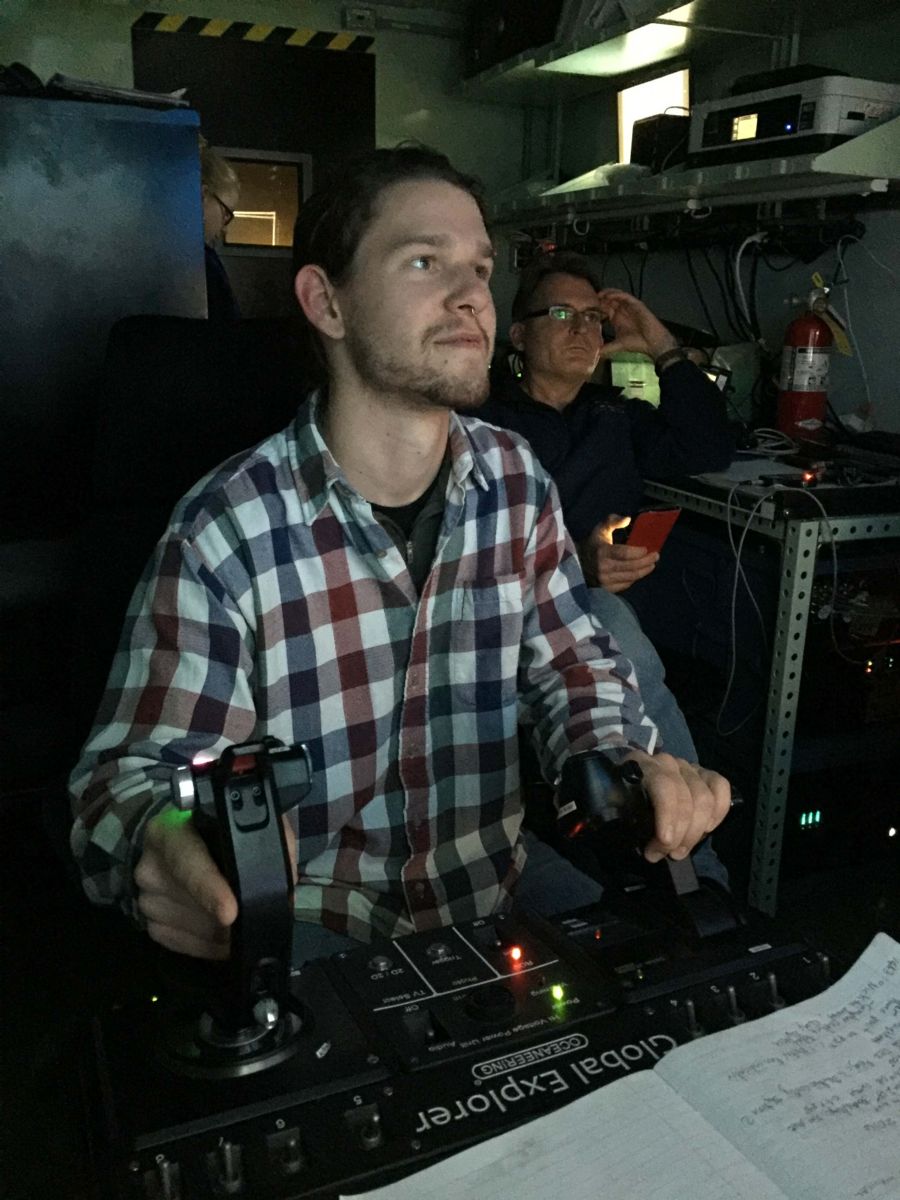
Luckily for me, I stayed long enough to watch the end of the dive and was invited to drive the ROV on the way up from the seafloor! The controls were reminiscent of a video game in that your hands were on a joystick and a lever, and your inputs could be seen with the on-screen attitude display. The constant feeling that your slightest movement would precisely move a very expensive VW Beetle sized submarine located at the end of a 900 m (~3000ft) cable was quite remarkable. 

We have now been sailing south towards the Bering Strait for about a day and have rounded Cape Lisbourne, and the ship is properly pitching and rolling now that we have left the ice. And since today is the 226th birthday of the United States Coast Guard we took advantage of the sunny and 40F weather to have a birthday barbecue on the flight deck. Even though there are no science operations, a lot of undoing the scientists’ set ups and packing samples will happen over the next few days so we are prepared for offload in Seward.

Photo thanks to Stuart Ireland


Creatures of the Pockmarks

26/07/16
Blog 5- Creatures of the Pockmarks
Things have been going swimmingly here on the Healy, even though we have finally run out of fresh vegetables. We are regularly deploying instruments and taking various types of samples. One of the most exciting deployments is the remotely operated vehicle, where humans get to take on the role of aliens shining light into a dark unknown world, sucking up organisms for later probing upon arrival to the mother ship. These blue-faced aliens usually crowd around to watch the live blue video feed on the 70″ monitor whenever the ROV is in the water. Spiders, worms, leeches, snailfish, and jellyfish are only a few kinds of the myriad bottom dwellers that have been seen.

But other sampling methods that bring up the microfauna are just as exciting in their own way. The multi-net in particular sometimes becomes very finicky and so Croy and I have to go try to fix it. This instrument uses a “smart” winch cable, so called because its core is a bundle of conductors, which feeds back to the winch, through a junction box, and eventually to the control box from which the scientist triggers the nets. 
Ideally the multinet is deployed, dropped to the bottom (or some other target depth), and raised through the water column while the scientist sends signals to open and close different nets. This gives a good idea of the copepods and plankton that exist in different sections of the water column. 

Unfortunately, there have been communication problems between the control box and the net itself. After application of various troubleshootings we determined that the problem might lay with one of the conductors within the winch cable. We cut off a section, and then reterminated the multi-net electronically and mechanically. (see photo)

Also, the pockmarks I mentioned in the title are the ~75m depressions in the seafloor, roughly 300m in diameter, which we preferentially sample during benthic ROV dives and with the box corer. They seem to be traces of methane hydrates degassing in response to warmer water temperatures. 

This week’s picture is brought to you by Croy Carlin: Nick soldering winch to multi-net in the Arctic

Pre-Internship on the R/V Sikuliaq!

Hi there!
I’m Kristie Okimoto, a recently graduated senior from University of California Berkeley. At Berkeley, I studied Conservation and Resource Studies with concentrations in Anti-Oppression, Decolonial Thought and Oceanography.

I applied to MATE Summer because I’m possibly interested in pursuing oceanography in graduate school. I’m also interested in doing culturally appropriate marine conservation, that is community based and better implements traditional knowledge, rather than using the western colonial conservation model. I’m also very interested in climate justice work, as low income communities and communities of color will be among those most affected by climate change.

When applying, I thought we’d probably be doing a cruise off of California, or possibly the South Pacific if I was lucky. When I was offered a cruise position to the Arctic, it was an unexpected surprise! The Arctic was not somewhere I’d think to visit, or do research in by myself, so I am very glad for the opportunity to go do work there.

At the moment, I am wrapping up my time at home, and trying to pack for the Bay Area, the Arctic and South America all in one. I’ll be visiting friends in the Bay Area and wrapping up ends there before my internship, and traveling with a friend around South America for a bit after the internship. Needless to say, the clothing in my bag is super varied, haha!

Well, off to go pack more. Tchau for now!

Week 2-Bioluminescent Sea Creatures


Week 2

In the afternoon of Saturday July 16, scientists supported by a grant from the NSF arrived at the dock and began loading their equipment.  The main instruments that were brought on board were two Tucker Trawl net systems- one full sized, referred to as Mother Tucker, and a smaller one, Baby Tucker.  The smaller one was included because no one was sure we would be able to deploy the full sized system from the Walton Smith, because our A-frame is not as tall as the other vessels they had used.    
  We worked all day Sunday preparing the larger trawl system for deployment, most of the time trying to devise different methods that would work.  
  We departed from Miami at 2000 hrs and headed northeast into the Florida Straits.  We endured some pretty rough seas and lightning, and by 0100 we arrived at the first station.  Due to the inclement weather conditions, the first cast was scrapped. 
  By Monday morning the weather had cleared and we were able to deploy around 0900.  The Tucker Trawl consists of a long tapered net with an aluminum frame at the top, which incorporates the underwater CTD unit, 3 bars at the opening- one at the top below the frame, one at the bottom, and furthest down a 400lb weight bar.  The frame and upper 2 bars slide up and down two cables, which serves to open and close the net. When the cables are pulled up, all three bars collapse together with the frame.  This was our challenge, since the A-frame was not tall enough to lift them out of the water.  
  The first retrieval was somewhat awkward and precarious, but the system was finally brought on board by brute manpower force.  During that night we made three more casts, each time modifying our approach, and the retrievals became easier.  The yield in all four casts wasn’t quite what the science party was looking for, so we made our way south to the next station.
  By Tuesday our method had been perfected and the new fishing ground was yielding results that had the scientists smiling.  The bioluminescent sea creatures that were caught were fascinating.
  By the end of the week we had racked up eleven successful casts and collected some pretty amazing specimens.  The science party departed happy and armed with many new photos of bioluminescent sea life. 
  On Saturday I was finally able to perform some original music at Luna Star Cafe and had a great a great time doing so.  I also made a lot of new friends and musical contacts in the Miami area.
  Till next week, enjoy the beautiful summer days and nights wherever you are.
 

Station to Station

19/07/16
Blog 4- Station to Station

Those of you following my posts should remember that the last time I wrote was from the middle of a metro-sized melange of multi-year ice. We have broken free and have since been conducting science operations, of course barring the occasional winch problem or encroaching ice chunks.

Today marks the arrival at the sixth science station, and we have just begun working down our standard list of ops. We are currently deploying the CTD, a water sampler that measures conductivity, temperature, depth, salinity, pressure, … in real time. The list goes on depending on what sensors are attached. Afterwards the ROV will get sent over and dive to the seafloor to look for very odd animals, perhaps even sucking a few up with its vacuum arm. Following the ROV dive are the multinet for sampling plankton through the water column, a box core for taking a cubic sample of the seafloor, and a trawl which has unfortunately been the most affected by the presence of ice. Working through the list is a 24 hour operation and scientists, marine techs, and crew change accordingly. It typically takes somewhere around eighteen hours to complete this list before we move on to the next station, rinse and repeat.

So far the responsibilities as a STARC (Ship-based Science Technical Support in the Arctic) tech on the Healy have been somewhat relaxed since there arent any major failures of mission critical instruments. Sure the multibeam system likes to crash occasionally, a meteorological sensor or two likes to spit out impossible data, or the gravimeter needs to be reset, but generally these are easy fixes. The scientific instruments are also performing very well.

One of the more fun things I get to do is to get out on deck and attach a pinger to the winch cable for the box corer deployment. This ~80lb yoga mat sends a 12kHz acoustic chirp as it descends so that we can “watch” it with the ship’s echosounder. This allows us to let the scientists know exactly how far the box core is from the bottom. 

Photo thanks to Stuart Ireland

Another successful cruise

Hello hello,

  So another cruise successfully wrapped up here.  It was a short trip (just 4 days) but the science teams never fail to keep us busy!  Everything went pretty well but we did have to abort one of the 4 MOCNESS casts because there was some trouble with the winch.  So to back up a little bit, the MOCNESS stands for Multiple Opening and Closing Net, with an Environmental Sensing System.  It is a big aluminum frame that has 9 big nets attached to it.  When the system is in the water the opening of each net is controlled by a person on the bridge so that each net can collect samples from different water depths.  It is a pretty cool contraption. 

Unfortunately the first time we got it into the water the MOCNESS was doing just fine but the winch controlling it started getting hot and smoking.  Thankfully the winch operator noticed it very quickly and was able to emergency stop the operation.  It then fell on the marine tech and one of the engineers to start tinkering with the winch to see what the issue was.  Apparently one of the 3 contact points on the brake was stuck and and had to be released and cleaned up before it could be put back together again.  A very special nod to the brilliantly capable engineers that keep these ships running…even at 3 am.  

After that small snafu the rest of the cruise was excellent.  Everything went well and we were able to collect all of the samples that the science team requested, and the other 3 MOCNESS casts went off without a hitch.  We even deployed and recovered a glider.  Unfortunately there is nothing on the glider that allows it to be picked up from the ship.  I mean really nothing…no D-ring, no hooks, no way to grab it at all.  So for us to recover the gliders we have to go out in the small boat and literally grab it out of the water by hand.  It was me, Nick the marine tech, and Ronnie the bosun out for a short ride in the small safety boat.  Thankfully Nick is a very tall young man with a good long reach so once we got to the glider he reached down and grabbed it while Ronnie and I tried to help him haul it in and secure it.  Then we drove it right up to the back deck of the Atlanitic Explorer and passed it over.  Went pretty smootly all in all but still very thankful Nick had those long arms:)

Well that is most of the excitement from our last cruise and I still have a few days here on land before the next one so until next time,

Elizabeth

PS…I do have more pictures to add for for the moment I am unable to upload images (again…sigh) so I will have to investigate before I can include any more

Page 71 of 89

Powered by WordPress & Theme by Anders Norén