WEEK 5
August 7-13
So far, August has been fairly uneventful. Initially, there were two 10 day cruises planned for this month working with the US Navy, and I had been looking forward to these projects. Unfortunately, though, the cruises had to be postponed and R/V Walton Smith was unable to accommodate the changes.
One of these involved assisting with an exercise referred to as shock trials. When the Navy produces a new design of a warship, they take it out to sea and detonate 10,000 pound ordnance near it, (fully manned), in order to gather data on the effects of the blasts regarding structural integrity, etc., and reevaluate before sending into full production.
The research vessel’s function is to ensure that the location for the tests is relatively free of sea mammals. If they are present, the operation is moved to a different location. After the testing is completed, the research team then surveys the site for damage to sea life.
Just before I arrived on board, the Walton Smith had participated in one of these operations. It was initially kept secret until reports of an ‘earthquake’ off the coast of Jacksonville begin to roll in. At that point the US Navy was forced to disclose details about the operation.
Another cruise that was cancelled involved a project known as USWTR, Undersea Warfare Training Range. This is a network of sonar and other various acoustic sensors located 50 nautical miles of the coast of Jacksonville. This subsea network processes and displays tracking data for ships, submarines, targets, weapons, and unmanned undersea vehicles.
During my first week aboard the ship, I was informed that schedules change quite frequently, but I still was disappointed not to be able to take part in these exercises.
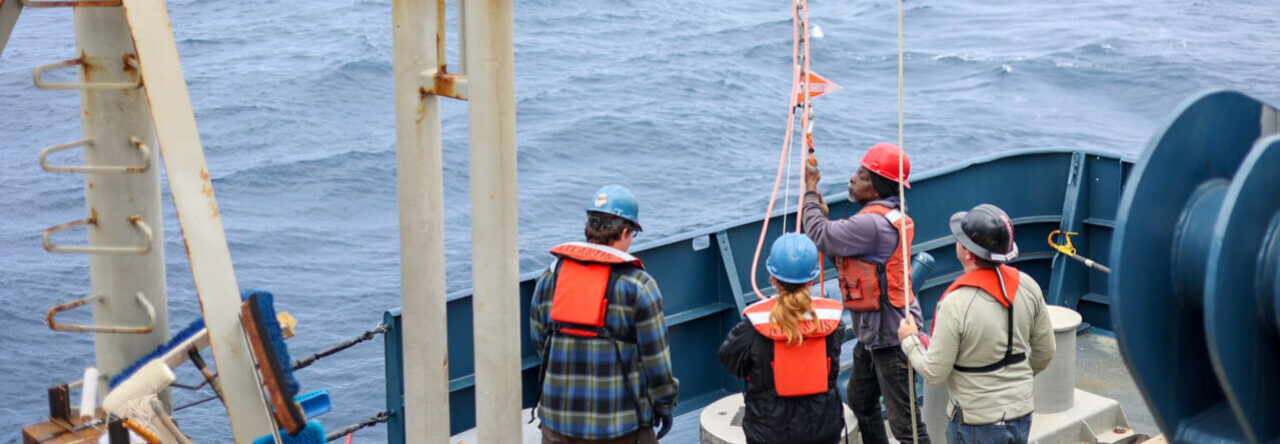
As a result, we remained alongside and tended to the deck tie-down socket testing. This must be performed once annually. For each of the sockets, three separate load tests must be conducted: vertical, 45 degree, and horizontal.
I was also tasked with creating a document as per UNOLS Safety Standards, Appendix B, that describes the process in detail for each of the three tests. This included a list of tools needed, step-by-step details, and photographs. This document is then filed in the ship’s records for reference in future testing.
As I mentioned in last week’s report, R/V Walton Smith sadly lost our Second Mate, James Sauers, to a boating accident last week. On Saturday, the ship’s crew, along with the entire Marine Operations staff, attended his memorial in Coral Gables. It was a heart-wrenching event, but the sight of all the green UM Marine Ops shirts that lined the outer perimeter was an inspiring sight. The family expressed their deep gratitude and appreciation for the show of support, and I was truly proud to be included in the ranks.
James was a great man and this tragedy will surely weigh on us all for a long time to come. (photo below)
