Author: John LaCross

WEEK 9- Breakdown, Bottles and Bees

WEEK 9
September 4-10

  As I mentioned in the previous blog, R/V Walton Smith is scheduled for a month-long cruise to Cuba in October in order to conduct studies on the coral reef using an ROV.  One of the many preparations requires all of the scientific equipment to be inventoried. An Export Control Classification Number, (ECCN), must be provided for each piece of equipment.  

  I was given the responsibility of tracking these down, which involved speaking with each manufacturer.  I also had to record all serial numbers for each item, original purchase price paid, quantity, and a basic description.  After all the data was entered into an Excel file, it was sent through the governmental channels for approval.  

  Early Wednesday morning we prepared to depart for a two-day cruise with NOAA as part of their continuous studies on the Gulf Stream current.  The Chief Engineer was absent due to jury duty, and it appeared that the ship did not want to leave without him.  Before we had even left the dock, problems with the electrical system forced us to abort.

  It was later determined to be an issue with a breaker, and it was promptly replaced.  Since next week’s schedule only consists of a three-day cruise beginning Wednesday, NOAA’s cruise is deferred to this coming Monday and Tuesday.

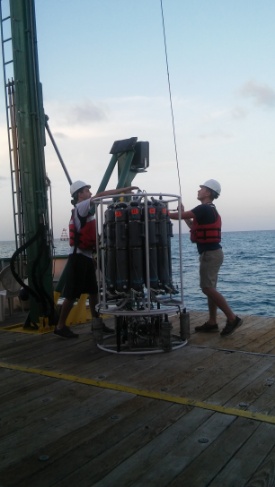
  I spent the rest of the week fitting our CTD with brand new Niskin bottles, part of the shipment that arrived from Brazil last month.  With new bottles and freshly calibrated sensors, and a newly terminated 322 cable, the CTD is now in tip top shape.

  On Friday we were given the opportunity to attend shipboard crane operation training, conducted by Captain Lake.  We were instructed on proper rules and safety involving crane operation and will be given the chance to be tested in order to obtain an official certificate.

  Captain Lake is also a beekeeper on the side and I have had the opportunity to assist him in several related activities.  This weekend we began a removal job that involved hives located in two different spots up inside a soffit of a house in North Miami.

  It always impresses me that people spend the time and money to have honey bees removed, rather than simply killing them.  By the end of the weekend we had one of the hives relocated into frames and placed into a special wooden hive, which was left in the yard in order for the stragglers to move into.  We’ll return next weekend and tackle the other hive.

Stripping the CTD of the old Niskin bottles

WEEK 8- Cable Termination, Nearing the End

WEEK 8
August 28-September 3

  The end of my stay here aboard R/V Walton Smith is in sight, and I’m pretty sure they are going to have to drag me away, kicking and screaming.  I’ve really become attached to my new home and family.  We are preparing for my final 3 cruises, making sure the dockside projects are all completed and that the vessel is in ship-shape.

  We are still having issues with a monitor in the bridge, and we have replaced all the components and cables…twice.  I’m beginning to think there is a ghost in the machine.

  Denis, the ship’s Marine Tech, and I cut a 15 meter section from the 322 cable used to deploy the CTD.  On the cruise that involved deploying the Tucker Trawl, it had become damaged as a result of the clumsy retrieval method.

  A short section of the counter-torque cable was unraveled, exposing the wires inside. The stainless steel termination was heated to melt the cerrobend inside, a metal alloy with a very low melting point of 158 degrees, comprised of bismuth, lead, tin and cadmium.  The strands of the counter-torque cable are wrapped in opposite directions, preventing the cable from twisting under a load.  Individual strands were separated and peeled back, then secured back to the cable with a winding of wire. The exposed wires were fed through the termination and out a hole in the side, and the exposed strands of cable were inserted into the bottom.  When the fresh cerrobend was melted and poured in, the splayed cable array served to secure the cable in place, much like rebar in cement.  When the cerrobend solidified, the three wires protruding from the side were then terminated and the cable was once again ready for use, as good as new.

  During the week we completed the horizontal testing of the deck tie-down sockets, using a load cell secured with shackles in line with a chain fall.  The new records were updated and filed for future reference.

  The ship is scheduled for a month-long trip to Cuba in October, and the extensive paperwork has been a nightmare for those involved in handling the logistics.  Next week I’ll be tasked with inventory duties in order to assist with this daunting effort.

Preparing the 322 cable for termination

WEEK 7- An Unexpected Visit Home

WEEK 7
August 21-27

  Early Monday morning our Chef, Peter, was kind enough to drive me to the Fort Lauderdale Airport, which was about a 45 minute trek from the ship.  I boarded a 737 bound for Detroit, en route to Lansing, Michigan, where the memorial service for my good friend would be taking place.
  A week earlier, Chris Bapst had been killed as a result of an accident involving his own double-shot Derringer pistol.  Anyone who knew Chris knows he would never have intentionally taken his own life, and the suspicious circumstances surrounding his death have left us with a mystery that may never be solved.  His death remains an open investigation.
  The memorial service was a heart-wrenching event, but at the same time it was uplifting and healing as his friends and family celebrated the life of a wonderful friend and father.  A former bandmate and I had the honor of leading the service in song as we performed many of Chris’s favorites.  His loss will leave a very painful hole in our lives and in the world as we all try to move on, striving to follow the righteous examples for living that he exhibited.
  The next day I boarded a flight that took us through a tornado system in the Midwest, only to land in the path of a tropical storm, on its way toward developing into a hurricane.  
  We all watched the weather closely as we prepared to move the ship either inland up the Miami River, or else up the east coast of Florida, depending on the intensity of the storm.  As it turned out, neither plan would be necessary.  By the time it reached us we were on the outskirts of the storm, but we still experienced heavy (horizonal) rain and 45 mph winds.  The storm continued to gather strength and had finally developed into a full-blown hurricane by the time it made landfall just north of Tampa Bay.  This was the first to see land in Florida in some 10 years.
  In the days leading up to the storm, we began the horizontal testing of the the deck tie-down sockets, and also replaced the cable in the starboard crane, which had begun to fray due to damage it had incurred the previous week.
  On Saturday, Captain Lake, (who also plays the banjo), and I attended the weekly Bluegrass Jam Session in Hollywood, FL.  This is an impressive gathering of talented musicians that meets every weekend at an old fire station and trades licks, performing a fine array of Bluegrass standards.
  Afterward it was on to Luna Star Cafe in North Miami, where I was able to perform several of my original songs at their Open Mic session, which takes place every other weekend.  I’m really growing to love this town.

RIP Chris Bapst

WEEK 6- Alongside

WEEK 6
August 14-20

  Since the only two cruises that had been scheduled this month were canceled, we will be working on maintenance both shipboard and around the facility of Rosenstiel School of Marine and Atmospheric Science. This is located on a slice of paradise known as Virginia Key, which lies 3 miles off the coast in between Miami and Key Biscayne.
  Vertical load testing of the deck tie-down sockets has been completed, so we have moved on to the 45° tests.  This will prove to be less time consuming, since two sockets are tested at the same time.  The only trick is to plan the pairs so that we don’t repeat any, since some are tested to 2500 pounds and others to only 1250 pounds (125% of rated load). There are over 200 individual sockets to be tested, each one requiring about ten minutes, so this is quite a time consuming task.
  A shipping container arrived from Brazil containing new equipment as well as freshly recalibrated sensors, so we spent a day unloading those contents into a new lab space, as well as moving gear from the existing space.  This included half a dozen large metal cabinets, requiring four of us and a fork truck to move, but all went smoothly.  
  It was also time to service the deionization filters in the ship’s reverse osmosis system.  This, of course is what transforms seawater into clean fresh water for the scientists, as well as drinking water.
  On Thursday I received devastating news.  One of my best friends back in Michigan had been tragically killed due to a gunshot wound.  He and I had known each other for many years, and he was one of the noblest souls to ever walk the face of the earth.  To say it was a tragedy would an enormous understatement.  Needless to say, I was paralyzed with grief for the next several days, and began trying to arrange a flight home.  
  Both the MATE Center and UM staff were incredibly understanding and accommodating, something that really meant a lot to me in this dark hour.  By Saturday I had made all the preparations to return for the funeral, and I struggled through the weekend in a haze.

deck tie-down socket testing

WEEK 5- Canceled Cruises, Funeral For Our Fallen Brother

WEEK 5
August 7-13

 So far, August has been fairly uneventful. Initially, there were two 10 day cruises planned for this month working with the US Navy, and I had been looking forward to these projects. Unfortunately, though, the cruises had to be postponed and R/V Walton Smith was unable to accommodate the changes.
  One of these involved assisting with an exercise referred to as shock trials.  When the Navy produces a new design of a warship, they take it out to sea and detonate 10,000 pound ordnance near it, (fully manned), in order to gather data on the effects of the blasts regarding structural integrity, etc., and reevaluate before sending into full production.
  The research vessel’s function is to ensure that the location for the tests is relatively free of sea mammals. If they are present, the operation is moved to a different location. After the testing is completed, the research team then surveys the site for damage to sea life.
  Just before I arrived on board, the Walton Smith had participated in one of these operations. It was initially kept secret until reports of an ‘earthquake’ off the coast of Jacksonville begin to roll in. At that point the US Navy was forced to disclose details about the operation.
  Another cruise that was cancelled involved a project known as USWTR, Undersea Warfare Training Range.  This is a network of sonar and other various acoustic sensors located 50 nautical miles of the coast of Jacksonville.  This subsea network processes and displays tracking data for ships, submarines, targets, weapons, and unmanned undersea vehicles.
  During my first week aboard the ship, I was informed that schedules change quite frequently, but I still was disappointed not to be able to take part in these exercises. 
  As a result, we remained alongside and tended to the deck tie-down socket testing.  This must be performed once annually.  For each of the sockets, three separate load tests must be conducted: vertical, 45 degree, and horizontal. 
  I was also tasked with creating a document as per UNOLS Safety Standards, Appendix B, that describes the process in detail for each of the three tests.  This included a list of tools needed, step-by-step details, and photographs.  This document is then filed in the ship’s records for reference in future testing.
  As I mentioned in last week’s report, R/V Walton Smith sadly lost our Second Mate, James Sauers, to a boating accident last week.  On Saturday, the ship’s crew, along with the entire Marine Operations staff, attended his memorial in Coral Gables.  It was a heart-wrenching event, but the sight of all the green UM Marine Ops shirts that lined the outer perimeter was an inspiring sight.  The family expressed their deep gratitude and appreciation for the show of support, and I was truly proud to be included in the ranks.
  James was a great man and this tragedy will surely weigh on us all for a long time to come. (photo below)

Week 4- Downtime and Tragedy

  Back in port this week after three back-to-back cruises, it was time to dive into some much needed maintenance on the R/V Walton Smith. During last week’s 5 day South Florida Ecosystem Restoration cruise, more than 80 stations were monitored while involving extensive utilization of the ship’s seawater flow-through system, along with the CTD. As a result, it was time to service the Turner C6 multi-sensor platform, which carries 5 Cyclops sensors to measure turbidity, CDOM, chlorophyll, phycocyanin and phycoerythrin.  Fortunately, the slot for crude oil wasn’t being utilized at this time.

  After separating all the components, meticulously cleaning them, and reassembling, the unit was reinstalled to ensure there were no leaks.  The next few days included fork lift certification training and general cleanup. 

  The next task was to begin testing of the main deck tie-down sockets.  In previous years, each socket required an entire page to document the testing results, which made it cumbersome to flip through page after page in order to find the document you were looking for.  To remedy this, I fired up Microsoft Excel and created a document that would incorporate up to 25 deck sockets per page, making it much easier to reference at a glance.

  UNOLS Research Vessel Safety Standards dictates proper standards for most shipboard operations performed, and in line with this we created a step-by-step procedure specific to the Walton Smith to be followed in the future regarding vertical, 45°, and horizontal load testing.

  As my many years as a union stagehand taught me, there’s no doubt that adventure and excitement (and in this case, on the high seas), frequently requires not so glamorous behind-the-scenes preparation, so I didn’t mind spending some time getting my hands dirty in the blazing sun.

  In the short time I’ve been Miami, I already feel like the Walton Smith is my home and the crew my family.  When I arrived, the ship had just taken on another new crew member, 2nd Mate James Sauers.  He and I hit it off immediately and quickly became good friends.  He was always quick to share his extensive seamanship knowledge with me and to crack a joke.  I watched and learned with admiration and tried to pick his brain for tips any time I had a chance.

  On Monday August 1, James failed to show, which was unlike him.  When he didn’t arrive the next day, we were concerned, but that afternoon we received word from his wife that he was OK, but that he had been in a boating accident in his sailboat and would be absent a few days.  Although he had suffered a head injury and was in Intensive Care, he was responsive enough to appreciate the card we had sent later in the week.  We were anxious for him to be released from ICU so that we could visit, which the doctors said should be the first part of the following week. 

  Early today, Monday August 8, barely a week after the incident, the Director of Marine Operations came aboard and called us all into the mess lounge for a meeting.  The room fell horribly silent as he explained how he had just received word that James had suddenly and unexpectedly succumbed to his injuries and passed away. 

  It is amazing how some people can make such an enormous impact on you in such a short time, and James certainly did.  I’m sharing this so that you all can know what a wonderful human being he was, and to say that we should appreciate and cherish those around us.  We are fortunate to walk the earth for a while with friends like this, and never should it be taken for granted.

  James leaves behind a loving wife and two young daughters, and I’ll never forget the time I had to work, laugh, and sail with the likes of him. I’m proud to have had the privilege of calling him my friend. RIP James. (photo below)


Week 3- South Florida Ecosystem Restoration Cruise


Along with a team of scientists from NOAA, we set out early Monday July 23rd from Miami with gorgeous weather and calm seas.  We were on a course that would take us west through the Florida Keys and up the coast of Florida Bay.  The mission was part of a greater effort referred to as South Florida Ecosystem Restoration.

  South Florida’s Everglades have been in grave danger, beginning in the late 1800’s, when humans began digging canals to drain the land so that it could be populated.  All through the Twentieth Century, up until the late 1980’s, these efforts continued on a large scale.  The projects were successful, but the precious ecosystem paid a terrible price.  As a result, the Everglades have shrunk to less than half the original size.  Approximately 90% of the native birds that were once abundant have disappeared, along with countless unique wildlife species.  Of the ones that remain, almost 70 species appear on the federal list of endangered or threatened wildlife.

  In 1993, the South Florida Ecosystem Restoration project was formed in order to curtail the damage being done and to attempt the reversal of the destructive process.  The initiative consists of federal, state, and tribal entities working together in effort to restore the priceless wetlands.

  NOAA’s role in the initiative is to monitor some 80+ stations throughout the Florida Keys and coastal regions of Florida Bay and Southwest Florida Shelf.  On this 5-day cruise we collected water samples around the clock at each of these locations using the ship’s CTD rosette, along with the on-board seawater flow-through system.  


  Lead Scientist Lindsey Visser explains, “The seawater was analyzed for chlorophyll, nutrients, and dissolved inorganic carbon as part of ongoing water quality monitoring that has occurred for decades in this region.  We also used nets to collect phytoplankton and zooplankton in order supplement chlorophyll levels measured in the seawater.  This dataset is used to analyze everything from the transport of nutrients and chlorophyll from the Mississippi River through the Gulf Stream off the east coast of Florida, or the conditions that are conducive to Harmful Algal Blooms off the Southwest Florida shelf.”

  Another one of the issues being monitored by NOAA is the toxic algae bloom crisis which began this past spring.  The toxic cyanobacteria bloom is driven by a combination of lack of infrastructure needed to raise the level of Lake Okeechobee, and runoff from manure, sewage, and fertilizer from the farming industry, namely the sugar fields, and it has taken over the Southwest Florida coastline.  The algae, which can be seen from space and has resulted in massive beach closings, contains nerve toxins and is not only a possible link to diseases such as Alzheimer’s, Parkinson’s and ALS,¹ but also depletes oxygen levels, leading to massive dead zones.  Among a multitude of other health risks, contact with an open wound may result in a staph infection.²

  I’m grateful to have had a small hand assisting in a mission that will help further the efforts of the restoration of the environment.  With big business such as US Sugar and others contributing to political interests, it will surely continue to be an uphill battle.  In spite of this, it’s reassuring to know that groups like NOAA are vanguarding these issues in attempts to keep policymakers and regulators in check, and to help spread awareness of the urgent need to affect change before the ecosystem is lost to agricultural development and anthropogenic climate change.


Acknowledgment

Special thanks to NOAA Affiliate and Head Scientist Lindsey Visser for consultation/contribution regarding this post

Sources

¹ TCPalm April 14, 2016

http://www.tcpalm.com/news/indian-river-lagoon/health/scientists-toxin-in-blue-green-algae-could-trigger-neurological-diseases-2fbede92-2377-08de-e053-010-375718471.html

² Tampa Bay Times July 1, 2016

http://www.tampabay.com/news/environment/water/toxic-algae-bloom-crisis-hits-florida-drives-away-tourists/2283838


Week 2-Bioluminescent Sea Creatures


Week 2

In the afternoon of Saturday July 16, scientists supported by a grant from the NSF arrived at the dock and began loading their equipment.  The main instruments that were brought on board were two Tucker Trawl net systems- one full sized, referred to as Mother Tucker, and a smaller one, Baby Tucker.  The smaller one was included because no one was sure we would be able to deploy the full sized system from the Walton Smith, because our A-frame is not as tall as the other vessels they had used.    
  We worked all day Sunday preparing the larger trawl system for deployment, most of the time trying to devise different methods that would work.  
  We departed from Miami at 2000 hrs and headed northeast into the Florida Straits.  We endured some pretty rough seas and lightning, and by 0100 we arrived at the first station.  Due to the inclement weather conditions, the first cast was scrapped. 
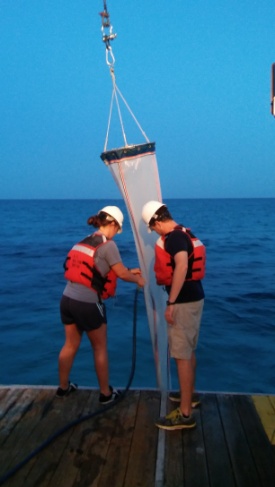
  By Monday morning the weather had cleared and we were able to deploy around 0900.  The Tucker Trawl consists of a long tapered net with an aluminum frame at the top, which incorporates the underwater CTD unit, 3 bars at the opening- one at the top below the frame, one at the bottom, and furthest down a 400lb weight bar.  The frame and upper 2 bars slide up and down two cables, which serves to open and close the net. When the cables are pulled up, all three bars collapse together with the frame.  This was our challenge, since the A-frame was not tall enough to lift them out of the water.  
  The first retrieval was somewhat awkward and precarious, but the system was finally brought on board by brute manpower force.  During that night we made three more casts, each time modifying our approach, and the retrievals became easier.  The yield in all four casts wasn’t quite what the science party was looking for, so we made our way south to the next station.
  By Tuesday our method had been perfected and the new fishing ground was yielding results that had the scientists smiling.  The bioluminescent sea creatures that were caught were fascinating.
  By the end of the week we had racked up eleven successful casts and collected some pretty amazing specimens.  The science party departed happy and armed with many new photos of bioluminescent sea life. 
  On Saturday I was finally able to perform some original music at Luna Star Cafe and had a great a great time doing so.  I also made a lot of new friends and musical contacts in the Miami area.
  Till next week, enjoy the beautiful summer days and nights wherever you are.
 

Week 1

  Hello again.  After a 1600 mile drive from my home in Michigan I arrived in Miami July 10th.  I made my way to the Walton Smith, which docks off the Miami coast on Virginia Key at University of Miami Rosensteil School of Marine and Atmospheric Science.  I became acquainted with the crew members who were present- Captain Shawn, Chef/1st Mate Pete, and 2nd Mate Steve.  Everyone was very welcoming and I felt right at home.
 By the next day, the rest of the crew of seven were aboard and we began preparing for the upcoming cruise. Marine Tech Denis and I began work right away.  The first order of business was to replace the pump on the reverse osmosis filter in the deionization system aboard the ship, which had broken down.  
  Once we had that reassembled and functioning properly we began to remove various components of the ship’s sea water flow-through system.  Just a bit of routine cleaning and inspecting, which ate up the rest of the day.
  Day 2 consisted of general maintenance tasks.  I spent most of the day removing the deck tie-down plugs from the 01 Deck.  After tapping all the threads, cleaning the plugs and applying anti-seize compound I returned them all to their happy homes.  Later that evening the NOAA scientists arrived and settled in to their state rooms.
  At 0600 the following morning we set out for the 12-hour transit northeast to the 27th parallel.  Around dinner time that afternoon, somewhere in the middle of the Bermuda Triangle, we deployed CTD rosette.  This was the first of nine stations that we would hit as we made way east along the 27th parallel against the Gulf Stream current.
  NOAA has been monitoring the Gulf Stream since the Eighties via a decommissioned telephone cable that stretches from West Palm Beach to the Bahamas.  The CTD data, along with ADCP (Acoustic Doppler Current Profiler) readings, help them to calibrate the cable, which uses a magnetic field to measure the volume and rate of current that flows through the Gulf Stream.
  All nine deployments went smoothly, the deepest being around 800 meters.  The science party was very pleased with the cruise and departed happy.  

  The next day, back in port, we removed the main underwater electronics unit from the CTD rosette and replaced it with a new one after cleaning all the cables and connectors.  The underwater unit we removed will be used to attach to the science party’s equipment during the next cruise.

  Stay tuned for this week’s cruise as a group with NSF collects bioluminescent sea life using a Tucker Trawl…
  

Pre-Internship Blog

Hello everyone, John LaCross here from Alpena, Michigan.  I just arrived in Florida, a few days before I board R/V Walton Smith for an 11-week internship.

The ship is owned and operated by University of Miami and ported at Rosenstiel School of Marine and Atmospheric Science on Virginia Key, just south of Miami’s South Beach.

I recently returned to my home town of Alpena and graduated from Alpena Community College’s Marine Technology program and I’m very excited and grateful for the hands-on experience I’m about to gain.

Hope everyone has a great day and I’ll be back in touch soon!


Powered by WordPress & Theme by Anders Norén