Hello again. After a 1600 mile drive from my home in Michigan I arrived in Miami July 10th. I made my way to the Walton Smith, which docks off the Miami coast on Virginia Key at University of Miami Rosensteil School of Marine and Atmospheric Science. I became acquainted with the crew members who were present- Captain Shawn, Chef/1st Mate Pete, and 2nd Mate Steve. Everyone was very welcoming and I felt right at home.
By the next day, the rest of the crew of seven were aboard and we began preparing for the upcoming cruise. Marine Tech Denis and I began work right away. The first order of business was to replace the pump on the reverse osmosis filter in the deionization system aboard the ship, which had broken down.
Once we had that reassembled and functioning properly we began to remove various components of the ship’s sea water flow-through system. Just a bit of routine cleaning and inspecting, which ate up the rest of the day.
Day 2 consisted of general maintenance tasks. I spent most of the day removing the deck tie-down plugs from the 01 Deck. After tapping all the threads, cleaning the plugs and applying anti-seize compound I returned them all to their happy homes. Later that evening the NOAA scientists arrived and settled in to their state rooms.
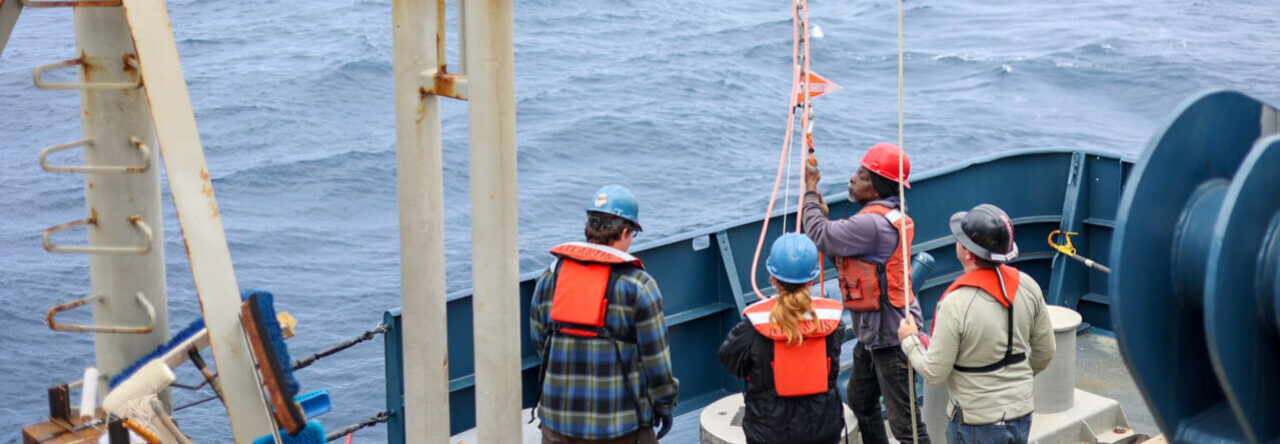
At 0600 the following morning we set out for the 12-hour transit northeast to the 27th parallel. Around dinner time that afternoon, somewhere in the middle of the Bermuda Triangle, we deployed CTD rosette. This was the first of nine stations that we would hit as we made way east along the 27th parallel against the Gulf Stream current.
NOAA has been monitoring the Gulf Stream since the Eighties via a decommissioned telephone cable that stretches from West Palm Beach to the Bahamas. The CTD data, along with ADCP (Acoustic Doppler Current Profiler) readings, help them to calibrate the cable, which uses a magnetic field to measure the volume and rate of current that flows through the Gulf Stream.
All nine deployments went smoothly, the deepest being around 800 meters. The science party was very pleased with the cruise and departed happy.
The next day, back in port, we removed the main underwater electronics unit from the CTD rosette and replaced it with a new one after cleaning all the cables and connectors. The underwater unit we removed will be used to attach to the science party’s equipment during the next cruise.
Stay tuned for this week’s cruise as a group with NSF collects bioluminescent sea life using a Tucker Trawl…