26/07/16
Blog 5- Creatures of the Pockmarks
Things have been going swimmingly here on the Healy, even though we have finally run out of fresh vegetables. We are regularly deploying instruments and taking various types of samples. One of the most exciting deployments is the remotely operated vehicle, where humans get to take on the role of aliens shining light into a dark unknown world, sucking up organisms for later probing upon arrival to the mother ship. These blue-faced aliens usually crowd around to watch the live blue video feed on the 70″ monitor whenever the ROV is in the water. Spiders, worms, leeches, snailfish, and jellyfish are only a few kinds of the myriad bottom dwellers that have been seen.
But other sampling methods that bring up the microfauna are just as exciting in their own way. The multi-net in particular sometimes becomes very finicky and so Croy and I have to go try to fix it. This instrument uses a “smart” winch cable, so called because its core is a bundle of conductors, which feeds back to the winch, through a junction box, and eventually to the control box from which the scientist triggers the nets.
Ideally the multinet is deployed, dropped to the bottom (or some other target depth), and raised through the water column while the scientist sends signals to open and close different nets. This gives a good idea of the copepods and plankton that exist in different sections of the water column.
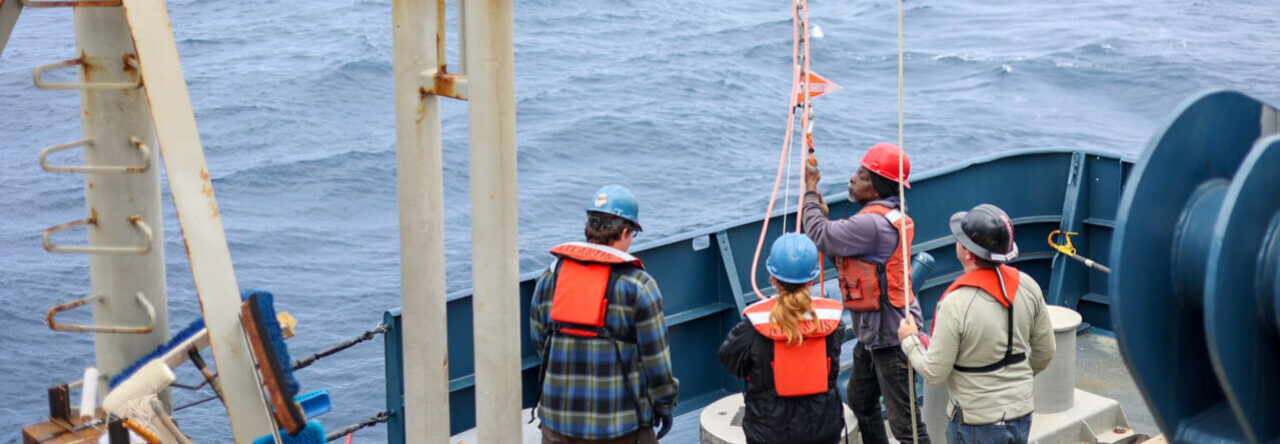
Unfortunately, there have been communication problems between the control box and the net itself. After application of various troubleshootings we determined that the problem might lay with one of the conductors within the winch cable. We cut off a section, and then reterminated the multi-net electronically and mechanically. (see photo)
Also, the pockmarks I mentioned in the title are the ~75m depressions in the seafloor, roughly 300m in diameter, which we preferentially sample during benthic ROV dives and with the box corer. They seem to be traces of methane hydrates degassing in response to warmer water temperatures.
This week’s picture is brought to you by Croy Carlin: Nick soldering winch to multi-net in the Arctic
