Author: Kristie Okimoto

Conclusions on the R/V Sikuliaq

And so, my time on the Sikuliaq comes to a close. Many CTD lines and supersucker attempts later, we’re done collecting data.Since we got done early, we were able to set up an ice station off of the Wainwright line. After a day of searching, we found a piece of sea ice that was large enough to be stable. Paul, our boson, drove the landing craft to get to it. We drilled and sawed into the ice to take samples and see if there was any ice algae. Afterwards, we shuttled groups of crew and science back and forth to let everyone get out on the ice. I got in a snowball fight, made snow angels with some crew friends and generally had a good time out on the ice. Afterwards, we got a speedy boat ride back through the sea ice. Nothing as  exhilarating as zooming through and around sea ice in a small boat in the Arctic!

We also were able to visit Point Hope, a small Alaskan Native village, for a day. We got to see the ceremonial whale burial grounds, and stopped in the town hall and grocery store. Afterwards, I walked around the north side of town for some alone time and a great view of the Brooks range. Those were some really gorgeous mountains. We took the landing craft back to the ship and set off again!

The ship navigated some choppy waters back through the Bering Strait. We anchored off shore near Teller to weather the storm. The next day, we finally docked in Nome and went to go celebrate a good cruise. It’s been a good time; I’ve learned a lot about CTDs, coring, nitrogen fixation and primary productivity, the Arctic, maritime life, how rigorous science is, and what it means to be a marine technician. I learned a lot about this cruise’s experiments, the ship’s seawater system, sonars, pco2 monitoring system and other underways. I also got to see the glider and super sucker and learn about both of them. I learned about deck ops and the AON morning. I got to help with sampling and even learned some about engineering. Interning has also taught me how to be more proactive, communicate professionally and work in a team. I mostly like the biological aspects and the technical aspects, and could be interested in specializing in one or both. I could be really interested in deep sea work, which would be very biological and technical. I’m also interested in doing work that’s more people oriented, working with local communities or front-line communities, perhaps implementing traditional knowledge or working with them on climate justice issues. All in all, this was a great internship to take right after school. It taught me about professionalism and oceanography, exposed me to marine careers, and gave me a better idea of what I want to do. But for now, I’m off to venture around Alaska!

P.S. I’ll put up one more photo blog. Stay tuned for pics! 🙂

Sheets and Ice Sheets: Taking the Plunge

Hey there!

This week, we’ve gone through lots of sea ice as we sail through the Arctic, to the north of Barrow and Wainwright. The Arctic Ocean views have been really gorgeous and tranquil, with the water’s surface as still and smooth as glass, reflecting the oh-so-blue sky. We’ve also gotten to see polar bears, a whole walrus colony, and a few auroras! 

With all this sea ice, the ship has been going a maximum of 2-3 knots, meaning there is more time between CTD stations.This week, I’ve learned to plot points in the Olex system, which helps us know our time to station. I’ve also relearned how to tie a bowline and a sheet bend. Sheets are ropes, or lines on a boat.

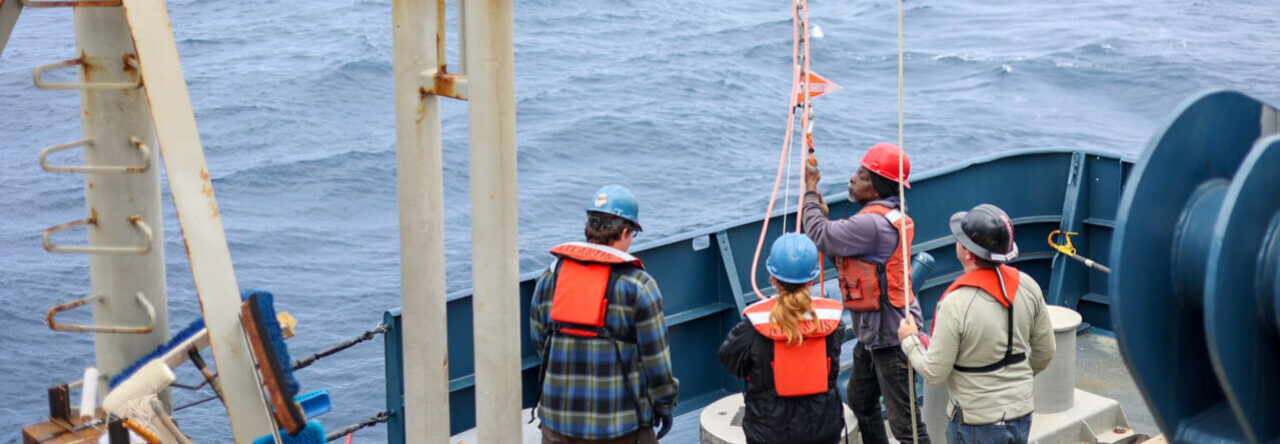
After getting through the ice, we’ve finally been able to start coring and using the supersucker. I really enjoy using the multi-corer because our camera system allows us to see what’s on the bottom. The multi-corer is also more hands-on than our CTD. It’s been fun to hop on the buddy lines, and use poles and hooks to safely deploy and recover the multi-corer.

I’ve also gotten to cut cores and sample water with Miguel Goni, a professor at Oregon State University, and his students. It’s been nice to be involved in science as well as science tech, particularly as someone interested in pursuing oceanography in graduate school. I’ve also gotten more involved this week overall. I finally got to operate the CTD, meaning that I got to direct the winch operator and tell them how deep to send the CTD, where to wait, etc. I think I was too laidback the first week, so other people got to operate the CTD and handle lines. I’ve realized that I just need to jump in more and ask to do things, rather than being shy and letting other people take the lead. Gotta take that plunge!

We’ve been sampling lots of lines: the Wainwright, Barrow, DB06 and DB04 lines, which means lots and lots of CTDs and a good bit of coring. The marine techs keep pulling intense hours, then resting when we tow the super sucker. The super sucker has to be towed continuously for 24 hours, so we can’t stop do CTDs or multi-core. This gives science a nice break, as there’s no water to process, and no cores to cut.

We’ve mostly been doing shallow water casts – 40 to 50 meters, but we also got to do some deep casts. These casts ranged from 1000-3900 meters, taking about 1 to 4 hours, respectively. We got to make souvenir cups on the deepest of the casts. We all decorated Styrofoam cups, packed them with paper towels, put them in mesh bags, then tied them onto the CTD rosette frame. We cast the CTD to 3930 meters, then pulled it back up. The cups came back bigger than a thimble, about the size of shot glasses. We all got to keep them for cruise souvenirs.

We also did test runs of the UAF carbon glider. My roommate, Brita, is the lab technician working on the glider project. Gliders are nice because you can launch them and they’ll continuously gather data for up to 4 months. One of the microcomputers on Brita’s glider went down though. We’re going to try launching it again tomorrow. We’ll do small boat ops to launch it. If we’re in the right area, we might also pick up another glider that is currently gliding around the Chukchi Sea to the North of us.

We’re at the midpoint of the cruise. I want to check in with the two marine techs for mid-internship feedback. I’ve also continued to appreciate the company of both science and crew. We’ve all gotten into a nice rhythm, and ops and data are flowing nicely. I’ve definitely made some great friends on the ship so far. Time on the R/V Sikuliaq is going far too quickly, if anything.

CTDs, Sea Ice and Polar Bears

Hey there all!

After being in port in Nome, seeing some Northern Lights, swimming in the Bering Sea, moving lots of equipment onboard and singing karaoke with science and new crew, we’re finally underway! It’s been really nice to be cruising this week and getting into the flow of things.

The first couple days were mostly transiting, with some CTD (Conductivity Temperature Depth) casts and preparing an AON (Arctic Observation Network) mooring. We went through the Bering Strait, past the Chukchi Sea and into the Beaufort. At our max, we hit about 72.5 degrees North. We lost internet right as we went into the Arctic Circle. Due to our heading, our mainstay blocks our satellite dish at a very specific angle. You’re reading this because it’s gone back up though, intermittently at least. It’s actually been nice getting away from the internet though.

In the past week, I’ve learned to prepare, check, operate and clean a CTD. I’ve learned how we process CTD data and utilize that to reset our sound velocity profile. Knowing the speed of sound at a particular site is important because it helps us recalibrate our multi-beam sonar. Our TOPAS system and multi-beam sonar are used to map both the bathymetry of the sea floor, and the substrate beneath it. These both operate whenever we’re underway, helping add to worldwide knowledge of the seafloor, one cruise at a time.

I also got to help recover and deploy this Arctic Observation Network mooring. Moorings like this are used to monitor temperature, salinity and other environmental conditions in a location over a long period of time. This helps scientists track climate change or other continued patterns in an area over time. In the Arctic and off the Alaskan coasts for example, scientists are doing research into what role increased glacial melt plays in the ecosystem. In recent years, there has been a coccolithophore bloom off the Alaskan coast, turning the normally dark blue Bering Sea a pale shade of turquoise with their calcium carbonate shells. As we passed through the Bering Sea, we were actually able to observe this, registering an increased amount of carbon at that micron size and seeing the clear blue turquoise of this bloom. Our research ties into this, monitoring nitrogen fixation and primary productivity of the Arctic. This helps us to gauge the Arctic’s importance in fixing carbon and nitrogen, and what the Arctic ecosystem’s role is globally.

In other cool things, the AON mooring also had an ADCP (Acoustic Doppler Current Profiler) and an Aural whale recorder. Although tricky at times, it was really cool to work with the deck crew to both recover and deploy the AON mooring. We worked together in the stormy Arctic weather to get everything in and out safely. After that, science, science tech and ABs (able-bodied sailors) have come together to make CTD casts happen 24 hours a day for the next 3 days. I really enjoy how the boat pulls together for these operations, it makes the boat community that much more tight. All in all, it’s been really great learning a lot this week, finding my niche and becoming a part of the R/V Sikuliaq family.

Transiting on the R/V Sikuliaq!

Hey there!
This is Kristie Okimoto, the final MATE Summer Intern! I’m on the R/V Sikuliaq, also headed up to the Arctic. We are somewhere in the Bering Sea at the moment! Tomorrow, we’re docking in Nome, and will be loading equipment, food and fuel for the upcoming cruise.

The transit from Seward to Nome has gone pretty smoothly. This week has mostly been an orientation week of sorts. The science party has gotten safety talks, an engine room tour and done fire and abandon ship drills. Ethan, one of my two mentors on the ship, showed me around some of the ship systems I’ll be helping to maintain. We looked at the ship multibeam sonar, the TOPAS system, the pCO2 system and the seawater inflow system. These systems operate at all times on the ship, gathering data whenever the system is underway.

As the upcoming cruise will be researching nitrogen fixation and primary productivity of waters in the Arctic, the seawater inflow system will be super important. Scientists will continuously measure the nutrients and gasses of this seawater. The researchers will also utilize a CTD (conductivity, temperature, depth) rosette and an ADCP (acoustic doppler current profiler) to help gauge nutrients throughout the water column and to help gauge the related currents. As marine technicians, we will be supporting all of these instruments.

I am excited for the actual research cruise to get underway! All in all, I have really enjoyed being at sea so far. There really is something amazing about being surrounded by a vast expanse of blue, blue water on all sides. Alaska was also really beautiful! Well, onward to Nome, and then onto the Juranek cruise!

Pre-Internship on the R/V Sikuliaq!

Hi there!
I’m Kristie Okimoto, a recently graduated senior from University of California Berkeley. At Berkeley, I studied Conservation and Resource Studies with concentrations in Anti-Oppression, Decolonial Thought and Oceanography.

I applied to MATE Summer because I’m possibly interested in pursuing oceanography in graduate school. I’m also interested in doing culturally appropriate marine conservation, that is community based and better implements traditional knowledge, rather than using the western colonial conservation model. I’m also very interested in climate justice work, as low income communities and communities of color will be among those most affected by climate change.

When applying, I thought we’d probably be doing a cruise off of California, or possibly the South Pacific if I was lucky. When I was offered a cruise position to the Arctic, it was an unexpected surprise! The Arctic was not somewhere I’d think to visit, or do research in by myself, so I am very glad for the opportunity to go do work there.

At the moment, I am wrapping up my time at home, and trying to pack for the Bay Area, the Arctic and South America all in one. I’ll be visiting friends in the Bay Area and wrapping up ends there before my internship, and traveling with a friend around South America for a bit after the internship. Needless to say, the clothing in my bag is super varied, haha!

Well, off to go pack more. Tchau for now!

Powered by WordPress & Theme by Anders Norén