Hey there all!
After being in port in Nome, seeing some Northern Lights, swimming in the Bering Sea, moving lots of equipment onboard and singing karaoke with science and new crew, we’re finally underway! It’s been really nice to be cruising this week and getting into the flow of things.
The first couple days were mostly transiting, with some CTD (Conductivity Temperature Depth) casts and preparing an AON (Arctic Observation Network) mooring. We went through the Bering Strait, past the Chukchi Sea and into the Beaufort. At our max, we hit about 72.5 degrees North. We lost internet right as we went into the Arctic Circle. Due to our heading, our mainstay blocks our satellite dish at a very specific angle. You’re reading this because it’s gone back up though, intermittently at least. It’s actually been nice getting away from the internet though.
In the past week, I’ve learned to prepare, check, operate and clean a CTD. I’ve learned how we process CTD data and utilize that to reset our sound velocity profile. Knowing the speed of sound at a particular site is important because it helps us recalibrate our multi-beam sonar. Our TOPAS system and multi-beam sonar are used to map both the bathymetry of the sea floor, and the substrate beneath it. These both operate whenever we’re underway, helping add to worldwide knowledge of the seafloor, one cruise at a time.
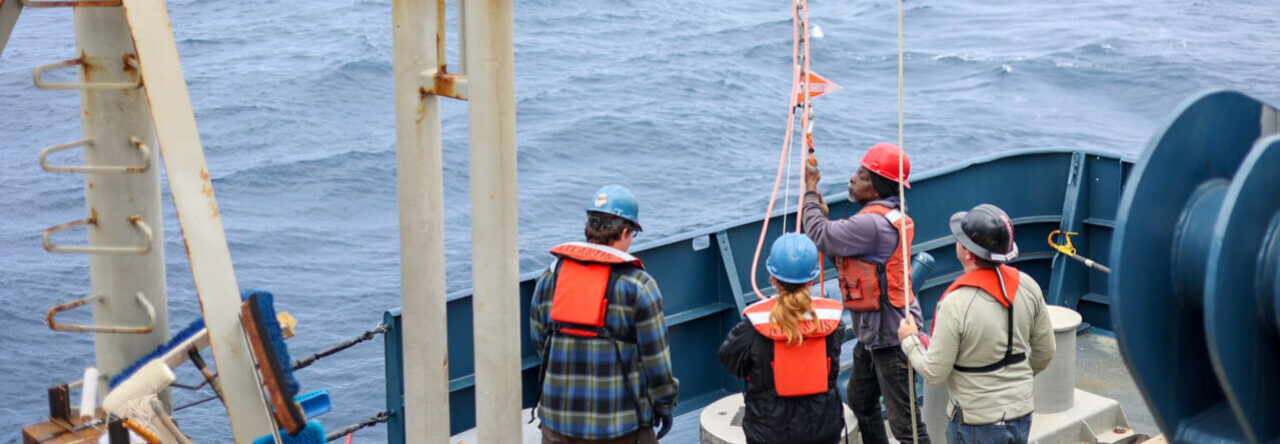
I also got to help recover and deploy this Arctic Observation Network mooring. Moorings like this are used to monitor temperature, salinity and other environmental conditions in a location over a long period of time. This helps scientists track climate change or other continued patterns in an area over time. In the Arctic and off the Alaskan coasts for example, scientists are doing research into what role increased glacial melt plays in the ecosystem. In recent years, there has been a coccolithophore bloom off the Alaskan coast, turning the normally dark blue Bering Sea a pale shade of turquoise with their calcium carbonate shells. As we passed through the Bering Sea, we were actually able to observe this, registering an increased amount of carbon at that micron size and seeing the clear blue turquoise of this bloom. Our research ties into this, monitoring nitrogen fixation and primary productivity of the Arctic. This helps us to gauge the Arctic’s importance in fixing carbon and nitrogen, and what the Arctic ecosystem’s role is globally.
In other cool things, the AON mooring also had an ADCP (Acoustic Doppler Current Profiler) and an Aural whale recorder. Although tricky at times, it was really cool to work with the deck crew to both recover and deploy the AON mooring. We worked together in the stormy Arctic weather to get everything in and out safely. After that, science, science tech and ABs (able-bodied sailors) have come together to make CTD casts happen 24 hours a day for the next 3 days. I really enjoy how the boat pulls together for these operations, it makes the boat community that much more tight. All in all, it’s been really great learning a lot this week, finding my niche and becoming a part of the R/V Sikuliaq family.