Category: Vessel/Laboratory Page 53 of 89

First Week in Bermuda

I arrived in Bermuda about a week ago. A beautiful island with gorgeous clear aqua blue water and the most beautiful flowers and plants. It is truly paradise. When I arrived at the Bermuda Institute of Ocean Sciences I was blown away at how beautiful the institute is. The buildings are structured in a way to collect rain water as that is their main source of drinking water and used for showers. It makes you appreciate and conserve as much water as you can. When I arrived the ship was gone for the night so I was able to stay in Wright Hall which was very comfortable and surrounded by nice people. There are many different programs, research, and classes that are taking place here and people from all over the world. I am lucky to be here and be surrounded by people from all over the world and learn from their experiences. BIOS is unique where everyone becomes friends instantly and hangs out all together. I have only been here for a week and I have made so many friends. I moved aboard on Saturday July 6th and we left on Monday for a research cruise with BIOS-SCOPE (Bermuda Institute of Ocean Sciences – Simons Collaboration on Ocean Processes and Ecology). They focus their research on the ocean’s smallest life forms. There were scientists from all over the world studying microbes and zooplankton. We used Conductivity-Temperature-Depth (CTD) rosette to document the environmental conditions of the sampling site and had 24 niskin bottles attached collecting seawater to be studied at various depths. Other gear was used such as WTS-LV (Large Volume Pump) which collects suspended and dissolved particulate samples in situ into a membrane filter which is used to sample a number of things including phytoplankton. We attempted to deploy a MOCNESS (Multiple Opening and Closing Net, with an Environmental Sensing System) but unfortunately it did not work properly but after hard work we were able to get it working again and ready to be deployed on the next cruise. Being aboard this vessel is such a great opportunity to further my marine technology skills. I am learning a lot more about marine electronics and how to assess and fix electrical issues aboard the vessel. The crew and everyone aboard the vessel is absolutely amazing, welcoming, and funny. The food is some of the best food I have ever had. It has only been a week and I am having such a great time and learning so much I cannot wait to see what the future holds. I am glad to be in Bermuda for so long because it is definitely going to be a hard place to leave. We are leaving again today July 14th and will be gone offshore until Friday July 19th. This upcoming trip will be for the Bermuda Atlantic Time Series Study. 

Always Saying Yes to Learning Experiences

It’s week three and we’ve nearly completed our western survey lines, parallel to the Reykjanes Ridge, about 300 – 500 km east of Greenland. Daily work has continued to consist primarily of monitoring multibeam, sub-bottom, magnetic, and gravity data acquisition, as well as post-processing multibeam data and routinely launching XBT’s to maintain an accurate sound velocity profile. During watch, I have also been studying the installation, maintenance, and acoustic theory behind the Kongsberg EM122 echo sounder system and creating a short training document using what I’ve learned. The marine technician role encompasses diverse responsibilities, meaning that one might benefit more from a good understanding of many instruments than a specialized understanding of a few of them. However, it is certainly valuable and inevitable for a marine tech to expand upon their understanding of such instruments as they go. As I have learned more about acoustic theory and the components that make up the EM122 multibeam, I have found myself in a much better position to effectively operate this system as a tech and I’m sure the same will hold true as I move on to studying other systems in-depth. As the lead marine tech aboard the R/V Neil Armstrong has repeatedly pointed out to us, a big part of being a tech is knowing how to locate reliable resources and teach yourself more about the systems you find yourself responsible for.


While studying your systems is a necessary and important skill as a tech, it is also valuable to expand upon the diverse niche skills that come in handy as a tech or general member of the crew. Although there hasn’t been a lot of hands-on work to be done this cruise, I got to improve multiple such skills this week. During one of our XBT casts, we experienced an issue in which the probe was sensing that it had been “launched” prior to actual launching. We decided to switch to our back-up gun, however the cable on this gun was too short to run the length of the fantail and had the wrong termination. To fix this, fellow MATE intern Ella and I spent part of the day soldering in a new section of cable and new 5-pin termination, as well as then waterproofing each joint. In one short project we were able to expand our troubleshooting and soldering skills, as well as our understanding of the XBT’s internal mechanics and cabling.


Later in the week, I learned more about magnetometer software troubleshooting when a minor issue arose, as well as practiced suturing wounds and putting in an IV with the Chief Mate using training skin and a dummy arm. Best of all, having done a lot of MIG welding in the past, I had the chance to practice stick welding with one of the Oilers. Stick welding was a different beast from MIG entirely, especially on a moving ship, but it felt great to pick up on a new welding technique! As always, I’m looking forward to seeing what next week will have in store!

The speed of sound

A large part of data collection on this cruise involves sound. We send sound into the ocean over a wide range of frequencies and listen for its echo, allowing us to collect data on the shape of the ocean floor using the multibeam, the nature of the substrate (whether its rocky or silty) using the sub-bottom profiler, what exists in the water column using the EK80, and where the currents are flowing using the ADCP. As I mentioned in my blog post last week, the accuracy of this data can be affected by the pitching and rolling of the ship. The accuracy is also dependent on knowing the speed of sound through the ocean where the data was collected. 

Sound speed in the ocean is dependent on the temperature and salinity of the water. In general, salinity is relatively constant through the water column, but temperature can change dramatically. The expendable bathythermographs (XBT) that we deploy approximately once a day measure the temperature through the water column, while the surface flow-through system measures surface salinity. Using this data, we can calculate the sound speed. 

The XBT is essentially a sensor attached to a long wire that connects back to a computer where the data is being saved. The electrical circuit that transmits this data is completed when the XBT touches the salty, electricity-conducting ocean water. However, if the circuit is completed elsewhere (by, say, a faulty cable), the computer won’t know the difference between the “data” coming from this faulty completion, and a real XBT deployment. This was the problem we ran into this week, yielding an opportunity for the other MATE interns and I to apply what we had previously learned about electrical circuits to this scenario.

After ruling out some of the easier solutions, we determined that an issue with the cable was likely the cause of our problems. We took an old XBT deployment device with an outdated connector, extended the length of the cable, and added a new connector. This task gave us the opportunity to hone our soldering skills and learn the process of waterproofing our soldered cable joints. After many hours of soldering practice, soldering the cable itself, and applying layers and layers of electrical and self adhesive tape and nocuous electrical insulation, we had our finished product. It has passed our initial test, and in the next few hours we will use it to deploy an XBT at the next planned station. Stay tuned!

Photo: Ella soldering electrical wires on the XBT cable

Photographer: Lila Bellucci, MATE Intern

Week 2, What to Do

The reality of a 35-day geophysical remote sensing cruise is that it can be quite boring. Especially when your duties are repetitive. However, it’s up to you to make the best of the time on your hands. Think to all the instances in which you wished you had had more time. To finish a project. To read a book. To learn a language. To study for something. To practice a skill. When you start to look at empty time on a ship as a long-awaited opportunity for growth rather than a void to fill with games and minor tasks, it gets so much easier to look at a calendar and realize that you still have 3 of 5 weeks left.

Everyone on the ship has been wonderful about sharing what they have, from their skills, to their art supplies, to their books in foreign languages. I have, of course, been continuing to stand watch and monitor the multibeam, sub-bottom, magnetometer, and gravimeter data, and have been learning new skills from the SSSG’s and other crew members. In fact, my time between watches, when the other MATE interns and I are introduced to new skills, is often the time of day that I look forward to most. We’ve learned to solder, climbed in the dome and learned about our satellites, learned about the EK80 and other major instruments on board, been introduced to networking, and more. Although many of these skills and instruments are not relevant aboard the current cruise, meaning there is little hands-on experience to be gained, members of the crew have been extremely generous in taking the time to teach them to us anyway.

In other news, many of the guys on the science team have taken up knitting (hats, sweaters, tiny scarves a.k.a toe cloths), taught to them by MATE intern Ella and German student Linus. In my own free time I’ve been learning Spanish, refreshing my German (by reading one of Linus’ books), water color painting on the bridge with Ella, working out (with ear muffs given to me by the electrician to drown out the multibeam), studying for the GRE (and sharing my study books with others), and doing origami (given to science by one of the mates). Each of these examples is just one instance where someone onboard offered what they had and made someone else’s day better. Perhaps a cheesy message, but truly one of the most important things I have learned to keep in mind aboard long cruises, and any cruise for that matter.

Week 2 – Ping it on

In stark contrast to Sean Connery’s “one ping only” in Hunt for Red October, we’ve pinged about 150,000 times and have calculated that we will ping around 302,400 times in total. Now that I’ve mentioned it I can’t seem to tune it out once again. Should be a great night’s rest ????. We are nearing the halfway point of the cruise and it’s starting to get to the point in the cruise where people are getting bored. Luckily, I’ve managed to procrastinate all of my work for the second half of the cruise. My plan is to map each system from transducer/radar/gps to computer to display so that I can better visualize the big picture of the tech-managed equipment onboard. After I have that, I want to examine and draw in how the systems interface with one another so that our displays show large varieties of data from different sources. I think this will be useful to build intuition as a tech e.g. if we stop receiving air temperature data I’ll know exactly where to go to start troubleshooting. 

Reality on a research vessel

Just because our cruise doesn’t require any deployments of the rosette sampler, doesn’t mean we haven’t had the chance to learn about it. This instrument is the bread and butter of chemical and physical oceanographic sampling. The most basic of its type collect seawater samples and measure the water column temperature, salinity, oxygen, and pressure (depth) with more sophisticated models like WHOI’s having additional sensors measuring water column turbidity, chlorophyll, and light, and the rosette’s depth from the seafloor. During our free time this first week, Lila and Jacob, the other two MATE interns aboard the R/V Neil Armstrong, and I have dismantled all of the instruments from the rosette, serviced them, and reattached them along with all 24 Niskin bottles. 

In past jobs and educational cruises, I’ve been responsible for filling samples from the Niskin bottles and monitoring the water column data as it is being collected, but I never felt confident in my understanding of the instrument operation. Now that I’ve held each sensor in my hand, connected their wiring and tubing, and scripted their operational files, I look forward to a cruise where I’ll be able to make use of my knowledge in action.

Although this cruise is bathymetry data focused, it has given us the opportunity to hone our data cleaning intuition. Much of this process includes repeatedly rejecting ridiculous data points from the multibeam that result from the imperfection of the instrument – often times due to simply the pitching and rolling of the ship – which can make the task seem mundane at times. When this happens I have to take a step back and remind myself where I am: on one of the most technologically advanced oceanographic research ships in the world, with scientists from all over the planet, mapping the ocean floor. This reminder humbles me back to reality, but losing touch of the uniqueness of these seagoing opportunities is not uncommon, especially when everyone surrounding you is operating business as usual.


Photo: Ella cleaning bathymetric data using the Caris software package.

Photographer: Maria Repczynska, Icelandic Student

The Midnight Sun Has Set on Week 1

            It’s hard to believe it’s only been a week! It feels like both so much and so little has happened. Once offshore from Iceland and within our permitted range, the marine tech team and MATE interns (Ella, Jacob, and I) started off this week by turning on the EM710 multibeam sonar and 3.5 kHz Knudsen CHIRP sub-bottom profiler. We then launched the magnetometer, and got all associated software properly running and collecting data. Once our depth increased beyond ~1000 meters, we switched from the EM710 to the EM122 multibeam sonar system, which we have been using ever since. Our first day or so involved minor troubleshooting of these systems as we became familiar with how to properly operate and monitor them.

            As a MATE intern on a geophysical remote sensing cruise, my on-watch tasks have primarily consisted of routine monitoring of the multibeam, sub-bottom, magnetometer, and gravimeter systems. Off-watch, the other Armstrong MATE interns and I have been making a point to learn as much as we can about the diverse technology and protocols that are central to most UNOLS research cruises, despite the fact that this one is limited in scope. The majority of our instruction has been under the lead marine technician aboard this cruise, known here as the lead member of the Shipboard Scientific Support Group. However, we also learn additional relevant skills from other crew members including the Mates. This week, our training has included: 

  • Learning about the pCO­2sensor, turning it on, and properly adjusting flow rates through the system
  • Fully disassembling and reassembling the CTD and Rosette (Conductivity, Temperature, and Depth probe with other optional additional sensors and the Niskin bottle carousel)
  • Gaining an understanding of how power and data are transmitted between the CTD deck box and CTD sensors, and properly entering our CTD configuration into the associated software so as to enable this flow of power and data
  • Creating hypothetical deck plans with the Chief Mate and entering them into DELFTload, a program which enables one to calculate the effects of different loads and their positioning on the ship. We also then utilized this program to balance these loads using the ship’s various ballasts.
  • Processing and cleaning multibeam data using two common programs: Qimera and CARIS
  • How to properly launch an XBT, upload the cast data into SSM (Sound Speed Manager) for processing, and incorporate the updated sound velocity data into SIS (the EM122 software).

Other than training, I’ve been eating amazing food (including daily cheese and charcuterie at cheese o’clock), making up for it at the gym, getting other work done, and hanging out with the crew, science party, and other MATE interns. Most of our free time has been spent chatting about life, playing endless card games, enjoying the deck when it’s not too cold and wet out, watching the FIFA Women’s World Cup, playing assassin, and talking about the gnarly weather ahead. Speaking of the weather, things are looking pretty rough for Wednesday! To prepare, we’ve been steaming toward a more optimal location, securing anything we don’t want flying, taking sea sickness meds, and being dramatic. Luckily, I haven’t had any need for sea sickness meds so far, so let’s hope it stays that way!

Week 1 in the N. Atlantic

So far we’ve learned a great deal of information in a short time. It’s a bit like trying to take a drink from a fire hose. But, overall it is great exposure to the Marine Tech way of life. We got the fundamental training on breaking down the CTD, cleaning all connector pins, and reassembly. The CTD has been described to us as the “bread and butter” of research cruises which is true in my experience. We also built the CTD software from scratch. This exposure will be vital in any future position as a tech. Techs are a liaison between science and crew so we also got some time in on the bridge discussing communications and load plans of scientific equipment. In general, it has been a week of life at sea where there is a lot to do and not enough time to do it. I tend to ask myself “Am I learning?” And if the answer is yes then all is well at sea! I am learning out here.

Orienting ourselves on an ocean mapping cruise

With 20 crew members, 14 scientists, 2 SSSG techs (marine technicians), and 3 MATE interns aboard, we exit the Reykjavík port with rare, beautiful, Icelandic weather. The first 24 hours consist of exploring the layout of the boat, learning everyone’s names, safety trainings, an abandon ship drill, and indulging in fresh fruits and vegetables like avocados, berries, cantaloupe, starfruit, pineapple, sprouts, the list goes on and on. With 35 days straight at sea, they won’t last long.

The R/V Neil Armstrong is a more modern boat than I’ve ever sailed on. If it wasn’t for the pitching and rolling of the waves, the inside would feel no different from any given science building at my alma mater, the University of New Hampshire (UNH). In my time onboard UNH’s R/V Gulf Challenger and the Sea Education Association’s SSV Robert C. Seamans, I spent most of my time on deck, collecting samples and adjusting sails, with the horizon constantly in sight. On the R/V Neil Armstrong, however, with few portholes for viewing the horizon, the ship’s movement is disorienting and stomach upsetting (at least until my sea legs grow).

Most of our time is spent inside due to the nature of the sampling plan. Unlike chemical, biological or physical oceanography cruises which include deployments several times a day, this geophysical research cruise focuses on data collected from instruments attached to the bottom of the hull. So, on top of learning deck operations, and the many duties of a marine technician, I am also responsible for monitoring the bathymetric, gravitational, and magnetic data on screens in the science lab as they come in.

The magnetometer is one of the only instruments we will deploy. We tow it behind the ship during the entire cruise, with plenty of pay out to ensure the metal ship doesn’t influence its measurements. It measures the magnetic field of the earth. By looking at the anomalies from the earth’s overall magnetic field, we can distinguish slight changes due to the presence or absence of rocky lava flows (which preserve the earth’s magnetic field at their time of formation), even if they’re beneath sediment. This data, combined with the bathymetric data from the multibeam sonar (which is limited to mapping only the sediment or rocky surface layers) and the gravity data from the gravitometer, help us reconstruct the history of fractures formed from the spreading of the Eurasian and North American plates – the main goal of this cruise.

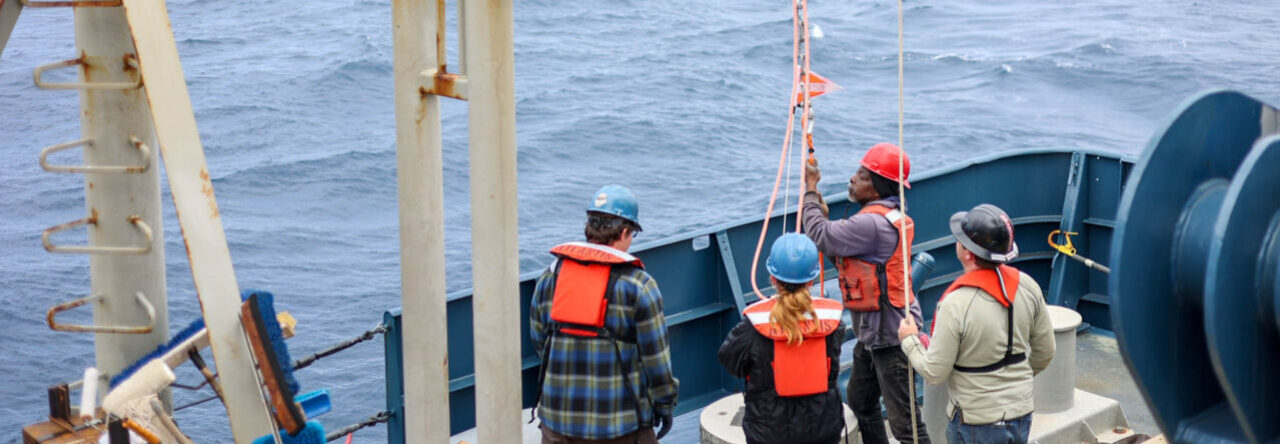
Photo: Ella and Lila observing while shipboard science support group members Cris and Becca prepare for deploying the magnetometer.

Photographer: Jacob Cooper, MATE Intern

Week Six: The Final Week on the R/V Hugh R. Sharp

6/24/19

              Hello all,

              The last full week of being out on the R/V Hugh R. Sharp, what a wonderful time it was. This was probably the easiest time for me with mostly demobilization and remobilization for a one-day cruise with the Office of Naval Research. The plan was to deploy four bottom mounts and one line of small sensors, then finally a few days to enjoy Delaware for all its flat glory.

              For Sunday, we arrived to Lewes around 0500, but since we got in when it was low tide, we couldn’t go into the channel until 0700. We were all just waiting ducks until the tide started to rise. The final tie off for the scallop trip finally ended. Since everyone was beat from the past few weeks, everyone tried to leave early to get some actual sleep in their beds and rest up for a demobilization and remobilization for a two-day cruise working with the Office of Naval Research. The boat was tied off in an easier fashion due to the nature of having lines on the dock instead of throwing them overboard. By 1200, the majority of the crew had left. All we ended up completing was removing trash. Tomorrow will be a hard day.

              We ended up with Christian later that night where he showed us around Rehoboth, DE. WE had some food a one of the restaurants and went back to the ship for an early 0700 morning. An early day to sleep at last.

              For Monday, an early morning to get all the large equipment off the deck and a few items onto the deck. We started around 0700 where we started with removing the sorting table, dredge ramp, HABCAM ramp, and HABCAM tracks. This part was mostly easy; we just needed to hook up lifting straps to the crane and move it to the shore where one of the shore-support would get the forklift move the items back to their spots. We spend a good few hours removing these large items. The last major removal was the laboratory van which was a little bit more involved due to a rigid metal lifting harness needed to be attached to the crane and then lifted to the van. We had to get on top of the van to attach the metal harness to van and off went the van. Next was washing the deck with ‘on-off rust remover’ to remove the rust that had built up being at sea. While I was working on that, a few guys removed the port side winch block as it was not going to be used for the next cruise with the Office of Naval Research

              After everything that could be taken off was, now its time to add some gear to the deck. We added a Zodiac type boat, as they call it a NAZ (not a zodiac) back to the 01 deck where it normally is; we added a huge 7200 pound winch to the center of the deck; we added a couple of cleats near the A-frame and the rails back to the port side of the deck; and we added a few counter weights as the winch was shifting the boat a little to starboard. All was easily done with the crane, a few lifting straps, shackles, and a tag line or two. We secured all the items with either bolts or rachet straps. By this time the science team had arrived, but they were working in the low bay in the operations building to work on getting their two spider bottom mounts and two larger platform bottom mounts ready for deployment on Wednesday. This was basically the end of our day as well because we got most everything done.

              Later that day, the cook, Hunter, took Shaun, Huxley and I to Dewey Beach to show us the little beach town. It was an interesting place that reminded be of a smaller Jersey Shore. Beaches and restaurants all around. Unfortunately, it started to rain a few hours in, and we ended up leaving back to the ship. I was able to get a good night sleep to keep getting ready for tomorrow.

              For Tuesday, another early morning at 0700, a great time to wake up with so much time having to finally sleep. After breakfast, Christian gave Shaun and I news that we needed to get the multibeam set up and installed before we leave tonight as it was a last-minute addition to the cruise plan. The multibeam was stored in a cargo container, but it wasn’t clean since they removed it, so a lot of TLC was needed before it was ready to be used. We also needed to take out one of the unused pods currently in the keel to put it in its place. Christian and Tim Deering were showing me the tricks of the trade to clean it off. I was using wooden dowels to scrap off the buildup of mud and barnacles. They did this because it was a soft and wouldn’t scratch the transducers. I will tell you; it took many hours of cleaning because they were satisfied with it. We also had to replace a couple zinc plates and rinse with water. Once it was cleaned, the other trick they told me to use for anti-fouling was vacuum grease and cayenne pepper. Tim told me fishermen used to use this for anti-fouling as paint cost too much as the time. Once greased up, we were good to move it to the ship. All the while, Shaun had been removing the metal grate that holds the pod in place in the keel so that it could be removed with the crane. First, lunch with sandwiches from the local sandwich shop. As soon as got done, we got the old empty keel pod out by Christian and Shaun going in the keel and hooking up to the crane. Huxley and I were guiding it out as the crane operator rose it up. A line was tied to it and we guided it back to shore where it was placed on the forklift. Next, we lifted the multibeam pod and placed it into the keel. This time I went down to put and tighten the grate. Then we ran the cable through the passage and into the dry-lab where we hooked it up to the computer. We finally got it all hooked up and it was ready to go. Most of the crew had left at this point, but soon the science team would start loading all their gear. All we needed was a forklift driver, a crane operator and Shaun, Huxley and I. We started with the gravity corer attached to a wooden frame, then the two spider bottom mounts, an hour later the two platform bottom mounts. We talked with the science team on how to secure all them down, then we went at it. A few large containers were added, and everything was on board. The plan was to leave at 2000 and start the next day at 0500. The crew came back around 1900 and we started off. Since all the deployments were during the day, Christian, Shaun, Huxley and I went to bed shortly after.

              For Wednesday, another early morning at 0500 this morning. We were getting ourselves ready before the science team wake up. The game place was to deploy a platform, then a spider, then a platform and lastly a spider. Before each deployment we would do a corer sample to make sure we at an acceptable location and deploy. After everything is in, we will do a little multibeam over the sites and back to Lewes.

              The first deployment of the platform was pretty quick. After we had to core sample finished, we used the winch to and four tag lines to inch it close to the transom until right at station. The science team had rigged up a removal compass to adjust the direction of the platform once in the water. Ever so slightly, they inched it closer with four men on the tag lines. It went over without any problems. It did take some time to get the compass right as the current and the boat made it a bit difficult. A couple of surface floats were laid out and the first site was done. Next was a spider which was easily moved into position by five men. We had to rig up two shackles to the side of the A-frame to get a line around the spider to lower it into the water easily, this was done pretty easily with two people on the spider to stabilize it. The first one went in without a problem, we adjusted its direction and it went in without a problem. Lunch time was shortly after then the last two. Another core sample was taken and another platform was released into the water. Again pretty quick and easy. The last spider was set in as well a little while later without an issue and we were done with everything on deck. The final task was the multibeam.

              They had one of their personnel working on the multibeam, but she hadn’t used it in some time and our crew was not fully familiar with the system.  I spent much time watching her figure out how to set up the system, get a base map, plot points, and figure out what was needed for the calibration test. Roll, pitch and yaw we needed to be calibrated using flat points in the water with two lines going in opposite directions for each variable. Once she figured out good points, we get the boat driver geared up to follow transect lines and we off. It took a good three hours before getting to this point, but only one and half hours was needed to actually perform the passes. Once we made multiple passes across the transect line for the bottom mount sites and calibration, we set for Lewes. By 2000, all was said and done back at the dock and ready for bed.

              For Thursday, the demobilization was a quick one today, with mostly just the bins and corer needing to be removed from the deck. This took maybe two hours and our day was over. All the science team were quick to leave by 0900 and my time aboard the Hugh R. Sharp was basically over. No more work was going to be getting done as the crew was taking a short vacation after being out at sea for so long.

              I spend the last few days in Delaware going around with Christian to show me the sights. I saw downtown Lewes with a few restaurants, but mostly I hung out with the graduate students for the University of Delaware. I talked with them about their projects and the type of work they were doing. By Monday morning, I was back in Florida and ready to take on the next part of my life. The last few days were quick, but unfortunately not much occurred after all the work was done for. I had to prep for a cruise with the Ocean Circulation Lab at the USF College of Marine Science so much time was spent getting all my needed paperwork for that.

              This had been an amazing experience, with lost of meeting of people and learning much about being a marine technician. I think I want to pursue a master’s degree after being a part of all this from talking with the different scientist involved. Here comes my next phase!

              A bittersweet time to leave. I had too much fun and worked extremely hard to learn what it takes to be a marine technician. I found my enjoyment of all the tasks at hand, but I feel a strong pull in specializing with a master’s degree. I definitely loved doing the work, but I’m feeling very motivated from all these experiences to keep it going and get a higher education degree in oceanography. I want to be out at sea and collecting data for my own research projects. I am definitely more affective when being on deck and collecting data, so I should use this experience to continue that for whatever I get into with it. I’m super appreciate for every opportunity I got in this; I really felt like part of the crew when I was here. Time to get myself in gear and get to grad school! Thanks for everything Christian, Huxley, Tim D., Tim N, Andy, Chuck, Hunter, Pam, Chris, Casey, Jimmy, Joe, and all the science team. I will never forget this and will continue to strive for greatness.

Best,

-Sebastian D.
Page 53 of 89

Powered by WordPress & Theme by Anders Norén